In 2025, Allianz set out to raise a billion-dollar fund for climate investment in emerging markets. It didn’t do that alone. Sitting underneath Allianz’s own capital is a $150 million junior tranche, contributed by British International Investment (BII) and four other development finance institutions, that takes losses first if the fund’s investments go bad. In blended-finance terms, that’s called a junior tranche, or first-loss tranche, meaning capital placed at the very bottom of a deal’s risk stack. It’s typically funded with concessional capital, money invested on deliberately below-market terms so that other, more risk-averse investors can join the deal safely. That layer is a large part of why the fund exists at its current size at all. The first close reached $690 million, anchored by Allianz SE and the Swiss pension fund GastroSocial Pensionskasse, on the way to a full target of $1 billion, made up of the $150 million concessional tranche plus up to $850 million in senior capital, as reported by Funds Europe.

Building the Bet: A Solar Farm Takes Shape on the Strength of a First-Loss Tranche
I recently spoke with Leslie Maasdorp, chief executive of BII, the UK’s development finance institution, about why this structure exists and whether it can be repeated at any meaningful scale. BII traces its history to 1948, when it was founded as the Colonial Development Corporation under a mandate its first chief executive summarized as doing good without losing money. That phrase, Maasdorp said, still shapes how the institution invests: a financial return and a development outcome as two parts of the same underwriting decision, not two goals pulling in opposite directions.
How the structure actually works
The mechanics are simple to describe and hard to execute. BII put $40 million into a first-loss tranche, then brought in Global Affairs Canada, IDB Invest, Sida, and the Impact Fund Denmark to bring the concessional layer to $150 million total. That money sits junior to everything else in the fund’s capital stack. If a solar project underperforms or a battery storage investment defaults, this tranche absorbs the loss before Allianz’s capital, or any other senior investor’s capital, is touched. Because the downside is capped for everyone sitting above it, senior investors can underwrite the fund at a risk profile closer to what their own mandates actually require. By Maasdorp’s own account, that structure pulled in roughly six times its size in senior capital, an outcome Funds Europe’s reporting on the deal’s tranche sizes bears out directly.
The capital BII used to seed its share traces back to a £100 million facility the UK government gave the institution in late 2024, earmarked specifically for crowding in private capital on a concessional basis. Rather than allocate that money by internal judgment alone, BII ran something closer to a competition: insurers and pension funds submitted proposals for how they’d multiply the £100 million, with Mercer brought in as an independent evaluator of which structures offered the most leverage. The Allianz proposal was one of the winners.
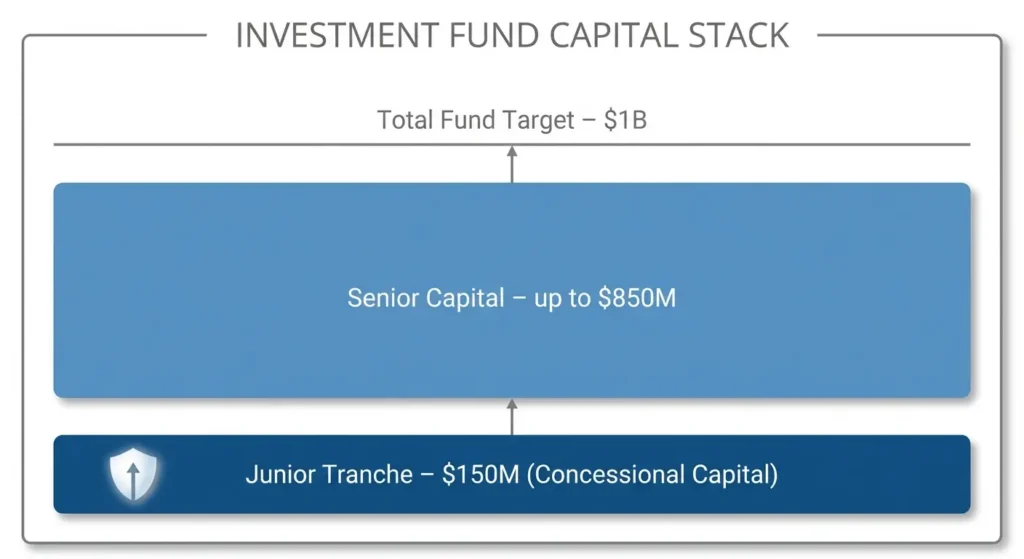
The Architecture of Risk: How $150M in Concessional Capital Unlocks $850M Above It.
A track record of building rather than waiting
The ACE Fund isn’t BII’s first attempt at pulling in capital that wouldn’t otherwise show up on its own. Back in 2017, working off a target the Indian government had set for 500 gigawatts of clean power capacity by 2030, BII backed a renewable energy platform called Ayana from scratch, seeding a management team before gradually diluting its own stake as other equity holders came in. By 2025, Ayana had grown to close to 5 gigawatts of generating capacity, and BII sold its position for between $2.1 billion and $2.2 billion. The mechanics are different (BII took outright equity risk there rather than absorbing losses beneath someone else’s capital), but the pattern underneath is the same one at work in the ACE Fund: take on the stage of risk commercial capital won’t touch, then hand the asset off once it looks investable to everyone else.
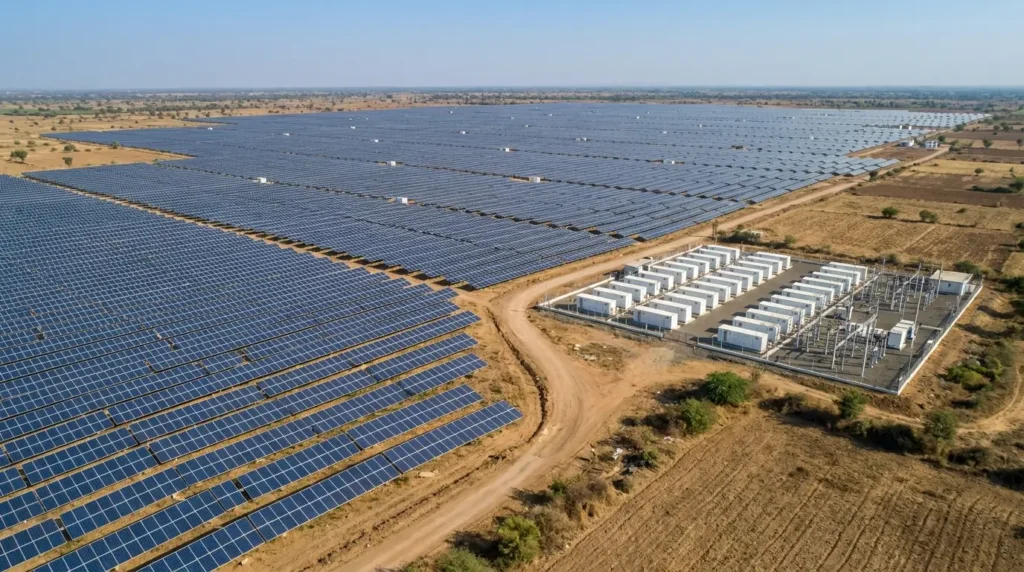
The Ayana Playbook: From BII Seed Capital to 5 Gigawatts and a $2.1B Exit
How this compares to the rest of the market
BII’s math on the ACE Fund, roughly $5.70 in senior capital for every $1 of concessional capital, sits well above the market average. Convergence Blended Finance, which tracks these structures across a dataset of more than 340 transactions, puts the typical leverage ratio at around $4.10 in commercial capital mobilized for every $1 of concessional or catalytic capital deployed. That gap is worth sitting with. It suggests the ACE Fund’s structure, and the process BII used to design it, is doing something the median blended finance deal isn’t quite managing. Whether that’s repeatable elsewhere, or a product of unusually favorable conditions this time around, an established sponsor already committed and a facility built specifically to seed this kind of deal, is the harder question.
A template, not a one-off, according to BII’s own strategy
BII’s newly launched 2026-2031 strategy treats structures like this one as a template rather than an exception. Under the plan, BII intends to commit up to $8 billion of its own capital over five years and mobilize a further $7 billion from private investors, for a combined $15 billion. Climate investment is set to rise to 40 percent of the portfolio, and at least 25 percent of capital is earmarked for the poorest and most fragile markets, the ones furthest from a standard institutional mandate, according to Devex’s coverage of the launch. First-loss and de-risking structures are named explicitly as one of the pillars behind that private capital target.
None of this guarantees the model scales on its own. Structuring a deal like the ACE Fund takes time, and it depends on finding institutions willing to underwrite first-loss risk in the first place rather than simply admiring the concept from a distance. BII’s own website currently shows a live portfolio of roughly 900 businesses in Africa and 760 in Asia, generating an average annual return of about 3.8 percent, a figure that sits below what most pension funds or insurers target on their own book. That gap is precisely what blended structures are built to close, by letting BII and its concessional partners absorb the slice of risk that keeps commercial capital’s required return out of reach.
The test isn’t whether one blended fund can close. It’s whether enough of them can close, quickly enough, for institutional capital in emerging markets to stop being the exception and start being routine.
Listen to the full conversation: Leslie Maasdorp on the SRI 360 podcast
More conversations with institutional investors on sustainable and responsible investing: Browse the SRI 360 podcast archive