The standard venture capital fund structure has remained essentially unchanged for decades. A general partner raises a fund, charges a 2% annual management fee to cover operations, and takes 20% of the profits (carried interest) above a hurdle rate. The model was designed for Silicon Valley: a dense ecosystem of serial entrepreneurs, specialized talent, shared services providers, and deep capital markets that allow a small investment team to write checks and let founders operate largely independently.
It works well in San Francisco. It works reasonably well in London and Berlin. It does not work in Lagos, Jakarta, Nairobi, or Doha.
This is not a theoretical argument. It is a conclusion reached independently by a growing number of investors who have spent years building companies in the Global South and discovered, often painfully, that the architecture of traditional venture capital is structurally mismatched with the realities of frontier market entrepreneurship.

An early-stage startup team working in a co-working space in Lagos.
The Math That Breaks the Model
The problem begins with arithmetic. I recently spoke with Alina Truhina, co-founder of Utopia Capital Management and managing partner of the Radical Fund, a Southeast Asia climate tech VC. Before launching Utopia, Truhina spent five years as chief strategy officer at Founders Factory Africa, where she helped build a portfolio of 56 startups and raise over $140 million in capital. The experience taught her a fundamental lesson about why the traditional model breaks down.
“Our model and our belief is that 2 and 20 models as VC are not enough from a commercial point of view to actually build a team that is able to derisk your portfolio,” Truhina explains. “The 2% management fee just doesn’t allow one to do that if you’re starting a fund where you can probably have three, maximum five people working at the fund.”
The numbers make this concrete. A typical early-stage emerging market fund might be $40 million to $50 million. A 2% management fee on that generates $800,000 to $1 million annually. In New York or London, that budget might support a lean team of partners and analysts who primarily evaluate deals and sit on boards. In Lagos or Jakarta, where founders need hands-on product development support, go-to-market strategy, regulatory navigation, and help building middle management teams that don’t yet exist in the local talent market, that budget is woefully insufficient.
“In order to build and grow companies in such nascent startup ecosystems, in order to support companies through more than just funding and capital, you needed a team and you needed a lot of corporate influence, corporate assets, and corporate value-add as well,” Truhina says.
The timeline compounds the problem. Research indicates that startups in emerging markets require roughly 56 months to reach Series A under traditional models, compared to significantly shorter timelines in developed markets. During those nearly five years, founders face what one practitioner calls “death by a thousand cuts”: operational failures in logistics, regulatory compliance, or talent retention that have nothing to do with the startup’s core technology or business model. A VC team of three to five people operating on $800,000 a year simply cannot provide the support needed to prevent those failures.
Why Founders in the Global South Need More Than a Check
This is not a reflection of founder quality. It is a reflection of ecosystem maturity. When Truhina and her partner launched Founders Factory Africa, total VC funding across the entire African continent was approximately $ 400 to $500 million annually. There were no established accelerator networks, limited specialized legal and accounting infrastructure for startups, and few experienced operators who had scaled technology companies in African markets.
“We work with entrepreneurs that have incredible IP, that are incredible founders and leaders,” Truhina emphasizes. “But we work in environments where there isn’t the same infrastructure or the same resources, the same ecosystem.”
This observation is not unique to Truhina. Across multiple conversations on the SRI 360 podcast, emerging market investors have arrived at remarkably similar conclusions through very different paths.
Eva Yazhari, founder of Beyond Capital Ventures, a women-led impact VC firm investing in India and East Africa, has structured her entire organization around the principle that proximity matters. Seventy percent of her team is physically based in the markets where the firm invests. This is not a lifestyle choice. It is an investment strategy rooted in the belief that you cannot effectively support founders from 8,000 miles away.
Beyond Capital employs behavioral assessments and a 38 to 40 question founder evaluation before investing, a level of diligence that requires deep, in-person relationships. And Yazhari’s portfolio management philosophy centers on hands-on value addition after the check is written, not passive board observation. The results suggest the approach works: 72% of Beyond Capital’s LPs are women or people of color, and the fund has generated outcomes including a 3x return from an eye care business in rural Assam that many investors would have overlooked entirely.
Tim Rann, founder of Mercy Corps Ventures, approaches the problem from a different angle but reaches the same conclusion. His firm operates around what he calls the “resilient future thesis,” investing in Global South innovators who are rebuilding food systems, agriculture, and climate resilience from the ground up. Rann has built partnerships with global corporations like PayPal, Starbucks, and Mars to channel capital and market access into underserved markets. His core argument is that impact investing will not advance until investors are willing to take on as much impact risk as they do commercial risk, and that means being present on the ground, understanding the operational challenges, and supporting founders through them.
Laura Ortiz Montemayor, founder of SVX Mexico, adds another dimension. Working in Latin America, she has focused on ecosystem building: the recognition that in frontier markets, the success of a single startup is often contingent on the strength of the surrounding infrastructure, including regulatory clarity, investor education, and the connective tissue between entrepreneurs and capital sources. Her conclusion that traditional ESG frameworks are “too slow and too incremental” for the scale of the challenge parallels Truhina’s observation that traditional VC structures are too thin for the depth of support required.
These are four investors working across four different regions (Southeast Asia, Africa, India and East Africa, Latin America) who have independently concluded that the standard playbook does not work. The pattern is too consistent to dismiss.
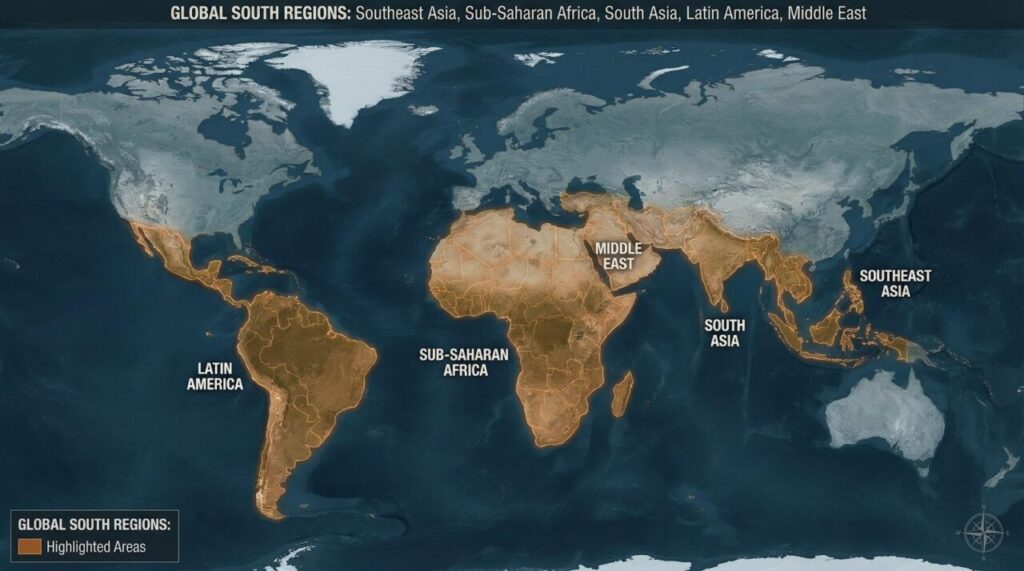
A map showing the global south regions discussed in the article: Southeast Asia, Sub-Saharan Africa, South Asia, Latin America, and the Middle East.
The Studio Model: Compressing Five Years into Two
If the 2/20 model is broken, what replaces it? One answer is the venture studio, sometimes called a startup studio or venture builder. Unlike a traditional fund that evaluates and selects existing companies, a studio initiates ventures from the ground up, providing dedicated capital, talent, and hands-on operational support from day one.
Truhina’s evolution from Founders Factory Africa to Utopia Capital traces this shift in real time. At FFA, the model was an operating company rather than a fund.
Investors were shareholders, and the firm invested off its balance sheet. This structure allowed FFA to build a team large enough to provide the product, technology, growth, and go-to-market support that early-stage African founders needed but could not afford to hire independently.
“Our investors were shareholders in the company. That’s how we invested in pre-seed to Series A companies across different sectors, predominantly health, agriculture, and financial services,” Truhina explains.
The performance data for the studio model is increasingly compelling. According to industry research, studio-backed ventures achieve an average IRR of 53%, compared to approximately 21.3% for traditional VC-backed startups. Studios also dramatically compress development timelines: studio startups reach Series A in an average of 25 months, less than half the 56 months typical for conventional startups. And the model is gaining institutional acceptance. By 2024, 10.3% of all new VC funds were created by venture studios.
Utopia has taken this model further with its AI-native studio, launched in November 2024 in Qatar. The studio is designed to compress the venture building cycle even more aggressively by using AI tools to accelerate every phase of company creation.
“Before, to go from pre-seed to Series A, you might take five years in an emerging market and you need to raise multiple bridge rounds,” Truhina explains. “Now you can have a solo founder that goes from idea to Series A in less than two years’ time, and you can do it without having a technical co-founder, and you might not need to raise that much funding.”
The studio currently has six entrepreneurs in its first cohort, with spinouts expected by Q2 2025. It works in what Truhina calls “pods,” or problem-oriented deep dives, where the team identifies specific opportunity spaces within sectors like energy, agriculture, and industrial processes, and then builds companies to address them.
“One of the challenges with climate in Southeast Asia is we have seen so much opportunity in adaptation, for example in early warning systems or disaster reduction,” she notes. “We have not seen any businesses around that. The studio can actually build a company that the Radical Fund can invest in.”
This is a structural innovation that addresses both sides of the emerging market venture problem simultaneously: the lack of investable companies in critical sectors and the lack of operational support for the founders building them.
The Capital Stack Is Evolving
The studio model is not the only structural innovation emerging in the Global South. The broader capital stack is becoming more sophisticated in ways that reflect the unique needs of these markets.
In Africa, after peaking at over $3 billion in 2021-2022, VC funding contracted to between $ 1.1 and $2.2 billion in 2024 before rebounding to $ 4.1 billion in 2025. But the composition of that capital has shifted dramatically. Debt financing hit a record $1.6 billion in 2025, representing 41% of all capital deployed in African startups, up from 17% in 2019. This shift toward less dilutive capital reflects a market that is maturing beyond the “equity or nothing” model that characterized earlier years.
In Southeast Asia, regional investment volumes reset to 2016 levels as of late 2024, lagging behind the recovery curves in India and Latin America. But the region’s digital economy is on track to surpass $300 billion by 2025, creating enormous underlying demand for venture-backed innovation.
In the Middle East, Qatar is positioning itself as a strategic bridge between the Global North and Global South. The Qatar Investment Authority expanded its Fund of Funds program to $ 3billion in 2026, anchoring international VC managers to catalyze the local ecosystem. Utopia’s Atypical Ventures, backed by QIA, is the first international early-stage VC fund licensed in Qatar.
“No other region, no other country has had that mandate or that intentionality to build a hub that actually serves emerging markets,” Truhina says of Qatar’s positioning. “It’s very unique and it’s part of Qatar’s Vision 2030.”
The geographic connectivity matters. Utopia already has portfolio companies moving between Southeast Asia and the Middle East, creating cross-border corridors that traditional VC funds, anchored to a single geography, cannot replicate. A B2B food procurement company from Southeast Asia can expand to Qatar. A decarbonization startup can serve clients in both regions simultaneously.

A modern innovation hub in Doha.
The Lesson Across Four Continents
The convergence of perspectives from Truhina, Yazhari, Rann, and Montemayor points to a set of principles that increasingly define successful venture investing in the Global South:
Physical presence is not optional. You cannot invest effectively in emerging markets from London or New York. Yazhari has 70% of her team in-market. Truhina relocated to Bangkok and then Doha. Rann has built and operated businesses in Cambodia and Afghanistan. Montemayor built SVX Mexico from within the Latin American ecosystem she serves. Every one of them would tell you the same thing.
As Truhina puts it: “You cannot build a business from London in Indonesia. You cannot build a business from New York in Qatar. You have to build in the market and you have to really understand it.”
Founders need operational support, not just governance. The traditional VC model of writing a check and joining a board does not address the operational gaps that kill startups in frontier markets. Studios, operating companies, and “more than capital” models exist because the alternative, passive check-writing, produces unacceptable failure rates.
The fee structure must match the work. If the work required to derisk an emerging market portfolio is significantly more intensive than the work required in a mature ecosystem, then the economics of the fund must reflect that. Whether through operating company structures, studio models, corporate backing, or blended capital approaches, the 2% management fee on a small fund is structurally insufficient.
Impact and returns are not a tradeoff. This is perhaps the most important convergence. Yazhari has said she wishes she had believed more boldly from the start that impact and strong financial returns are not mutually exclusive. Rann argues that investors must take on impact risk alongside commercial risk. Truhina targets 25% IRR and 3x returns while embedding climate impact measurement into every portfolio company. Montemayor has moved beyond ESG entirely toward regenerative models.
The common thread is not a single model. It is a shared rejection of the idea that what works in Silicon Valley should be exported unchanged to the rest of the world. The Global South does not need a copy of Western VC. It needs venture architecture designed for its own realities.
For LPs evaluating emerging market allocations, the question is no longer whether to invest in the Global South. The question is whether the fund structure they are backing is actually designed to succeed there.
To hear Alina Truhina’s full perspective on rebuilding venture capital for emerging markets, listen to the complete interview on the SRI 360 Podcast, Episode 124. For related perspectives, see Tim Rann on Episode 103, Eva Yazhari on Episode 112, and Laura Ortiz Montemayor on Episode 123.
This article is based on discussions from the SRI 360 Podcast. For more perspectives on sustainable and responsible investing, visit sri360.com/podcast.