
In December 2022, generators bid to supply electricity across the PJM Interconnection, the regional grid operator serving 67 million people across thirteen Mid-Atlantic and Midwestern states plus Washington, D.C., for the 2024/2025 delivery year. The clearing price: $28.92 per megawatt-day. The next auction, held in July 2024 for the 2025/2026 delivery year, cleared at $269.92, a jump of more than 800 percent. According to Monitoring Analytics, the independent market monitor for the region, data centers were responsible for 63 percent of that increase, translating into $9.3 billion in additional capacity costs recovered from ratepayers in a single year. In Washington, D.C., residential Pepco customers saw their bills rise by roughly $21 a month starting in June 2025. Households in western Maryland absorbed an $18 monthly increase; Ohio ratepayers saw about $16 more. The auction held a year later, in July 2025 for the 2026/2027 delivery year, cleared even higher, at $329.17, hitting the price cap regulators had imposed to keep it from going higher still. None of the households paying these bills own a graphics processing unit or run a large language model. They are simply plugged into the same grid as the data centers that increasingly are.
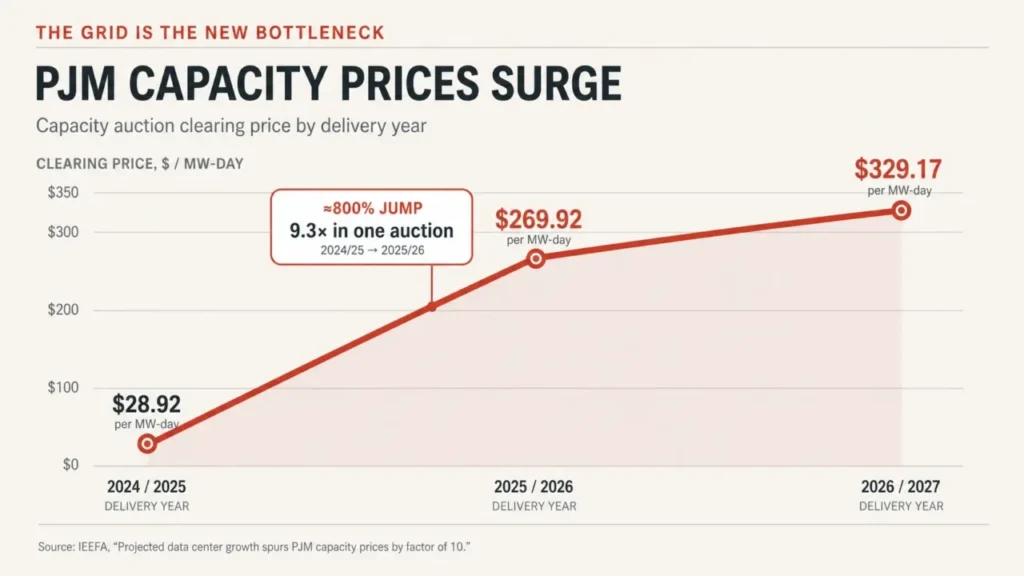
PJM’s capacity auction price rose more than tenfold in two years, from $28.92 per megawatt-day to $329.17, as data center demand collided with limited supply.
That is the shape of the problem now defining energy investing more than any single technology: artificial intelligence’s power demand is colliding with the broader electricity system, and the collision is not playing out as a contest between clean and fossil generation. It is playing out as a contest over who gets electrons first, on what timeline, and who bears the cost of building the infrastructure to deliver them. I recently spoke with Sanjeev Krishnan, co-founder and managing partner of S2G Investments, about what he calls the collision between the shift from central processing units to graphics processing units and the broader energy transition, both of which are drawing on the same limited near-term supply of dispatchable power. His view is that there is no settled consensus yet on how curtailment, cost allocation, and grid architecture will be resolved, only a shared recognition that the grid needs to become more flexible and more integrated than it has been, built on the back of the demand growth artificial intelligence has created rather than despite it.
For sustainable and climate-focused investors specifically, this collision is not simply a cautionary tale about grid strain. It is also the single largest new source of demand for clean and firm power the industry has seen in years. Amazon, Meta, Google, and Microsoft together accounted for roughly 49 percent of all clean energy power purchase agreement volume signed globally in 2025, up from 43 percent of a smaller market the year before, according to BloombergNEF research reported by ESG Today and the Brookings Institution. That concentration grew even as the broader corporate clean energy market shrank for the first time in eight years, global volumes fell 10 percent in 2025 to 55.9 gigawatts, meaning Big Tech alone is now propping up demand other corporate buyers have pulled back from. Roughly a quarter of Meta’s and Amazon’s 2025 clean power contracts were nuclear specifically, part of a broader pivot: all four hyperscalers have now signed agreements to restart or expand existing nuclear plants, led by Microsoft’s $16 billion, twenty-year power purchase agreement with Constellation Energy to bring Three Mile Island Unit 1, renamed the Crane Clean Energy Center, back online by 2027, and Amazon’s expanded offtake agreement with Talen Energy for 1.92 gigawatts from the Susquehanna Steam Electric Station through 2042. Google has taken a similar approach with older, proven assets, agreeing in July 2025 to pay Brookfield Renewable more than $3 billion over twenty years for 670 megawatts of carbon-free hydropower in Pennsylvania, with an option to expand to 3 gigawatts. That pivot toward nuclear and firm, low-carbon power is not replacing the natural gas buildout described below so much as running alongside it: Microsoft signed its own twenty-year deal with Chevron in June 2026 for gas-fired electricity to power a roughly 2.67-gigawatt West Texas data center, in the same year it was finalizing the Three Mile Island restart, evidence that hyperscalers are locking in long-term contracts across every available power source at once rather than treating gas purely as a bridge to something cleaner.
The scale of the demand is not in dispute. The International Energy Agency’s Key Questions on Energy and AI report, published in 2026, found that the five largest technology companies’ combined capital expenditure exceeded $400 billion in 2025 and is set to rise a further 75 percent in 2026. Global data center electricity consumption grew 17 percent in 2025 alone, with consumption from artificial intelligence-focused facilities surging 50 percent, far outpacing the roughly 3 percent growth rate of global electricity demand overall. The agency’s central projection has total data center electricity consumption roughly doubling from 485 terawatt-hours in 2025 to 950 terawatt-hours by 2030, with the artificial intelligence-focused share tripling over the same period. In the United States specifically, RaboResearch estimated in a May 2026 report that data centers are on track to add roughly 300 terawatt-hours of incremental electricity demand by 2030, equivalent to the combined annual consumption of New York and California.
What makes this different from previous waves of electricity demand growth is the mismatch in construction timelines. A data center facility can be built in twelve to twenty-four months; the transmission and generation infrastructure needed to power it typically takes three to seven years, according to RaboResearch, with grid connection queues in constrained markets such as California now stretching past seven years. Hyperscalers, facing that gap and sitting on unprecedented capital reserves, have started to close it themselves. RaboResearch tracked more than 130 gigawatts of behind-the-meter energy resources, meaning generation built at or near a facility to bypass or supplement the public grid, now proposed to serve planned data center projects across the United States, with natural gas accounting for more than 80 percent of that pipeline. Behind-the-meter power is not cheap: it costs $100 to $165 per megawatt-hour, against $90 to $95 for grid-connected alternatives. Hyperscalers are paying the premium anyway, because idle server capacity waiting on a grid connection can represent billions of dollars in annual depreciation and lost revenue.
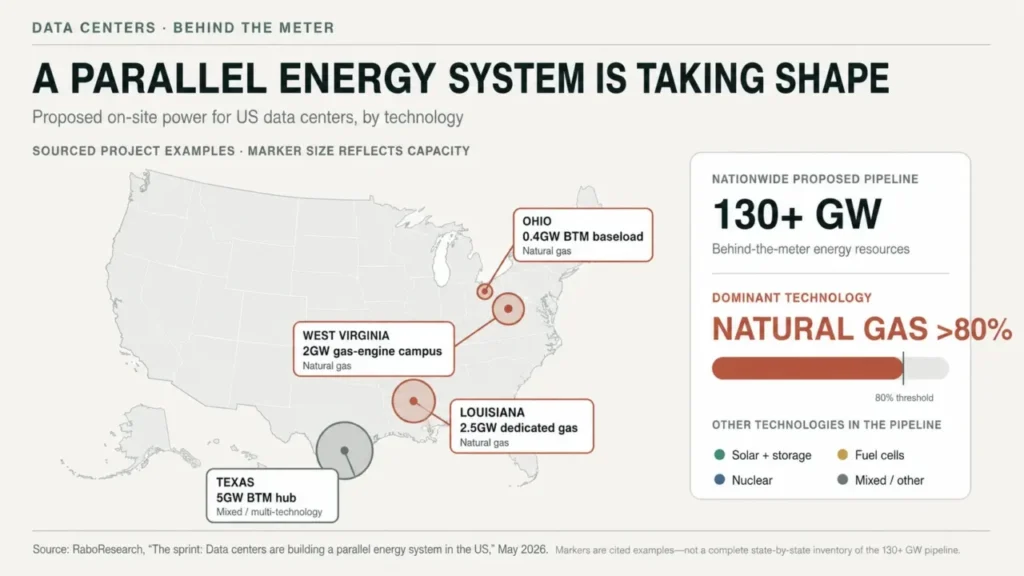
More than 130 gigawatts of behind-the-meter power projects are now proposed to serve US data centers, over 80 percent of it natural gas.
The clearest evidence of the shift from buying power to owning it came in December 2025, when Alphabet agreed to acquire Intersect Power, a developer of solar, battery storage, and other clean power generation, for $4.75 billion, a deal that closed in March 2026. The transaction included a co-located data center and power campus under construction in Haskell County, Texas, along with multiple gigawatts of additional projects in Intersect’s pipeline. The logic is not primarily about the electrons; it is about controlling a site, an interconnection pathway, and a platform for future power resources, the kind of control a standard multi-year power purchase agreement cannot reliably buy.
None of this activity is actually solving the underlying capacity shortage; it is largely routing around it. The International Energy Agency found that providing reliable onsite gas-fired electricity to meet the variable load patterns of an artificial intelligence data center requires overbuilding onsite generation infrastructure by 30 to 70 percent relative to average demand, because these facilities see power swings of more than 50 percent of rated capacity within a single second. Global orders for gas turbines rose 70 percent in 2025, and GE Vernova alone ended the year with an 83-gigawatt backlog stretching into 2029. The equipment deploying fastest, fuel cells in as little as 90 days, gas-fired reciprocating engines in twelve to twenty-four months, is not the equipment best suited to run a campus efficiently for decades. It is simply what is available on the timeline the market demands.
The consequences for everyone else on the grid are becoming concrete rather than theoretical. Virginia’s State Corporation Commission approved a new electricity rate class in November 2025 for large-scale customers such as data centers, requiring them starting in January 2027 to pay at least 85 percent of contracted distribution and transmission demand and 60 percent of generation demand upfront. The commission’s stated purpose was to insulate ratepayers from a buildout tied to an 833 percent increase in PJM’s capacity auction price for the 2025-2026 delivery year, in a state where energy demand overall is projected to rise 183 percent by 2040. Oregon moved first and differently: its legislature passed the POWER Act in June 2025, creating a distinct rate category for any data center, cryptocurrency operation, or other industrial user drawing more than 20 megawatts, requiring ten-year contracts with a minimum payment and coverage of new transmission costs. The gap the bill responds to is stark: large industrial customers on Portland General Electric’s system were paying about 8 cents per kilowatt-hour, against close to 20 cents for residential customers on the same grid.
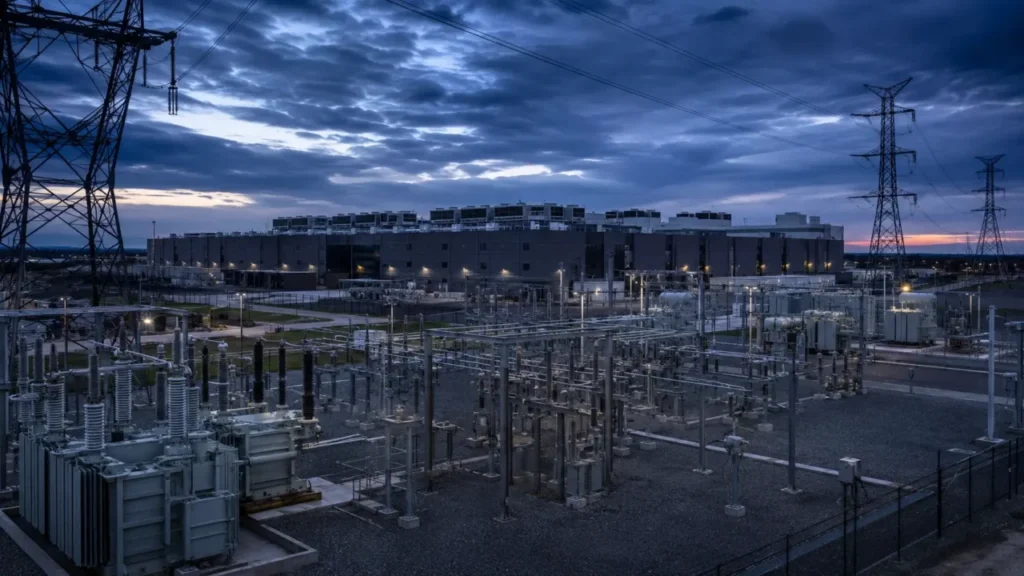
Virginia’s new large-load rate class for data centers takes effect in January 2027.
This is the tension that matters most for anyone allocating capital to the broader energy transition, not just to artificial intelligence infrastructure directly. Every gigawatt of gas turbine capacity, every transmission upgrade, and every skilled construction crew committed to a hyperscaler’s private power buildout is not available to the industrial electrification, transportation, and manufacturing projects already competing for the same constrained supply chains before artificial intelligence entered the picture. A Deloitte survey of 120 US-based data center and power company executives, published in June 2025, found 80 percent of data center respondents and 57 percent of power company respondents were already experiencing meaningful competition for resources with other industries. More than 99 gigawatts of gas-fired capacity is now planned across 38 states, according to the same survey, even as many of the largest data center markets face constrained pipeline capacity to actually deliver the fuel.
Not every study agrees on how the costs break down, and there is a genuine counter-argument worth real weight. A December 2025 white paper prepared for Amazon by the consulting firm E3 found that its data centers generate surplus revenue for host utilities rather than shifting costs onto other customers, a conclusion a separate February 2026 Charles River Associates report for the Edison Electric Institute reached too, though both frame it as applying outside the PJM region specifically. That carve-out does not contradict the IEEFA finding on PJM capacity prices so much as narrow it: a well-structured contract can generate a rate surplus in a market with ample capacity, while the same demand growth concentrated within a constrained market like PJM pushes wholesale prices up for everyone connected to it. More broadly, hyperscaler capital could, in principle, pull forward grid investment that would otherwise never have happened on this timeline. Robert Keepers, head of climate technology at JPMorgan Commercial Banking, has argued that clean baseload energy investors are seeing some of their strongest results in years precisely because surging demand has created a signal too large for capital markets to ignore. Whether that ultimately expands the grid for everyone or simply reroutes existing capacity toward the highest bidder is not yet settled.
What is measurable today is the direction of travel. Hyperscaler capital expenditure is rising faster than grid infrastructure can be permitted, built, or connected. Ratepayers in constrained markets are already paying billions of dollars more per year for capacity they did not ask for. And the companies with the deepest pockets are increasingly choosing to build their own power systems rather than wait for a public grid that cannot move at their speed, a choice available only to those who can absorb a cost premium other electricity users cannot. For sustainable energy investors, the more useful question may be adjacent to that concern rather than opposite it: whether the capital hyperscalers are committing to nuclear restarts, advanced reactor development, and firm renewable contracts becomes the demand signal that finally gets clean baseload power built at a scale climate-focused investors have wanted for years, or whether gas simply gets there first because it can be built faster, with clean power arriving as a slower second wave rather than the primary answer to this decade’s demand surge.
Listen to the full conversation with Sanjeev Krishnan on the SRI360 podcast, where he discusses the collision between artificial intelligence power demand and the energy transition, and where S2G Investments sees opportunity at the seams of the two.
For more interviews and insights on sustainable, responsible, and impact investing, visit the SRI360 podcast archive.