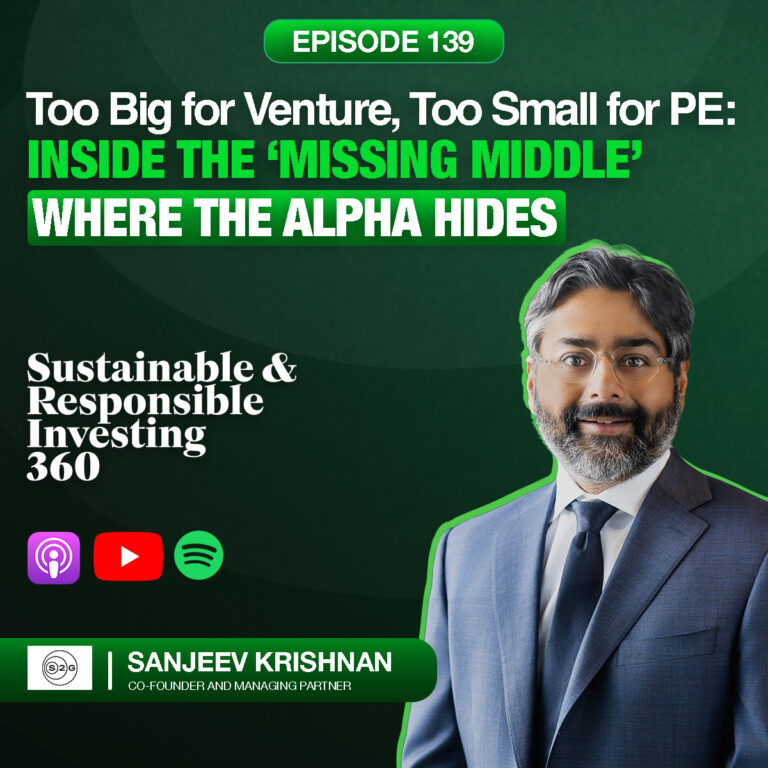
“This doesn’t need to be concessionary. This is alpha generating. It’s cheaper, faster, better. ”
— Sanjeev Krishnan
In this episode, I speak with Sanjeev Krishnan, Co-Founder and Managing Partner of S2G Investments, about why the real constraint on the clean economy is capital structure rather than technology — and the path from Bangalore to a JPMorgan trading floor to a nearly $3 billion platform investing at the seams of food, energy, and ocean systems.
Sanjeev was born in Bangalore in pre-liberalization India and moved at nine to Grosse Pointe, Michigan — his first time ever on a plane, and the start of what he still calls a migrant love story with America. Watching India’s 1992–93 liberalization unlock growth pointed him toward development economics, first at the University of Michigan, then at the London School of Economics — where a summer project taught him something heretical: the private sector could drive change more durably than government or civil society. To do that, he needed to understand capital markets.
At JPMorgan’s TMT M&A group in London and Johannesburg, he watched the dot-com boom implode from the inside — his European team shrank from 120 people to 15, and the lesson stuck: Wall Street overshoots and undershoots massively. He then left one of the most prestigious desks in finance for the mobile-telecom build-out across Africa — Mo Ibrahim, Celtel, Vodacom — where prepaid models eliminated credit risk and infrastructure appeared within six months.
At the World Bank’s IFC, one investment became formative: a company that cut the cost of a Hepatitis B vaccine by roughly 80–90% — from $2.50 a vial — while holding margins above 60–70%. Proof that impact did not have to be concessionary. Then five years at the Global Environment Fund inside clean tech 1.0, watching companies he believed in go to zero for reasons that had nothing to do with their technology.
In 2013 he met Lukas Walton — an heir to the Walton family behind Walmart — and in 2014 they co-founded S2G Investments, starting in food: a sector where the boomer-to-millennial demand shift meant no dependence on policy or subsidy. In S2G’s first four months, the team mapped the entire food system from 1945 to 2014.
Today S2G manages close to $3 billion across eight funds and more than 120 portfolio companies, investing across venture, growth, structured finance, and real assets like its Clear Frontier farmland platform. The firm works with 400 corporates, 80 of them tier one, brokering revenue introductions, and runs dedicated policy work. S2G came first; the team then helped Lukas Walton stand up Builders Vision, and in May 2024 registered independently with the SEC — a move Lukas calls a launch, not a spin-off.
The “missing middle” is his name for the financing void between early-stage venture and infrastructure-scale debt — a zip code in between where companies get stranded; in May, S2G closed a billion-dollar fund built for exactly those businesses. “Fit-for-purpose capital” means matching the structure of the money to the reality of the business — the way U.S. biotech can take an unproven, clinical-stage company public, which climate finance has never managed. And his “Financing Reality” white paper looks back 300 years to argue that every great economic transition was made possible only because someone first invented the financial structure to fund it: the joint stock company for oceanic trade, bond syndicates for continental railroads, the venture partnership for the microchip era. Each was an act of imagination before it was an economic reality.
We also get into his “Age of Adaptation” thesis — five forces rewriting growth at once, from the CPU-to-GPU shift to a multipolar world, an unknown price of money, warming, and demographics. He reframes climate as a 10,000-year economic megatrend — fire, agriculture, fossil fuels: humans taking useful energy and turning it into useful materials — and is blunt that the next chapter is still extractive: copper, cobalt, nickel, lithium. And he explains why he co-founded Apeiron Labs in 2022 to measure the oceans — a domain we understand less well than space.
What stayed with me is how steadily Sanjeev looks past the technology to the structure underneath it. A breakthrough with the wrong financing is a breakthrough that dies. Building the right financial container may matter more than any single invention — and that, he believes, is where the real edge lies.
Listen to the full conversation.
–
Listen to the episode on Apple Podcasts, Spotify, Overcast, Podcast Addict, Pocket Casts, Castbox, YouTube Music, Amazon Music, or on your favorite podcast platform. You can watch the interview on YouTube here.



What was your favorite quote or lesson from this episode? Please let me know in the comments.
SHOW NOTES:
[03:34] Bangalore: pre-liberalization India
[04:28] Landing in Grosse Pointe at nine
[06:31] Michigan, London & the pull of LSE
[07:51] Why the private sector, not aid
[09:58] JPMorgan & the appeal of banking
[13:13] TMT M&A & the dot-com collapse
[14:40] 120 people to 15
[15:28] Leaving JPMorgan for Africa
[16:11] Mobile telecom & what prepaid unlocked
[18:17] Cold-calling the IFC six times
[20:27] The Hep B vaccine deal
[21:46] Global Environment Fund & clean tech 1.0
[24:38] Singapore & the Asia bet
[25:25] The EV company killed overnight
[27:29] The 2009 attempt that failed
[28:59] Meeting Lukas Walton
[30:28] Why food first
[31:40] Mapping the food system, 1945-2014
[33:03] S2G today: the platform
[33:59] 400 corporates & the policy team
[35:29] AUM & the funds
[36:45] Investing at the seams
[39:59] Builders Vision & the May 2024 launch
[45:19] Lukas Walton’s role today
[46:38] The Age of Adaptation: five forces
[49:57] Aging, AI concentration & the S&P
[53:05] The missing middle, defined
[54:30] A real missing-middle deal
[55:31] Financing Reality & the joint stock company
[59:30] Fit-for-purpose capital
[01:00:58] Clear Frontier & farmland duration
[01:03:06] Why biotech works and climate doesn’t
[01:05:11] The physical economy & AI CapEx
[01:07:39] Climate as a 10,000-year megatrend
[01:10:18] Apeiron Labs & the ocean data gap
[01:14:19] AI vs the grid
[01:16:50] Politics: the 2026 & 2028 elections
[01:18:17] Every bust has an opportunity
[01:20:21] 30 years watching capital fail
[01:21:21] The 8-year-old self
[01:22:58] Rapid Fire Questions
Additional Resources:
- Sanjeev Krishnan on LinkedIn
- S2G Investments website
- S2G “Financing Reality” report
- Builders Vision website
MORE QUOTES FROM THE INTERVIEW:
“The technology works. The capital doesn’t. ”
— Sanjeev Krishnan
“It is my argument that in climate, we do not have fit for purpose capital markets that understand the economic reality. ”
— Sanjeev Krishnan