In the summer of 2025, Royalty Pharma committed up to $2 billion to Revolution Medicines for a single asset: a cancer drug called daraxonrasib that, at the time of the deal, had cleared only Phase 1 trials. No commercial sales. No regulatory approval. Just early clinical data and a projection of what the drug might earn if the rest of the process goes well. It was, according to the law firm Goodwin Procter, the largest-ever committed synthetic royalty financing in the industry’s history, priced against a product years from market. Nothing in climate or industrial technology investing looks like that transaction, and the absence is not incidental. It is the clearest evidence of a gap between two sectors that both claim to be capital intensive and both claim to need patient money.

The Royalty Pharma Revolution Medicines deal was priced against Phase 1 clinical data alone.
Biotech’s financing system did not appear by accident. It was built in layers over four decades, each layer designed to fund a specific, well-defined stage of drug development against a specific, well-understood kind of risk. Early venture capital funds the science before a drug enters human trials. A functioning market for clinical-stage initial public offerings, meaning a company selling shares to the public for the first time, lets companies raise real money once Phase 1 or Phase 2 data exists, even with the drug still years from approval. And underneath both, a growing market for royalty and venture debt financing lets companies borrow against the future revenue of a specific product, sometimes before that product has even reached the market. Each layer prices a different, discrete kind of risk, because the regulatory pathway itself, structured around the Food and Drug Administration’s phased trial process, produces the discrete, well-defined milestones that make that pricing possible.
I recently spoke with Sanjeev Krishnan, co-founder and managing partner of S2G Investments, about what he calls fit-for-purpose capital: financial structures built to match the actual duration, liquidity needs, and risk profile of the underlying business, rather than forcing every company into a generic venture or private equity mold. Biotech’s layered system, whatever its flaws, is the clearest large-scale example of that kind of capital market working at scale.
The royalty layer alone has become a genuinely large market. Biopharma royalty financings totaled approximately $29.4 billion from 2020 through 2024, according to Deloitte research cited by Goodwin Procter in October 2025, more than double the volume raised between 2015 and 2019. The structure comes in two forms: traditional royalties, financed against an existing license or collaboration agreement, and synthetic royalties, created specifically for the financing transaction and paid from a product’s future revenue whether or not any license already exists. Nearly 90 percent of biotech executives surveyed by Deloitte said they were considering a royalty financing within the next three years. The market has widened well beyond specialist funds: KKR bought a majority stake in HealthCare Royalty Partners in July 2025, and OrbiMed closed a $1.86 billion royalty and credit fund days earlier, both moves that a January 2026 Pharma’s Almanac analysis frames as a bet that demand for non-dilutive financing will keep growing in a tight fundraising climate. Within the royalty market itself, the structures are getting more specialized: synthetic royalties, the kind created for a specific financing rather than tied to an existing license, grew at an average annual rate of roughly 33 percent between 2020 and 2024, and by the first half of 2025 the market was running at an annualized pace of about $5.42 billion across roughly two dozen deals, with an average transaction size near $226 million, according to the same analysis. This is not a niche instrument anymore. It is a standard tool in a biotech company’s capital structure, alongside equity and conventional debt, with its own specialist law firms, its own repeat institutional buyers, and its own pricing conventions built from a decade of comparable deals.
Biotech’s capital structure has absorbed a genuine downturn without losing its layers, which is itself informative. Overall biotech financing fell by about 10 percent in 2024 to roughly $73 billion, then dropped a further 17 percent year over year in the first quarter of 2025, according to Ernst & Young research cited in a January 2026 Pharma’s Almanac analysis. But the contraction has been selective rather than uniform. Average round size grew from about $21 million in 2019 to $36 million in 2024, even as early-stage deal count fell around 20 percent, meaning investors concentrated larger checks into fewer, more scrutinized companies rather than abandoning the earlier stages outright. That is a capital market rationing risk in an orderly way. A shrinking climate technology venture market, by contrast, is not just rationing; entire categories of company, outside the energy sector specifically, are losing access to any specialist capital at all.
Part of what makes that rationing orderly in biotech is a category of investor climate technology has no real equivalent of: corporate venture arms tied to companies that already understand the science. Corporate venture funds linked to Novo Holdings, Eli Lilly, and Sanofi Ventures ranked among the most active startup investors in biopharma through 2025, with Novo Holdings’ venture arm participating in eighteen private financing rounds and Lilly and Sanofi Ventures in thirteen each, according to Biopharma Dive reporting cited in the same analysis. At least 70 percent of biopharma initial public offerings since 2022 have included a corporate investor, and corporate venture funds have backed at least 60 percent of acquired biotechs over the same period. These are not passive financial investors. They are strategic buyers with deep technical expertise in the exact risk they are underwriting, stepping in precisely when traditional venture capital pulls back. A grid-scale battery startup or a novel cement chemistry company has no equivalent bench of deep-pocketed, technically fluent corporate investors it can reliably turn to when a financing round gets hard to fill.
The public equity layer above it has been more volatile but never absent. Biotech initial public offerings peaked in 2021, when more than 100 companies priced offerings and raised nearly $15 billion combined, according to BioPharma Dive’s ongoing tracker. That window shut hard: only eleven drugmakers priced initial share sales the following down year. But the window has never fully closed the way it effectively has for early-stage climate technology, and when it reopens even partially, the market has kept a specific preference intact: companies with real clinical data, not just a platform and a pitch. That preference is itself a form of risk pricing biotech investors have decades of practice doing. Climate and industrial technology investors, by comparison, are still working out what the equivalent milestone even looks like for, say, a novel battery chemistry or a carbon capture process, because no regulatory body issues the equivalent of Phase 1, Phase 2, and Phase 3 approval along the way.
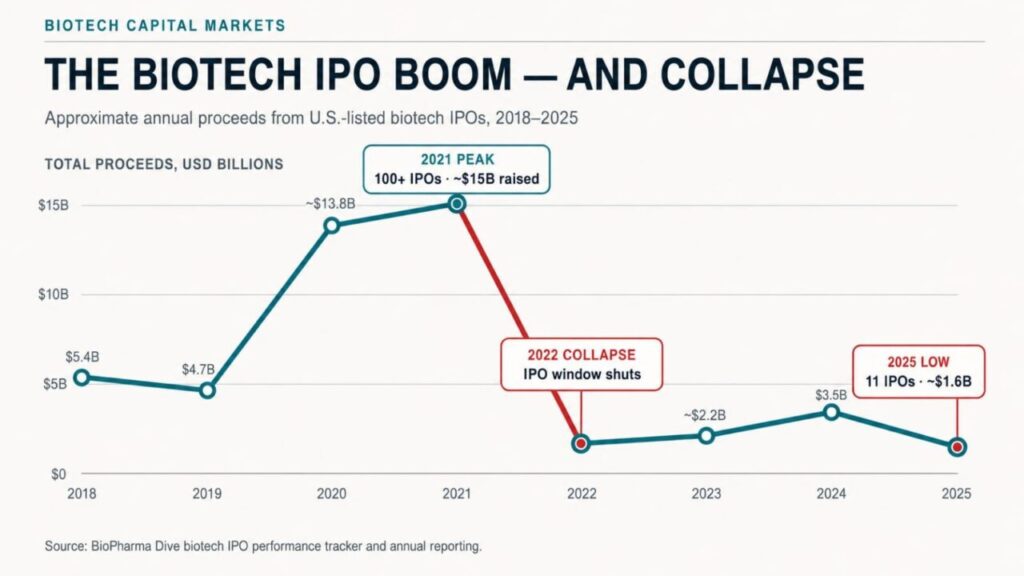
Biotech IPOs raised nearly $15 billion in 2021. The following year, only eleven priced at all.
Set that layered system against what climate technology venture capital looked like in 2025. Climate-focused funds raised a record $92 billion across 179 vehicles that year, according to Sightline Climate’s Dry Powder and New Funds report, cited by Heatmap News in May 2026. On the surface, that looks like a healthy, growing market. Underneath it, 77 percent of that total concentrated among the largest infrastructure players, firms comfortable underwriting utility-scale solar, wind, and battery storage because the risk is already well understood, not among funds willing to back the earlier, unproven technology that most needs financing. Early-stage venture’s share of total climate capital fell from around 20 percent in 2021 to under 8 percent in 2025. Only 39 percent of climate-focused venture funds trying to raise a new vehicle in 2025 actually closed one, against 73 percent of infrastructure funds and 60 percent of growth funds. Total dedicated climate venture and growth investment did rise to $40.5 billion in 2025, up 8 percent year over year according to Sightline’s own year-end report, and cumulative investment since 2020 has reached $255 billion. The market is not small. It is simply missing the middle layers, the royalty-style and structured-debt instruments, that let a biotech company monetize a specific, well-understood risk before that risk resolves.
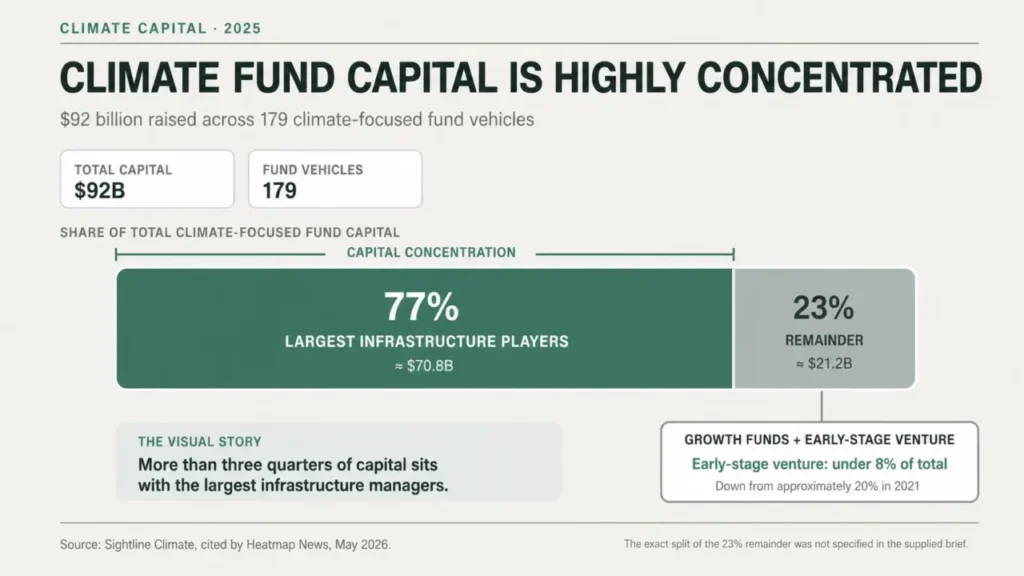
Of the record $92 billion raised by climate-focused funds in 2025, 77 percent went to the largest infrastructure players. Early-stage venture’s share fell under 8 percent.
The unevenness compounds a second problem: even within the venture capital climate technology does have, most of it goes to one place. Three-quarters of new capital raised by climate-focused funds in 2025 was earmarked specifically for energy investments, according to the same Sightline data, leaving transportation, industrial technology, and agriculture increasingly cut off. A biotech investor backing an oncology asset and one backing a rare disease therapy draw from the same deep, liquid capital markets infrastructure, the same royalty funds, the same specialist banks, the same clinical-stage IPO investors. A founder building a novel cement chemistry and one building a grid-scale storage technology are, in practice, competing for a shrinking and increasingly energy-skewed pool, with no equivalent specialist infrastructure built around either one specifically.
None of this means climate and industrial technology are less investable than biotech, or that the underlying science is any less proven. It means the financial instruments that let capital find that science efficiently, at each stage of its development, simply were not built the same way, and the industry has not yet built an equivalent regulatory or technical framework that produces the kind of discrete, verifiable milestones the royalty and structured-debt markets need to price risk against. A drug’s Phase 2 data is a specific, auditable thing a royalty investor can underwrite. A decarbonization technology’s “successful pilot” is a much fuzzier signal, defined differently by every company that claims it, and harder for a specialist lender to price consistently across a portfolio.
Biotech’s layered system, whatever its flaws, took decades, a defined regulatory pathway, and enough repeated deal volume for specialist investors to build real expertise pricing a narrow kind of risk again and again. Climate and industrial technology are still in the early stages of that same process, building the equivalent infrastructure roughly one deal, one fund, and one asset class at a time.
The gap will not close through better storytelling about the urgency of the energy transition. It will close, if it closes, the way biotech’s did: through enough repeated, well-structured transactions that specialist capital providers can build real expertise pricing a specific kind of physical-economy risk, and through some version of standardized, verifiable milestones that let a royalty investor or a structured-debt fund underwrite a decarbonization technology with the same confidence a biotech lender now underwrites a Phase 2 cancer drug. The $29.4 billion biopharma royalty market did not exist at that scale a decade ago either. It was built, deal by deal, once enough investors decided the risk was worth learning to price.
Listen to the full conversation with Sanjeev Krishnan on the SRI360 podcast, where he discusses fit-for-purpose capital and why S2G Investments has built distinct financing structures for venture, growth, and farmland strategies.
For more interviews and insights on sustainable, responsible, and impact investing, visit the SRI360 podcast archive.