
The most powerful investment opportunities are often the ones created by a sustained, structural failure to pay attention. For decades, the venture capital industry largely ignored women’s health as a serious investment category, treating it as a niche slice of reproductive care rather than a multi-dimensional, high-growth market shaped by biological reality and unmet demand. The evidence that this assessment was wrong is now considerable, and it is arriving in the form of exit data that institutional investors are finding difficult to dismiss.
I spoke with Sharon Vosmek in January 2026, CEO of Astia, about the investment thesis behind women’s health as a category. For Astia, it is not a separate thesis but an illustration of the same principle that drives all of their work: when a market systematically fails to include women in the development and evaluation of products meant to serve the entire population, it produces both a health problem and an investment opportunity.
The clinical exclusion that created the gap
To understand why women’s health represents the investment opportunity it does, you have to start with how the gap was created. For much of modern medical history, clinical trials in the United States operated under a 1977 FDA policy that explicitly recommended excluding women of childbearing potential from Phase I and early Phase II drug trials. The rationale was protective: keeping women out was framed as shielding them from experimental risk.
The downstream consequence was a generation-long shortage of baseline data on how drugs, devices, and therapies interact with female biology. It was not until the NIH Revitalization Act of 1993, signed into law 30 years ago, that the NIH mandated the inclusion of women and minority populations in federally funded clinical research. Prior to that point, the medical knowledge base was built almost entirely on male subjects, and it shaped product design, drug dosing, diagnostic criteria, and standard of care across virtually every therapeutic area.
The effects of that blind spot persist today. Medical protocols remain disproportionately calibrated to male physiology. As Sharon noted in our conversation, the problem extends to things most people would assume were solved long ago.
What gets missed when women are not in the room
The asthma inhaler example Sharon raised at the J.P. Morgan Healthcare Conference is a useful illustration. Biological differences between men and women, including reduced lung volume and lower Peak Inspiratory Flow Rates in women, affect how dry powder inhalers must be engineered to function effectively. Research published in PMC documents that inhaled corticosteroids and combination therapies are generally less effective in women when device design has not accounted for female physiology. The treatment considered standard of care does not work as intended for a substantial portion of the patient population.
The cardiovascular picture is more stark. Heart disease has been the leading cause of death for women in the United States for over 40 years, according to the American Medical Women’s Association. Yet the clinical presentation of heart disease in women frequently involves fatigue, shortness of breath, nausea, and back pain rather than the classic chest-pressure pattern documented in male patients, leading to decades of delayed diagnosis and less aggressive treatment.
The American Heart Association and McKinsey Health Institute have calculated that closing the cardiovascular care gap between men and women could restore at least 1.6 million years of quality life and generate $28 billion annually for the U.S. economy by 2040. McKinsey’s broader analysis of the global women’s health gap estimates a $1 trillion opportunity to improve both health outcomes and economic productivity.
For Sharon, the investment framing is direct: every one of these gaps represents an unmet clinical need that the market has not yet priced. Teams that include women are more likely to identify, develop, and bring to market the diagnostics and therapeutics that address these needs. That is not a social argument. It is a deal flow argument.
The exit data that changed the conversation
The most significant development in the women’s health investment conversation in recent years has been the arrival of hard exit data. For a long time, institutional investors used the absence of documented exits as justification for avoiding the category. That reasoning no longer holds.
In January 2026, at the J.P. Morgan Healthcare Conference, AOA Dx released a landmark report titled Follow the Exits: Why Women’s Health Is a Smart Bet in Healthcare. The analysis covered 272 publicly announced exits between 2000 and 2024 in the women’s health space, finding more than $91 billion in disclosed exit value across 159 transactions. When 2025 transactions were included, total realized value in the category crossed $100 billion. The report identified 27 distinct companies that had achieved unicorn status over the past two decades.
One of the reasons this data surprised institutional investors is structural: women’s health companies have been systematically miscategorized in major databases. A company developing an ovarian cancer diagnostic or an endometriosis therapeutic was routinely labeled under oncology, diagnostics, or medical equipment in platforms like PitchBook and Crunchbase, making the specific scale and financial performance of the women’s health category invisible to standard sector screens. As Health Tech World reported, the exits were happening. The category just was not being credited for them.
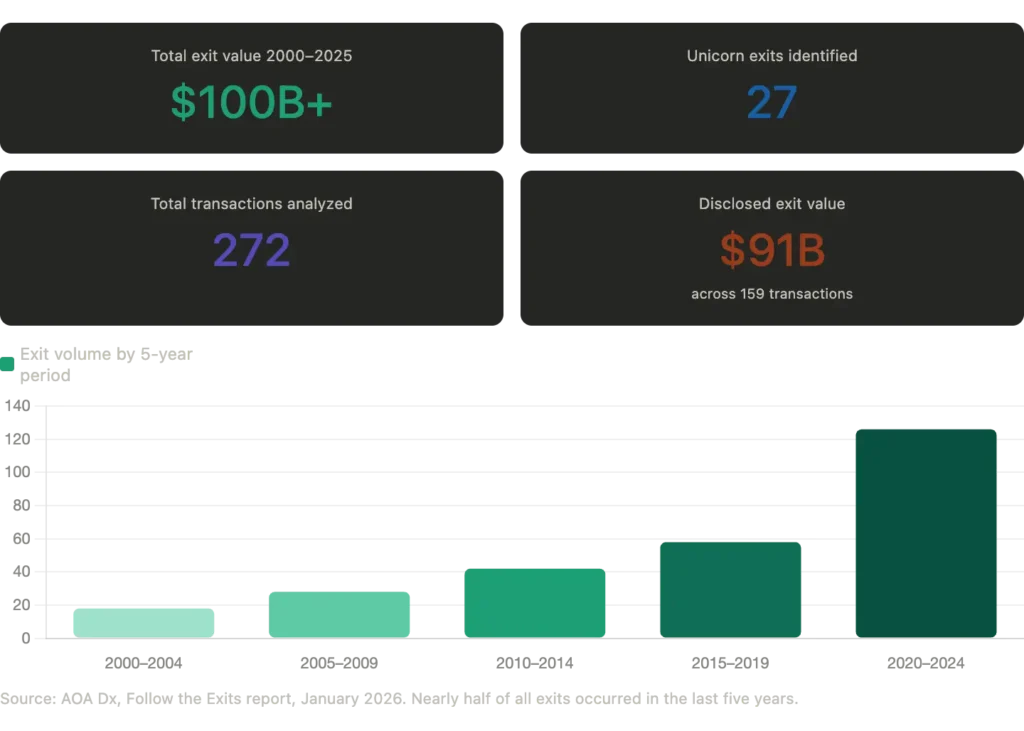
$100B+ in women’s health exits, key data from AOA Dx report.
For Astia, the numbers validate what the portfolio data had already shown. Sharon noted that Astia’s seven women’s health investments return on average four times the capital invested compared to the rest of the firm’s life sciences portfolio.
What the market looks like now
The global women’s health market was valued at between $31.9 billion and $38.1 billion in the 2021 to 2023 period, with projections ranging from $43.8 billion to $58.3 billion by 2030, according to data from Nova One Advisor. The compound annual growth rate of 4% to 5.5% is driven by an aging female population, rising prevalence of conditions like endometriosis and polycystic ovary syndrome, and growing consumer demand for non-invasive and digital diagnostic tools.
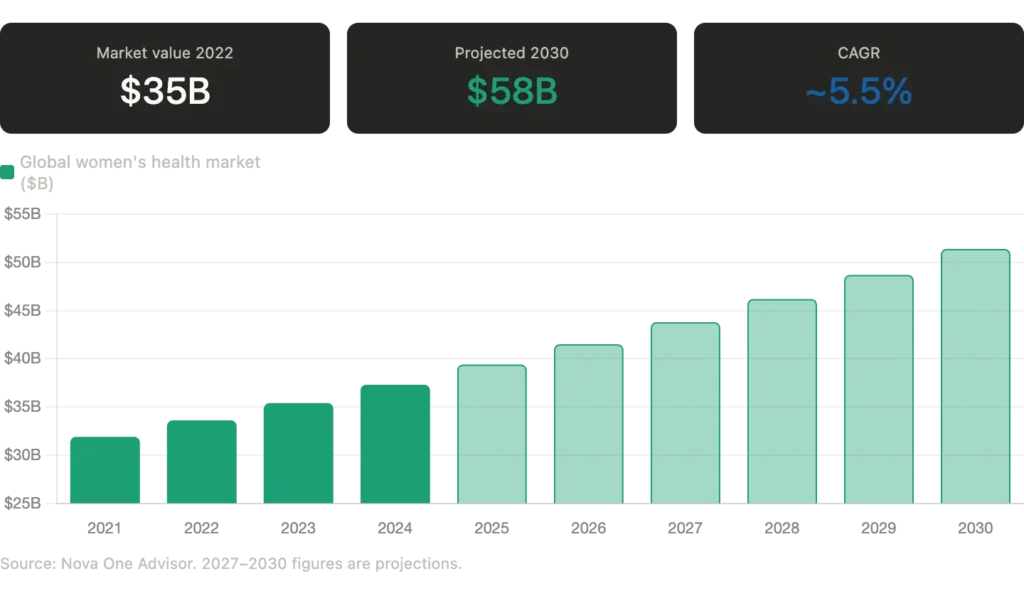
Women’s health market size and growth projection to 2030.
Venture capital is beginning to move in this direction. In 2024, digital health startups focused on women’s health captured $671 million in funding, representing 6.6% of all digital health investment, the highest proportion recorded since 2021, according to Rock Health. Rock Health’s research also documents that women are highly active digital health consumers who readily adopt virtual care and wearable technology.
Strategic acquirers are already consolidating the space. Hologic, Roche, Labcorp, and Abbott are actively building out their platforms through targeted M&A in women’s health diagnostics. Everly Health achieved a $3.6 billion valuation and acquired women’s health startup Natalist to expand its reproductive care footprint.
The J.P. Morgan Healthcare Conference in both 2025 and 2026 marked a visible shift in how institutional capital is framing women’s health. KPMG hosted dedicated discussions focused specifically on advancing women’s health as a healthcare innovation priority. The conversation has moved away from philanthropic framing and toward core alpha generation logic.
The investment case
The case for women’s health as an investment category rests on several converging factors: a large and growing addressable market, chronic historical underinvestment that has kept valuations below intrinsic value, a documented track record of unicorn exits that the market failed to properly attribute, and a biological imperative that drives recurring demand regardless of economic cycle.
What the OECD documents as the gender-health paradox compounds this further: while women generally outlive men, they spend significantly more years living in poor health, dealing with chronic illness and disability. That health burden represents both a clinical failure and a market opportunity.
The World Bank’s 2024 Women, Business and the Law report confirmed that the global gender gap in workplace and healthcare access is wider than previously estimated. The institutional recognition of that gap, combined with the commercial data now documenting its scale, is beginning to shift capital. For investors who see the opportunity clearly, the window before the market fully reprices this category may not stay open for long.
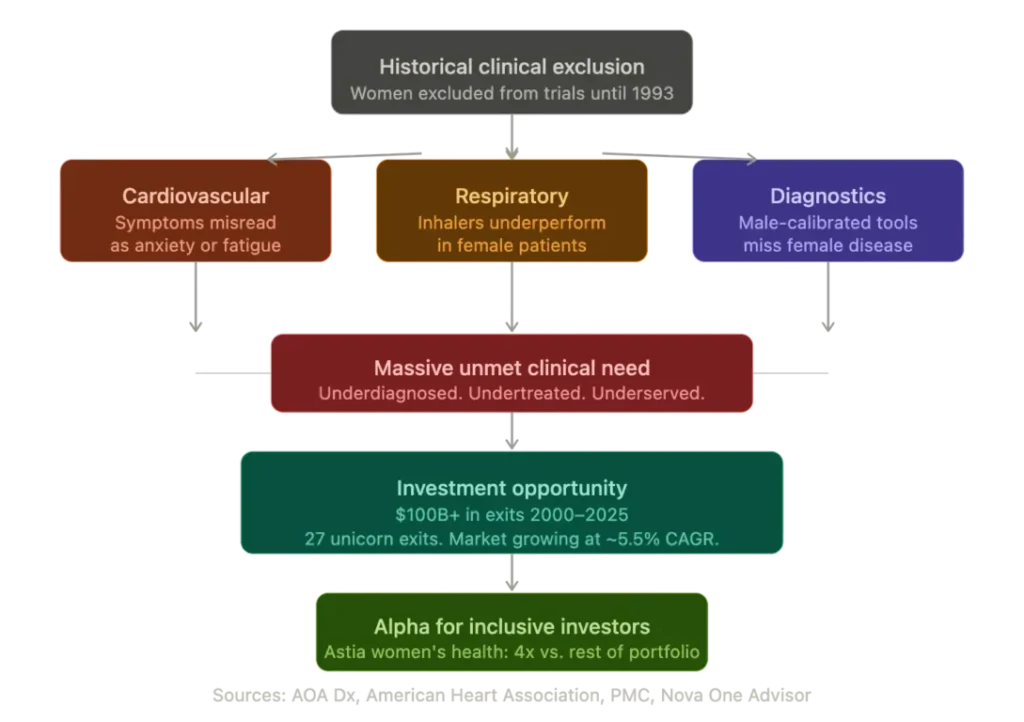
The diagnostic gap, a structural diagram of where women’s healthcare falls short.
🎙 Listen to the full conversation with Sharon Vosmek on the SRI 360 Podcast: Episode #126
For more interviews with leading SRI, ESG, and impact investors, visit sri360.com/podcast.