
In conventional capital markets, both sides of a financing transaction enter negotiations with professional representation. When a corporation seeks equity or debt financing, it engages investment bankers, corporate finance advisors, and legal counsel whose sole duty is to advance the company’s financial interests and preserve its operational flexibility. The institutional investors sitting on the other side of the table deploy their own in-house research desks, specialized counsel, and sophisticated due diligence teams. Negotiations proceed from a foundation of mutual professional support, because finance has recognized that severe information asymmetries and one-sided advisory arrangements produce systematically skewed, fragile transactions.
Impact investing has failed to construct that institutional balance. Across the sector, transaction intermediaries operate predominantly on behalf of the capital provider. They source deal flow for institutional asset managers, structure vehicles around investor risk appetites, and establish rigid compliance hurdles that operating enterprises must satisfy to be deemed fundable. The enterprises and fund managers seeking capital routinely enter these negotiations without comparable sell-side advisory backing, forced to navigate intricate institutional term sheets without independent advocacy in their corner.
I recently spoke with Laurie Spengler, Founder and Chief Executive Officer of Courageous Capital Advisors, a transaction advisory firm that works explicitly on the opposite side of that dynamic. Her firm represents asset owners, mission-driven operating enterprises, and specialist fund managers raising capital, rather than the institutional allocators deploying it. The advisory gap she highlights is not a technical footnote. It directly dictates what gets financed, on whose terms, and at what long-term cost to the underlying mission.
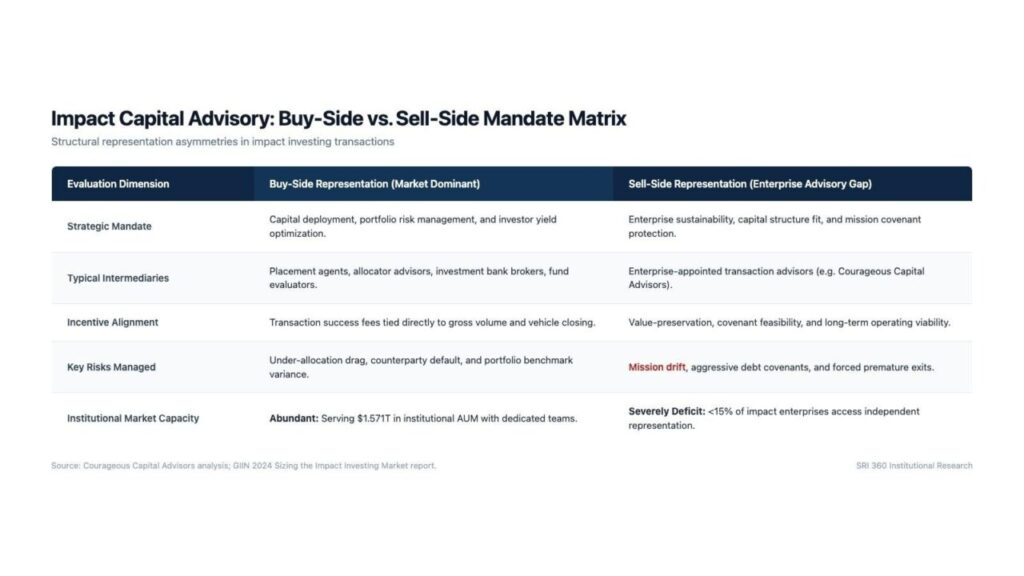
Figure: Buy-side vs. sell-side advisory matrix: comparing institutional allocator infrastructure with enterprise transaction representation.
DEFINING THE PRIVATE MARKET POCKET
To understand the severity of this advisory deficit, one must define the exact pocket of the market where it occurs. The term impact investing has become an expansive umbrella covering multiple asset classes, investment instruments, and enterprise scales. At one extreme sit public equities, sovereign green bonds, and multi-billion-dollar debt issuances by multinational corporations. When a Fortune 500 company, an international utility, or a multinational industrial conglomerate raises capital for an environmental or social initiative, it does not lack representation. It enters the market backed by deep in-house corporate treasury teams, dedicated investor relations departments, and global investment banking syndicates that structure every covenant to protect the company’s balance sheet.
The structural advisory vacuum does not exist in that corporate tier. It sits squarely within the private markets: small and medium-sized enterprises (SMEs), mid-market growth companies, community development financial institutions (CDFIs), and specialist emerging fund managers. These organizations represent the real economy of impact, delivering essential services in financial inclusion, sustainable agriculture, affordable housing, off-grid clean energy, and healthcare. Typically seeking between $5 million and $50 million in debt, equity, or structured facilities, they are large enough to absorb institutional capital but far too small to support permanent corporate finance departments or retain Wall Street investment banks.
When a mid-sized agricultural processor in East Africa or a regional housing developer in the American South sits down across from a European development finance institution or a multi-billion-dollar global impact fund, the negotiating field is structurally tilted. The capital provider arrives with legal teams, financial modelers, and institutional mandates designed in Zurich, London, or Washington. The entrepreneur arrives with operational expertise, deep community ties, and little technical experience in dissecting cross-border capital stacks. This specific private market pocket is where the advisory deficit causes systemic market failure.
HOW ADVISORY IS STRUCTURED IN IMPACT INVESTING
The global impact investing market has expanded into a recognized asset management sector, reaching approximately $1.571 trillion in assets under management (AUM), according to the Global Impact Investing Network (GIIN) 2024 market sizing report, spanning more than 3,900 organizations. That institutional maturation has spurred substantial professional infrastructure on the investor side of the equation. Institutional allocators, such as pension funds, insurance companies, and family offices, rely on dedicated impact consultants, specialist fund-of-funds, and third-party verification providers to screen, benchmark, and audit potential investments.
The sell-side advisory ecosystem has experienced no corresponding growth. Enterprises attempting to navigate impact capital raising, whether designing a blended finance facility, issuing holding company notes, or securing growth equity, confront a landscape where the overwhelming majority of transaction expertise serves the capital provider. Commercial law firms and placement agents exist, but their business models depend on closing transaction volume, often resulting in incentives aligned with the party providing the capital. Independent advisors whose explicit legal and fiduciary mandate is to champion the enterprise, evaluate whether a proposed instrument fits the company’s operating cash cycle, and empower leadership to reject misaligned capital are vanishingly rare.
This asymmetry distorts transaction incentives. An intermediary aligned with the capital provider operates under a mandate to execute a closing, tailoring terms to accommodate the fund’s investment policy. An advisor representing the enterprise operates under a mandate to secure viable capital on terms that sustain the business over its full operational cycle. In impact investing, where capital structures determine whether a community-focused organization can survive economic volatility while preserving its mission, that difference is existential.
WHAT ONE-SIDED REPRESENTATION PRODUCES
When enterprises enter institutional capital negotiations without independent advisory support, they routinely agree to financial terms that jeopardize their long-term operational viability. Lacking comparative transaction benchmarks, enterprise leaders frequently accept investor-imposed growth trajectories that force them to expand faster than their operational capacity can support. They accept restrictive debt covenants, such as quarterly debt service coverage thresholds calibrated for mature commercial banks, which restrict working capital during seasonal revenue downturns. They also concede governance rights that grant external investors disproportionate veto power over core strategic choices.
Courageous Capital Advisors has demonstrated the practical value of rebalancing this dynamic through advisory mandates spanning diverse geographies and asset classes. The firm structured a $500 million affordable housing credit facility, holding company loan notes for BRAC (the Bangladesh-based international development organisation operating across 11 developing nations), and common equity for Southern Bancorp (a rural Community Development Financial Institution serving distressed communities across the American Mid-South). In each engagement, transaction structuring proceeded from the operational perspective and mission requirements of the entity raising capital, not the administrative convenience of the investor.
The Organisation for Economic Co-operation and Development (OECD) has repeatedly noted in its blended finance analyses that the private impact market remains characterized by a ‘cottage industry’ of bespoke, fragmented, one-off transactions rather than scalable, standardized capital flows. While market participants often attribute this fragmentation to inherent operational complexity, a significant driver is the absence of professional sell-side capacity. Without dedicated enterprise representation to negotiate standardized templates that safeguard borrower interests across multiple transactions, every deal is negotiated from scratch under investor-dictated terms.
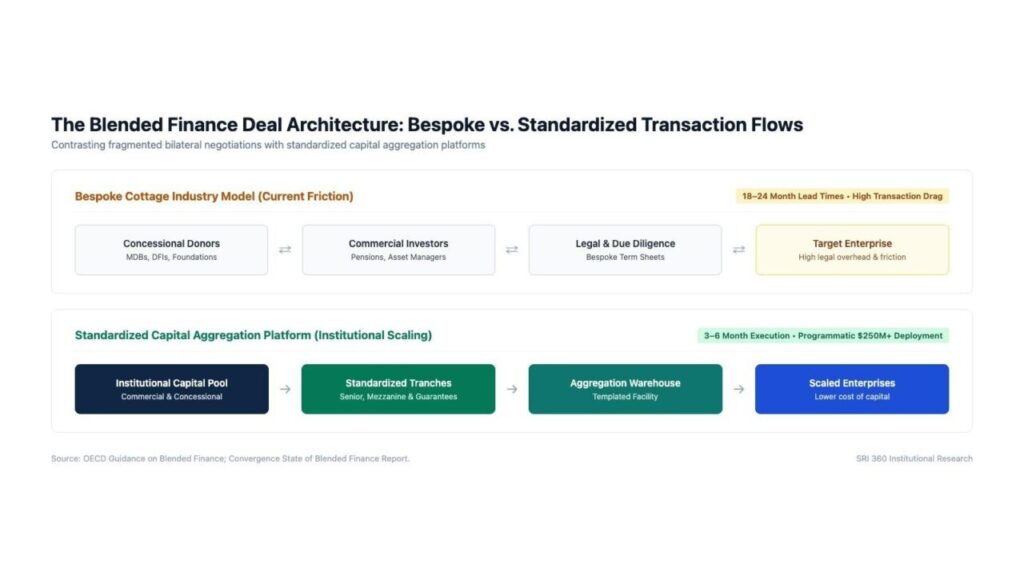
Figure: Blended finance deal architecture: bespoke cottage industry negotiation flows versus standardized capital aggregation platforms.
WHAT A GENUINE SELL-SIDE MANDATE INVOLVES
Professional sell-side advisory in impact finance begins with a fundamental diagnostic inquiry: does the capital on offer solve the specific operational problem facing the enterprise, or does it introduce novel financial and governance constraints disguised as a solution?
Answering that question requires analyzing the company’s operating cash cycle, its revenue volatility, and its mission covenants. A private equity or debt fund structured with a rigid seven-year fund life imposes refinancing or exit deadlines that clash with the multi-decade timelines required for physical infrastructure development or community trust-building. Hard-currency debt carrying floating interest rates and onerous quarterly compliance covenants introduces solvency risk for enterprises generating revenue in fluctuating local currencies. Similarly, concessionary capital that demands extensive, unstandardized impact reporting metrics can divert executive bandwidth away from core operational execution.
Mid-market impact enterprises in developing markets frequently possess exceptional operational and programmatic delivery capabilities, yet lack internal teams trained to model the compounding downstream effects of subordination provisions, waterfall mechanics, or restrictive liquidity covenants. Genuine sell-side advisors provide this analytical rigor exclusively for the borrower. Crucially, the mandate must empower the advisor to recommend walking away from capital when the proposed structural terms threaten the enterprise’s mission or solvency.
This authority to advise rejection is what distinguishes fiduciary representation from transactional deal brokering. While conventional intermediaries focus on driving deals across the finish line to secure closing fees, authentic sell-side representation prioritizes capital alignment over transaction velocity.
THE INFORMATION ASYMMETRY THAT PERSISTS
Institutional allocators in the impact sector operate with specialized investment teams, seasoned international legal counsel, proprietary databases of historical deal pricing, and pattern recognition developed across hundreds of portfolio transactions. An individual impact enterprise founder or regional fund manager, by contrast, may enter the institutional capital markets once or twice every five years. They have limited visibility into prevailing market terms, standard covenant carve-outs, or the degree of flexibility an allocator’s mandate actually permits.
In established corporate finance, this information gap is bridged by robust investment banking and advisory desks that ensure borrowers negotiate from a position of informed strength. In private impact investing, the market’s historical development prioritized capital mobilization above all else, focusing almost exclusively on designing incentives to entice risk-averse institutional capital into underserved markets. The question of who represents the enterprise receiving that capital was treated as secondary, leaving borrowers to navigate institutional negotiations with minimal technical defense.
While prioritizing capital supply was understandable during the market’s formative years, it has become counterproductive in a market managing $1.571 trillion in assets under management. Persisting with one-sided transaction negotiations perpetuates structural vulnerabilities that undermine the durability of the investments themselves.
THE MARKET CASE FOR REBALANCING
When mission-driven enterprises accept capital structured around investor preferences rather than operational realities, the resulting friction leads predictably to mission drift, financial restructuring, or early asset liquidation. These breakdowns harm not only the enterprise and the vulnerable populations it serves, but also the institutional investor, who is left holding an impaired, non-performing asset that damages its own track record and reputational standing.
Research from the Global Impact Investing Network consistently shows that impact investments can meet or exceed commercial financial benchmarks. However, realizing that potential at scale requires capital structures tailored to the underlying operational realities of the business. Establishing dedicated, professional sell-side advisory capacity across private impact markets is the essential prerequisite for transforming impact investing from an allocator-dominated market into a balanced, resilient capital ecosystem capable of delivering sustainable real-world outcomes over the long term.
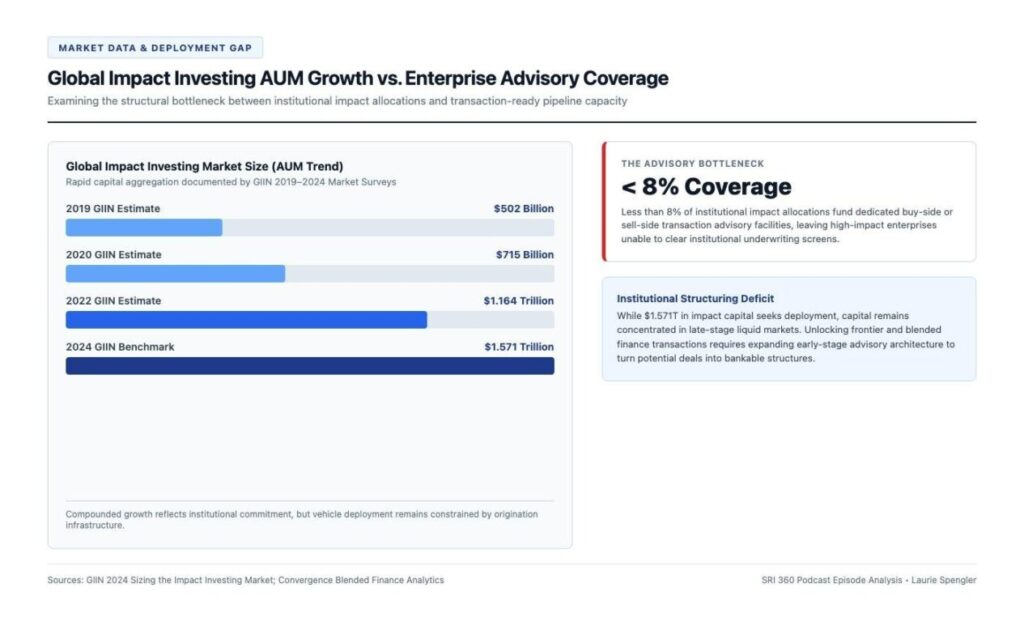
Figure: Global impact investing growth versus enterprise advisory coverage: GIIN $1.571T AUM alongside transaction advisory deficit.
This episode of the SRI 360 podcast featuring Laurie Spengler is available at https://sri360.com/podcast/laurie-spengler/ The conversation explores her experience structuring impact capital vehicles internationally, the institutional necessity of capital discipline, and the critical distinction between patient and permanent capital.
For more in-depth conversations exploring institutional sustainable finance and private market impact investing, explore the full SRI 360 platform archive at https://sri360.com/podcast/