Sustainable fund outflows hit $27 billion in the fourth quarter of 2025, according to Morningstar’s global sustainable fund review. That landed alongside a string of institutional retreats: global asset managers pulled out of the Net Zero Asset Managers (NZAM) initiative, banks left climate coalitions, and listed companies walked back sustainability commitments they had made when the political climate was more receptive. Financial media treated the combination as a single verdict — ESG strategies failed to deliver. That reading misses what was actually driving this institutional capital movement.
I recently spoke with Antony Bugg-Levine, co-founder of the Global Impact Investing Network (GIIN) and Managing Director of Bugg-Levine, Inc. He has spent nearly two decades at the center of this field. He convened the 2007 Rockefeller Foundation gathering at Bellagio, Italy, where the term impact investing was first coined. He helped launch the GIIN as an inaugural board member, and later spent a decade as Chief Executive Officer (CEO) of the Nonprofit Finance Fund, one of the largest Community Development Financial Institutions (CDFIs) in the United States. His perspective on the current retreat does not come from defending an ideology. It comes from understanding what institutional allocators were actually buying when they poured capital into sustainable funds — and why so much of it was always likely to leave.
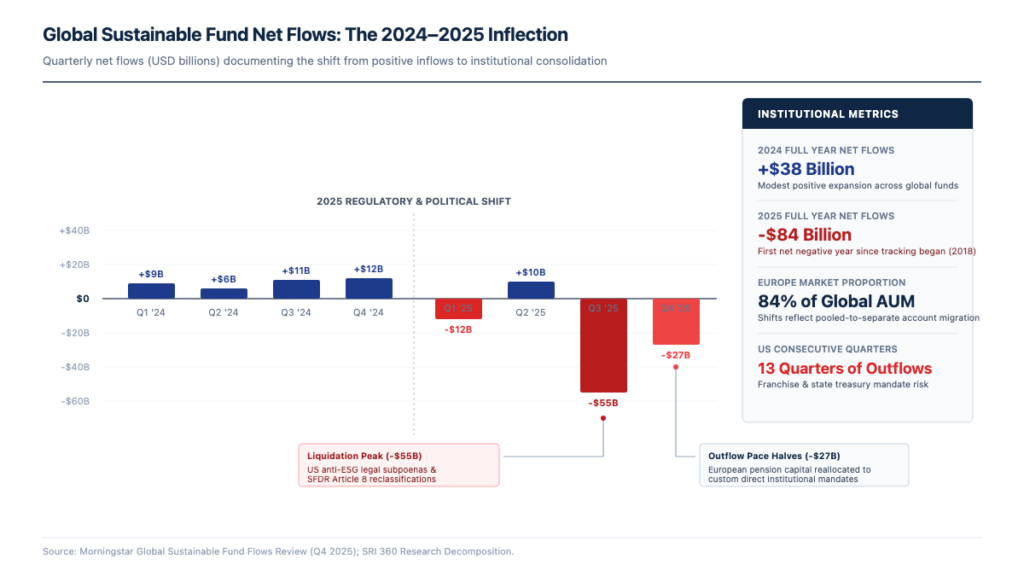
Global sustainable fund net quarterly flows from 2024 to 2025.
THE $27 BILLION HEADLINE NEEDS CONTEXT
Before allocators draw strategic conclusions from the $27 billion figure, the number needs to be pulled apart. It is a large single-quarter redemption, but it actually represented a slowdown from the third quarter of 2025, when sustainable funds saw nearly $55 billion in net withdrawals. Across all of 2025, global sustainable funds recorded $84 billion in net redemptions — the first full calendar year of net outflows that Morningstar has documented since it began tracking the category in 2018. After positive net inflows of $38 billion in 2024 and hundreds of billions in prior years, the reversal is real. But the composition of those outflows tells a more specific story.
A critical detail sits inside the European market, which accounts for 84 percent of global sustainable fund assets under management. A large portion of the European redemptions did not represent investors walking away from sustainability altogether. Pension systems in the Netherlands, the United Kingdom, and the Nordic countries redeemed capital from standard pooled mutual funds and broad exchange-traded funds (ETFs) and moved those allocations into custom separate accounts and direct mandates. Because Morningstar tracks pooled public vehicles rather than bespoke institutional accounts, these transfers showed up in the data as capital exits.
This shift reflects how European regulatory requirements have evolved, specifically under the Sustainable Finance Disclosure Regulation (SFDR). Institutional investors navigating Article 8 and Article 9 classifications have grown frustrated with generic ESG products that carry disclosure obligations without offering meaningful portfolio differentiation. Rather than paying active management fees for broad funds that simply apply exclusion screens, they moved to build their own mandates matched to their decarbonization targets and risk budgets.
A RISK MANAGEMENT EXERCISE, NOT A RETURNS VERDICT
In the United States, the outflow dynamics have been sharper and more politically driven. Domestic sustainable funds recorded their thirteenth consecutive quarter of net redemptions in Q4 2025. This coincided with high-profile exits by some of Wall Street’s largest managers. BlackRock withdrew from the Net Zero Asset Managers initiative in January 2025, citing coordinated legal pressure, subpoenas, and anti-boycott threats from Republican state attorneys general. State Street Global Advisors split its position — pulling its US business from the coalition while keeping its European and UK entities as signatories to protect international mandates.
Bugg-Levine offers an analytical framework for these exits that moves well beyond the usual performance debate. The standard argument is that asset managers left because their ESG portfolios underperformed. Bugg-Levine is clear that these decisions were not made by portfolio managers evaluating returns. They were made by general counsel, chief risk officers, and executive committees assessing franchise risk.
When a firm managing trillions decides whether to stay in an international climate alliance, the equation is not about whether a clean energy ETF beat its benchmark. The executive team is weighing whether maintaining a public ESG profile risks losing multi-billion-dollar state treasury mandates, municipal bond mandates, or federal pension contracts. If keeping a $10 billion thematic fund franchise in place puts a $500 billion institutional mandate at risk, the decision is straightforward: the product gets shut down or rebranded.
As Bugg-Levine noted, financial returns can be measured precisely through audited data — but risk cannot. Risk perception is subjective, shaped by regulatory environment and political pressure. When legal threats are active and regulators are hostile, the perceived institutional risk rises sharply. Decisions to exit sustainable strategies or leave alliances are risk management moves, not mathematical verdicts on whether sustainable investing works.

Institutional investors evaluating risk in an executive boardroom.
WHO WAS NEVER REALLY THERE
Bugg-Levine’s sharpest insight is about who the capital that left actually represented. He draws a clear line between two very different groups of investors that were both active in the sustainable investing space during its peak growth between 2020 and 2022. Understanding that divide explains why recent outflows do not signal the collapse of authentic impact finance.
The first group consists of specialized, high-conviction investors who entered sustainable markets because the economics made sense. They backed industrial decarbonization, renewable infrastructure, climate-resilient water systems, and underserved commercial credit because technology advances and regulatory tailwinds made those real assets genuinely investable. They understood resource scarcity, recognized the cash flow advantages of energy efficiency, and built their underwriting around commercial fundamentals rather than public positioning. That capital has stayed put through the political pushback.
The second group arrived during the post-2020 liquidity surge, driven by commercial opportunism and the pressure to appear socially conscious. Corporate managers, regional banks, and institutional allocators launched ESG products and made sustainability commitments primarily because the environment made it commercially appealing and reputationally safe to do so. Commitments were announced at international summits. Marketing materials were loaded with sustainability imagery. But the underlying conviction was thin.
When the political environment shifted — introducing regulatory scrutiny and public blowback — this group found that the incentives had flipped. What had been a marketing advantage became a liability. And the broad retreat gave these investors collective cover: when everyone is pulling back, no single institution takes the reputational hit alone. Capital that was allocated without real strategic conviction left at the first sign of friction.
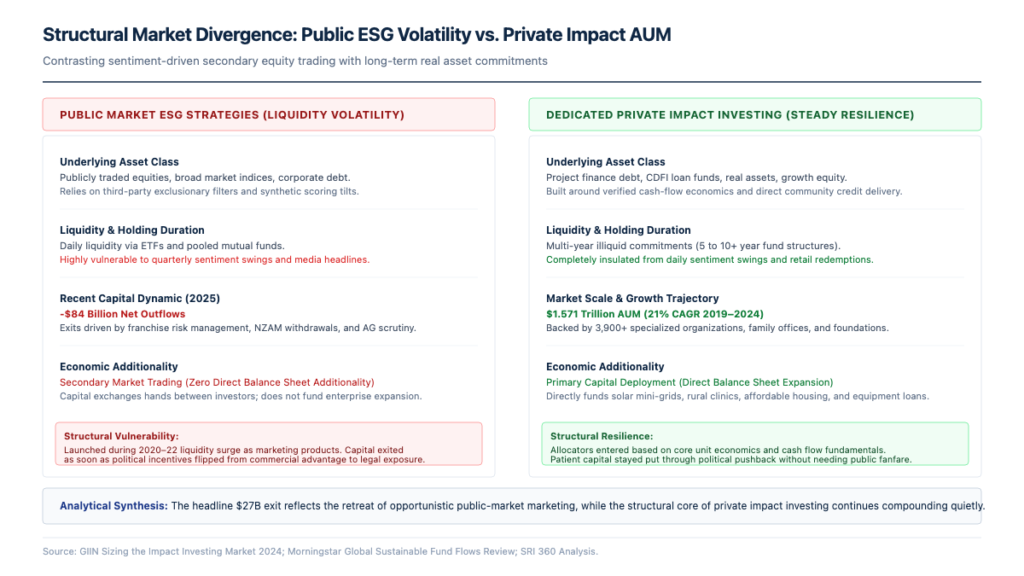
Public ESG fund volatility compared to private impact investing growth.
WHAT COMMITTED CAPITAL ACTUALLY LOOKS LIKE
The gap between public ESG marketing and authentic impact finance shows up clearly in the data from the Global Impact Investing Network. The GIIN’s 2024 flagship report, Sizing the Impact Investing Market, found that the dedicated global impact investing market had grown to $1.571 trillion in assets under management across more than 3,900 specialized investment organizations. The private market impact base expanded at a 21 percent compound annual growth rate between 2019 and 2024 — steady institutional growth even as public ESG funds were bleeding outflows.
This divergence comes down to a fundamental difference in what these investment types actually are. Broad-market ESG mutual funds and ETFs typically apply third-party exclusion filters or positive tilt scoring to publicly traded equities. When an investor buys an ESG index fund, they are buying shares in large listed companies that have made certain disclosures or adopted certain policies. The capital does not go to the company’s balance sheet to fund new projects. It simply changes hands in secondary markets.
Authentic impact investing, as defined by the standards the GIIN established, requires explicit intent: capital deployed with the upfront objective of generating measurable environmental or social outcomes alongside financial returns. This capital goes primarily into private market structures — project finance debt, growth equity, mezzanine facilities, and CDFI loan funds. These investments fund physical assets: solar installations, rural health clinics, small business lending, regenerative agriculture. Because they are illiquid and tied to multi-year operating cycles, they are insulated from the sentiment swings and headline volatility that drive public fund flows.
THE QUIET WORK CONTINUING UNDERNEATH
Beyond institutional asset managers subject to public scrutiny, a significant shift in private wealth is creating a resilient counter-current. Bugg-Levine highlighted a structural trend that rarely gets coverage: the rapid accumulation of capital within multi-generational family offices and private foundations. In the United States alone, the billionaire population has grown from roughly 800 to more than 1,300 over the past several years, concentrating large pools of patient capital in private entities that operate entirely outside public market reporting requirements.
These family offices and independent foundations do not face quarterly performance pressure, legislative scrutiny, or the threat of losing state treasury mandates. They are not accountable to public investment committees or reliant on municipal contracts to sustain earnings. As a result, sophisticated private allocators are putting significant capital to work in private impact structures — deep climate technology, community lending facilities, and distressed mission-critical assets — without any need for a press release.
Bugg-Levine pointed to specific market dynamics that illustrate this quiet activity, including secondary asset sales and complex restructurings where conventional institutions were forced to exit positions. Patient, mission-driven allocators stepped in to buy quality operational assets at attractive prices, securing durable outcomes without fanfare.
The $27 billion quarterly headline will eventually become a footnote. If you are evaluating impact strategies right now, the more useful question is not why retail ESG funds are shrinking — it is whether the capital you are looking at was ever genuinely committed in the first place. The structural core of private impact finance has not retreated. It simply never needed a press release.
Listen to the full conversation with Antony Bugg-Levine on the SRI 360 Podcast, exploring the early history of the impact investing movement, institutional risk dynamics, and private capital deployment, at https://sri360.com/podcast/antony-bugg-levine/.
For additional conversations exploring sustainable finance, community development banking, and private market impact investing, explore the complete SRI 360 platform archive.