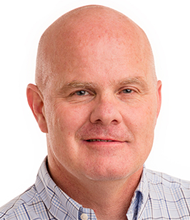
“I literally wrote the last speech that Nelson Mandela gave as president of South Africa and listened to him deliver it in front of 100,000 people. ”
— Antony Bugg-Levine
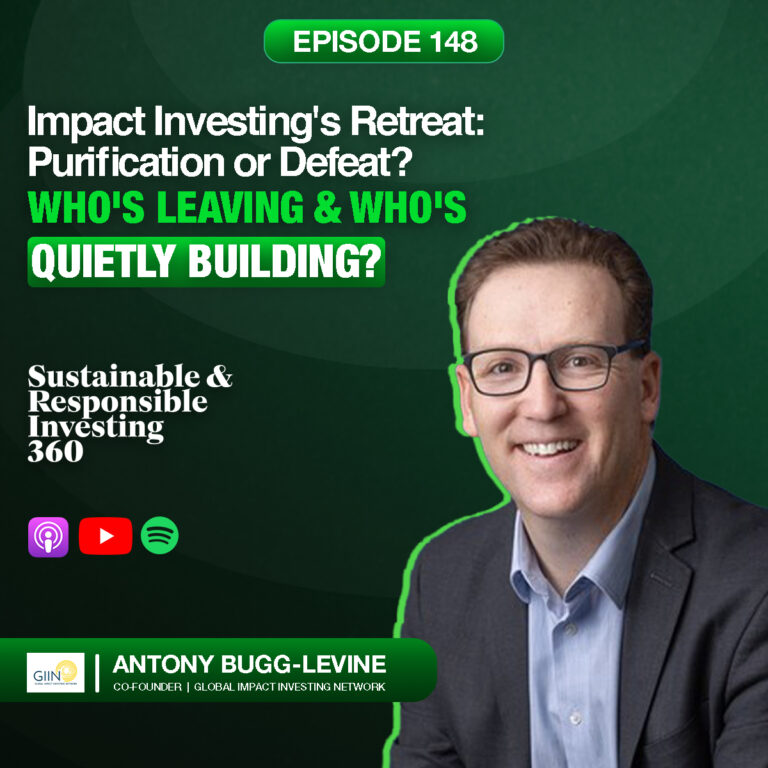
In this episode, I speak with Antony Bugg-Levine, Managing Director of Bugg-Levine, Inc. and co-founder of the Global Impact Investing Network, about whether impact investing’s retreat is a defeat or a purification, who’s leaving and who’s quietly building, and what it was like to be in the room when “impact investing” got its name.
Antony grew up in Johannesburg in the 1970s and early 1980s, in a politically active family under apartheid. His mother was likely headed for jail for her opposition to the government and chose not to do that with young children; the family moved to the US in 1984. His grandmother, Lydia Levine, had been a proud German citizen before the Holocaust, in which 10 of her 13 siblings were killed. He was the teenager reading Mandela’s treason trial transcripts by the pool.
He got to Yale because someone lent him the money. After graduating he went back to South Africa, leading communications at the newly formed Human Rights Commission and then joining the communications team for the African National Congress’s 1999 election campaign. He wrote the last speech Nelson Mandela gave as president, and listened to him deliver it in front of 100,000 people.
From there the path ran through Princeton, McKinsey and TechnoServe in Kenya, each step about understanding how capital decisions actually get made. At McKinsey, he realized a pharmaceutical client would make more by adding five people to the US sales force of its latest blockbuster drug than by building an entire consumer business in Nigeria. In Kenya, he learned that the conviction that the businesses he worked with were “imminently investable” by outside capital was often wrong — there were real reasons private equity and venture investors weren’t showing up.
At the Rockefeller Foundation, a back-of-the-envelope calculation told him there would never be enough money in philanthropy and government, and that the money that could do it was sitting in roughly $100 trillion of global capital markets. In October 2007 he convened a small group at the Foundation’s Bellagio Center on Lake Como. In a breakout session, someone suggested “impact investing.” He doesn’t remember who, and thinks that’s beautiful. What mattered was that people who had called themselves affordable housing investors or microfinance investors now had a common language.
He then ran the Nonprofit Finance Fund for a decade. During COVID, NFF closed a $29 million Ford Foundation loan in nine days — the kind of deal that normally takes nine months — to launch a $75 million relief fund for New York nonprofits. When the red line came back, all three of the Foundation’s proposed changes made the loan easier. You shouldn’t need a crisis, he says, to work that way.
Now he’s asking harder questions of the field. The $27 billion that left sustainable funds in Q4 2025 was, he suspects, a risk management exercise rather than a verdict on returns. The people who dabbled because it was expedient “have found comfort in the ability to retreat without repercussions” — while a lot of the most exciting work is being done by people, often inside large family offices, who don’t write press releases about it. He is also sharply critical of his own field: an impact methodology that never speaks to the people it claims to help is, to him, a red flag.
What stayed with me is the arc from pragmatist to radical. He started on “Team Unlock More Money for Impact,” and now says mainstream capital has had a generation to move further and faster than it has. “Returns are objectively measured,” he says, “risk is not.” Seven words that go a long way toward explaining why capital doesn’t simply follow the numbers.
Listen to the full conversation.
–
Listen to the episode on Apple Podcasts, Spotify, Overcast, Podcast Addict, Pocket Casts, Castbox, YouTube Music, Amazon Music, or on your favorite podcast platform. You can watch the interview on YouTube here.



What was your favorite quote or lesson from this episode? Please let me know in the comments.
SHOW NOTES:
[01:20] Guest intro
[02:56] Welcome & meet Antony Bugg-Levine
[07:32] Childhood: a politically active family and grandmother Lydia Levine
[09:37] Team Unlock: his early position on impact investing
[10:43] The Yale loan story
[14:03] “My 21-year-old self would be very judgy”
[19:35] Princeton, McKinsey, and TechnoServe in Kenya
[24:35] The back-of-the-envelope math at Rockefeller
[27:30] The Bellagio meeting and coining “impact investing”
[34:37] The two camps in the room
[37:59] Radicalized: 17 years later
[40:34] Purification or refutation?
[42:16] The FTX / Anthropic governance play
[46:46] The COVID story: $29M in nine days
[57:23] The fiduciary reality: $27B out in Q4 2025
[01:00:39] The CRA and the CDFI Fund under threat
[01:07:10] 800 to 1,300 billionaires — the quiet money
[01:10:13] Benjamin Franklin’s 1789 will
[01:15:00] Rapid Fire Questions
Additional Resources:
- Antony Bugg-Levine on LinkedIn
- Bugg-Levine Incorporated website
- Book – Investing in America: Expanding Access to Finance to Solve Our Shared Challenges
- Global Impact Investing Network website
- Nonprofit Finance Fund website
- Columbia Business School — Capital for Good podcast featuring Antony
MORE QUOTES FROM THE INTERVIEW:
“Returns are objectively measured, risk is not. ”
— Antony Bugg-Levine
“When we look back at what defined this era, it’s gonna be the people we’re not talking about right now. ”
— Antony Bugg-Levine