Ninety two percent of impact investing assets now sit with investors managing more than $500 million each, according to the Global Impact Investing Network (GIIN)’s 2024 State of the Market survey of 305 organizations. Ask someone in the field what a typical impact deal looks like, though, and their answer rarely matches that number. It’s usually something small: a founder-led fintech, a solar micro-grid startup, a company nobody outside the sector has heard of yet. The unspoken assumption is that big means compromised, and small means pure. The data doesn’t back that up.
I recently spoke with Samantha Duncan, founder and CEO of Net Purpose, a data platform that supports investors managing roughly $20 trillion in assets, about how that assumption holds up against real portfolio outcomes. Her own career passed through LeapFrog Investments, a private equity firm built to reach underserved consumers in Africa and Asia, which gives a useful window into where the bias actually breaks down.
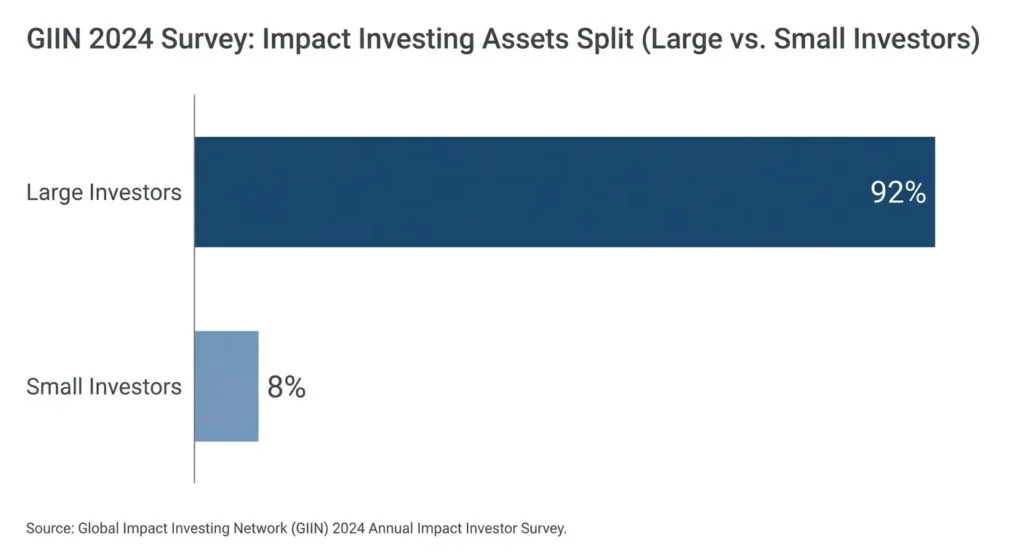
92% of impact investing assets already sit with the large investors the industry is taught to distrust.
The same GIIN survey that puts 92% of assets with large investors also found those investors increasingly deploying capital into mature, growth-stage companies rather than early-stage ones. That is worth sitting with. The industry’s dominant narrative, that impact investing means backing scrappy founders before anyone else will, describes a shrinking share of where the money is actually going. Part of the reason is structural. A portfolio manager screening deals for a large fund faces real career risk in backing an unproven micro-enterprise versus a company with an established track record, audited financials, and existing distribution. Diligence teams are built to evaluate scale, not to bet on it appearing later. None of that is a moral failing. It’s an incentive structure, and it quietly pushes capital toward exactly the kind of company the industry’s self-image says it should be skeptical of.
The Insurance Case: Express Life and BIMA
Express Life is the clearest example of what happens when that skepticism gets tested against results. LeapFrog invested $5.5 million in the Ghanaian insurer in 2012, when it had 12,000 customers. Within two years the company had grown to 423,000 clients, reaching close to 900,000 people once family members were counted, according to LeapFrog’s own account of the deal. That growth is what drew Prudential, one of the world’s largest insurers, to acquire the stake in March 2014, a transaction that marked Prudential’s first entry into the African insurance market. GIIN’s independent case study confirms the acquisition was driven specifically by LeapFrog having proven the market and reduced the risk for a much larger buyer. The scale-up happened under a small investor. The continued reach, and the opening of an entire new market to insurance access, happened because a large one stepped in.
BIMA followed the same arc at a bigger multiple. LeapFrog backed the mobile insurer early, betting on a distribution model built around airtime-based premium collection, letting customers pay for coverage through their phone credit rather than a bank account or cash agent. That mechanism is what let BIMA reach customers no traditional insurer had bothered to serve. By the time Allianz’s digital investment arm bought a stake for $96.6 million in 2017, BIMA had sold more than 30 million policies across 14 countries, held one in ten life insurance policies in Ghana, and become Cambodia’s largest life insurer within a year of launch, according to LeapFrog’s deal announcement, independently corroborated at the time by TechCrunch. Three quarters of BIMA’s customers were buying insurance for the first time in their lives.
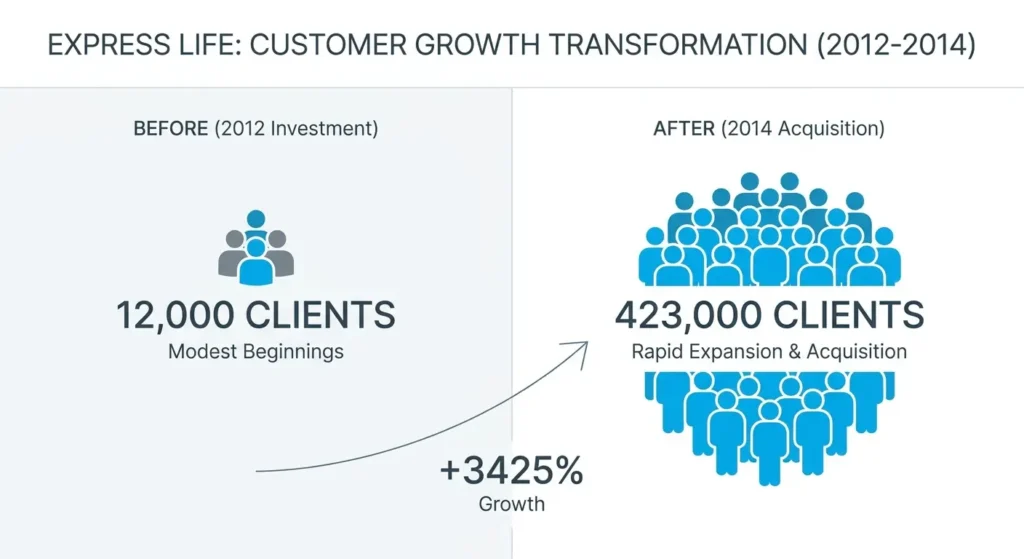
Express Life went from 12,000 to 423,000 clients in two years, proving the market before Prudential ever entered it.
In the conversation, Duncan pointed to deals like these when describing what she called an “ingrained perception that big companies are bad” in impact investing, one that made some in the industry uneasy about partnerships with insurers as large as Allianz and Prudential. Her point wasn’t that big companies are automatically better. It was narrower: size alone doesn’t determine impact, and the assumption that small and homegrown always beats large doesn’t hold up against what actually happened in these deals.
The wider numbers support that narrower point. LeapFrog’s original 2007 target was to reach 25 million people. By 2025, the firm’s companies were reaching 622 million people, nearly 25 times that original goal, a figure from LeapFrog’s own reporting rather than an independent audit, though the individual Express Life and BIMA numbers above were reported independently. Much of that overshoot came specifically from portfolio companies scaling to, and past, the size where “large company” skepticism tends to set in.
There’s a reason that kind of scale matters more than it gets credit for, and it comes down to what closing a real gap actually requires. Reaching a few hundred first-time customers in one city takes a good product and a motivated sales team. Reaching hundreds of millions of people across a continent takes distribution infrastructure, balance sheet strength to absorb claims at volume, and regulatory relationships built over years, closer to the requirements of building out a national power grid than launching a single app. In Ghana, financial account ownership has climbed to 81% of adults, level with South Africa and just behind Kenya’s 90%, according to the World Bank’s Global Findex Database 2025. But insurance access hasn’t kept pace with bank account access. Across Nigeria, Ghana, Kenya, and Rwanda, more than half of adults experienced an insurable risk in the past year, and only 1% filed a formal claim, according to FSD Africa, the financial sector development organization that tracks these markets. Most people instead fall back on high-cost borrowing or cutting spending to absorb a shock insurance was supposed to cover.
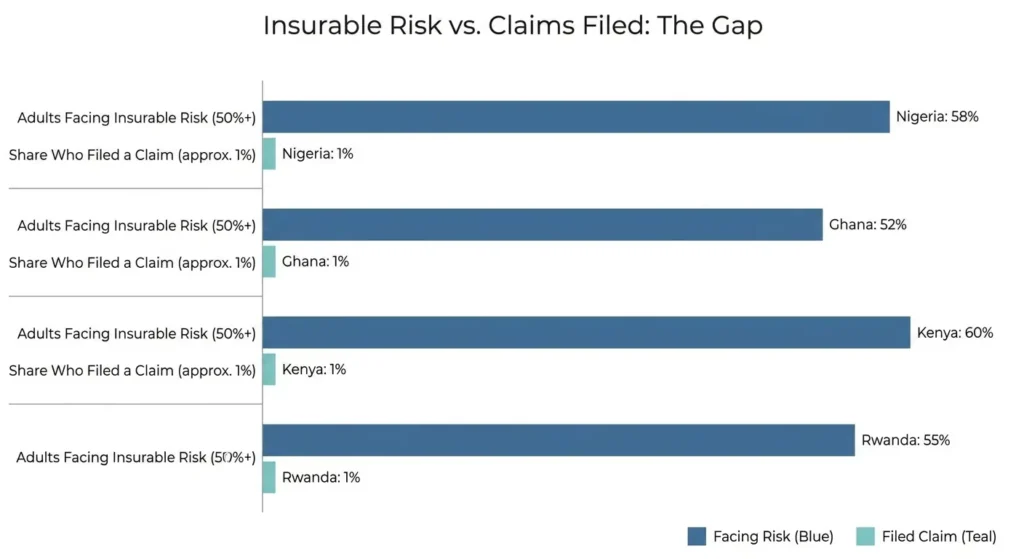
Across Nigeria, Ghana, Kenya, and Rwanda, over half of adults faced an insurable risk last year and only 1% filed a claim.
Closing a gap that size takes exactly the kind of scale small companies rarely have on their own. Duncan made this point in the conversation more bluntly: treating large companies as the opposition, rather than as potential partners in scaling impact, risks missing real opportunities to close gaps like this one.
What this suggests for how impact funds actually screen deals is worth taking seriously. Many impact mandates still use revenue caps, employee headcount limits, or “early stage only” language as a proxy for mission alignment, on the assumption that scale and compromise move together. The Express Life and BIMA deals suggest the opposite relationship in at least these cases: the compromise-free period was the small, undercapitalized one, before either company could reach the millions of people its product was built to serve. The acquisition by a larger player wasn’t the moment the mission diluted. It was the moment it was actually fulfilled at scale.
None of this erases the role small companies play. LeapFrog’s early capital and hands-on work with Express Life and BIMA is what made both companies attractive to a bigger acquirer in the first place. But the deals that actually closed the protection gap, reaching hundreds of millions of people, happened after a large company stepped in, not despite it. If 92% of impact capital already sits with large investors, and the clearest measurable outcomes in this space came from deals with large acquirers, screening out big companies on principle means walking away from where a lot of the impact has already been proven to land.
Listen to the full conversation: Samantha Duncan on the SRI 360 podcast
More conversations with institutional investors on sustainable and responsible investing: Browse the SRI 360 podcast archive