Nearly 700 medicines approved for use in the United States depend on at least one chemical produced solely in China, according to United States Pharmacopeia data cited in a June 2026 Council on Foreign Relations report. The same report traces how that dependence took root: Chinese manufacturers flooded the global market with low-priced penicillin and vitamin C in the early 2000s, a wave of production that undercut Western competitors on price until much of that manufacturing capacity simply stopped existing anywhere else. What is left behind in China is not just market share. It is physical infrastructure, fermentation tanks and processing lines built for one purpose that can be repointed at another whenever demand shifts.
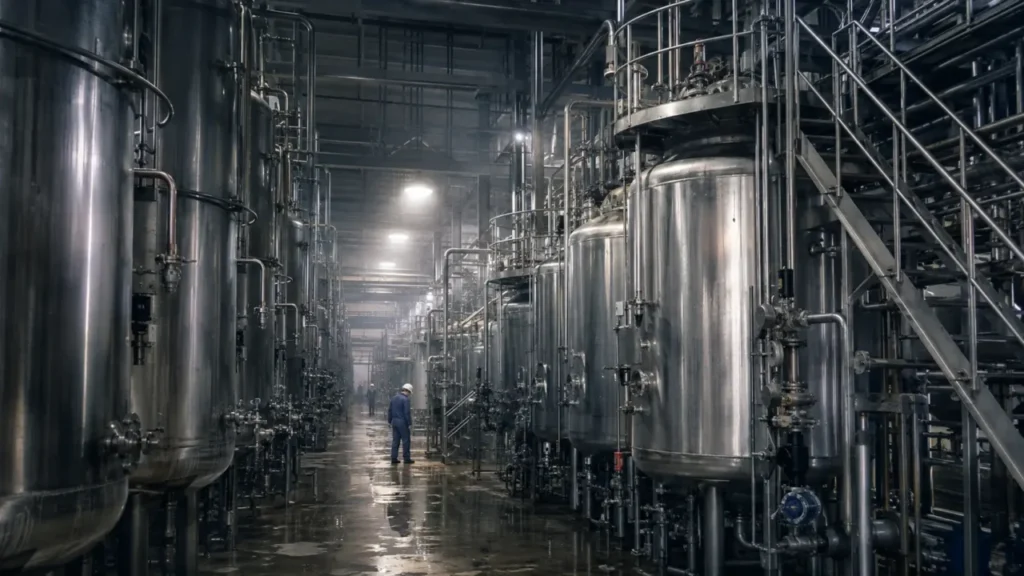
China dominates global vitamin and amino acid production through repurposed fermentation capacity.
That repointing is now happening at scale, and it is reshaping who controls the raw inputs behind food, feed, and pharmaceutical supply chains worldwide.
I recently spoke with Matilda Ho, founder and managing director of Bits x Bites, a China-focused food technology venture fund, about why she considers fermentation capacity one of the country’s most underpriced assets. Her argument is straightforward: where European biotech founders struggle to fund the leap from lab to factory, Chinese manufacturers already have the tanks sitting there, built for antibiotics or industrial chemicals whose domestic demand has since declined, available to retool at a fraction of the cost of building new capacity from scratch.
The scale of what that capacity now produces is difficult to overstate. China’s biomanufacturing industry reached a total market size of roughly RMB 1.1 trillion, or $157.3 billion, according to figures presented at the 2025 Biomanufacturing Conference and reported by China Briefing. The country accounts for more than 70 percent of the world’s biofermentation product output, with its food additives and biopharmaceutical subsectors each generating over RMB 400 billion, or $57.2 billion, in annual output value. China also contributes more than 20 percent of global publications and patent filings in the biomanufacturing field, evidence that the advantage extends beyond raw manufacturing into the research base that feeds it.
For the specific ingredients used in food, feed, and dietary supplements, American dependence on Chinese supply is close to absolute. Roughly 78 percent of United States vitamin imports come from China, according to a May 2026 issue paper from the American Feed Industry Association, drawing on analysis by the Institute for Feed Education and Research. The paper found the United States is effectively dependent on China for 100 percent of the imported vitamin D3 and lysine used in livestock feed, 85 to 90 percent of amino acids such as threonine and methionine, and up to 95 percent of certain B vitamins. China’s amino acid dominance runs deeper still, controlling more than 62 percent of global production overall, including 77 percent of lysine, 91 percent of threonine, and 84 percent of valine specifically.
90 percent of amino acids such as threonine and methionine, and up to 95 percent of certain B vitamins. China’s amino acid dominance runs deeper still, controlling more than 62 percent of global production overall, including 77 percent of lysine, 91 percent of threonine, and 84 percent of valine specifically.
Outside pharmaceuticals, the same fermentation infrastructure has quietly taken over specialty food ingredients too. China now produces more than 70 percent of the world’s commercial steviol glycoside supply, the compound behind stevia sweeteners, according to industry data compiled by SweetSteviaM. That dominance followed a similar path to vitamins and amino acids: fermentation-based production methods, layered on top of existing extraction infrastructure, let Chinese manufacturers undercut the cost of growing and processing stevia leaf anywhere else at scale, including in Paraguay, the plant’s country of origin.
The pharmaceutical supply chain shows the same concentration playing out with sharper geopolitical consequences. China controls 94 percent of the key starting material behind amoxicillin, the most prescribed antibiotic in the United States, according to the Council on Foreign Relations analysis, with five Chinese companies, including the state-owned North China Pharmaceutical Corporation, controlling more than four-fifths of global production of that starting material between them. Chinese production capacity for that single ingredient reached fourteen thousand tons, nearly three times India’s capacity, in a country whose physicians write more than sixty million amoxicillin prescriptions a year. In 2021, China’s antibiotic exports made up one-fifth of the global total and nearly half of all global antibiotic ingredient exports specifically. China separately supplies 80 percent of the world’s heparin. Both figures matter for reasons beyond cost. The report documents a 2019 remark by the Chinese economist Li Daokui to a top political advisory body in Beijing, stating that if China reduced its exports of vitamins and antibiotic raw materials, the medical systems of some developed countries would stop functioning. Whether or not that scenario ever plays out, the concentration itself is the story: capacity this centralized creates leverage whether or not anyone chooses to use it.
Europe’s experience shows what happens when a region has the scientific talent but not the manufacturing base to match it. A December 2025 European Commission proposal for a new Biotech Act found that United States biopharmaceutical startups received roughly nine times more late-stage funding than their European Union counterparts, with around €219 billion of venture capital directed at health biotechnology in the United States compared to just €25 billion in the European Union between 2015 and June 2025. The same document found that European Union venture capital accounts for only about 5 percent of global venture capital, and that 66 of the last 67 European biotechnology companies that went public chose to list outside the European Union entirely. The scientific output is there. The proposal notes European biotechnology has grown more than twice as fast as the broader European Union economy over the past decade. What is missing is the capital and manufacturing capacity to carry that science from a laboratory bench to an industrial-scale fermentation tank, which is precisely the gap Chinese brownfield capacity is positioned to fill for any company willing to manufacture there.
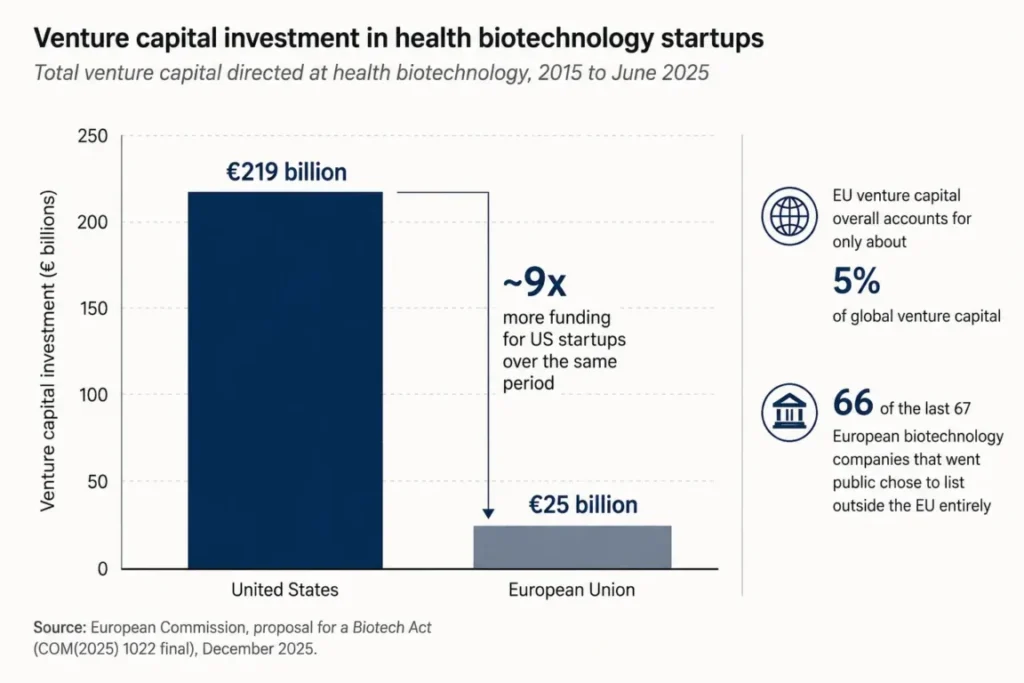
US biotech startups raised roughly 9x more late-stage funding than EU counterparts, 2015–2025.
Regulatory friction compounds the funding gap rather than sitting apart from it. The same European Commission proposal found that multinational clinical trial authorizations in the European Union currently take an average of 113 days, against roughly 60 days in the regions now competing hardest for the same biomanufacturing investment. Stakeholders consulted for the proposal ranked the length and complexity of permitting for new manufacturing facilities and the difficulty of scaling up from pilot to industrial production among the top challenges facing European biomanufacturing specifically, alongside high energy costs and high raw material costs. Each of those frictions adds time and capital that a Chinese brownfield fermentation site, already permitted, already connected to power and water, and already staffed with production workers, simply does not carry.
Beijing has made the strategic value of this position explicit in its own planning documents. China’s biomanufacturing sector has already been named one of the country’s core strategic emerging industries by the 2023 Central Economic Work Conference and again in the 2025 Government Work Report, which grouped it alongside quantum technology and next-generation wireless networks as sectors to be deliberately nurtured and scaled, according to China Briefing’s reporting. The draft 15th Five-Year Plan, covering 2026 through 2030, goes further on the food side specifically, stating explicit goals to promote the biomanufacturing industry, build key technology and raw material platforms, and strengthen research and applications in microbial proteins and functional food ingredients, according to Green Queen’s reporting on the draft text submitted to China’s legislature. The plan frames this explicitly as a food security measure, aimed at reducing China’s reliance on imports by building domestic production of proteins and ingredients through fermentation and cultivation rather than conventional agriculture alone. Annual investment in Chinese biomanufacturing has climbed to nearly RMB 30 billion, or $4.29 billion, according to China Briefing’s reporting, with regional clusters developing distinct specializations rather than duplicating one another. The Suihua-Harbin-Daqing corridor in Heilongjiang Province, built on abundant biomass resources, already generates more than RMB 60 billion in annual output from amino acids and fuel ethanol alone. Shenzhen has become the country’s synthetic biology hub specifically, accounting for roughly 30 percent of all newly established Chinese synbio firms and hosting major shared research infrastructure that individual startups could not afford to build alone. Shanghai’s Zhangjiang Pharma Valley concentrates on biologics and synthetic biology closer to the pharmaceutical end of the spectrum, while Hainan and Qingdao are building out marine biomanufacturing and microbial resource banks from a standing start. The effect of that specialization is a national system where a company can locate near the specific fermentation, feedstock, or research infrastructure its product needs, rather than every region competing to build the same generic capacity.
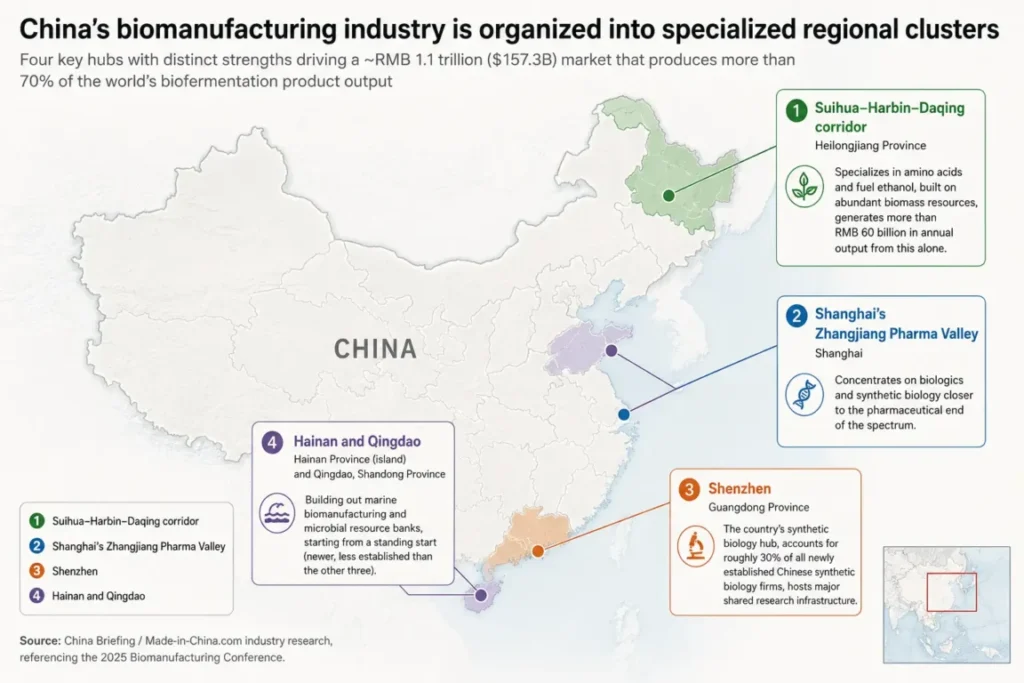
China’s biomanufacturing regions specialize rather than duplicate the same capacity.
The manufacturing advantage is increasingly paired with a rapidly closing innovation gap, not just capacity Western companies can rent. Chinese biotech licensing activity reached $137.7 billion in 2025, a tenfold increase from 2021, according to the Council on Foreign Relations analysis, as Chinese firms move up the value chain from producing raw ingredients toward developing and licensing the underlying science itself. In the first half of 2025 alone, United States pharmaceutical companies signed fourteen licensing agreements worth a potential $18.3 billion to acquire drug and vaccine candidates from Chinese biotech firms, compared with just two such deals in the same period a year earlier. That shift matters for how the fermentation advantage compounds over time. A country that only manufactures cheaply eventually faces price competition from wherever labor and energy are next cheapest. A country that manufactures cheaply and increasingly originates the science being manufactured has built something harder to compete away.
None of this means Chinese manufacturing dominance is permanent or uncontested. Global synthetic biology-driven biomanufacturing has grown at a compound annual rate of roughly 30 percent since 2015, with worldwide investment in the sector expected to reach $25 billion, spread across manufacturers in the United States, Europe, and elsewhere still competing for the same underlying demand. The Ministry of Industry and Information Technology has signaled it plans to issue a dedicated five-year plan for biomanufacturing specifically, alongside efforts to identify flagship products, expand pilot-scale testing capacity, and set formal biomanufacturing standards, suggesting the current advantage is meant to deepen rather than plateau over the coming five years.
Competing against Chinese fermentation capacity means competing against brownfield sites that do not need to be built from empty ground, backed by a policy apparatus that has now named the sector a national priority for the next five years. For an investor evaluating where the next generation of bio-based ingredients gets manufactured at commercial scale, that combination of idle capacity, patient state capital, and an already-dominant market share is not a temporary pricing advantage. It is closer to a structural one, and the gap is more likely to widen from here than to close on its own.
Listen to the full conversation with Matilda Ho on the SRI360 podcast, where she discusses Bits x Bites’ approach to investing in China’s biomanufacturing and functional ingredient opportunities.
For more interviews and insights on sustainable, responsible, and impact investing, visit the SRI360 podcast archive.