Environmental, Social, and Governance (ESG) funds recorded a net outflow of $935 million in January 2026, the fourteenth consecutive month of negative flows, according to a DragonGC analysis of Investment Company Institute data published by the Harvard Law School Forum on Corporate Governance. Major asset managers closed or repurposed roughly 100 ESG-labeled funds over the preceding twelve months. At least 21 states have enacted anti-ESG legislation since 2021, out of 52 such bills signed into law, according to research from Pleiades Strategy reported by ESG Dive. By almost any measure, the three-letter acronym itself is in retreat.
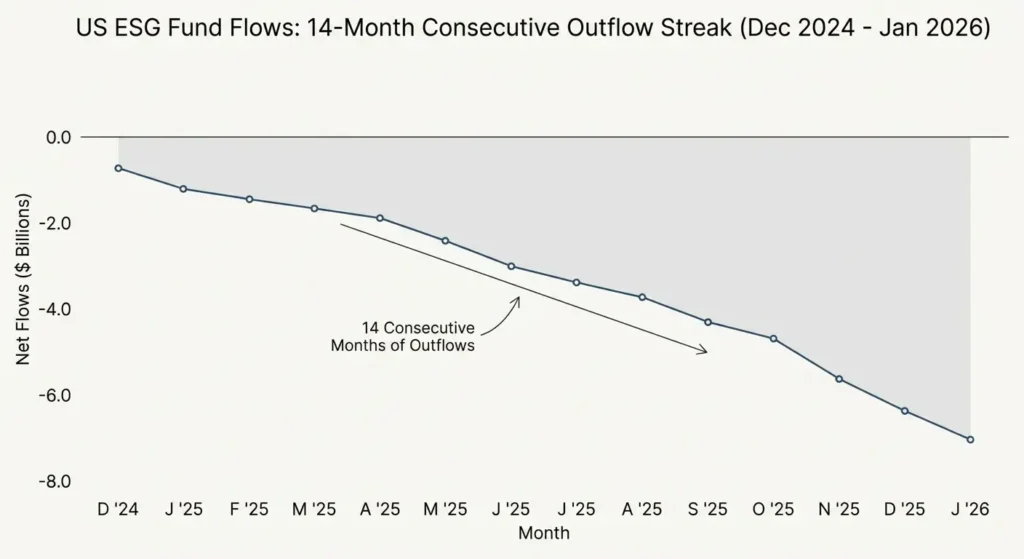
Fourteen months of consecutive outflows from ESG funds, and still counting as of January 2026.
I recently spoke with Samantha Duncan, founder and CEO of Net Purpose, a data platform used by investors managing roughly $20 trillion in assets, about what happens to sustainable investing once the ESG label stops being politically useful.
Some of what’s collapsing deserved to. Long before the current backlash, the mechanics of mainstream ESG ratings had a specific and well documented problem: they were built to measure risk to the company, not risk from the company. Bloomberg Businessweek’s 2021 investigation “The ESG Mirage” reviewed 155 rating upgrades that MSCI, the largest ESG ratings provider, awarded to S&P 500 companies between January 2020 and mid-2021, at a time when nearly 90% of the S&P 500 had ended up inside some fund built on MSCI’s ESG ratings. McDonald’s, which generated 54 million tons of greenhouse gas emissions in 2019, more than the entire country of Portugal, received an upgrade that year after MSCI determined climate change posed no material risk to the company’s bottom line. Emissions themselves barely factored into the review at all. A separate tally of the 155 upgrades, compiled by the Institute for Energy Economics and Financial Analysis, found that exactly one of them cited a reduction in carbon emissions as a factor.
The Tesla and Exxon episode the following year made the same point from the opposite direction. In May 2022, S&P Dow Jones Indices removed Tesla from its S&P 500 ESG Index over governance concerns, including discrimination allegations and its handling of a federal safety investigation, while ExxonMobil remained a constituent. An electric vehicle manufacturer scored worse than an oil major on an index meant to signal sustainability leadership. Both cases point to the same underlying design choice: mainstream ESG ratings evaluate financial materiality within a company’s own industry peer group, not a company’s absolute impact on the world, and that choice produces results that look absurd to anyone expecting the second thing.
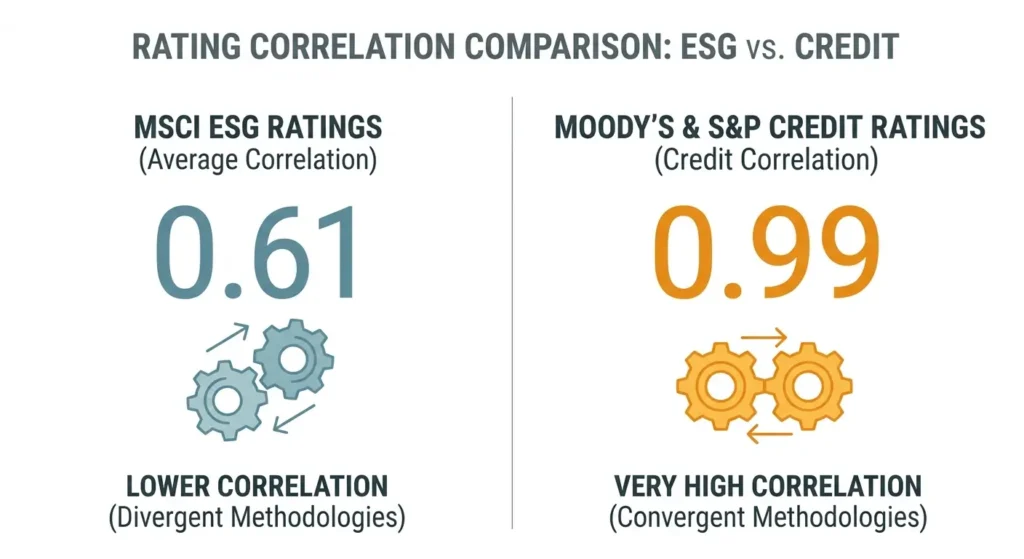
Two credit raters looking at the same bond will almost always agree. Two ESG raters looking at the same company often will not.
Academic research backs up that this isn’t a matter of one or two cherry picked examples. A widely cited study from MIT Sloan’s Sustainability Initiative, later published in the peer reviewed journal Review of Finance, compared ratings from six major ESG rating agencies and found their correlation averaged just 0.61. Credit ratings from Moody’s and Standard & Poor’s, by contrast, correlate at 0.99. Two credit raters looking at the same bond will almost always agree on its risk. Two ESG raters looking at the same company routinely don’t. That gap is the actual substance behind complaints that ESG ratings are inconsistent and opaque, and it existed well before the term became politically toxic in parts of the US market.
The political retreat, meanwhile, has moved faster and further than the ratings debate alone would predict. BlackRock’s support for environmental and social shareholder resolutions fell from more than 40% in 2021 to under 2% in 2025, according to the NYU Stern Center for Business and Human Rights. Vanguard settled a case with the Texas attorney general for $29.5 million, agreeing to withdraw from its climate commitments and to stop using divestment or opposition to company directors as leverage on environmental and social issues. Neither firm framed the retreat as a response to bad data. Both cited a mix of legal exposure, proposal quality, and political pressure specific to the current US environment.
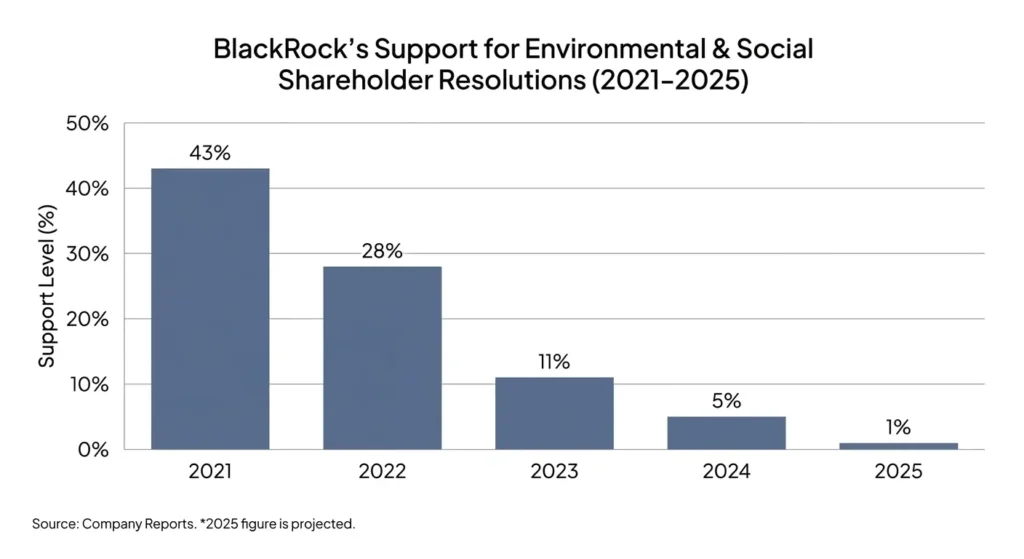
BlackRock backed over 40% of environmental and social resolutions in 2021. By 2025, that number had collapsed to under 2%.
In the conversation, Duncan framed the current moment less as a verdict on sustainability itself and more as a correction aimed at a specific measurement approach. Her argument, built around the company she founded to provide raw facts rather than aggregated scores, is that a rating meant to obscure methodology was always going to be more politically fragile than the underlying data feeding it. Emissions figures, water use, and board composition are measurable facts a company either discloses or doesn’t. A single letter grade compressing all of that into one number, using a methodology only the rating agency fully understands, is a much easier target for a political argument, from either direction, than the disclosures themselves.
That distinction matters for how far the current backlash is likely to reach. Even a figure often repeated about MSCI’s own scale illustrates the point about noisy information circulating unchecked in this space. MSCI’s market capitalization is regularly cited in the tens of billions above its actual level; as of June 2026 the company’s market cap was approximately $44.8 billion, not the $130 billion figure that still circulates in some commentary. If a basic, publicly available number like a company’s market cap gets inflated by that much in casual conversation, it’s a reasonable bet that more complex claims about what ESG ratings actually measure are traveling with similar levels of distortion attached, in both directions of the political argument.
What doesn’t retreat, regardless of what happens to the label, is the underlying demand for the data itself. Regulators in the UK and EU are still building disclosure and fund labeling regimes that require exactly the kind of granular, verifiable metrics that ratings agencies have struggled to standardize. Corporate emissions reporting, water usage figures, and board diversity statistics are still required inputs for those regimes whether or not any given jurisdiction is willing to use the term “ESG” to describe them. Companies that have publicly dropped ESG language from their proxy filings, Target among the more visibly documented examples, have in many cases continued to report the underlying metrics under different headings.
That split, between a politically contested label and a durable demand for the facts behind it, is where the current moment actually lands. The rating industry’s methodology problems were real and are well documented independent of any political motive. The political retreat from the term “ESG” in the US is also real, and it has moved faster than the underlying data problem alone would explain. Both things can be true at once, and an investor trying to navigate what comes next is better served asking whether a specific claim is backed by a specific, sourced number than by asking whether a fund still uses the label at all.
You can hear the full conversation with Samantha Duncan on the SRI360° podcast. For more conversations with investors building the infrastructure behind sustainable finance, visit SRI360°.