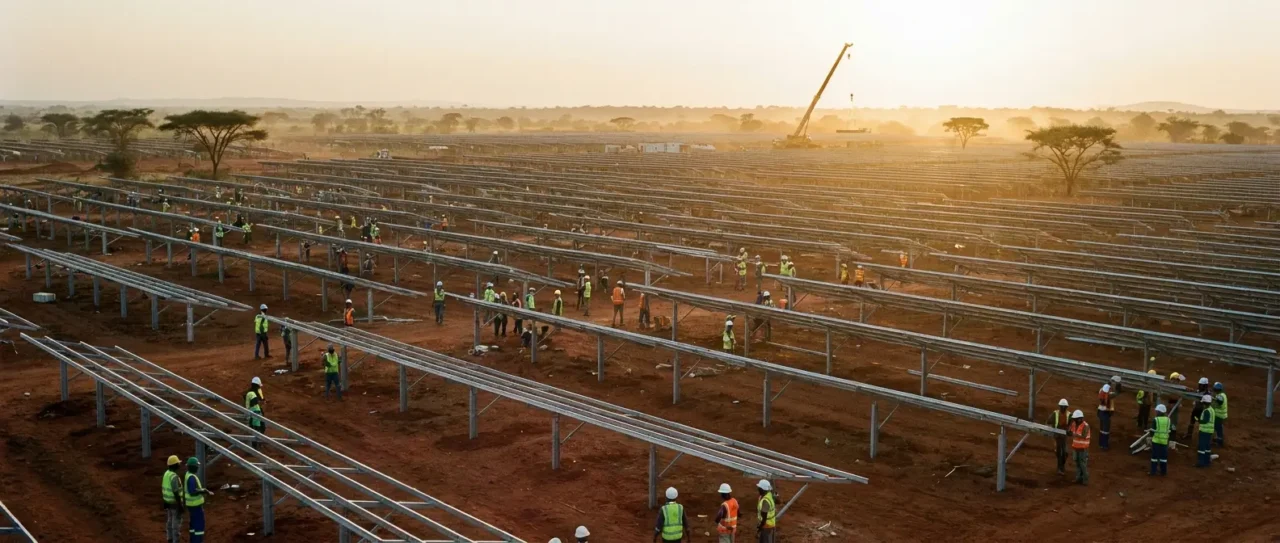
Official development assistance from the members and associates of the Development Assistance Committee fell 23.1 percent in real terms in 2025, to USD 174.3 billion. That is the largest annual contraction recorded in the history of official development assistance, according to the Organisation for Economic Co-operation and Development’s preliminary data, published in April 2026. It returns aid volumes to roughly where they stood when the 2030 Agenda for Sustainable Development began.
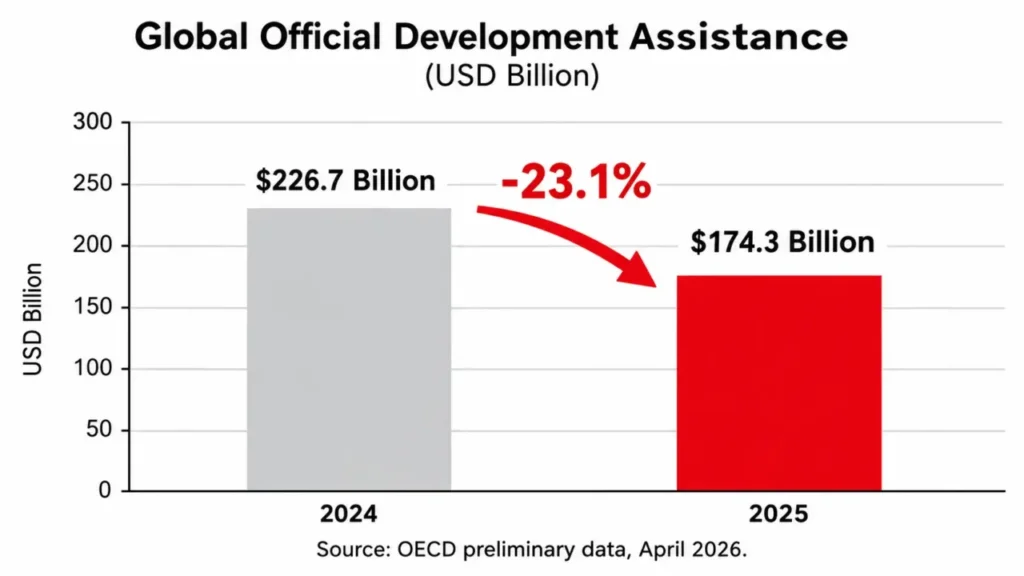
Official development assistance falling 23 percent in 2025, its largest annual decline on record.
The reflexive question in the impact investing sector has been whether private capital can fill the hole. It is the wrong question, and the arithmetic will show why within about two paragraphs.
The better question is what the public money that remains is now being asked to do, because that has changed more than the headline number suggests.
I recently spoke with Elizabeth Boggs Davidsen, chief executive of GSG Impact, the Global Steering Group for Impact Investment, who served as a Biden administration appointee at the United States International Development Finance Corporation before taking the role. She frames the shift as a reallocation of purpose rather than a shortfall. “The question is not how do we use public money well,” she said. “It’s how do we figure out how to use scarce public and catalytic capital to mobilize much larger pools of private, domestic, and institutional capital.”
The number, and what sits underneath it
The aggregate understates how concentrated and how targeted the fall was.
Twenty six of 34 members cut. But the five largest providers, France, Germany, Japan, the United Kingdom and the United States, accounted for 95.7 percent of the total decline. The United States alone drove 75.1 percent of it, its own contribution falling 56.9 percent, the largest reduction by any provider in any year on record. For the first time in the history of the data, Germany is the largest provider of official development assistance.
Underneath the total, the composition is worse than the headline.
Multilateral assistance fell 12.7 percent, and has now dropped 21.3 percent since 2023. Core contributions to the United Nations system fell 27 percent, the steepest annual decline in United Nations core funding on record, driven by an 87.2 percent cut from the United States.
Bilateral assistance to sub-Saharan Africa fell 26.3 percent to USD 24.5 billion. Assistance to least developed countries fell 25.8 percent.
The most telling line is the least quoted. Net bilateral assistance for development programmes, projects and technical co-operation, stripped of humanitarian spending, debt relief and in-donor refugee costs, fell 26.3 percent. That is the largest fall on record for that component, and it had been the resilient one, rising 24.2 percent between 2019 and 2024. The cuts went past the volatile edges of the aid budget and into the core.
Nor is this a single bad year. The OECD projects a further 5.8 percent decline in 2026, and expects assistance to remain 6.6 percent below its 2025 level as late as 2028. Those projections exclude any effect from the current crisis in the Middle East.
The United Kingdom’s trajectory is documented in more detail than most. Aid spending falls from 0.5 percent of gross national income to 0.3 percent by 2027/28, taking the budget to an estimated £9.2 billion, the lowest in cash terms since 2012 and the lowest as a share of national income since 1999. The savings fund defence spending rising to 2.6 percent of gross domestic product. Total Foreign, Commonwealth and Development Office programme value falls 31 percent against 2025/26. Bilateral aid to Africa drops from £818 million to £688 million.
The arithmetic does not work
Set the aid decline against the demand it is meant to address and the “private capital fills the gap” thesis collapses on contact.
The International Finance Corporation estimates the financing gap for formal micro, small and medium enterprises across 119 emerging market and developing economies at USD 5.7 trillion, equivalent to 19 percent of those countries’ combined gross domestic product. Add informal enterprises and potential demand rises by a further USD 2.1 trillion.
Total global impact investing assets under management, on the Global Impact Investing Network’s most recent count, are USD 1.571 trillion across 3,907 organisations. That is the entire industry, across every geography and asset class, at roughly 28 percent of one financing gap in one segment. And almost none of it is sitting idle, waiting for a mandate change.
Private impact capital is not going to substitute for aid at scale. Anyone selling that story is selling something.
What private capital can plausibly do is different in kind. It can be mobilised in larger multiples by smaller amounts of public money, if the public money is deployed as risk cover rather than as subsidy. That is a narrower claim, and it is the one the machinery is now being rebuilt around.
Public money is not shrinking so much as changing shape
Two developments make this concrete, and neither gets the attention the aid numbers do.
The first is the United Kingdom’s explicit repositioning. Its 2026 approach to international development frames the country as an “investor” rather than an aid “donor,” working through country systems and partnership rather than grant transfer. When FSD Africa Investments backed a Ghanaian pension-anchored fund in January 2026, the British High Commissioner to Ghana described it as “a clear example of putting the UK’s new Approach to Africa into action, one that moves the UK from donor to investor.” Whether that is a strategic reinvention or a rationalisation of a budget cut is a fair question. It is nonetheless the operating model now.
The second is the United States, where the picture is more complicated than a straightforward retreat. In December 2025 the Development Finance Corporation secured a six year reauthorisation through 2031 via the FY2026 National Defense Authorization Act. Its maximum contingent liability rose to USD 205 billion, an increase of more than 300 percent. It gained a USD 5 billion equity revolving fund and authority to take minority stakes up to 40 percent. Its geographic remit widened to all countries outside the wealthiest twenty, with carve outs for energy, critical minerals and rare earths, and information and communications technology including undersea cables.
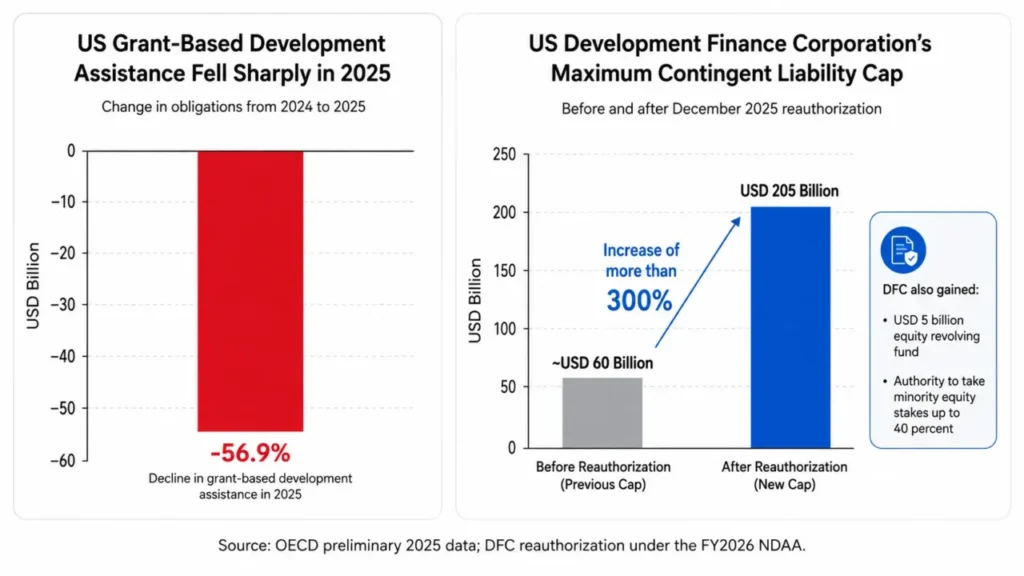
US grant aid falling by more than half while the Development Finance Corporation’s capacity more than tripled.
Read those two facts together. American grant assistance fell by more than half in a single year while American development finance capacity expanded more than threefold, with an explicit tilt toward strategic sectors and commercial return.
This is not the same institution doing less. It is a different instrument doing something else. For an impact allocator, that distinction matters more than the aid total, because it determines what kind of co-investor is available and on what terms.
Boggs Davidsen’s read on the incentive shift is consistent with it. “Public capital is more constrained and so every dollar has to just work harder,” she said, pointing to guarantees, first loss capital and a resurgence of outcome based instruments* that pay for success. “Public money is not about subsidizing transactions. It’s much more focused, I think, today on market building.”
What actually mobilises private capital
The mechanisms doing the mobilising are less glamorous than the policy debate.
Convergence’s market data points to credit ratings as the binding constraint on institutional participation, identifying investment grade ratings around the BBB threshold as the most important single driver of private investment mobilisation at scale. Pension funds and insurers cannot buy what their mandates cannot classify. The Emerging Africa and Asia Infrastructure Fund obtained an A2 issuer rating from Moody’s in 2022. Lendable secured investment grade on the senior tranche of its MSME Fintech Credit Fund II by subordinating 60 percent of the capital structure beneath it.
Securitisation is doing similar work on the supply side. The West Africa Development Bank completed a XOF 160 billion, roughly USD 270 million, multi-tranche securitisation of performing non-sovereign loans, retaining the senior and first loss tranches while placing an AA+ rated mezzanine tranche† with institutional investors, including the Africa Local Currency Bond Fund. The bank moved risk off its balance sheet, kept the assets, and deepened a domestic capital market in the process.
Boggs Davidsen’s own view on guarantees is worth recording because it is a reversal rather than an endorsement. Asked what she had been wrong about, she said she was “initially skeptical about portfolio guarantees to financial institutions” and has since seen them work repeatedly to unlock capital for underserved populations.
Her wider caution is about where the money lands. Convergence data puts local capital at under 20 percent of all blended finance flows. The mobilisation machinery works. It is still mostly mobilising the wrong passport.
The performance question, answered honestly
There is a claim circulating that impact investing outperforms, and it deserves more care than it usually gets.
The Global Impact Investing Network’s market sizing shows 21 percent compound annual growth in impact assets under management since 2019. That is a measure of how much money has arrived, not of what it earned.
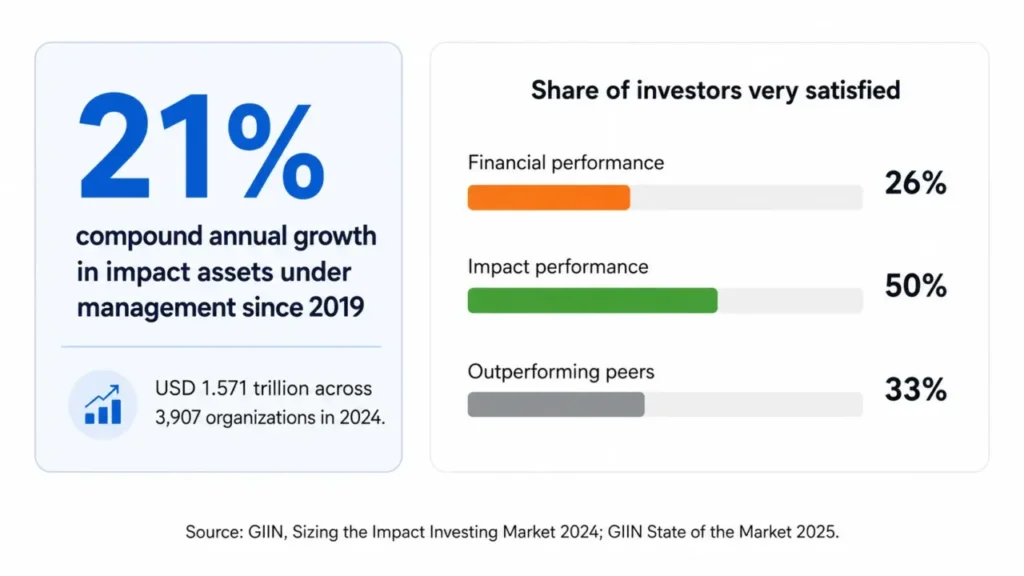
Impact assets growing 21 percent annually since 2019, even as investor satisfaction with returns stays modest.
On returns, the same organisation’s State of the Market 2025 is more sober. Just over a quarter of impact investors, 26 percent, report being very satisfied with the financial performance of their impact investments. Half are very satisfied with impact performance. Just over a third believe they are outperforming peers. Of capital raised, 70 percent was market rate and 18 percent concessional.
That is a market with real institutional participation and honest dispersion, not a market with a demonstrated return premium. Investors making the case internally are better served by the risk argument than the return argument, and Boggs Davidsen makes it in those terms. Climate exposure, workforce stability and supply chain resilience are, on her account, material factors rather than preferences. “If you ignore those factors, you’re not being financially disciplined. You’re missing material risks.”
What this asks of allocators
The useful conclusion is not that private capital replaces aid. It cannot, not at the volumes the enterprise financing gap implies.
It is that the counterparty has changed. Development finance institutions are being rebuilt around risk sharing, ratings and commercial return, with a shrinking pool of grant money increasingly concentrated in design work, first loss layers and technical assistance that no commercial investor will fund. The organisations that understood this early are the ones now anchoring locally structured vehicles.
Boggs Davidsen’s summary of what the sector still gets wrong applies directly. “What everybody gets wrong about impact is they think it’s about a transaction, a fund, a project. It’s really about building a system.”
For an allocator, that translates into a fairly concrete set of expectations for the next few years. Grant money will be harder to find and will concentrate in the unglamorous places, on fund design, trustee training and first loss layers. Development finance institutions will show up more often as risk sharing partners on commercial terms and less often as the funder of last resort. Deals will increasingly need a credit rating to reach the institutional money they are aiming at.
None of that guarantees better outcomes than the system it replaces. It does mean that an investor who spent the last decade waiting for a development finance institution to write the first cheque is now waiting for something that is being redesigned around a different question.
Notes
* Guarantees, first loss capital and outcome based instruments. A guarantee is a promise by a public body to cover a lender’s losses up to an agreed limit if a borrower defaults. No money changes hands unless something goes wrong, which is why a small guarantee budget can support a much larger volume of lending. First loss capital sits inside a fund rather than beside it: one investor, usually a donor or foundation, agrees to absorb the earliest losses so that commercial investors above them are only exposed once that layer is exhausted. Outcome based instruments invert the usual payment order. Rather than funding an activity upfront, the public payer commits to pay only if an agreed result is independently verified, so private investors carry the delivery risk and are repaid on success.
† Mezzanine tranche. When a pool of loans is packaged and sold to investors, the proceeds are split into layers, or tranches, that are repaid in a fixed order. The senior tranche is paid first and carries the least risk and the lowest return. The junior, or first loss, tranche is paid last and absorbs any losses first. The mezzanine tranche sits between them, taking more risk than senior debt and less than junior, and paying accordingly. Structuring in layers lets a single portfolio serve investors with very different risk appetites, which is what allows conservative institutions such as pension funds to buy into assets they could not hold unstructured.
Hear the full conversation with Elizabeth Boggs Davidsen on the SRI 360 podcast: https://sri360.com/podcast/elizabeth-boggs-davidsen/
For more interviews with world class sustainable and responsible investors, along with research and analysis on impact investing, visit https://sri360.com/podcast/