Capital is necessary but not sufficient. Once the blended finance structures are in place and the money is deployed, the real question is whether the businesses receiving that capital can actually reach millions of fragmented, geographically dispersed smallholder farmers in a way that changes something measurable in their lives. That is an operational problem as much as a financial one, and it requires a specific kind of business model to solve it.
I spoke with Tamer El-Raghy in March 2026, Managing Director of the Acumen Resilient Agriculture Fund, about how the most effective agribusinesses in East and West Africa are structured. What he describes is not a conventional supply chain or a standard fintech product. It is what he calls a platform business: a model that addresses multiple constraints facing the farmer simultaneously rather than solving one problem in isolation. The platform thesis is both the investment logic behind ARAF and the operational explanation for why some agribusinesses in Africa scale while most do not.
The constraints that define the opportunity
Tamer frames the investment opportunity by starting with the pain points. Smallholder farmers across Africa face the same cluster of structural problems regardless of which country they operate in. They do not have access to affordable credit, which means they cannot buy the inputs they need in sufficient quantity. They do not have reliable access to high-quality seeds and fertilizers, or the technical knowledge to use them effectively. They do not know what to grow, not just how to grow it, because growing what everyone else grows creates local oversupply and price crashes. And even when they produce a good crop, they often cannot access markets that will pay them a fair price for it.
These constraints compound each other. A farmer without credit buys fewer inputs and gets a lower yield. A lower yield means less income. Less income means no savings and no ability to absorb a climate shock. A climate shock sets the entire cycle back to zero. This is what income volatility looks like at the smallholder level, and it is the mechanism through which climate change operates on rural poverty.
The Total Addressable Market for digital agricultural services and platform models in Africa is estimated at a mid-range of EUR 2.3 billion, with high-end projections reaching EUR 5.3 billion, growing at 44% per annum. Globally, the agri-fintech market was valued at $7.3 billion in 2024, growing at a compound annual rate of 14.2%. In the first half of 2024 alone, African agri-fintech startups attracted $145 million in venture and impact investment.
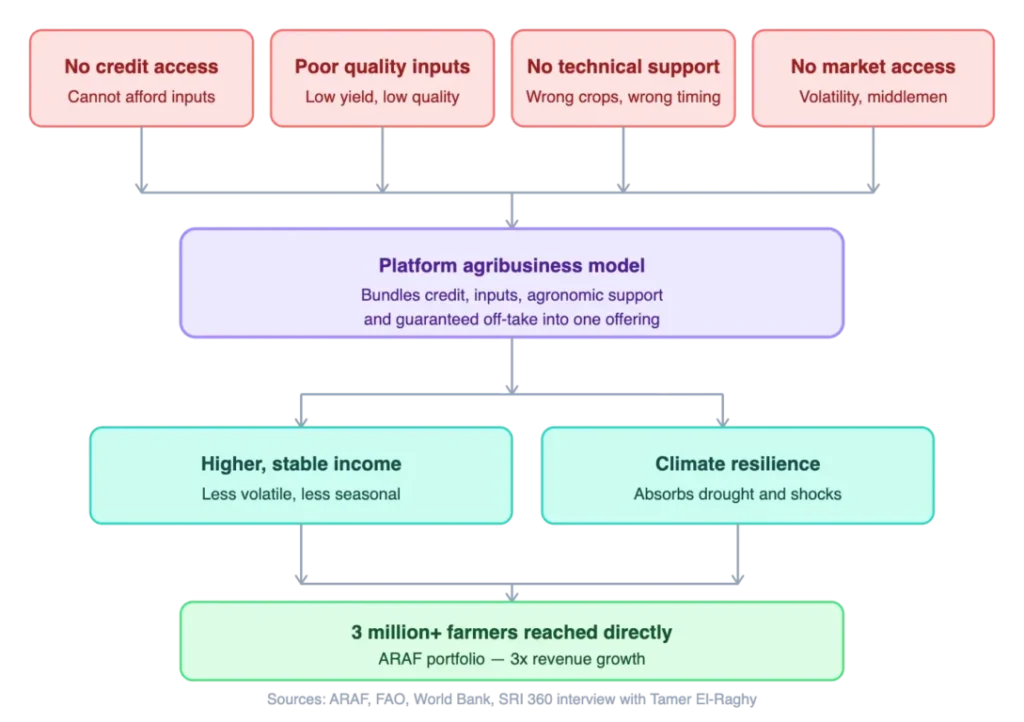
The four farmer constraints and how platform models solve them
Why single-product solutions fail
The platform insight is that solving one of these constraints in isolation does not move the needle. A company that provides credit but not technical support will see farmers borrow money and then use it inefficiently. A company that provides better seeds but no guaranteed off-take leaves farmers exposed to price volatility at harvest. A company that connects farmers to markets but provides no input financing cannot get them to the yield levels that make the supply relationship worth maintaining.
What Tamer calls a platform business addresses more than one pain point simultaneously. It might be an aggregator that provides inputs on credit, walks with farmers through the growing season with technical support, and then acts as a guaranteed buyer at harvest. Or it might be a technology company that uses solar energy to solve the irrigation problem while also providing agronomic advice through the same mobile interface that manages repayments. The bundling is not incidental. It is what makes adoption possible and what makes scale financially viable.
Tamer is also explicit about what he is not looking for in a pitch meeting. Hockey sticks do not exist in African agriculture, and any presentation that features one is a deterrent rather than an attraction. What he wants to see is a founder who understands the difficulty of the sector, listens when challenged, and has the kind of traction that suggests real farmer adoption rather than projected adoption. Farmers are extraordinarily conservative, and for good reason. If they try something new and it fails, it takes them a full season to recover. Genuine adoption data is the clearest signal that the platform has actually earned farmer trust.
Solar irrigation and the yield-doubling effect
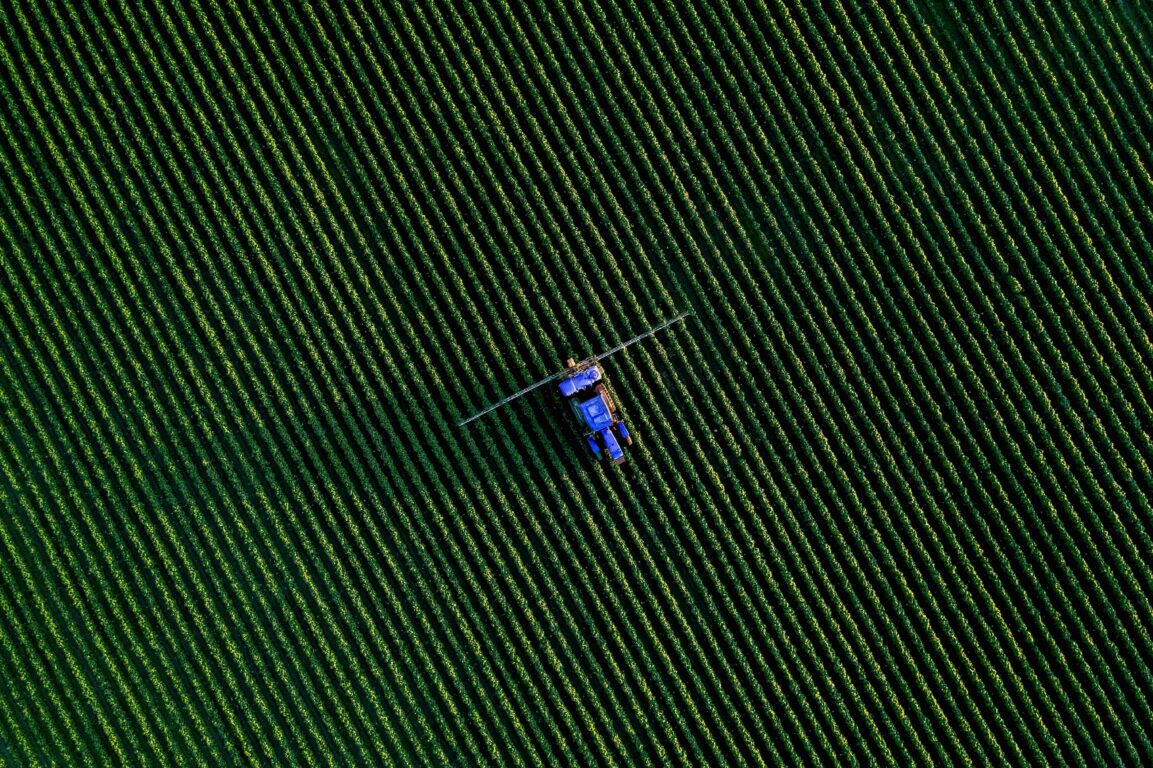
The most concrete illustration of the platform model in action is solar-powered irrigation. Less than 4% to 6% of African farmland is currently irrigated. The rest depends on rainfall, and rainfall is becoming less reliable across almost every agricultural region on the continent. Delayed rains, droughts, and erratic precipitation patterns are the primary mechanism through which climate change is destroying smallholder yields.
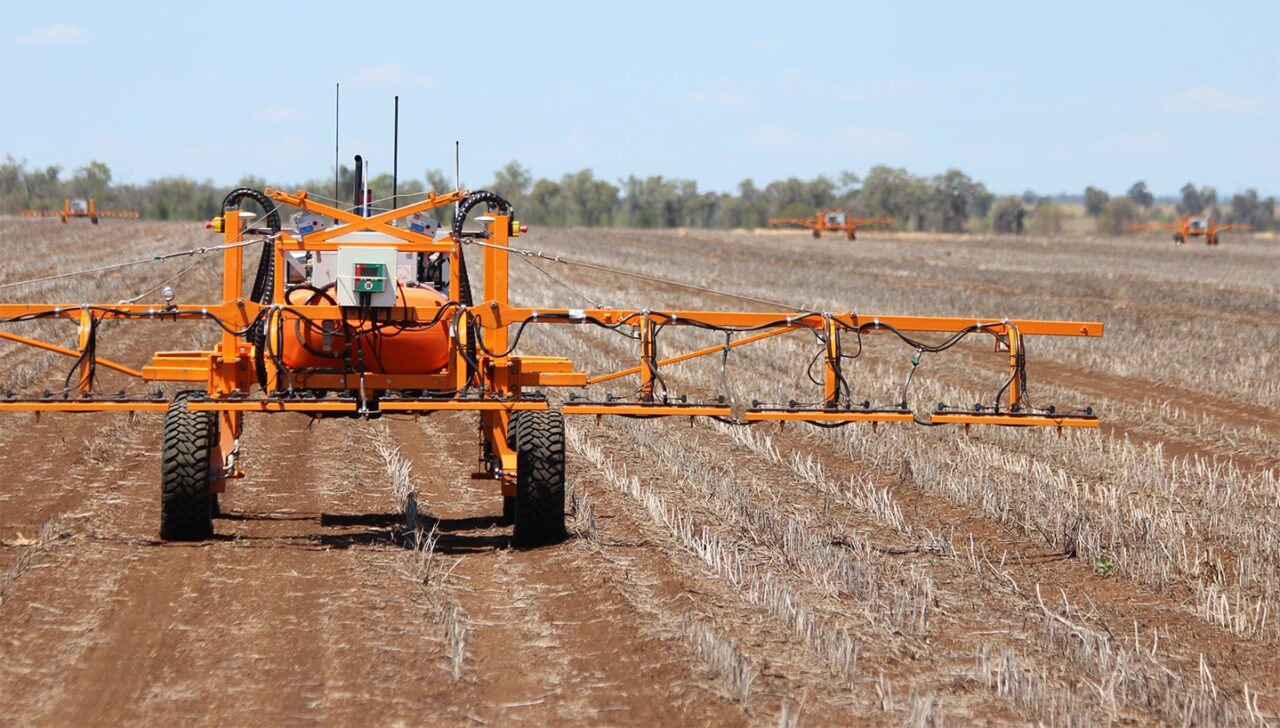
Solar-powered irrigation breaks this dependency. Agronomic research confirms that transitioning from rain-fed agriculture to active solar irrigation can more than double a smallholder’s yield, representing a 90% to 100%+ increase in crop production. Research by the International Institute for Applied Systems Analysis estimates that a $3 billion annual investment in solar irrigation could generate over $5 billion in yearly profits from increased yields across Sub-Saharan Africa.
SunCulture, a Kenya-based climate-tech company in the ARAF portfolio, is the leading example of this model in practice. SunCulture designs, finances, and installs solar water pumps, using IoT sensors and mobile money to allow farmers to pay for capital-intensive equipment in micro-installments. An impact survey of 150 SunCulture customers conducted by 60 Decibels found that 76% of farmers reported a direct increase in money earned due to the system, and 83% reported an overall improvement in their quality of life.
Tamer’s observation about the gender dimension of this impact is worth stopping on. When he asks male farmers what they value about the solar irrigation system, the first answer is almost always income. When he asks female farmers the same question, the first answer he consistently receives is that their back does not hurt anymore. Before the pump, a female farmer was the one fetching water, hauling 20-liter containers or operating a manual pump. The pump removes that physical burden first. Then comes cleaner water for the children and the livestock. Then comes the income gain. The sequence is different, and understanding it is the difference between a product designed for the average farmer and a product that actually serves female farmers as they experience their own lives.
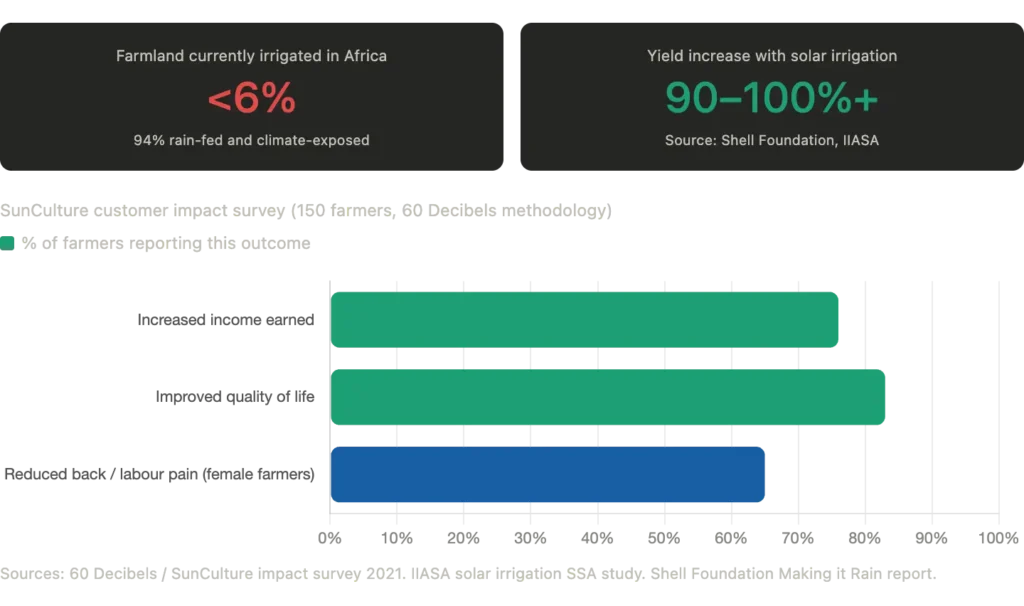
Solar irrigation impact: from rain-fed to irrigated farming
Diversifying income through backyard poultry and contract farming
Solar irrigation addresses the water constraint, but income volatility has a second dimension: seasonality. Crop farming produces income once or twice a year. Between harvests, smallholder families have no cash flow. A bad season means a year of financial damage that cannot be partially recovered through other sources.
The integration of backyard poultry production solves this directly. In many African nations, village poultry systems account for the vast majority of local chicken markets. Research indicates that for semi-commercial smallholders, poultry production can contribute up to 15.1% of total household income. Hatch Africa, an ARAF portfolio company, distributes dual-purpose chicks with genetics developed for backyard conditions: higher egg production, more meat yield, and greater resilience to weather and disease than conventional breeds. A farmer who grows maize as a primary crop and raises poultry in the backyard is not just earning more money. They are earning it in a different pattern, weekly from eggs, smoothing the income volatility that makes a bad harvest catastrophic rather than merely difficult.
Tamer describes the compounding effect clearly. Once a farmer starts from five day-old chicks and grows to 5,000 chicks, it becomes a business. The income is no longer seasonal. The risk is no longer concentrated in one crop cycle. That diversification is exactly what climate resilience looks like at the household level.
Contract farming completes the picture for farmers who grow commodity crops. A Ghanaian company in the ARAF portfolio secures demand from international buyers and then back-to-back signs contract farming agreements with smallholder farmers, providing inputs on credit, delivering technical support throughout the growing season, and acting as a guaranteed buyer at harvest. Farmers who participate can sell their crops at export quality prices rather than local spot market prices, earning significantly more for the same yield. The contract also tells the farmer what to grow and how to rotate crops, introducing soil health practices that improve long-term productivity alongside the immediate income gain. Working with over 7,000 farmers, this company has helped ARAF cross 3 million farmers reached directly across its portfolio since inception.
Weather insurance and the basis risk problem
Even with improved yields and diversified income, smallholder farmers remain exposed to the kind of climate shock that wipes out an entire season in a week. Insurance is the tool designed to address this, but traditional indemnity insurance is economically unviable at the smallholder scale because field assessments to verify crop damage are too expensive relative to the size of the premium.
Weather-Based Index Insurance addresses this by using objective external triggers, satellite-measured rainfall deficits or temperature anomalies, to automatically disburse payouts without requiring field verification. The administrative savings are substantial and the moral hazard problem largely disappears. Payments are triggered by the weather, not by a farmer’s claim about what happened on their plot.
However, as Tamer acknowledges, the measurement data for climate resilience includes one consistently troubling finding. Despite more than 80% of ARAF’s surveyed farmers reporting income increases, the farmers’ ability to absorb a climate shock has barely improved. The reason is that insurance remains inaccessible or unaffordable for most smallholders, and savings remain a luxury when income gains are immediately consumed by inflation, housing improvements, school fees, and health costs.
The structural barrier to insurance adoption is what researchers call basis risk: the gap between the weather index trigger and what actually happens on a specific farm. A weather station 30 kilometers away may register adequate rainfall while an individual farmer’s micro-climate experienced a devastating drought. Research shows basis risk can result in up to 40% of farmers experiencing crop losses not covered by payouts. That discrepancy destroys trust. Platform models address it by bundling insurance directly with seed and fertilizer loans, making it part of the overall risk management package rather than a standalone product the farmer has to evaluate independently.
Compressing the supply chain
For commodity crops, the most powerful adaptation of the platform model is direct trade: compressing or eliminating the intermediary layers that extract value between the farmer and the end consumer.
Beyond Good, an ARAF portfolio company operating in Madagascar and Uganda, illustrates this at its most ambitious. The global cocoa industry is one of the most exploitative commodity supply chains in the world. Farmers typically receive a small fraction of the final retail price of chocolate. Beyond Good bypasses brokers entirely, sourcing directly from a network of farmers, and then does something unusual: it built a chocolate manufacturing factory in Madagascar itself. Rather than exporting raw cocoa beans to be processed in Europe or North America, the company captures the manufacturing margin at origin and shares those premiums with its supply base.
Farmers in the Beyond Good network earn five to six times more than the industry average. The company also absorbs the cost of obtaining organic certification for its farmers and tracks environmental data including biodiversity metrics and agroforestry health, linking higher income directly to climate-positive land management. When you see Beyond Good chocolate at Whole Foods, you are looking at the only chocolate bar made in Africa on US retail shelves. That is supply chain compression as a business model, not as a marketing claim.
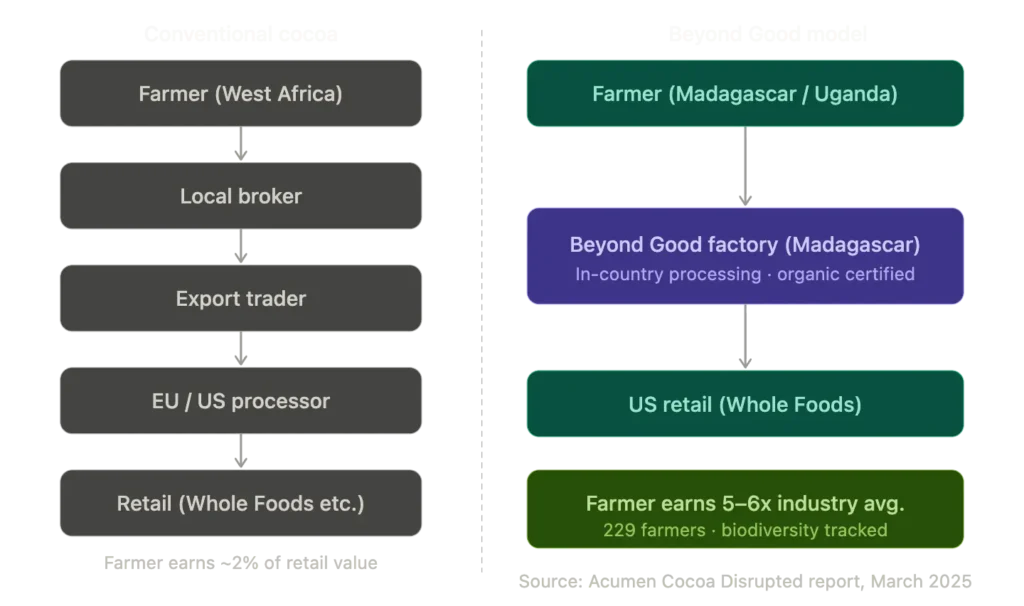
Beyond Good supply chain compression vs. conventional cocoa
Measuring what actually changes
The ultimate test of any climate adaptation investment is whether the people it is supposed to help are actually more resilient. Tamer is insistent that this cannot be self-reported by the fund manager. Any fund manager whose carry is partly based on the number of farmers impacted has an incentive to count generously. The only credible answer is independent, third-party measurement conducted in the local language with statistically meaningful samples.
ARF uses 60 Decibels, a company that spun out of Acumen’s own Lean Data methodology. 60 Decibels uses mobile technology, SMS and voice calls, to communicate directly with farmers in their own language, gathering standardized data on income, quality of life, and climate-smart practice adoption. The approach is faster and cheaper than traditional field surveys and produces data that is reliable enough to report to institutional LPs and development finance investors.
ARF has now collected over 5,000 data points from farmers across its portfolio and recently published a report sharing that data publicly rather than keeping it internal. The decision to share it openly reflects something Tamer emphasizes throughout the conversation. If the data is good, share it and let others improve on it. If the data reveals a problem, as it does with shock absorption capacity, acknowledge the problem publicly and work with a broader community of investors and donors to address it. The measurement is not a compliance exercise. It is how you learn what is and is not working, and how you build the credibility to attract the next wave of capital into a sector that still has a serious perception problem among mainstream institutional investors.
Over 3 million farmers have now been reached directly by ARAF portfolio companies since deployment began in 2020. The portfolio revenues have grown more than 3x. Every dollar ARAF invested has brought in more than $5 from other investors. These are not projections. They are the documented outcomes of a fund that was built, from the beginning, around the thesis that helping African smallholder farmers adapt to climate change is not a philanthropic activity. It is an investment.
🎙️ Listen to the full conversation with Tamer El-Raghy on the SRI 360 Podcast: Episode 127
For more interviews with leading SRI, ESG, and impact investors, explore the full archive at sri360.com/podcast.