
Africa carries a borrowing cost premium that is not explained by its actual credit history. Development finance institutions and multilateral development banks have been lending to African infrastructure projects for decades, and the track record those loans have produced is systematically better than the risk premium Africa pays in the market would suggest. The data exist. The problem is that they are not the data institutional investors routinely consult when making allocation decisions.

Renewable infrastructure delivery on site in Sub-Saharan Africa
I recently spoke with Andrew Johnstone, Co-Founder and Chief Executive Officer of Climate Fund Managers (CFM), a blended-finance investment manager with just over $3 billion in assets under management across funds spanning renewable energy, water, green hydrogen, and private credit. His career spans 15 years at Macquarie, including as Chief Executive Officer of African Infrastructure Investment Managers (AIIM), followed by a decade building CFM. The point he returns to most directly, across a conversation that covers the full architecture of blended finance, is a simple empirical one: the risk premium attached to Africa is not calibrated to the actual probability of losing money in African projects.
THE DATA THAT INSTITUTIONAL INVESTORS ARE NOT READING
The most systematic source on this question is the Global Emerging Markets Risk Database (GEMs) Consortium, a collaboration of 29-plus multilateral development banks and development finance institutions co-chaired by the European Investment Bank (EIB) and the International Finance Corporation (IFC). The consortium pools anonymized credit data from member institutions and publishes annual statistics on default and recovery rates across emerging market and developing economy lending portfolios, covering private lending from 1994 to 2024 and sovereign lending going back to 1984.
The October 2025 release of GEMs data for the 1994 to 2024 period shows an average annual default rate of 3.54 percent for private sector lending by member institutions across more than 10,000 borrowers in 169 countries. Recovery rates on defaulted loans averaged 72.9 percent annually, which is high by any international benchmark. The financial sector specifically recorded the lowest default rate among all sectors at 2.26 percent, with recovery rates averaging 79.1 percent.
Sub-Saharan Africa shows the highest regional default rate in the GEMs data at 6.05 percent, which is the figure that typically circulates in investment committee discussions. What circulates less often is the context. This figure reflects development-finance lending to some of the most difficult operating environments on the continent, without the credit screening that commercial lenders apply. It also does not account for recovery rates, which in Sub-Saharan Africa have historically been among the highest of any region covered by the database. Net loss after recovery is a different and more relevant number.
The broader point, which the GEMs data makes clearly, is that the average default rate across all development-finance lending in emerging markets and developing economies is roughly comparable to private-sector credit in advanced economies over the same period. The World Bank Group’s March 2024 release of these statistics framed the finding directly: “making this data publicly available is the latest in a concerted effort to drive more private sector investment to emerging and developing economies.” The release was intended to interrupt a pattern in which allocation decisions are made on perceived risk rather than measured risk.
WHY THE PREMIUM PERSISTS DESPITE THE EVIDENCE
Johnstone is specific about where the mispricing comes from. It is not primarily analytical error. It is institutional inertia. He has spent years in investment forums where the question “are we taking enough risk?” is never asked. The question is always the reverse. Committees are designed to prevent loss, and the framework they operate within rarely asks whether the risks they are screening out are real rather than perceived.
The second source of the premium is regulatory. Capital requirement frameworks such as Basel III and Solvency II treat asset categories in ways that do not always map to realized loss experience. An unrated loan to an infrastructure project in Nairobi and an unrated loan to a comparable project in Poland may carry different regulatory capital charges not because their underlying credit quality differs but because one falls into a category that compliance infrastructure handles routinely and the other does not. The category, rather than the credit, determines the charge.
The third factor is information asymmetry. The GEMs database was opened to public access only in recent years. Before that, the 40-year track record of development-finance lending to African infrastructure was proprietary to the institutions that generated it. Commercial fund managers, pension trustees, and insurance allocation teams were not working from that data when they set their risk parameters. They were working from sovereign credit ratings, media coverage, and the anecdotal experience of colleagues who had tried direct exposure and found the operational complexity prohibitive. That historical absence of public data has consequences that a single data release cannot immediately undo.
WHAT THE MISPRICING COSTS IN CAPITAL NOT DEPLOYED
The cost of the mispricing is not abstract. Africa requires annual infrastructure investment equivalent to approximately 7.1 percent of gross domestic product to meet its development goals, according to World Bank estimates. Current investment runs at roughly half that rate. The financing gap, across all infrastructure categories including energy, water, transport, and digital infrastructure, runs to tens of billions of dollars annually.
Climate finance compounds the gap. Developing countries need an estimated $1.3 trillion per year by 2035 to implement their national climate plans under the Paris Agreement, a figure agreed at COP29 in Baku in 2024 as part of the New Collective Quantified Goal on Climate Finance (NCQG). Total global investment requirements to meet net-zero transition targets are estimated by various reports at $5 trillion or more annually. Africa is central to both the mitigation and adaptation components of that requirement, and its infrastructure pipeline is one of the largest underfunded opportunities in global climate finance.
Johnstone puts the dynamic in straightforward terms. The fundamental issue is not that Africa is generating losses that justify the premium. The issue is that institutions have not looked closely at the data. He points out that development finance institutions, which have been pricing African infrastructure debt at rates consistent with the actual statistical record, cannot move those assets into the commercial market because commercial buyers perceive the pricing as too tight for the risk. The loans are not mispriced for the risk they carry. They are mispriced relative to the perception of risk that commercial investors bring to the conversation.
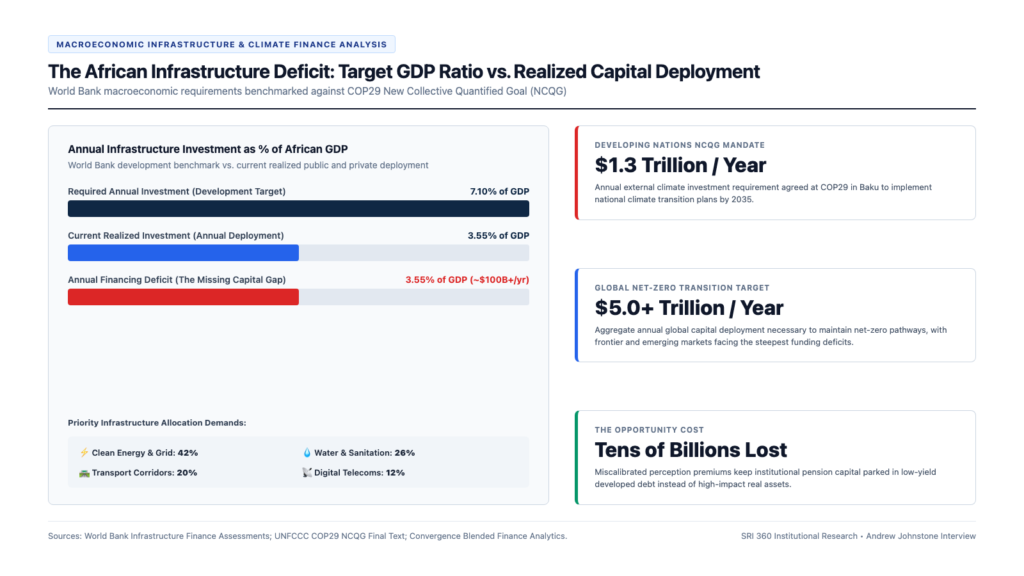
African infrastructure investment deficit vs. annual GDP requirements
That gap between statistical risk and perceived risk is where the entire blended finance apparatus has to operate. First-loss capital from development donors does not exist primarily because the underlying projects are loss-generating. It exists because commercial capital will not enter at the margin without a mechanism that reassigns the tail risk it cannot price. Whether that mechanism will eventually become unnecessary as the GEMs data becomes more embedded in commercial credit processes is the open question. The data are now public. The habits of institutional allocation take longer to move.
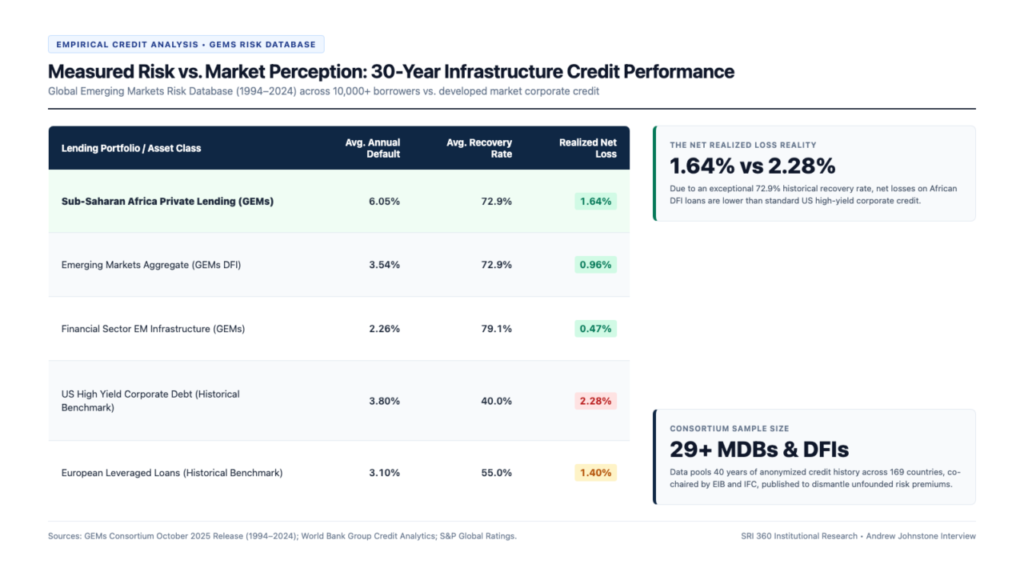
GEMs Consortium 30-year default and recovery rates vs. market benchmarks
The full conversation with Andrew Johnstone is available at https://sri360.com/podcast/andrew-johnstone/. It covers Africa’s risk premium in detail, the mechanics of blended finance construction equity, the Galapagos debt-for-nature swap, and how Johnstone thinks about the next decade of climate infrastructure deployment.
For more conversations at the intersection of institutional investing and sustainable finance, visit the SRI 360 podcast platform.