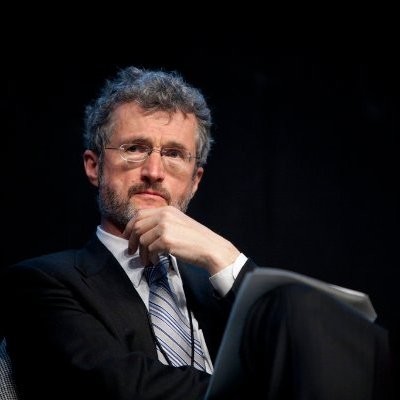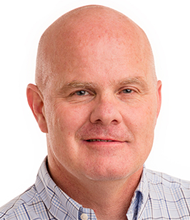
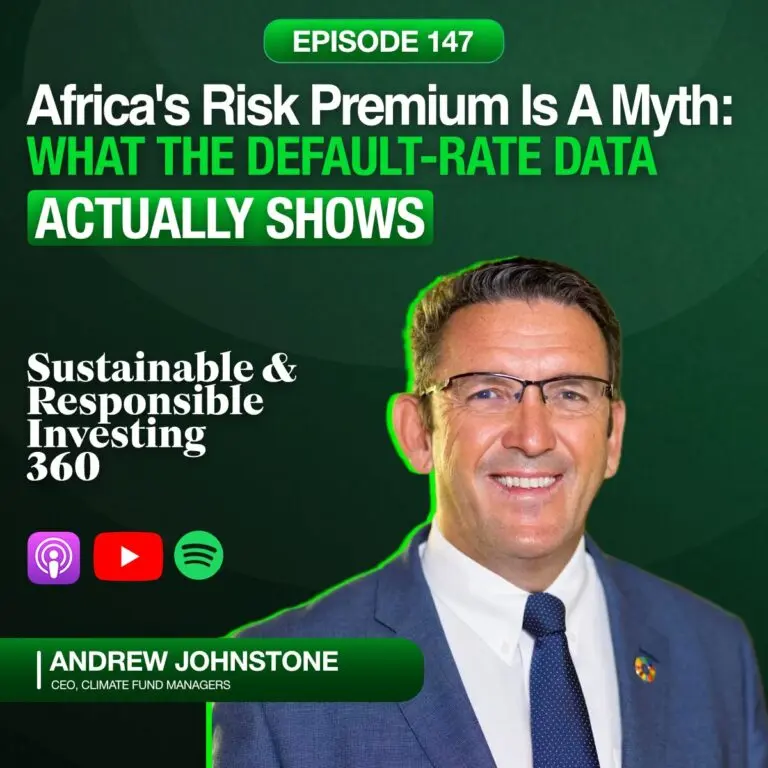
“The term bankability is a bit of a kiss of death. If a project is deemed to be unbankable by one institution, that’s it. It goes out as wildfire and is done. ”
— Andrew Johnstone
Africa carries a risk premium far greater than its actual risk. Fifty years of development-lending and World Bank data show the probability of loss on African infrastructure is on par with, or lower than, developed markets — and yet the capital keeps getting priced as if it isn’t. Andrew Johnstone has spent the last decade building a fund designed around that gap.
KEY TAKEAWAYS
- The mispricing is real and measurable. Fifty years of DFI and World Bank data on African debt performance show default probability on par with, or better than, developed markets — the premium investors demand is not supported by the loss data.
- CFM’s whole-of-life model treats a project’s life as three linked funds — development, construction, operations — with a 20% first-loss / 40% commercial / 40% senior capital stack that lets a donor grant and a pension fund sit in the same deal.
- Construction is financed with equity, not debt, for one reason: speed. Debt requires certainty the earliest stage of a project can’t offer.
- The Galápagos debt-for-nature swap shows the model in miniature: buying distressed Ecuadorian bonds, keeping only the return needed, and directing the rest to conservation — mobilising $90 million of commercial capital into a 50% expansion of the marine reserve.
- Andrew’s answer to the fee-fairness question: the blend absorbs risk, it doesn’t enhance returns — and the waterfall structure means the manager cannot earn carry while the public first-loss capital is underwater.
- CFM manages just over $3 billion against a global climate funding requirement Andrew puts at $5 trillion a year. His prescription for closing that gap is standardisation: “with standardization you get replication, and you get scale.”
THE ENGINEER WHO BECAME A FINANCIER
Andrew was born in Johannesburg to British parents who emigrated to South Africa after the Second World War; his father was a mechanical engineer on the mines. The family moved to Pietermaritzburg when Andrew was eighteen months old, and he was schooled there before following his father into engineering — civil, “just to really break the mold.” A bursary from the Natal Roads Department took him through a BSc in Civil Engineering at the University of Natal, with vacations spent surveying, setting out roads and fixing graders. National service followed — a commission as a lieutenant in the South African Air Force — then a spell backpacking before he moved to the UK, where an MBA in Engineering Management and Finance at City University London marked his pivot from building things to financing them. A year implementing toll-road concessions around Rio de Janeiro came next, then a return to South Africa in 1997, the year the country won the Rugby World Cup, to work for the construction company Group Five.
THE AIIM YEARS AND THE PROBLEM HE COULDN’T STOP SEEING
In 2000, Andrew joined Macquarie as one of two people building an infrastructure team in South Africa. In partnership with Old Mutual, the team took over management of the South African Infrastructure Fund — the first African infrastructure fund, established in 1996 — from Standard Bank. That business grew into African Infrastructure Investment Managers (AIIM), where Andrew rose to CEO while also chairing Macquarie Africa. Over roughly 15 years and seven funds, he watched infrastructure evolve from what he calls “a very boring sector” that nobody cared about into an institutional asset class. His lasting lesson: institutions matter, and partnerships have a lifespan — curating, managing and eventually unwinding them is its own discipline.
By 2015, at the peak of the platform’s success and preparing to launch an eighth fund, Andrew concluded the model wasn’t actually winning. Demand for infrastructure was outstripping delivery, and the shortfall wasn’t money, intent, or opportunity — it was method. Project finance assumes risk can be defined, parameterised and allocated at a fixed moment in time. On a toll road in Nigeria, the list of risks is never complete, the parameters never hold, and the risks keep changing. He had presided over projects that took eight years to reach financial close. He resigned, telling his wife he never wanted to be a fund manager or a CEO again. Eighteen months later, through Climate Policy Initiative’s Innovation Lab for Climate Finance — described in the episode as a “petri dish” for reworking the model from scratch — he co-founded Climate Fund Managers as a joint venture between the Dutch development bank FMO and Sanlam InfraWorks of South Africa’s Sanlam Group.
THE WHOLE-OF-LIFE MODEL, IN DETAIL
CFM’s architecture splits a project’s life into three linked funds — development, construction, and operations — each holding capital comfortable with the risk of that stage. The project itself is static; the money moves in and out of it. Construction is financed with equity rather than debt for a single reason: speed. The cost of that equity is brought down by blending capital within the fund itself: a 20% first-loss tranche, a 40% commercial tranche, and a 40% senior tranche, paid out by waterfall — senior first, then commercial, then first-loss — rather than pro rata. The project company itself never sees the tranches; it receives one cheque of 100. On Climate Investor One, the model has now developed more than 70 projects, built 16 of them, taken seven or eight to refinancing, and completed three full exits — the three-stage proof Andrew uses to argue the thesis is “proved up.”
CASE STUDY: THE GALÁPAGOS DEBT-FOR-NATURE SWAP
CFM bought Ecuadorian government bonds trading at distressed prices in the secondary market, where buyers were demanding 19% — far more than CFM’s blended structure actually required, which was 10%. The nine-point spread was split: half went to the Ecuadorian government as fiscal headroom (a reduced repayment obligation), and half was redirected into conservation funding for the Galápagos Islands, expanding the marine protected area by 50%. The result mobilised $90 million of commercial capital into an outcome whose primary beneficiary is the marine reserve itself.
GAIA: THE MOVE INTO PRIVATE CREDIT
CFM’s newest fund, GAIA, extends the model from equity into private credit, in partnership with the Japanese bank MUFG, the Canadian development finance institution FinDev Canada, and the Green Climate Fund. GAIA lends to sovereign and sub-sovereign borrowers — governments, municipalities, and eventually cities — many of which have credit too weak to borrow internationally and can only borrow locally on short terms. Where multilateral development banks typically require a sovereign counter-guarantee that governments increasingly can’t or won’t provide, GAIA is structured to lend without one, in local currency, over longer tenors — using a first-loss tranche to absorb currency and repayment-tenor risk instead.
THE HARDEST QUESTION: IS THE FEE FAIR?
The clearest tension in the conversation is direct: if these deals cannot happen without public capital sitting in first loss, in what sense are the returns commercial — and why layer a private equity fee structure on top? Andrew’s answer has two parts. First, the blend is absorbing risk, not enhancing returns — the return profile is what any conventional investment would look like, adjusted for operating in a higher-risk jurisdiction. Second, the waterfall structure means there is no scenario in which the manager earns carried interest while the public first-loss capital is losing money; the manager is repaid only after the capital ahead of it is made whole. He also notes that CFM and its shareholders are, collectively, among the largest investors in their own funds.
WHAT ANDREW GOT WRONG — AND THE VIEW FORWARD
Asked what he’d tell his younger self, Andrew doesn’t point to a bad deal — he points to a misjudgment about institutions. He went into this work assuming private markets were the volatile table and governments were “rock steady.” A decade in — through Brexit and, he notes, CFM’s fourth Dutch government since founding — he’s seen more volatility in the public sector than the private one. Looking ahead, he argues infrastructure has swung back to where it started: an economic-support asset valued for resilience and geopolitical independence rather than climate credentials alone, and he names a universal cost of carbon — still absent from the Paris Agreement’s implementation — as the single biggest unresolved lever for the whole industry.
Listen to the full conversation.
–
Listen to the episode on Apple Podcasts, Spotify, Overcast, Podcast Addict, Pocket Casts, Castbox, YouTube Music, Amazon Music, or on your favorite podcast platform. You can watch the interview on YouTube here.



What was your favorite quote or lesson from this episode? Please let me know in the comments.
SHOW NOTES:
[00:00] Intro
[03:11] When COVID hit the construction sites
[03:51] A continuity plan that stopped at one week
[07:21] What standing on site teaches a CEO
[09:18] Every assumption is wrong: risk tolerance and time
[10:38] Growing up in South Africa
[12:46] Roads department, Air Force, MBA, Brazil
[14:57] Joining Macquarie and Africa’s first infrastructure fund
[17:13] Macquarie and Old Mutual: an unlikely partnership
[19:50] Why institutions and partnerships matter
[22:17] Walking away in 2015
[25:43] The Paris Agreement and the Innovation Lab
[28:13] Frustrated project financiers, liberated blended financiers
[32:55] First loss: shock absorbers for risky territory
[35:45] CFM today: from renewables to Gaia private credit
[42:08] 135 people, four hubs, $3B AUM
[43:52] Pace, impact and profit
[45:54] The whole-of-life model: three funds, three houses
[51:41] 20/40/40: how the capital stack pays out
[56:25] Why $3B isn’t enough: turning 3 into 30
[58:28] What makes a project bankable, and what kills it
[01:01:35] Africa’s risk premium vs. the real risk
[01:04:33] Are emerging market default rates really lower?
[01:06:08] The OECD’s “cottage industry” verdict
[01:07:45] Why blended finance hasn’t standardized
[01:09:43] Adaptation and the Galapagos debt-for-nature swap
[01:13:33] Gaia: lending to cities and governments
[01:18:19] The exit problem and bridge to bond
[01:23:03] Shrinking aid budgets and the return of infrastructure
[01:25:40] The fee question: are these returns really commercial?
[01:31:18] Who takes the risk, who gets the carry?
[01:34:01] The next ten years: heat, energy, water
[01:36:03] The weapon is money
[01:36:34] The missing cost of carbon
[01:38:15] What he wishes he’d known in 2015
[01:39:20] The Thailand project that should have died sooner
[01:40:22] The investment that beat expectations
[01:41:19] Where to start a climate finance career