In January 2026, a fund of funds in Accra reached first close with more than two thirds of its capital anchored by Ghanaian pension schemes. The fund is denominated in cedis, Ghana’s national currency, rather than US dollars. It is registered in Ghana rather than offshore. Its managers spent roughly five years in rooms with pension trustees before a single cedi moved.
On the league tables of global development finance, a USD 75 million vehicle barely registers. As a test of whether the standard model for financing emerging market enterprise still works, it registers a great deal.
The standard model is familiar to anyone who has worked in development finance, though it is worth spelling out for anyone who has not, because the mechanics explain the problem.
The money starts with a small set of publicly backed institutions in a small set of wealthy countries. The International Finance Corporation, the World Bank Group’s private sector arm, committed USD 71.7 billion in its 2025 financial year. FMO, the Dutch entrepreneurial development bank, invests across more than 85 countries. British International Investment, the United Kingdom’s development finance institution, holds a £6.6 billion portfolio including 899 businesses in Africa.
A fund is then structured, and typically registered somewhere other than the country it will invest in. Around 60 percent of Africa focused funds are domiciled offshore, in jurisdictions such as Mauritius, Luxembourg and Delaware. A manager is hired, often from outside the market. The vehicle invests, reports quarterly, gets reviewed annually, and eventually exits. The capital leaves. What remains on the ground is a set of portfolio companies and, if things went well, a track record that lives on a slide deck in another hemisphere.
I recently spoke with Elizabeth Boggs Davidsen, chief executive of GSG Impact, the Global Steering Group for Impact Investment, who spent twenty years running exactly that playbook at the Inter-American Development Bank before concluding it had a structural flaw. “Good deals do not automatically create good markets,” she said. “You need local partners. You need policy alignment.”
That is a narrow sounding claim with wide consequences. It suggests the constraint on capital in emerging markets is not the supply of capital.
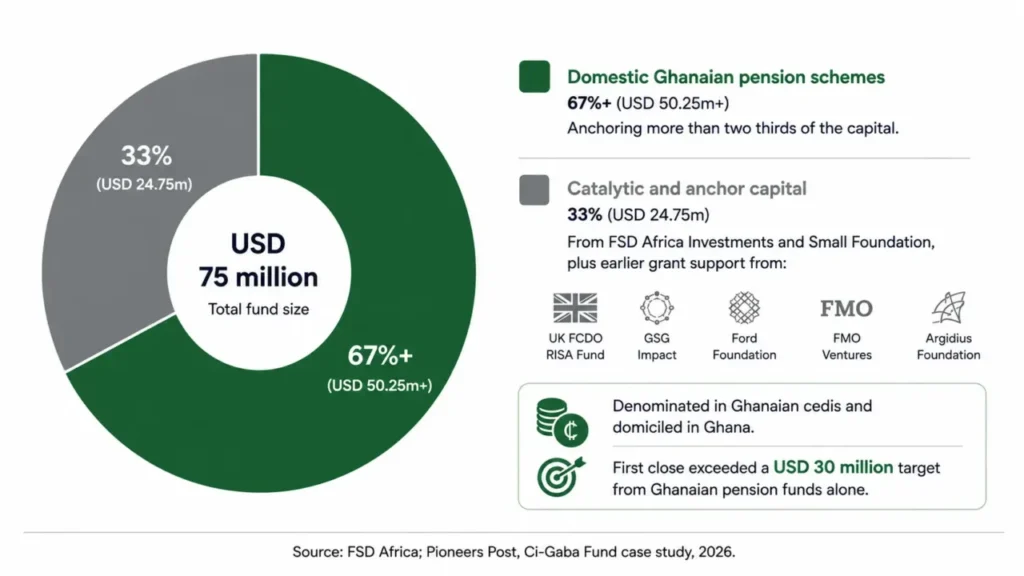
Ghanaian pension schemes supplying more than two thirds of the Ci-Gaba Fund’s capital at first close.
What the parachute model was actually built to do
The offshore structure was not a mistake. Foreign limited partners wanted legal certainty, familiar tax treatment, convertible currency and an exit route that did not depend on a local court. Mauritius and Luxembourg delivered all four. Hiring a manager with a track record legible to a Boston pension consultant made fundraising possible.
Every one of those choices optimised for the investor’s comfort rather than the market’s development. That trade was defensible when the alternative was no capital at all.
It is less defensible now, because the maths has changed. The International Finance Corporation puts the financing gap for formal micro, small and medium enterprises across 119 emerging market and developing economies at USD 5.7 trillion, or 19 percent of those countries’ combined gross domestic product.
No plausible volume of offshore capital closes a gap of that size. Global impact investing assets under management, on the Global Impact Investing Network’s count, reached USD 1.571 trillion in 2024. The entire global impact industry, across every geography and asset class, is just over a quarter of the shortfall in one segment in one set of countries.
The money is already in the country
Here is the part that reframes the problem. Across Africa, pension schemes hold more than USD 600 billion in assets. In Ghana alone the figure is around USD 7 billion. Less than 10 percent of that regional pool, according to Impact Investing Ghana, ever reaches productive sectors such as housing, infrastructure or private credit. The rest sits in government securities and listed equities.
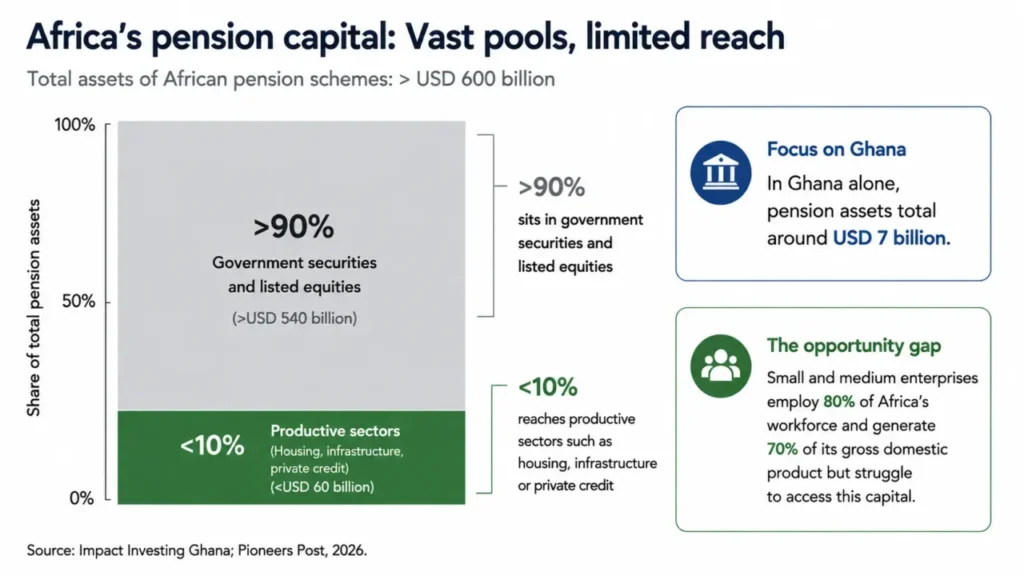
Under 10 percent of Africa’s more than 600 billion dollars in pension assets reaches productive sectors.
Meanwhile the small and medium sized enterprises that employ 80 percent of Africa’s workforce and generate 70 percent of its gross domestic product cannot raise money.
The two facts are the same fact, viewed from opposite ends.
This is not confined to Africa. Boggs Davidsen made the same observation about the emerging markets she now works across. “In many emerging markets, the long term capital already exists in pension funds, in insurance companies, in banks and sovereign funds, but it’s not always able to move into productive or certainly impact generating investment because the policy or the regulatory or the vehicle structure is not there.”
The pattern shows up in the global data too. Pension and retirement funds supplied 35 percent of impact assets under management deployed in 2024, ahead of banks at 14 percent, and their contribution grew at a compound annual rate of 47 percent between 2019 and 2025. Pensions are already the largest single source of impact capital. They are simply not the largest source of it inside the countries where the impact is meant to happen.
Why it does not move
Convergence, which maintains the largest database of blended finance transactions, puts local capital at under 20 percent of all blended finance flows. Local private investment crept from 17 percent to 19 percent between the 2019 to 2021 period and the 2022 to 2024 period. That is movement, but it is glacial.
Three constraints keep the number low, and none of them is a shortage of money.
The first is currency, and it is the constraint most often waved away by people structuring funds from outside.
A pension scheme in Accra collects contributions in cedis and will pay pensions in cedis decades from now. Its liabilities are a cedi obligation. Put its money into a dollar denominated fund and the scheme is no longer simply betting on whether the underlying companies succeed. It is also betting on the cedi to dollar exchange rate over the life of the investment. A fund can return a respectable dollar profit and still leave a Ghanaian pensioner worse off, or the reverse, entirely because of currency movement the trustees neither chose nor control.
Stack that on top of illiquidity, since the money is locked up for years, and on top of an asset class most trustees have never held. Most are uncomfortable with this concept and decline to invest.
This is why the dollar is not the easy default it looks like from London or Washington. Denominating in dollars solves a problem for the foreign investor and creates one for the domestic one. If the point is to bring local institutions in, the currency has to match the liabilities they already carry.
The second is regulation. Pension supervisors in many markets simply did not write rules contemplating alternatives. Boggs Davidsen described this as the day to day work of GSG Impact’s national partners: “How do you work with your local pension commission to ensure that they can change the rules so that local pensions can invest in alternatives such as an impact fund?”
The third is credit assessment, and it is the one most often overlooked. Institutional allocators run on ratings. Convergence identifies investment grade ratings, around the BBB threshold, as the single most important driver of private investment mobilisation at scale, yet most blended vehicles remain unrated because they are structurally complex and there is no standard methodology for rating them. The Emerging Africa and Asia Infrastructure Fund is the counterexample, having obtained an A2 issuer rating from Moody’s in 2022 on the strength of a diversified portfolio and highly rated shareholders.
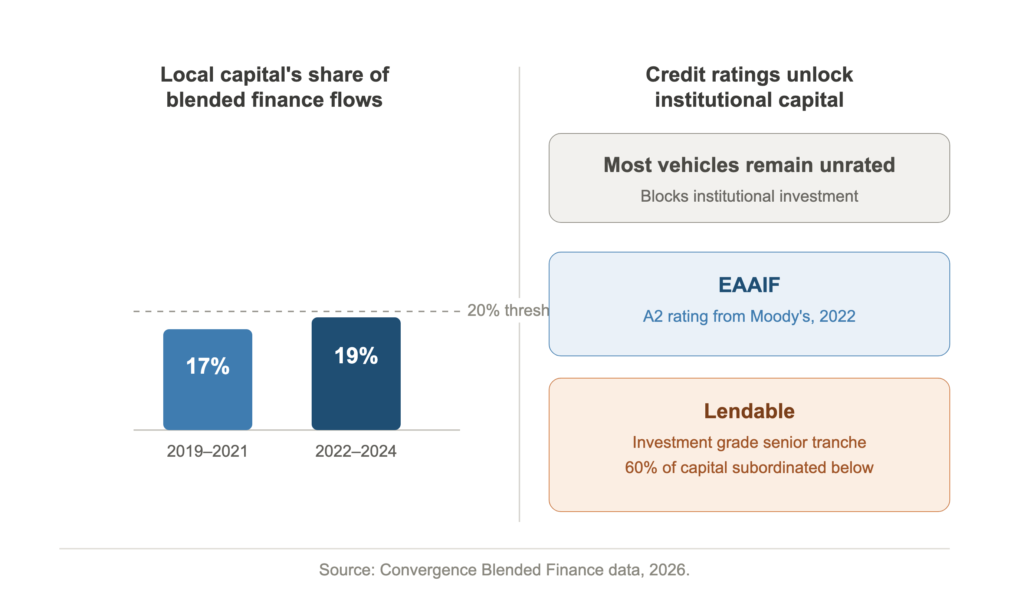
Local capital’s share of blended finance inching from 17 percent to 19 percent between 2019 and 2024.
Think of it the way a bond desk thinks about a new issuer. The credit may be perfectly sound, but without a rating there is no line in the mandate that permits the purchase. The asset is not rejected. It is invisible.
What one Ghanaian fund did differently
The Ci-Gaba Fund is sponsored by Impact Investing Ghana, which is the national advisory board for the Global Steering Group for Impact Investment, and managed by Savannah Impact Advisory. Its architects have written up their own design choices in detail, including the ones they found difficult, which makes it a useful case rather than a press release.
They set the catalytic first loss layer at 30 percent of the fund. Their stated reasoning is worth quoting because it is a real trade rather than a talking point: high enough to genuinely de-risk participation for trustees, but not so high that it distorts incentives or lets the manager get sloppy.
They denominated in cedis and registered the vehicle in Ghana. Amma Lartey, Hamdiya Ismaila and Benedict Yiyugsah describe this as one of the most decisive choices they made, and their framing is pointed. Structuring locally “signalled that this was a Ghanaian vehicle, not another dollar denominated fund parachuted in from outside.”
The case for onshore domicile is not sentimental. A study of Africa as a domicile for investment vehicles, summarised by African Business, finds that registering funds locally lowers operating costs, builds trust, and deepens domestic capital markets. It also pushes investee businesses toward formal registration, since funds require it, which widens the tax base. Most importantly for this argument, it is what allows domestic institutions to participate at all, because many pension regulators will not permit an allocation to a vehicle they cannot supervise.
They used an open ended structure rather than a closed end private equity fund, on the view that small companies need patient capital rather than a ten year clock.
The catalytic layer came from FSD Africa Investments and Small Foundation as anchors, with earlier grant support from the Foreign, Commonwealth and Development Office’s RISA Fund, GSG Impact, the Ford Foundation, FMO Ventures and the Argidius Foundation. The sequencing matters: grants first, for design, structuring and trustee training, and only later risk absorbing capital.
The first close exceeded its USD 30 million target from Ghanaian pension funds. The fund is now deploying across Ghana, Nigeria and Côte d’Ivoire.
The part nobody wants to pay for
The least fundable element of Ci-Gaba was the one its designers describe as decisive: training pension trustees.
Not generic curriculum. Experiential training built on Ghanaian case studies, embedded in national institutions, teaching trustees who had never evaluated an alternative asset how to think about illiquidity, valuation and governance. Their conclusion is blunt. Technical assistance is not an add on to blended finance vehicles, it is the infrastructure that holds them together.
This is the expenditure that dies first in any budget review. No attributable return, no clean impact metric, no obvious owner. It also appears to be the difference between a fund that closes and a fund that does not.
Boggs Davidsen puts the same point more bluntly about the sector she has spent a career inside. Development, she said, “really only works well when it’s locally directed. Full stop.”
What allocators should take from this
For an investor, the practical question is not whether localisation is a good idea. It is which markets have actually built the plumbing.
Three tests are worth applying. Do local institutional investors have regulatory permission to hold alternatives, and has that permission been tested by an actual transaction rather than asserted in a policy paper? Does the market have vehicles denominated in its own currency? Is there a local intermediary that has already navigated the supervisor, or is the sponsor learning the rules at the investor’s expense?
Ghana currently answers yes to all three, which is not a coincidence. It also has a full jurisdictional profile with the International Financial Reporting Standards (IFRS) Foundation for sustainability disclosure, alongside Kenya, Nigeria, Rwanda, Tanzania and Zambia. Markets that build one kind of financial infrastructure tend to build the others.
The honest caveat is scale. Ci-Gaba is USD 75 million against a continental enterprise financing gap of over USD 331 billion. Its own designers call it a proof of concept and warn that replication takes years, not months, because the binding constraint is local trust rather than structure. That is a slow answer to an urgent problem.
It is also the only answer on the table that does not require the capital to be flown in.
Hear the full conversation with Elizabeth Boggs Davidsen on the SRI 360 podcast: https://sri360.com/podcast/elizabeth-boggs-davidsen/
For more interviews with world class sustainable and responsible investors, along with research and analysis on impact investing, visit https://sri360.com/podcast/