
UK pension funds held about £14.2 billion in emerging market assets in 2022, roughly 0.5 percent of the sector’s total assets under management, according to research from the Overseas Development Institute (ODI). That’s a strikingly small allocation given the size of the UK pension sector and the returns available in these markets. The reason isn’t primarily about expected return. It’s about what a UK pension fund or insurer is structurally permitted to hold in the first place.
The Perception Gap: How Institutional Risk Models Overshoot 30 Years of Real Data
I recently spoke with Leslie Maasdorp, chief executive of British International Investment (BII), the UK’s development finance institution, about the mechanics behind that gap. His framing was direct: a UK insurer, he said, cannot invest in the Democratic Republic of Congo, Rwanda, or Sierra Leone. Not won’t. Can’t. The mandate doesn’t allow it, regardless of what the underlying credit might justify.
A regulatory wall, not just a cultural one
That restriction traces back to Solvency UK, the regime governing how UK insurers hold capital against their liabilities. Under its Matching Adjustment framework, assets backing long-term liabilities such as annuities generally need highly predictable, fixed cash flows, and the regime caps how much of that book can sit in sub-investment-grade assets, according to a briefing from law firm Clifford Chance on the reform. Most frontier markets, and a fair number of emerging ones, carry sub-investment-grade sovereign ratings or lack a rating altogether, which puts them outside the eligible universe before an investment committee ever reaches the underlying credit story.
Pension funds face a related but separate set of constraints. Rather than a hard regulatory ceiling, the ODI’s research points to fiduciary duty interpretations, benchmark construction, and internal risk appetite that owe more to convention and unfamiliarity with these markets than to any binding rule.

The Mandate Wall: Where UK Regulators End the Conversation Before the Credit Does
What the default data actually shows
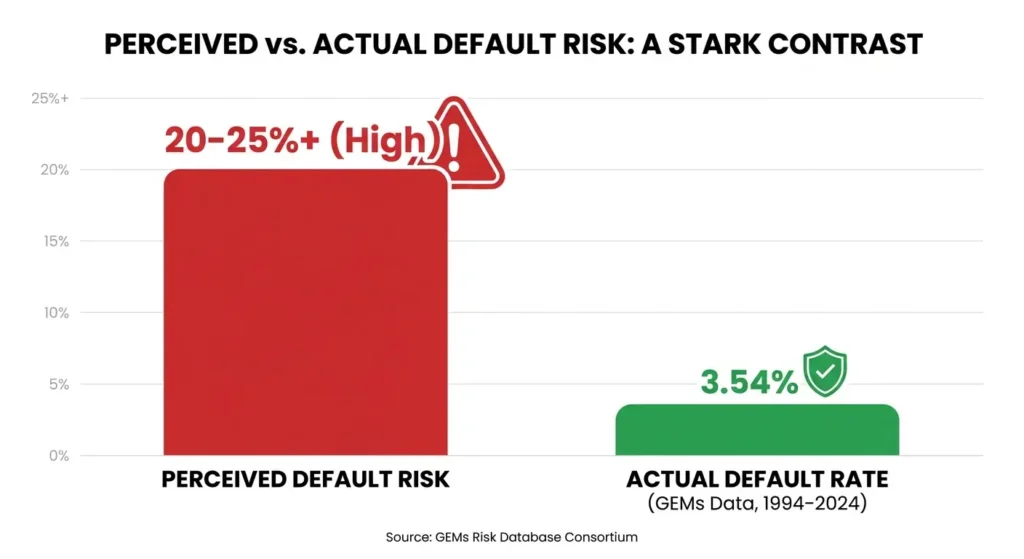
The perception behind those conventions doesn’t line up with the numbers. The Global Emerging Markets (GEMs) Risk Database Consortium, a group of multilateral development banks and development finance institutions including the World Bank Group and the European Investment Bank (EIB), pools default and recovery data from decades of private sector lending across emerging and developing markets. Its most recent dataset, covering 1994 through 2024, puts the average default rate on private sector loans at 3.54 percent, with an average recovery rate of 72.9 percent once a default does occur, according to the EIB’s report. A separate write-up of the same dataset from IDB Invest puts the finding plainly: risk in these markets tends to run lower than the conventional wisdom, and the models built on it, would suggest.
Put those two figures side by side and the picture shifts. A recovery rate above 70 percent on defaulted private loans isn’t a marginal risk profile. It sits closer to what a diversified corporate credit book might show in a developed market. Yet the barriers in front of it, Solvency UK’s cash flow rules on one side, mandate conservatism on the other, mean that data rarely reaches the table where an allocation decision actually gets made. The cost isn’t abstract. It shows up as emerging market borrowers paying a risk premium calibrated to perceived rather than actual default experience, and as UK institutional capital sitting out of returns that, on the GEMs numbers, look defensible.

Off the Map: The Frontier Markets That UK Insurers Are Structurally Forbidden to Enter
One institution’s attempt to act on the gap
BII’s own newly launched 2026-2031 strategy is a partial response to this pricing gap. Rather than waiting for the broader capital markets to reassess these risk premiums on their own timeline, the institution has ring-fenced a quarter of its committed capital, 25 percent under the new plan, specifically for frontier and least developed markets that fall outside conventional mandates entirely, according to Devex’s coverage of the launch. That doesn’t fix the pension and insurance sector’s approach broadly. It’s a demonstration, on a relatively small pool of capital, that the GEMs data can actually be acted on rather than just cited in conference presentations.
Some of the gap is starting to close at the margins through blended structures, namely first-loss tranches (capital that absorbs losses before any other investor’s money is touched) and guarantees (a pledge to cover losses up to a set amount, paid out only if a default actually happens), that absorb the part of the risk profile insurers and pension funds aren’t mandated to hold, in effect substituting for the credit rating the market hasn’t caught up to supplying. Whether that closes the gap at scale, or whether the underlying rules themselves eventually have to change, is a live argument inside the sector rather than a settled one.
For now, the data and the allocation decisions point in opposite directions. Closing that gap, rather than working around it one deal at a time, is the harder and more consequential problem.
Listen to the full conversation: Leslie Maasdorp on the SRI 360 podcast
More conversations with institutional investors on sustainable and responsible investing: Browse the SRI 360 podcast archive