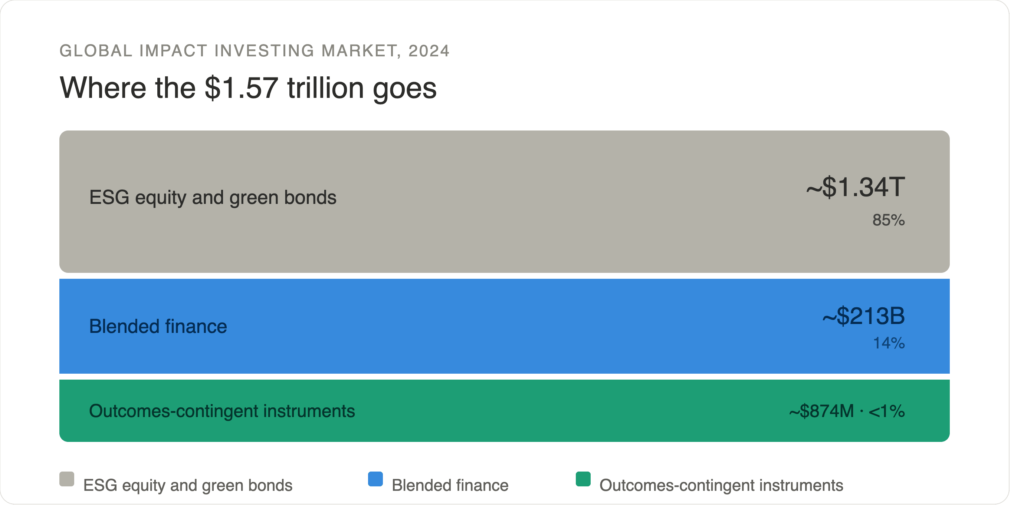
The global impact investing market reached an estimated $1.57 trillion in committed capital in 2024, according to the Global Impact Investing Network. Education, one of the largest and most underfunded sectors in development, attracted a fraction of that. The reasons have less to do with investor appetite than with structural problems in how education impact deals are currently packaged. Those problems are solvable, but solving them requires rethinking the product, not just the marketing.
I recently spoke with Amel Karboul, CEO of the Education Outcomes Fund (EOF), about where EOF currently sits at $130 million deployed across six countries, what the path to $1 billion looks like by 2030, and whether the model she has built can ever attract capital at a scale that actually moves global development indicators. The honest answer, and Karboul gives it honestly, is: not yet. But the trajectory matters, and so does the question of what “yet” actually requires.
The Capital That Isn’t There Yet
The investors currently active in education impact bonds are a small, specialist group. They include organizations like Bridges Outcomes Partnerships, the UBS Optimus Foundation, and a small number of development finance institutions willing to accept illiquid, bespoke exposure in emerging-market education programs. These are patient, mission-aligned investors who understand that the return profile looks nothing like a liquid fixed-income allocation.
Pension funds are not in this market. Sovereign wealth funds are not either, with a few exceptions. Neither are the large asset managers running ESG or impact-themed equity products, because the investment structure in education impact bonds does not fit a listed equity or bond fund format at all.
The structural reasons are straightforward. Convergence’s State of Blended Finance 2024 report identifies minimum transaction size, lack of standardization, and the absence of secondary market liquidity as the three most common reasons large institutional investors cite for not entering blended finance and social outcome markets. Each of these applies, in full, to education impact bonds.
The minimum size problem is basic. A pension fund managing $100 billion has governance costs and diligence processes that make a $10 million investment economically unviable regardless of the return. The average education impact bond in the Government Outcomes Lab’s INDIGO dataset sits well below that. EOF’s largest program to date, the Ghana Education Outcomes Project, is $30 million. Even with a strong track record and competitive returns, the deal is too small for most institutional mandates.
“The broader impact investing market has grown significantly, but the outcomes-contingent segment, where payment is tied to verified results, remains a much smaller fraction.”
Source: GIIN 2024 Sizing the Impact Investing Market report; Brookings Institution, “What Is the Size and Scope of the Impact Bonds Market?”
The standardization problem is more complex. Every EOF program is designed from scratch for a specific government, a specific target population, and a specific outcome metric. That bespoke design is part of what makes the programs effective. It is also what makes them impossible to aggregate or compare. An investor building a portfolio of 20 education impact bonds across five countries would need to underwrite 20 different legal structures, 20 different verification methodologies, and 20 different government counterparty relationships. That is not a portfolio. That is 20 separate consulting engagements.
Why Institutional Investors Have Stayed Away
The deeper issue is that education lacks the actuarial infrastructure that makes large-scale institutional investment possible in comparable sectors. In infrastructure, decades of data allow investors to model default probability, return distribution, and correlation. In microfinance, a mature secondary market and standardized loan agreements enable aggregation and securitization. In carbon markets, a common unit of account, the tonne of CO2, enables trading even with all the legitimate criticism of how those units are priced and verified.
Education has none of this. There is no standardized unit of educational outcome that translates across geographies. A literacy score improvement in Sierra Leone cannot be directly compared to a job retention rate in Tunisia. Without a common unit, there is no market.
Japan’s Government Pension Investment Fund (GPIF), the largest pension fund in the world at approximately $1.6 trillion in assets, commissioned a full report on impact investing examining how large public pension funds can engage with the asset class. The report identifies impact measurement inconsistency and illiquidity as the primary barriers to meaningful allocation. It does not rule out future engagement, but is clear that the product development work required to make impact investing institutional-grade is largely not yet done.
The GIIN’s 2024 market sizing report puts the total impact investing market at $1.57 trillion, but much of that figure includes ESG equity funds and green bonds that do not require the outcomes verification that defines the impact bond market. The outcomes-contingent segment, where payment is actually tied to verified results, is a much smaller subset. The Brookings Institution’s analysis of the impact bond market puts total capital mobilized through SIBs and DIBs globally at well under $1 billion, which shows how early-stage the truly outcomes-linked segment remains.
Blended Finance as a Bridge
The mechanism that currently brings any institutional-adjacent capital into development finance is blended finance, using concessional or philanthropic money to absorb the first-loss position and make the risk-return profile acceptable to commercial investors. The Convergence State of Blended Finance reports consistently find that blended deals in education are rare relative to climate or health, in part because outcomes are harder to quantify and time horizons are long.
EOF already operates with a blended structure in the sense that philanthropic and government “outcomes funders” sit at the top of the capital stack, committing to pay for results, while impact investors provide working capital in a subordinated position. The philanthropic layer makes the investor position lower risk. But this structure caps investor returns and limits how much can be raised from purely commercial sources.
For blended finance to bring in genuinely large institutional capital, the concessional layer needs to be large enough relative to the commercial layer to materially change the risk profile. In most education programs, the concessional funding available is not large enough to do that. The result is a market where deals that get done are those that sophisticated mission-aligned investors are willing to do at below-market terms, not deals that make commercial sense for a fiduciary investor with no particular commitment to education as a theme.
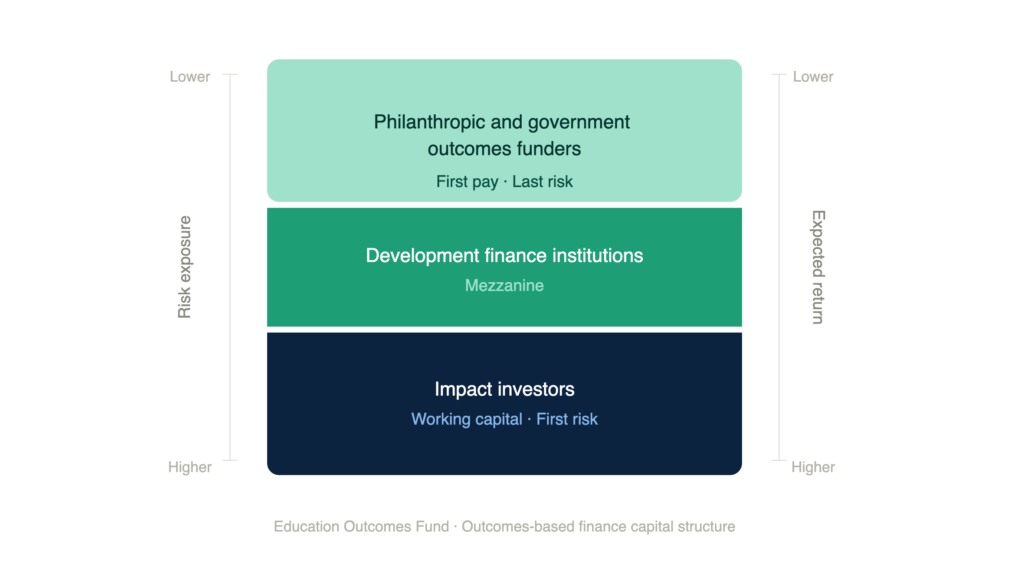
“Blended finance structures use concessional capital to absorb first-loss risk, making the investor position more commercially viable, though returns remain below market for most institutional mandates.”
Source: Based on the Education Outcomes Fund’s capital structure, as described by Amel Karboul in this interview.
The World Bank and IFC have made various efforts to develop standardized instruments for social outcomes in education, but no instrument has achieved the market adoption that green bonds achieved in the climate space. Green bonds benefit from a clearer physical unit (carbon emissions), from underlying assets (solar farms, wind projects) that are familiar to infrastructure investors, and from regulatory pressure in the form of net-zero commitments that creates demand independent of pure return. Education has none of these tailwinds at the same scale.
The Tradable Outcomes Question
Karboul is thinking about something more structurally ambitious than scaling the current model. She describes it as “tradable impact,” the idea that verified education or employment outcomes could eventually be bought and sold as a standardized unit, similar to carbon credits but for social results.
“I could see things like social credits or young people credits appearing,” she said. “We’re working with partners right now to develop what this 2.0 or 3.0 looks like.”
The analogy to carbon markets is useful but also cautionary. Carbon markets took decades to develop, went through serious credibility crises around verification and additionality, and still face significant challenges around the quality and permanence of offsets being traded. Social outcome credits would face equivalent, probably harder, challenges. The link between an intervention and a learning outcome is less direct than the link between a renewable energy installation and avoided carbon emissions. The counterfactual problem, what would have happened to this child without the intervention, is harder to establish than the emissions calculation for a wind turbine.
That said, the carbon market experience also shows that standardization and market infrastructure can be built where none previously existed, and that once they exist, capital flows in at much larger scale. The GSG Impact network has been working on the policy architecture for social outcomes markets, and several government-level experiments, including the UK’s work on social value and outcomes-based commissioning, provide early evidence of what standardized outcome pricing could look like in practice.
The verification problem is central. EOF’s model depends on RCTs conducted by independent third parties. These are rigorous but expensive and slow. For a tradable social credit market to work, verification would need to be faster and cheaper without becoming meaningless. One possibility is that AI-assisted analysis of administrative data, attendance records, assessment scores, employment records, could reduce verification costs enough to make it viable at much larger scale. EOF is already building AI-supported outcome-tracking databases for this reason.
What Would Actually Move the Needle
The structural barriers to large institutional capital are real and will take years to address. The solutions are knowable. None of them are quick.
Standardization requires a sustained effort across multilateral institutions, bilateral donors, and independent standard-setters to agree on what counts as a verified education outcome, how it is measured, and what it is worth. This is a political and technical challenge as much as a financial one. The Impact Genome Registry and similar efforts to catalog and standardize impact data across programs are relevant here but have not yet achieved the market depth needed to support trading.
Scale requires aggregation. Individual education impact bonds need to be pooled into vehicles large enough to accommodate institutional minimum ticket sizes. This probably requires a government or multilateral commitment to act as a cornerstone outcomes funder at a scale much larger than any single bilateral program. A $500 million combined commitment from FCDO, USAID equivalents, and World Bank concessional windows, structured to support a portfolio of standardized outcome contracts, would change the economics of fund formation materially.
Track record requires time. The evidence base on education impact bonds is growing but still thin by institutional standards. EOF’s Sierra Leone results, in the 70th to 90th percentile for learning outcomes in a highly constrained environment, are genuinely strong. Three years of results from one program does not give a risk committee at a large pension fund enough data to build a return distribution model. Five to ten years of results across a dozen programs in different geographies might.
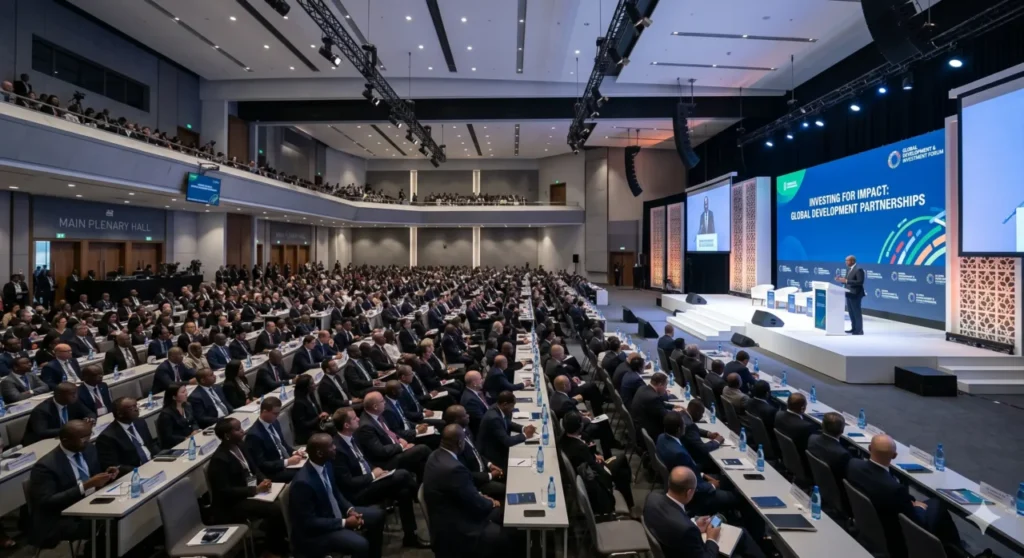
“Pension funds and sovereign wealth funds remain largely absent from education impact bonds, citing deal size, complexity, and the absence of standardized outcome metrics.”
Karboul’s $1 billion target by 2030 is ambitious given where the market sits. Getting there probably requires government outcomes funders to step up commitments materially, and it requires more programs to close with results as strong as Sierra Leone’s. It also requires EOF to do something it acknowledges it has not fully done yet: simplify the product to the point where it does not take a heroic effort to structure each transaction.
“Everything that requires a heroic effort can’t be scaled,” Karboul said. It is a frank self-assessment, and it captures the gap between where the model is and where it needs to go.
For investors in the impact space now, the practical entry point is the existing bespoke model: taking a position as an impact investor in an EOF outcomes program, accepting the illiquidity and complexity, and building experience in a market that is still constructing its infrastructure. That is a reasonable allocation for a foundation or specialist impact fund. For a pension fund or sovereign wealth fund, it is not yet realistic. But the foundational work being done now, on pricing, verification, legal templates, and evidence generation, is what will make the institutional market possible later. That distinction between what is ready now and what is being built for later matters for anyone trying to position a portfolio for where impact investing is actually heading.
Listen to the full conversation with Amel Karboul on the SRI360° podcast. For more on impact investing, blended finance, and scaling social outcomes, visit sri360.com/podcast/.