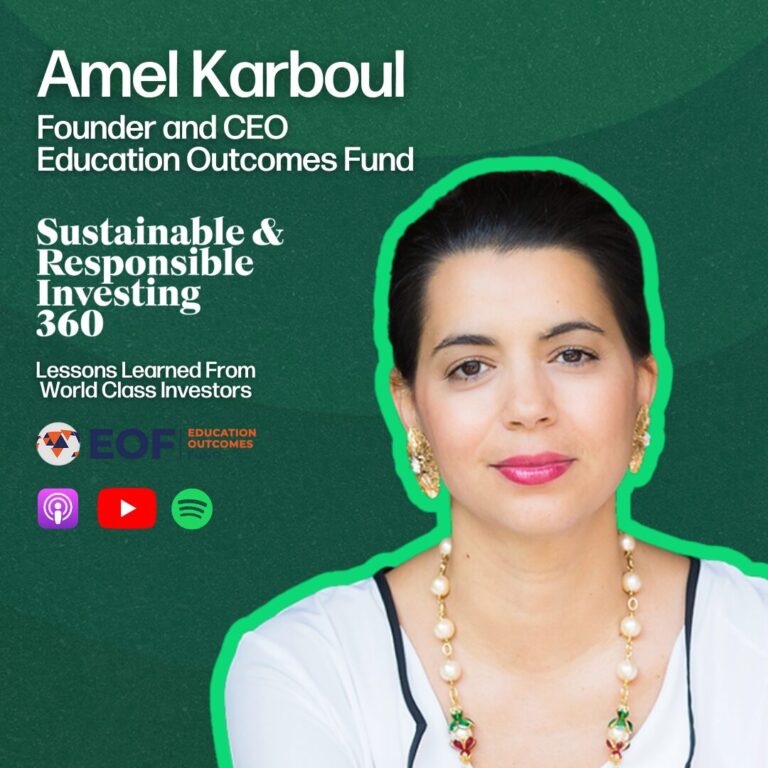
“We have to move the power and the decision making of what needs to be done much closer to the people and hold people accountable for the outcomes we wanna see without telling them what they need to do. ”
— Amel Karboul
Impact investing is entering a new phase, one defined less by intention and more by accountability.
In this episode of Sustainable & Responsible Investing 360, I’m joined by Amel Karboul to explore what it really means to tie capital to measurable outcomes, and why that shift could reshape how impact investing operates at scale.
Amel leads the Education Outcomes Fund, where she has mobilized over $130 million across multiple countries, working at the intersection of governments, philanthropies, and private investors. Her perspective is grounded in execution, navigating complex, multi-stakeholder systems to deliver tangible improvements in learning outcomes for children.
We begin with a core challenge: traditional funding models often prioritize inputs over results. Money is deployed, programs are launched, but whether meaningful impact is achieved is rarely measured. Outcomes-based financing flips that equation, aligning incentives so that funding is directly tied to results. But as Amel explains, this introduces a new layer of complexity, requiring coordination between actors with very different goals, from philanthropic donors seeking impact to investors expecting financial returns.
A central theme in the conversation is orchestration. These models don’t work without a neutral entity capable of aligning incentives, managing conflict, and sustaining partnerships over time. Without that role, even well-designed initiatives can fail.
We also explore the tensions inherent in this approach. What does it mean for investors to earn returns in low-income contexts? Does focusing on measurable outcomes risk narrowing the definition of impact? And can governments build lasting capacity, or do these models risk creating parallel systems?
At the same time, there are clear signals of progress. From programs in Sierra Leone and Ghana to expanding pipelines in Asia, outcomes-based models are beginning to demonstrate both results and adaptability.
Looking ahead, the key question is scale. Today’s structures are often complex and resource-intensive. For impact investing to reach institutional capital, these models will need to become simpler, more standardized, and potentially even tradable.
What emerges is a clear shift: the future of impact investing may depend less on how much capital is deployed, and more on how effectively it is aligned with real-world outcomes.
Listen to the full conversation.
–
Listen to the episode on Apple Podcasts, Spotify, Overcast, Podcast Addict, Pocket Casts, Castbox, YouTube Music, Amazon Music, or on your favorite podcast platform. You can watch the interview on YouTube here.



What was your favorite quote or lesson from this episode? Please let me know in the comments.
SHOW NOTES:
[44:06] From Cost Per Beneficiary to Cost Per Outcome
[54:24] Building Government Capacity to Buy Outcomes
[01:02:56] Impact Investors as Active Performance Partners
[01:06:31] Orchestration as Critical Impact Infrastructure
[01:28:01] Using Incentives to Drive Equity Outcomes
Additional Resources:
MORE QUOTES FROM THE INTERVIEWS:
“We need to make sure every dollar spent achieves results, we need to do this in true partnerships with governments, and we need to leverage more capital from the market. Governments alone can’t solve this; we need the private sector, civil society, and the third sector all working together. ”
— Amel Karboul
“It cost me literally leaving a company, my livelihood, my family, and just taking a plane and going to serve. I could have sold my company for multiple million dollars, but I decided not to because I wanted to do something that has a stronger social impact. ”
— Amel Karboul