There is a number that appears regularly in sustainable finance discussions and rarely receives the attention it deserves. The annual financing gap for achieving the United Nations Sustainable Development Goals (17 global targets covering poverty, climate, health, education, and more) in developing and emerging countries has grown from the $2.5 trillion figure first cited in 2017 to somewhere between $4 trillion and $4.3 trillion today, with projections suggesting it could reach $6.4 trillion annually by 2030 if the international financial system does not undergo systemic reform.
That is not a rounding error. It is a structural failure of capital allocation on a civilizational scale.
For years, the dominant narrative in impact investing pointed to private equity and venture capital as the vehicles of change. The logic seemed intuitive: private markets can move fast, absorb illiquidity premiums, and take the concentrated bets required to fund early-stage environmental and social innovation. What that narrative overlooked was the sheer arithmetic of the problem. Private markets, however creative and committed, cannot absorb a multi-trillion dollar annual shortfall. They are structurally too small, too illiquid, and too concentrated in developed markets to do the job alone.
The answer, to a growing number of institutional investors and impact practitioners, lies in a market that most people never associate with impact investing at all: the global bond market.

Shanghai’s Pudong financial district reflected in the Huangpu River at twilight.
The Financing Gap That Private Markets Cannot Fill
I recently spoke with Matt Lawton, Head of Impact Fixed Income at T. Rowe Price, about his journey building one of the world’s first dedicated impact fixed income platforms inside a major active asset manager. His framing of the SDG financing problem was direct: “You don’t close that funding gap exclusively through privates. You need all markets participating in mobilizing capital towards those solutions.”
That view is backed by data that is hard to argue with. According to the UNCTAD Financing for Sustainable Development Report 2024, total available funding for SDGs grew by only 22 percent between 2015 and 2022 while estimated financing needs surged by 36 percent in the same period, largely because climate change is creating additional costs that were not fully anticipated when the goals were first set. Official Development Assistance from DAC (Development Assistance Committee) member countries, the group of major donor nations coordinated by the OECD, actually fell by 7.3 percent in 2024, representing just 0.3 percent of donor country gross national income against an internationally agreed target of 0.7 percent.
Meanwhile, debt sustainability in the Global South has deteriorated sharply. Public external debt service, meaning the interest and principal payments that governments owe to foreign creditors, including other governments, multilateral institutions, and private international lenders, rose to 8.4 percent of government revenue in 2024, up from 7 percent the year before. The SDGs require investment across education, health, clean water, and infrastructure, and while both governments and the private sector play a role in funding those investments, public budgets carry a significant share of the burden in lower-income countries. When an increasing portion of government revenue is consumed by debt repayments, it crowds out the fiscal space needed to fund those priorities. In low-income countries, debt service payments consumed a record 24.2 percent of export earnings in 2024.
The math points toward one conclusion: closing the SDG financing gap requires the private sector, which manages over $450 trillion in global wealth, to redirect capital at a scale that only the world’s largest securities markets can provide.
The Case for the World’s Largest Securities Market
The global fixed income market is, by a meaningful margin, the largest pool of investable capital on the planet. As of 2024, global fixed income outstanding is estimated at approximately $145.1 trillion, compared to a global equity market capitalization of roughly $126.7 trillion. In the United States alone, fixed income securities outstanding total between $55 trillion and $60 trillion.
This scale matters in a way that no other asset class can replicate. When you need to mobilize capital measured in trillions of dollars annually, you need a market that can absorb that demand without distorting pricing or concentrating risk in ways that threaten financial stability.
But scale is only one part of the argument. The structural characteristics of fixed income make it particularly well suited to impact deployment in ways that equity markets are not.
First, bonds are often issued to finance specific projects. The “use of proceeds” structure, which sits at the heart of green bonds, social bonds, and blue bonds (debt instruments that ring-fence proceeds for environmental or social projects, with blue bonds specifically targeting ocean health, clean water, and marine conservation), creates a direct, auditable link between investor capital and real-world outcomes. When a utility issues a green bond to fund a solar farm, the proceeds go to that project and no other. Contrast this with buying shares of the same utility in the secondary market, where no new capital flows to the company at all.
Second, the long duration of many fixed income instruments aligns naturally with the multi-decade investment horizons of the infrastructure projects the SDGs require. Building clean water infrastructure, coastal flood defenses, and renewable energy capacity are not three-year projects. They require patient, long-term capital, which is precisely what institutional bond investors provide.
Third, and critically for the institutional investors who must actually move the money, fixed income serves an irreplaceable role in asset-liability matching. Pension funds and insurance companies manage long-term obligations to beneficiaries, and they structure their portfolios to match the duration of those liabilities. For a pension fund with obligations stretching out thirty years, equities and private market alternatives serve one function; bonds serve another. US retirement assets alone reached $49.6 trillion in 2024. Even a modest shift in allocation within this pool toward impact-oriented fixed income would represent hundreds of billions of dollars in new capital deployment.
As Lawton put it when describing his rationale for building T. Rowe Price’s impact fixed income capability: “The global bond market, as the world’s largest securities market, I can think of no better market that’s well placed to facilitate capital flow from asset owners and investors to issuers and projects that are helping to address said pressure points.”
How Impact Actually Works Inside a Bond
For investors who have spent their careers associating impact with private equity or venture capital, the mechanics of impact in public bonds can feel counterintuitive. The most common objection is straightforward: if I buy a bond in the secondary market, no money goes to the issuer, so how does that generate impact?
It is a fair challenge, and Lawton does not dodge it. His answer is worth understanding carefully, because it clarifies both what public market impact can and cannot claim.
“I’m not sure there is impact to be generated from buying and selling bonds in the secondary,” he said, with a candor that is unusual in the impact investing world. “I think you can maybe make a link or an argument that you’re maybe reducing the cost of capital for the issuer. I think that link is a little tenuous.”
Instead, Lawton grounds his firm’s approach to impact on two more defensible mechanisms. The first is primary capital provision: participating at new issuance, where investor capital flows directly to the issuer to fund specific projects. T. Rowe Price aims to keep roughly 60 percent of its impact portfolios in primary issuances. The second is stewardship: engaging with issuers before, during, and after bond transactions to influence how proceeds are allocated, how outcomes are measured, and how standards improve over time.
This is not a passive strategy. Lawton described working with DP World, one of the world’s largest port and logistics companies, to originate a $500 million blue bond that financed sustainable shipping retrofits, marine pollution prevention, and coral reef restoration. The engagement started before the bond was structured, with T. Rowe Price providing guidance on eligible project categories and measurement standards. The firm became an anchor investor when the bond came to market in December 2024. Without that origination work and anchor commitment, it is hard to argue the bond would have been structured or sized the way it was.
That is additionality. It is not the counterfactual purity that philosophers might demand, but it is a credible, auditable chain of events connecting investor action to real-world outcome.
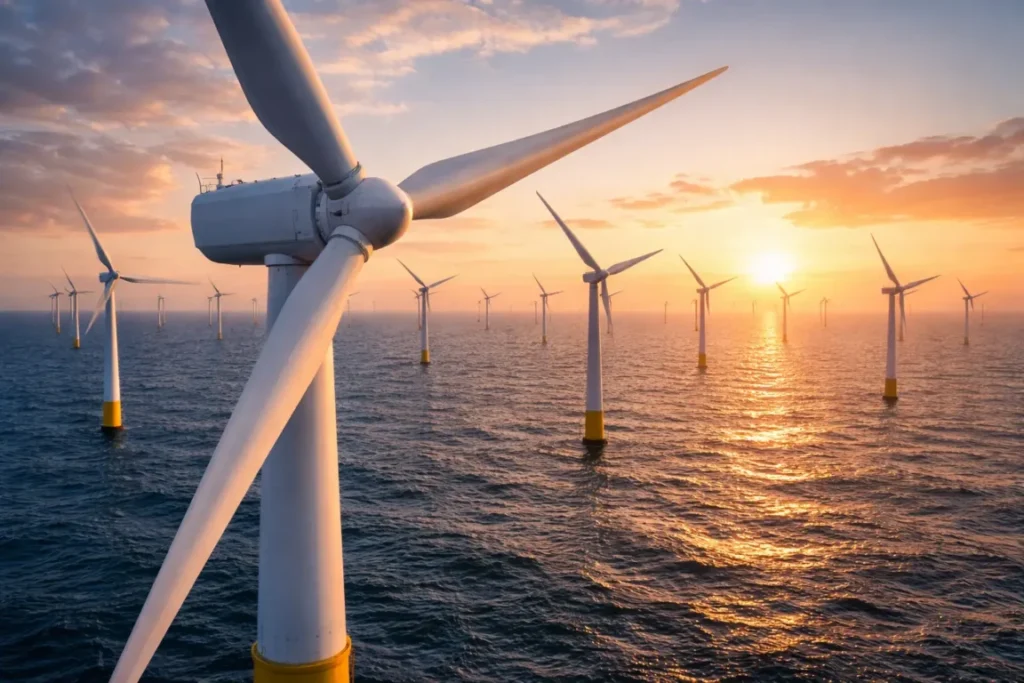
An offshore wind farm stretches to the horizon at sunset.
The Labeled Bond Market Is Maturing Fast
The market infrastructure for impact fixed income has developed rapidly over the past decade. The green, social, sustainability, sustainability-linked, and transition (GSSS+) bond market reached record annual issuance of over $1.05 trillion in 2024, representing growth of approximately 5 to 11 percent over 2023 levels. By end of 2024, cumulative labeled sustainable bond issuance stood between $6.2 trillion and $6.9 trillion.
Green bonds continue to dominate, accounting for roughly 57 to 64 percent of annual labeled issuance in 2024. Sustainability bonds, which combine green and social project allocation in a single instrument, grew by 89 percent in 2024 to a record $206 billion, reflecting increasing issuer appetite for flexible, multi-objective frameworks.
The International Capital Markets Association (ICMA) maintains the Green Bond Principles, Social Bond Principles, and related frameworks that define eligible project categories and disclosure standards for the labeled bond market. These voluntary standards have become the de facto global reference for issuers and investors, and ICMA’s Illustrative KPI Registry, updated in June 2024, now includes over 300 indicators to help design more credible instruments across sectors.
One notable countertrend within this growth story is the sharp decline of sustainability-linked bonds. This format, which ties coupon rates to issuer-level sustainability performance targets rather than specific project use of proceeds, saw issuance fall more than 57 percent from 2022 levels to its lowest volume since 2020. The contraction reflects mounting investor skepticism about weak penalty structures, poorly defined KPIs, and instances where targets were largely achieved before the bond was even issued. The market is, in effect, voting for substance over structure.
Why Pension Funds and Insurers Need Fixed Income Impact
The structural argument for impact fixed income ultimately comes back to who holds the most capital and how they are constrained in deploying it.
Pension funds and insurance companies are the largest institutional investors in the world. Their fiduciary mandates require them to match long-duration liabilities with long-duration assets. They cannot simply shift to private equity impact funds without creating duration mismatches that regulators and beneficiaries would not tolerate. Fixed income is not optional for these investors. It is a structural requirement.
This creates both an opportunity and a responsibility. If impact objectives can be embedded within the fixed income allocations that pension funds already hold, the capital mobilization potential is extraordinary. Global pension assets reached a record high in 2024, and even a one-percentage-point increase in the share of pension fixed income directed toward labeled or impact-oriented bonds would represent tens of billions of dollars in new annual deployment.
Lawton’s story captures the personal dimension of this systemic argument. He described arriving at his decision to give up a $12 to $15 billion book of conventional investment grade credit to build T. Rowe Price’s impact fixed income capability through three realizations: there is a genuine and large need as evidenced by the SDG financing gap; the global bond market is the best-positioned market to meet that need at scale; and, as he put it, “I just believe capital can do more than just create alpha.”
That belief is increasingly shared by the clients who are allocating to impact fixed income strategies, including European pension funds, UK retail platforms, and development finance institutions like IFC. The question is no longer whether public fixed income belongs in the impact investing conversation. The question is how fast the infrastructure, standards, and investor confidence can develop to channel the necessary scale of capital. At $145 trillion and counting, the market is ready. The $4 trillion annual gap is waiting.
To hear more, listen to the complete interview with Matt Lawton on the SRI 360 Podcast.
This article is based on a discussion from the SRI 360 Podcast. For more perspectives on sustainable and responsible investing, visit sri360.com/podcast/.