Somewhere in northern Ghana, a school has three toilet blocks and no doors on the classrooms. The third toilet block was built by an NGO whose funding was restricted to sanitation infrastructure, even though the headmistress told them she already had two and needed furniture. She took the money anyway. She took the third toilet block.
I recently spoke with Amel Karboul, founder and CEO of the Education Outcomes Fund (EOF), and that story captures, more cleanly than any data table, what is broken about how the world pays for education. The funding is not the problem. The accountability for what it produces is.
EOF is trying to fix the accountability side. It has mobilized over $130 million across six countries, Ghana, Sierra Leone, Rwanda, South Africa, Tunisia, and Nigeria, using an outcomes-based financing model that shifts financial risk from taxpayers and donors onto private impact investors, who are repaid only when independently verified results are achieved. It is not a new concept. But at the scale and complexity EOF is operating, it is still genuinely rare.
The $97 Billion Gap That Traditional Aid Cannot Close
The numbers on global education spending are large enough to obscure how little of it goes where it matters most. Global education expenditure reached approximately $5.8 trillion in 2022, according to the World Bank and UNESCO’s Education Finance Watch 2024. High-income countries account for 64% of that. Low-income countries, where the learning deficit is most severe, receive 0.45%.
In low-income nations, Official Development Assistance (ODA) covers only around 12% of education budgets. Meeting Sustainable Development Goal 4 (SDG 4) targets by 2030 requires closing a financing gap of $97 billion and $100 billion annually, and domestic governments are in no position to absorb that gap on their own. Their debt service obligations already average 72% of GDP, according to UNESCO, which leaves little room to redirect public spending toward education even where the political will exists.
The less-discussed problem is not the volume of funding but its effectiveness. A meta-analysis by Patrick McEwan, cited by the World Bank, found that only around 10% of evaluated education interventions track impact more than a month after completion. The World Bank’s own Global Education Evidence Advisory Panel has found that a significant portion of reviewed education programs showed no measurable impact on learning outcomes at all.
Karboul puts it in blunter terms. She describes a job training program in an unnamed country where 100,000 young people went through a subsidized employment scheme costing hundreds of millions of dollars. When they checked how many participants were still employed one year after the subsidy ended, the answer was 15%. “Your price per outcome is those hundreds of millions divided by the 15%, not by the hundred thousand,” she told me. “When you make that calculation, you could have sent each one of them to Harvard.”
From Inputs to Impact: What Outcomes Financing Actually Does
Outcomes-based financing (OBF) covers a spectrum of mechanisms, from relatively simple results-based grants to complex multi-party structures like Social Impact Bonds (SIBs) and Development Impact Bonds (DIBs). The core logic across all of them is the same: payment is conditional on verified results rather than on the delivery of activities.
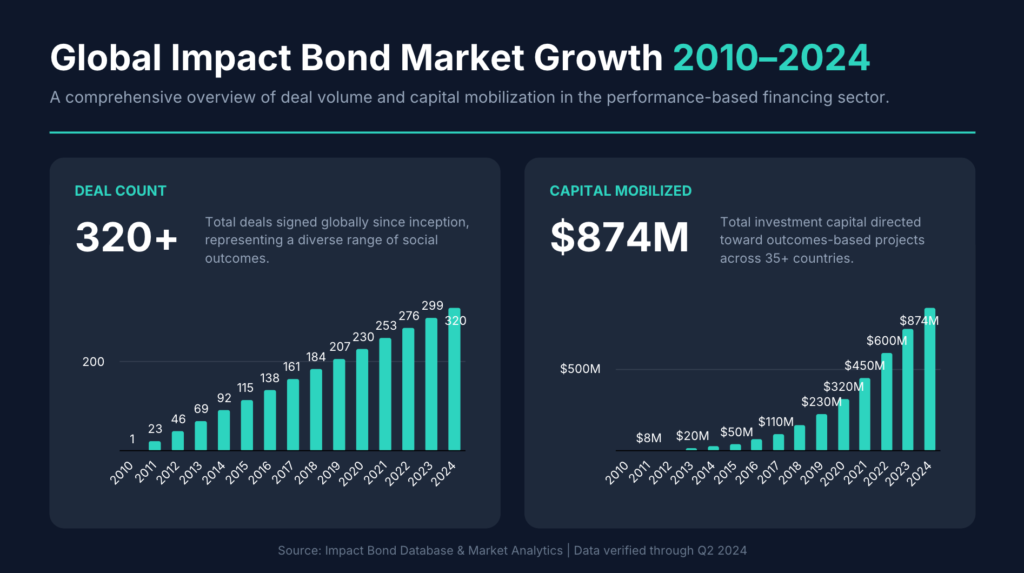
The Government Outcomes Lab at Oxford tracks the global impact bond market and puts the current figure at over 320 contracted bonds across 42 countries, mobilizing more than $874 million in upfront capital and reaching over 3 million service users. Europe leads with 200 deals; Africa has 16. The market is still small relative to total development finance, but it has moved past the proof-of-concept stage.
The mechanism works like this. A government or donor commits to pay for specific, pre-agreed outcomes once those outcomes are independently verified. A service provider, an NGO, a social enterprise, or sometimes a private company, is contracted to achieve those outcomes. Because payment only comes after results are confirmed, the service provider needs working capital upfront. That capital comes from impact investors, who carry the execution risk. If outcomes are not achieved, investors lose their return. If they are achieved, investors are repaid principal plus a pre-set rate.
What this structure does, in theory, is align incentives. Donors pay for results rather than activities. Service providers have flexibility to adapt without requiring approval for every budget line change. Investors have a direct financial stake in whether the program works.
The Education Outcomes Fund in Practice
EOF sits in the middle of these transactions as an orchestrator. Karboul is careful about that word. EOF does not manage investors’ money directly, and it does not deliver education programs. What it does is structure the deals, bring stakeholders together, establish outcome metrics and pricing, and manage the verification process. It is also building legal templates that allow governments to buy outcomes at all, something most procurement frameworks are not set up to do.
“In a perfect world, you would take the contract you have with us and go raise working capital,” Karboul said. “We’re not in a perfect world.”
The Sierra Leone Education Innovation Challenge is probably the clearest illustration of the model. EOF worked with the Sierra Leone government and five implementing partners, including Save the Children and local organizations, across 325 primary schools and approximately 134,000 children. A randomized control trial conducted by an independent evaluator measured literacy and numeracy outcomes. Results in Year 3 placed the program in the 90th percentile for learning outcomes across sub-Saharan Africa, and at least 70% better than comparable programs on the continent, according to Karboul.

In many low-income countries, access to school and access to learning remain two very different things
The program included a financial innovation on gender: service providers received a 20% premium on the price per outcome for improvements in girls’ learning results relative to baseline. By Year 3, girls had nearly closed the gap with boys in both literacy and numeracy. EOF is now extending a similar mechanism to children with disabilities in Rwanda, paying double the standard rate for each child with a disability who is enrolled and learning.
The Ghana Education Outcomes Project is larger, at $30 million, structured as a partnership with the World Bank. It focuses on out-of-school children in the northern regions, where cocoa farming historically pulls children out of school, and targets 70,000 children through an accelerated learning reintegration program, alongside support for over 100,000 children across 600 primary schools.
Accountability by Design: RCTs, Verifiers, and Risk Transfer
The credibility of outcomes-based financing rests almost entirely on measurement. If outcomes can be gamed, the structure fails. EOF uses randomized control trials (RCTs) as its primary verification tool, which is methodologically rigorous but expensive and slow. Karboul acknowledges the tension. The Ghana program took five years from design to launch. Nigeria took less than a year.

The global impact bond market has grown to over 320 contracted deals across 42 countries, though education remains a smaller portion of total deployments.
Source: Government Outcomes Lab, University of Oxford, INDIGO Impact Bond Dataset v2.
Third-party verifiers, independent of both EOF and service providers, confirm whether stated outcomes were achieved before any payment is released. This is non-negotiable in the model. Without independent verification, the incentive structure breaks down, and the product becomes indistinguishable from a conventional grant with extra paperwork.
The risk transfer is real but bounded. Impact investors in EOF structures can earn returns of up to 10%. Karboul makes the point that the total price per outcome, including investor returns, is designed to be no higher than what governments and donors were already spending per beneficiary. Given that much of that prior spending produced, by the evidence, very little, the comparison is not unflattering to the outcomes model. Several service providers have also told Karboul that working with impact investors changed how they used data and performance management in ways that improved their programs independent of the financial structure.
The Peterborough Prison Social Impact Bond, launched in the UK in 2010, remains the canonical early example of this model. Designed by Social Finance UK, it reduced reoffending rates among short-sentenced male prisoners and demonstrated that the structure could work at scale. The GPRBA documents dozens of similar structures across health, employment, and education that have since moved from pilot to full implementation.
What This Means for Investors
The universe of investors currently active in education impact bonds is small. It includes organizations like Bridges Outcomes Partnerships, UBS Optimus Foundation, and a handful of family offices and development finance institutions willing to take illiquid, bespoke positions in emerging-market education programs. Pension funds and sovereign wealth funds are largely absent.
EOF’s stated target is $1 billion deployed by 2030. Getting from $130 million to $1 billion requires either more of the same bespoke deal-by-deal fundraising, which does not scale, or a structural shift in how the product is packaged. Karboul is thinking about both, including whether something like tradable social outcome credits could eventually be created, an analogue to carbon markets but for verified learning or employment outcomes.
Randomized control trials conducted by independent evaluators are the primary verification mechanism for outcomes payments under EOF’s framework
That idea is still early-stage. What does exist is a functioning proof of concept across six countries, a growing body of RCT evidence, and a set of legal and financial templates that make future transactions faster to structure. That is more than most of this sector had five years ago.
Whether it is enough to move institutional capital at meaningful scale is a different question. What Karboul does claim, and the Sierra Leone data supports, is that outcomes-based financing produces better results at comparable or lower cost than the activities-based funding it is designed to replace. For investors trying to build portfolios with genuine social return, that is worth understanding in depth.
Listen to the full conversation with Amel Karboul on the SRI 360 Podcast here.
For more episodes on impact investing, development finance, and sustainable investing strategies, visit sri360.com/podcast/.