Most global allocators think of Brazil through a limited set of lenses. Carnival. The Amazon. Political volatility. What they rarely think about is that Brazil is now the second-largest exporter of agricultural products in the world, dispatching food, fiber, and bioenergy to more than 200 countries, and that the sector generating those exports has grown at a productivity rate that no other major segment of the Brazilian economy comes close to matching. For investors focused on climate and food security, this gap between perception and reality is where the opportunity lives.
I recently spoke with Francisco “Chico” Jardim, General Partner at SP Ventures, widely regarded as one of Latin America’s leading agri-food venture capital firms. Jardim has spent nearly two decades building an investment platform specifically around the thesis that Brazil’s tropical agricultural system is not just a commodity story but a deep technology story, one that demands locally developed science, patient capital, and a fundamentally different investment framework than anything Silicon Valley has historically applied to food and farming.
The Scale Most Investors Have Not Priced In
The numbers alone are striking. In 2024, Brazil’s agricultural sector generated a near-record USD 164.4 billion in export revenue, representing roughly 49% of the country’s total exports. Brazil holds absolute global leadership positions across multiple critical value chains. It is the number one producer and exporter of soybeans, coffee, raw sugar, and frozen concentrated orange juice, and the top global exporter of beef and poultry. When you aggregate the full agribusiness value chain, including upstream inputs, primary production, processing, and logistics, the sector accounts for approximately 24% to 26% of Brazil’s total GDP.
What makes this more than a commodity story is the productivity data underneath those export figures. Between 2000 and 2013, agricultural productivity in Brazil surged by 105.6%. Over the same period, the services sector grew productivity by 11.7% and the manufacturing sector saw productivity decline by 5.5%. The most efficient commercial farms grew their total factor productivity at 4.4% annually between 1985 and 2006, meaning they increased output by 138% while holding inputs fixed at 1985 levels. These are not the numbers of a low-value-added commodity exporter. They are the numbers of a sector that has been compounding innovation for decades.
As Jardim described it plainly, agriculture in Brazil is “by far the most dynamic, competitive, innovative sector of the economy.” That is not promotional language. It is a statement the productivity data supports.
How Brazil Built a Food Superpower From Scratch
Understanding what Brazil has built requires going back to where it started. In the 1960s, Brazil was a food-insecure nation, a net importer of staple foods, heavily reliant on foreign agricultural donations to support its rapidly urbanizing population. The land that would eventually become the global breadbasket, the vast Cerrado savanna covering much of central Brazil, was characterized by highly acidic, aluminum-toxic soils considered entirely unsuitable for commercial farming.
The catalyst for transformation was the establishment of EMBRAPA, the Brazilian Agricultural Research Corporation, in 1973. Over the following decades, EMBRAPA pioneered the large-scale application of agricultural liming to neutralize soil acidity and engineered the tropicalization of the soybean, a crop that originated in temperate Northeast China. Through hyper-localized research, EMBRAPA developed over 200 tropical soy varieties and perfected biological nitrogen fixation techniques, eliminating the need for expensive synthetic nitrogen fertilizers in soy production.
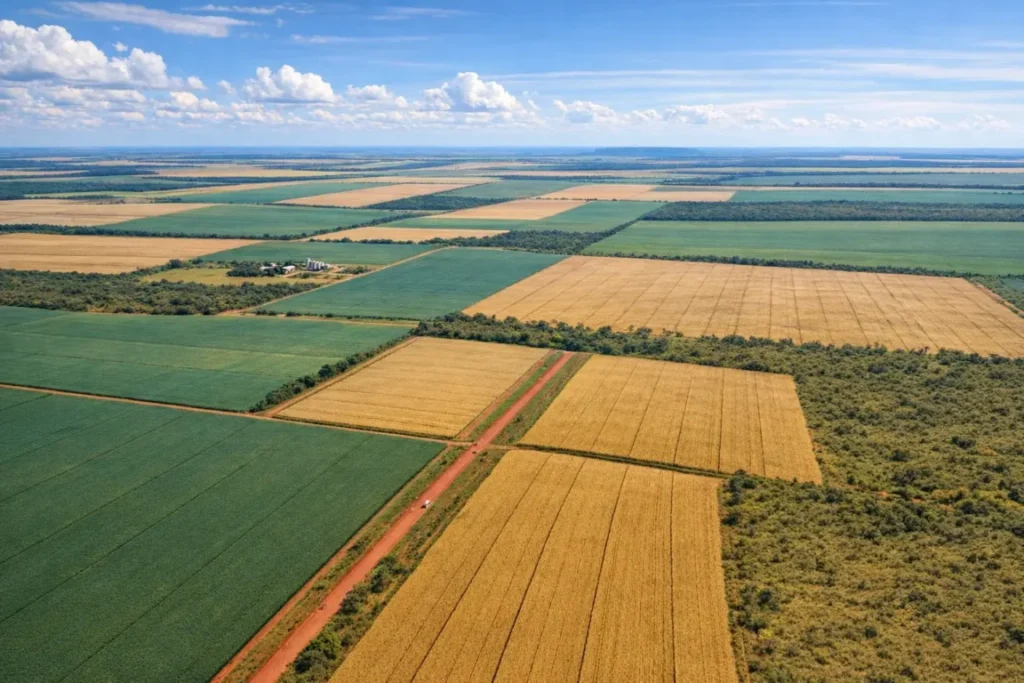
Brazil’s Cerrado biome produces more than 60% of the country’s soy and corn output, making it the geographic engine behind Brazil’s rise to become the world’s second-largest agricultural exporter.
The economic impact of that public investment has been staggering. EMBRAPA’s innovations increased Brazil’s aggregate agricultural productivity by 110%, accounting for 39% of total agricultural productivity growth since 1970. The benefit-cost ratio on the public R&D investment that made this possible has been calculated at 17 to 1. What that story illustrates is that Brazil’s agricultural dominance was not an accident of geography. It was the result of sustained, science-led, state-backed investment in locally relevant knowledge.
Jardim built his entire investment philosophy around the extension of that logic into the venture capital era. The science that made Brazilian agriculture globally competitive was developed in Brazil, for Brazilian conditions. The next generation of that science will follow the same pattern.
Why Tropical Agriculture Is Harder and More Innovative Than Temperate Farming
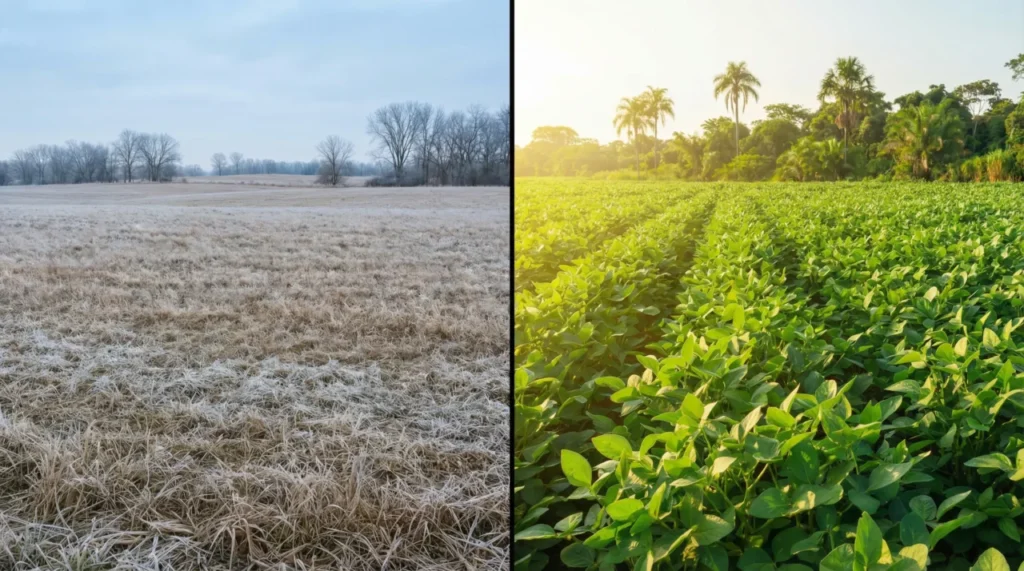
Unlike temperate farms that get a natural biological reset each winter, Brazilian tropical fields stay biologically active year-round, forcing the development of locally built pest management solutions that no imported formula can replicate.
The most underappreciated dimension of the Brazilian agricultural story is how much harder the operating environment is compared to what most global investors understand from their experience with North American or European agriculture.
In temperate zones, a hard winter freeze acts as a natural biological reset. It decimates overwintering insect populations, fungal spores, and weed seeds, allowing farmers to begin each season with a relatively manageable baseline of pest pressure. Brazilian tropical agriculture has no equivalent mechanism. Temperatures, humidity, and rainfall remain high year-round, allowing continuous biological activity. Insects in Brazil exhibit multivoltine life cycles, producing exponentially more generations per year. Studies have shown that pesticide resistance levels can be up to 158 times higher in warm overwintering sites compared to sites with seasonal die-offs.
This is why, as Jardim described it, Brazil earned the reputation among major chemical companies as the “graveyard of chemical technologies for agriculture.” Legacy pesticide formulas that work reliably across European or North American growing seasons lose efficacy in three to five years in tropical Brazil, as pest populations select for resistance far faster. The practical consequence is that Brazilian farmers cannot simply import agronomic protocols developed in temperate climates. They need locally developed, locally validated solutions built for conditions that have no equivalent elsewhere.
This constraint has produced an unintended but powerful advantage. The same biological pressure that defeats imported chemical solutions has forced Brazil to develop the world’s most advanced biologics industry for agriculture, a set of nature-based crop protection tools that are increasingly recognized globally as the future of the sector.
A Sector That Grows When Everything Else Contracts
One of the most compelling investment characteristics of Brazilian agribusiness is its countercyclical behavior during periods of macroeconomic stress. Over the past decade, the sector has been tested repeatedly under conditions that would devastate most other industries.
During the 2015 to 2016 domestic recession, when Brazil’s total GDP contracted significantly, agriculture maintained positive growth, expanding by 1.8% in 2015 while the broader economy shrank. During the 2020 COVID-19 pandemic, currency depreciation of the Brazilian Real dramatically increased local-currency net returns for farmers whose commodity revenues are priced in US dollars. Agricultural exports surged even as urban economies collapsed. In 2023, during a turbulent political transition, the agricultural sector recorded an 11.7% to 13.1% expansion and was the single largest driver of the nation’s 3% overall GDP growth for that year.
The structural reasons for this resilience are straightforward. Brazilian agribusiness sells to more than 200 countries, providing geographic diversification that cancels out localized demand shocks. Its revenue is dollar-denominated, providing a natural hedge against domestic currency crises that have historically been a recurring feature of Latin American macroeconomics. And the products themselves, food and fiber, sit at the base of Maslow’s hierarchy. Demand for calories does not disappear when financial markets are under stress.
The Unsubsidized Proving Ground
Perhaps the single most important structural fact about Brazilian agriculture for a global investor to internalize is that it competes at the top of global league tables without the safety nets that define its major competitors.
According to the OECD Agricultural Policy Monitoring and Evaluation Report, Brazil’s Producer Support Estimate averaged just 5.4% between 2022 and 2024. The OECD average for the same period was 12.5%. The European Union came in at 16.4%. The United States at 7%. Brazilian domestic prices align almost perfectly with international border prices, meaning farmers receive no artificial floor. They compete on the open global market every single day.
This absence of subsidy has a profound effect on innovation dynamics. Brazilian farmers adopt technology aggressively because doing so is not optional. Efficiency gains are the difference between a profitable season and a failed one. Technologies that deliver clear and immediate return on investment spread rapidly through farming communities through word of mouth and peer demonstration. Those that do not deliver get abandoned quickly.
For venture-backed agtech companies, that environment is both demanding and clarifying. A product that achieves adoption in unsubsidized Brazilian conditions is, almost by definition, genuinely useful. And as Jardim has argued, a product proven in those conditions travels well to other large-scale, commercially oriented agricultural markets around the world.
With global food production needing to increase by roughly 70% by 2050 to feed a population approaching 10 billion, and Brazil holding approximately 28 million hectares of degraded pastureland that can be converted to high-yield production without further deforestation, the country is positioned as one of the most consequential geopolitical actors in global food security over the coming decades. Investors who have not yet developed a serious view on Brazilian agriculture are not just missing a return opportunity. They are missing the geography where a significant portion of the world’s food security challenge will be won or lost.
Listen to the full conversation with Francisco Jardim on the SRI 360 podcast.
For more interviews with leading voices in sustainable and responsible investing, visit the SRI 360 podcast archive.