A Market Built on Owning Things, Not Lending Money
The global sukuk market closed in 2025 above $1 trillion outstanding for the first time, and roughly 60% of the buyers of the newest US dollar issues from the Gulf were not Islamic investment institutions at all. They were the same pension funds, insurance companies, and asset managers who buy conventional emerging market debt every day.
A sukuk, for anyone meeting the term for the first time, is an Islamic fixed income instrument. In most respects it behaves like a bond: it has a maturity date, a regular income stream, and a credit rating from the same agencies that rate conventional debt. The difference is that it pays investors out of the earnings of a real underlying asset rather than out of interest, which Islamic law prohibits. That single structural point drives almost everything that follows.
What is pulling a decades-old, faith-based financing structure into the middle of a mainstream fixed income allocation is not religion. It is a set of return, volatility, and correlation numbers that are hard to find anywhere else in the asset class.
I recently spoke with Elizabeth Alm, Senior Investment Analyst and Portfolio Manager at Saturna Capital, the oldest and largest Sharia-compliant asset manager in the United States, about what that data actually shows and why it keeps surprising investors who assume Gulf-region debt must be riskier than it looks.
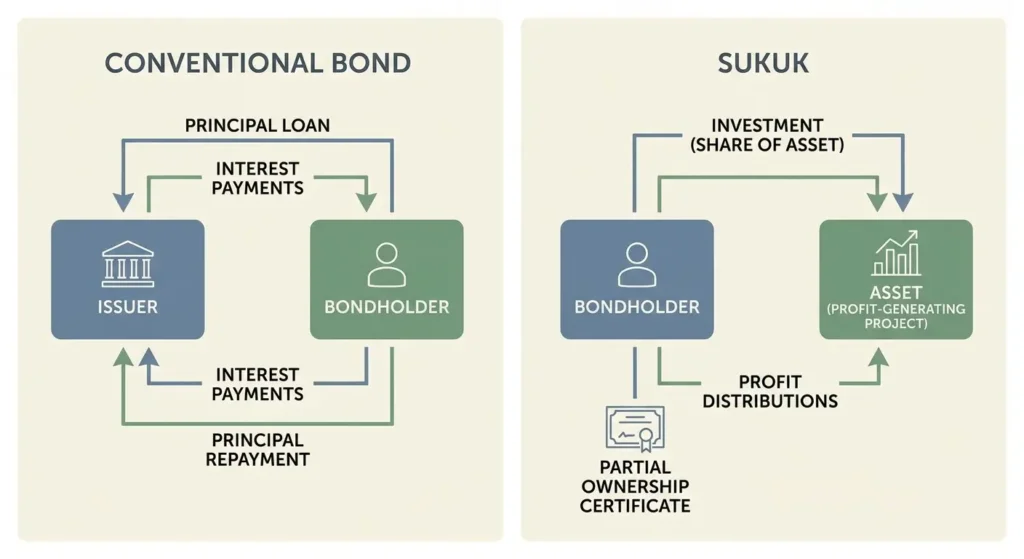
A conventional bond pays fixed interest, while a sukuk pays returns from an underlying asset the investor partly owns.
The Numbers That Get a Conventional Investor’s Attention
It is worth going one level deeper on the structure, because it explains the return profile. A conventional bond is a loan: the issuer owes the bondholder principal and interest on a fixed schedule, full stop. Islamic law prohibits charging or receiving interest, known as riba, so a sukuk instead represents fractional ownership in a real asset, a business venture, or a stream of revenue, such as rental income from a group of buildings or lease payments on aircraft. The holder is paid from what that underlying asset actually earns, not from a guaranteed coupon. Since 2021, the Accounting and Auditing Organization for Islamic Financial Institutions (AAOIFI), the industry’s Sharia standards body, has required that at least 51% of a sukuk’s structure be backed by real, tangible assets for the security to remain compliant.
That asset-backed structure is a big part of why sukuk behave differently from ordinary bonds. According to Saturna’s fourth edition GCC Sukuk Primer, published in April 2026, the FTSE IdealRatings Sukuk Index posted the lowest standard deviation of any benchmark the firm tracked over both the five-year and three-year periods ended 2023, coming in well below the Bloomberg US Aggregate Index and the Bloomberg US Treasury Index. The same research found the sukuk index’s five-year correlation to West Texas Intermediate crude oil had fallen to negative 0.129 by the end of 2025, down from 0.367 in the primer’s original edition five years earlier. In plain terms, an asset class made up almost entirely of issuers in oil-exporting countries currently shows no meaningful relationship to the price of oil.
The reason has more to do with the US dollar than with hydrocarbons. Every major Gulf Cooperation Council (GCC) currency, the six-country bloc of Bahrain, Kuwait, Oman, Qatar, Saudi Arabia, and the United Arab Emirates (UAE), is either pegged or effectively tied to the dollar, so the region’s monetary policy tracks the US Federal Reserve rather than the oil cycle. That is also why the sukuk index’s correlation to the Bloomberg US Aggregate has been climbing, reaching 0.847 over the five years ended 2025. Sukuk move with US interest rates. They do not move with crude.
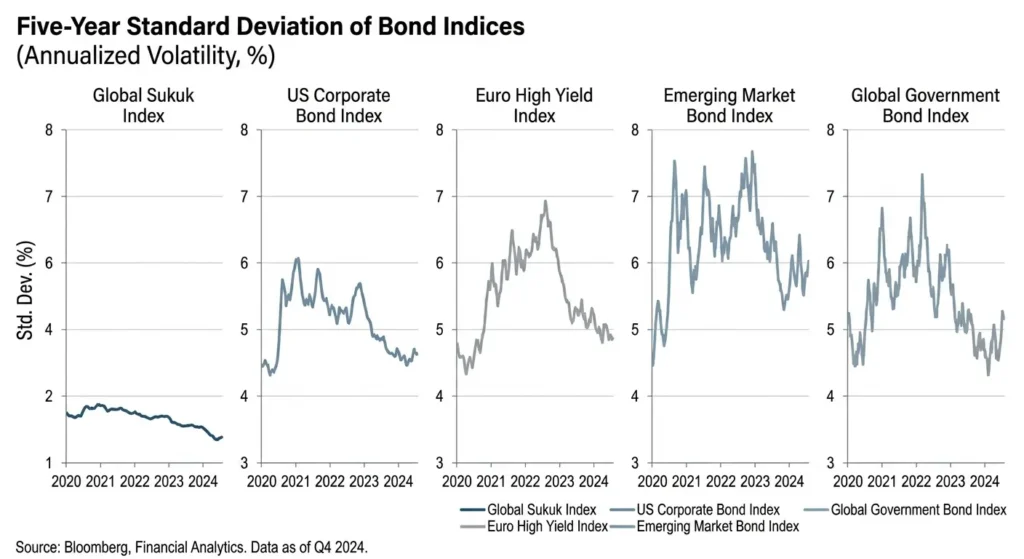
Sukuk have shown lower volatility than major bond benchmarks over the past five years, based on Saturna’s research.
The market backing those numbers has grown fast. The International Islamic Financial Market’s 14th annual Sukuk Report put total global issuance at $205 billion in 2024, with global outstanding sukuk reported at $902.82 billion that same year. Fitch Ratings has since reported that global outstanding sukuk crossed the $1 trillion mark by the end of 2025. US dollar-denominated sukuk make up $301.75 billion of that total, and the GCC region now accounts for 84% of all new dollar sukuk issuance, up from 76% the year before. Saudi Arabia alone became the largest dollar-denominated debt issuer among emerging markets outside China in 2024, and in the first half of 2025 it accounted for 18.9% of the roughly $250 billion in dollar-denominated debt issued across all emerging markets ex-China.
What the Rating Agencies Are Actually Saying
None of this would matter to a conventional pension fund if the credit quality behind it were shaky, and that is where the region has quietly closed a gap with the developed world. By year-end 2025, Fitch rated both Abu Dhabi and Qatar at AA, with Saudi Arabia at A+. Those are ratings more commonly associated with northern European sovereigns than with emerging market issuers.
The comparison gets sharper set against what happened to the United States over the same stretch. In May 2025, Moody’s downgraded US sovereign debt from Aaa to Aa1, citing rising debt and interest costs “significantly higher than similarly rated sovereigns.” That made 2025 the first year in history that all three major rating agencies had US debt rated below the top tier, a downgrade cycle that started with S&P’s move in 2011. J.P. Morgan made its own judgment about the region in February 2025, when it announced it would reclassify Qatar and Kuwait as developed markets and phase them out of its widely tracked Emerging Market Bond Index over six months. That is not a routine index rebalancing. It is a bank telling clients the countries no longer fit the risk category investors had been putting them in.
None of this erases the region’s fragility elsewhere. Bahrain was downgraded by S&P from B+ to B in November 2025, reflecting deteriorating fiscal and debt metrics that stand in sharp contrast to its neighbors. The Gulf’s credit story is not uniform, and the sukuk market’s returns depend heavily on which part of the region an issuer sits in.
Strong ratings alone would not draw conventional money if the yield pickup weren’t there too. Saturna’s research shows Saudi Arabian sovereign debt averaged 71.6 basis points above the five-year US Treasury yield in 2025, with Qatar at 35.1 basis points and Abu Dhabi at 27.8. That is a smaller premium than a decade ago, when Saudi Arabia’s spread ran above 100 basis points, but it is still a real pickup over developed-market government debt carrying a comparable or, in the US case, now a worse rating. Layer in sovereign wealth funds that collectively hold close to $6 trillion in assets and debt-to-GDP ratios for Saudi Arabia and the UAE that sit well below Germany’s or Japan’s, and the combination of yield, ratings, and balance sheet strength is not one conventional fixed income investors see together very often.
There is also a specific misconception the data pushes back on directly: that conflict in the region automatically means the bonds get hit. Saturna’s research tracked market reactions in the seven business days following major geopolitical events going back to 2022, measuring stock indices, bond yields, currencies, and credit default swap spreads. When Israel launched Operation Rising Lion against Iran in June 2025 and Iran retaliated, Israeli markets registered a clear risk-off reaction. Saudi Arabian markets over the same seven days showed no meaningful impact at all. The firm’s broader finding across a decade of events, including the Hamas-led attack on Israel in October 2023, was that fiscal and debt sustainability crises in developed markets, a UK mini-budget, a French election, a US credit downgrade, produced more severe and longer-lasting market volatility than regional conflicts did. Investors, Alm suggested, tend to overestimate how much a war in the region will move their bond price and underestimate how much a fiscal surprise somewhere else will.
Running Two Screens on One Credit
For a fund like Saturna’s, the practical work is running Sharia compliance and sustainability analysis on the same credit at the same time, and Alm described the two as reinforcing each other more often than conflicting. Negative screens rule out alcohol, tobacco, weapons, gambling, and pornography across both the firm’s Islamic and sustainable fund families. On the Sharia side specifically, a sukuk cannot come with the kind of guaranteed principal or collateral posting that a conventional bond might carry, since Islamic finance requires genuine risk-sharing between issuer and investor rather than risk transfer. That structural requirement, Alm argued, tends to reward exactly the kind of governance discipline that a sustainability analyst is separately looking for.
She pointed to Tabreed, the UAE’s national district cooling company, as an example of how the two screens converge on one holding. Saturna held the company’s conventional sukuk for years before Tabreed issued any labeled green debt at all, on the basis of the underlying business rather than a label. By Saturna’s own estimate, the efficiency of centralized cooling versus individual air conditioning units has let Tabreed avoid emissions equivalent to taking 1.6 million cars off the road over 25 years of operations, a case Alm cited as the kind of story a bond label alone would never capture.
Green and sustainability-labeled sukuk are still a small slice of the total market, but they are growing quickly. Outstanding ESG-labeled sukuk across all currencies passed $58 billion by the end of 2025, up 62.5% in a single year, with US dollar-denominated ESG sukuk making up roughly two-thirds of that figure. Much of the recent growth has come from an unexpected corner: UAE real estate developers. Binghatti Holdings priced a $500 million green sukuk in October 2025 that was oversubscribed more than four times. Sobha Realty followed in November with a $750 million green sukuk, the largest ever issued globally by a real estate developer, oversubscribed nearly three times over. Arada Development, a Sharjah-based developer, priced a $450 million sukuk the same July at what it called the tightest reoffer yield in the company’s history, drawing more than $2 billion in orders. Omniyat Holdings, a luxury developer, made its first entry into the dollar sukuk market in April 2025 with a $500 million green issue, oversubscribed 3.6 times. None of these are sovereigns or state-linked entities. They are private developers discovering that a Sharia-compliant, green-labeled structure can pull in a wider order book than a conventional bond would.
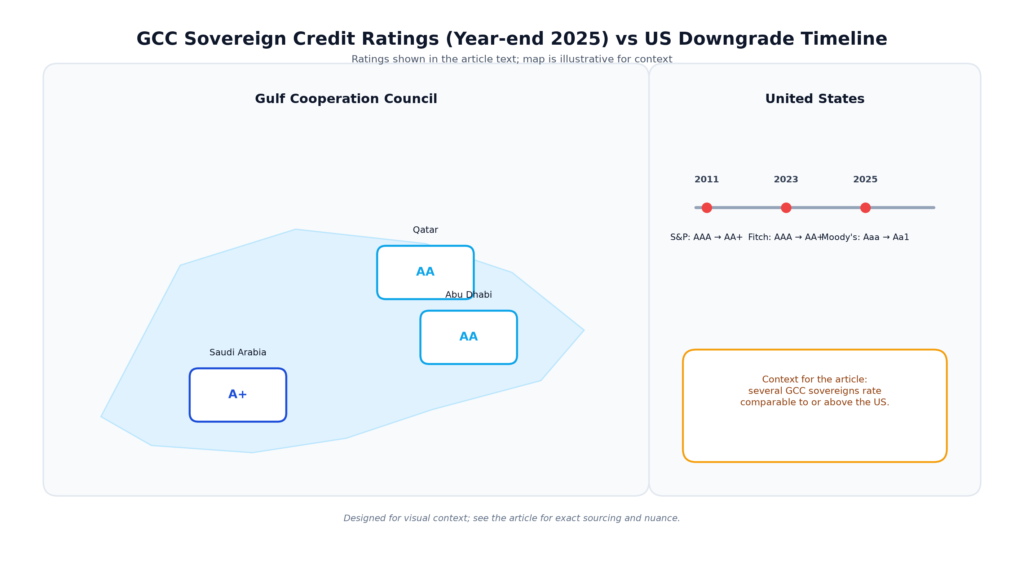
Several Gulf sovereigns now carry credit ratings equal to or above the United States, whose rating has slipped since 2011.
Where the Market Is Still Thin
None of this is new to Western capital markets, even if it feels unfamiliar. The United Kingdom became the first non-Muslim sovereign to issue a sukuk back in June 2014, a modest £200 million deal that still drew £2.3 billion in orders, more than eleven times the amount on offer. Robert Stheeman, the chief executive of the UK’s Debt Management Office at the time, told Euromoney the government had deliberately structured the sale to attract “a diversified spread of investors” by both geography and type, and the deal’s joint bookrunner said afterward it had been well received by “major institutional and Islamic accounts” alike. More than a decade later, that same pattern, conventional institutional money sitting alongside faith-based buyers in the same order book, has simply scaled up across an asset class that has gone from a regional curiosity to a trillion-dollar market.
What still limits it is depth rather than demand. Even with a US dollar sukuk market approaching $302 billion, that is a fraction of the size of the US investment-grade corporate bond market alone, and liquidity in individual issues can thin out quickly outside benchmark-sized deals from the largest sovereigns. For now, that scarcity is arguably part of the appeal. A conventional investor buying sukuk for diversification is, in effect, buying exposure to a part of the credit markets that most of their peers have not gotten around to yet.
Notes
Sharia compliance and sustainability analysis are two separate screens applied to the same security, and it helps to be precise about what each one does.
Sharia compliance asks whether an investment is permissible under Islamic law. It has two parts. The first is a business activity screen, ruling out issuers whose revenue comes from prohibited sectors such as alcohol, tobacco, gambling, pornography, conventional interest-based banking, or weapons. The second is a structural screen applied to the instrument itself: the security cannot pay interest, must be tied to real assets, and must involve genuine risk-sharing rather than a guaranteed return, which is why guaranteed principal and collateral posting are ruled out. Compliance is confirmed by an independent Sharia scholar or supervisory board, which issues a written opinion, and by ongoing monitoring against standards set by bodies such as AAOIFI.
Sustainability analysis asks a different question: whether an issuer’s environmental, social, and governance conduct creates or destroys value, and whether risks the market has not priced are building up inside the credit. In Saturna’s case this covers climate and carbon exposure, regulatory and transition risk, governance quality, and, for labeled bonds, what the proceeds are contractually allowed to fund and how the issuer reports on them afterwards. The firm does not use third-party ESG ratings, preferring to run the analysis in-house rather than rely on a score whose methodology it cannot see.
The two screens overlap but are not interchangeable. A credit can be fully Sharia compliant and still fail a sustainability review, or the reverse.
Hear the full conversation with Elizabeth Alm on sukuk structures, Saturna’s investment process, and what a month of meetings across the Gulf revealed on Episode 137: Elizabeth Alm, SRI360°.
For more conversations with the investors, analysts, and asset managers building the sustainable finance market, visit the SRI360° podcast.