Beyond Meat spent 2025 shutting down its business in China. Every quarterly filing that year carried the same line item, expenses tied to the suspension and eventual cessation of the company’s operations in the country with the world’s largest population of meat eaters. By the fourth quarter, full-year net revenue had fallen to $275.5 million, down 15.6 percent year over year, and gross margin had collapsed to 2.8 percent from 12.8 percent the year before, according to the company’s own investor filings. A product built to compete with conventional meat on taste and conscience could not make its unit economics work in the one market where the comparison mattered most.
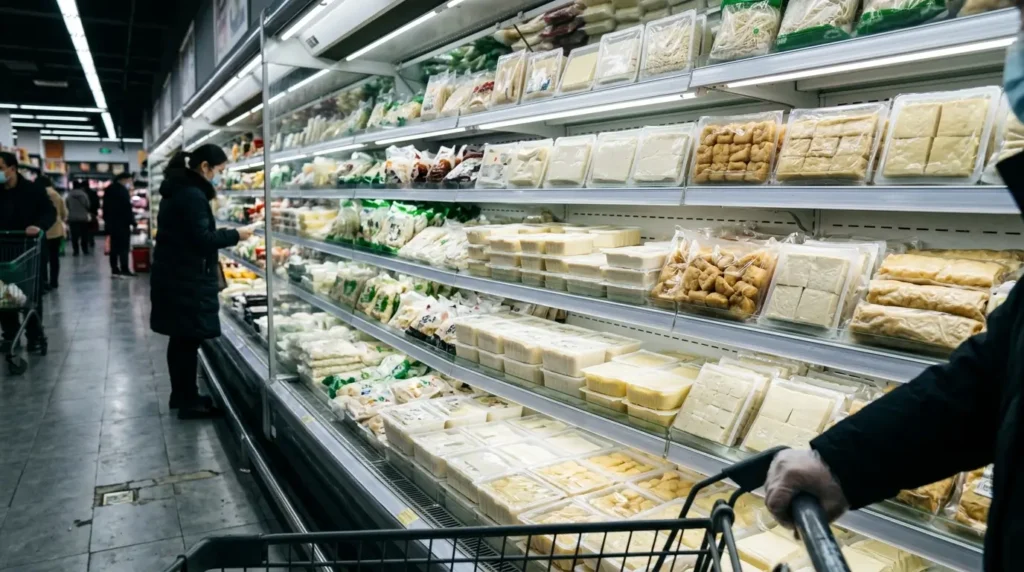
Tofu’s two-thousand-year cost advantage remains unbeatable for novel protein.
That specific failure sits inside a much larger retreat.
I recently spoke with Matilda Ho, founder and managing director of Bits x Bites, about why she thinks Chinese consumers do not need alternative protein in the way Western investors assumed they would. Her argument centers on a benchmark that is nearly impossible to beat: tofu, a plant-based, minimally processed protein that has existed in China for roughly two thousand years and costs a fraction of what any novel protein product can currently achieve at scale. Where Western alternative protein investors had the luxury of comparing their products to conventional meat, in China the real competitor was already sitting on every dinner table, cheap and unimprovable.
The investment numbers back up how badly that comparison has gone for novel protein globally. Total funding for alternative protein companies fell to $881 million in 2025, down from $1.1 billion in 2024 and below the $1 billion mark for the first time in seven years, according to the Good Food Institute’s analysis of Net Zero Insights data reported by Green Queen. That total is roughly one-eighth of the category’s 2021 peak of $6.9 billion, a decline sustained across four consecutive years. The decline was sharpest in the categories furthest from cost parity with conventional food. Cultivated meat and seafood companies raised just $73.9 million in 2025, down from $139 million the year before, while fermentation-derived protein funding fell to $357 million from $651 million. Plant-based protein was the one bright spot on paper, rising 31.5 percent to $450 million, but $100 million of that total came from a single debt financing deal at Beyond Meat, the same company shutting down its China business that year. Strip that one transaction out and plant-based funding grew only 2 percent. The consolidation beneath these numbers has been severe: more than 60 alternative protein businesses have been acquired, merged, gone insolvent, or shut down entirely since September 2024, including Believer Meats, the cultivated meat company Meatable, and the longtime plant-based brand Yves Veggie Cuisine. Even the geography of what remains has shifted. European alternative protein startups raised $418 million in 2025 against $347 million for North American startups, the second consecutive year Europe has outraised the region that once dominated the category, a gap Good Food Institute analyst Daniel Gertner attributes partly to European public investment that has helped de-risk manufacturing scale-up in a way American capital markets currently do not. Some of that broader pullback is not specific to protein at all. Gertner has also pointed to a simpler, blunter cause behind the decline: investment across food and climate technology broadly was heavily concentrated in artificial intelligence in 2025, leaving less capital available to deploy into any other sector, alternative protein included. Novel protein is not only losing a cost comparison against tofu and conventional meat. It is losing a capital-allocation competition against the single most crowded investment theme in the world right now.
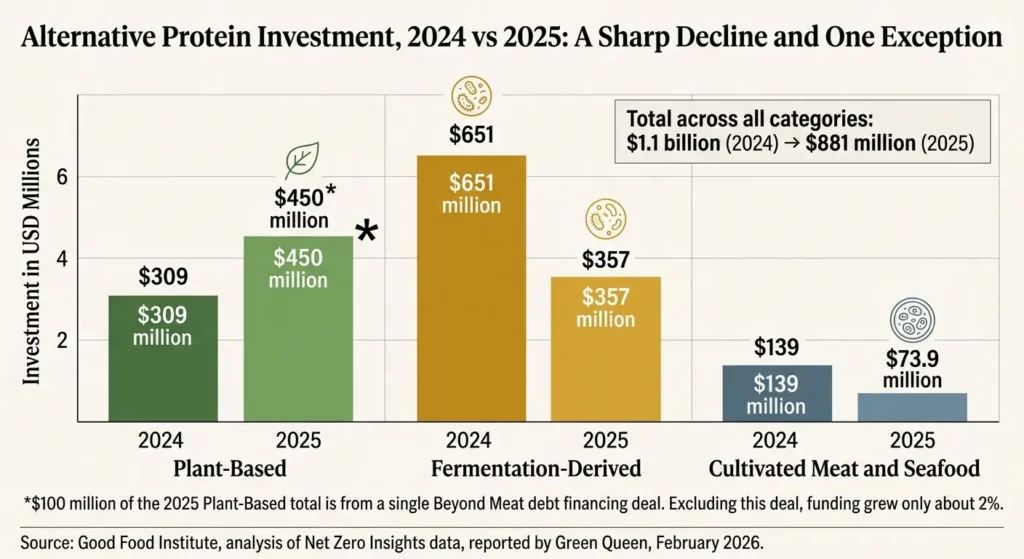
Alternative protein investment fell below $1 billion in 2025, a seven-year low.
China’s own consumption data explains why the country was never going to be the breakout market Western alternative protein investors once hoped for. Per capita meat consumption in China has grown to roughly 49 kilograms a year, about half the American level, according to a peer-reviewed analysis published in the journal Food Quality and Preference. The same study found that Chinese consumers’ willingness to pay for meat alternatives ranges from 5 percent below to 5 percent above the price of conventional meat, a premium tolerance comparable to consumers in the United States and European Union. That is not a market desperate for a meat substitute. It is a market still working through the early stages of rising meat consumption, where the pressing question is affordable protein volume, not an alternative to a food most households have not yet eaten enough of.
What growth does exist in the category is concentrated in products already close to conventional manufacturing and distribution, not in the technologies that once drew the most attention. Global retail sales of plant-based meat, seafood, milk, yogurt, ice cream, and cheese reached an estimated $28.9 billion in 2025, up 3 percent from the year before, according to Euromonitor data cited in the Good Food Institute’s 2026 State of the Industry report series. The plant-based meat and seafood subcategory specifically was estimated at $6.6 billion globally, with continued sales declines in the United States offset by growth elsewhere. Established food companies kept adding plant-based lines to existing product ranges rather than betting on standalone novel-protein brands: Danone launched a plant-based Silk Protein line, IKEA’s United Kingdom cafeterias added plant-based pork sausages to their menus, and McDonald’s India introduced a plant-based Protein Plus addition to its burgers. At least 19 plant-based companies were acquired during the year, evidence that capital is consolidating around platforms that already have manufacturing and retail relationships rather than funding new entrants to build them from scratch.
Regulatory approval has not solved the underlying cost problem either, even in markets furthest along. Seven companies now hold clearance to sell cultivated meat somewhere in the world, with commercial sales currently permitted in Singapore, the United States, and Australia, according to the Good Food Institute’s 2026 State of the Industry report series. Yet Believer Meats, one of five companies to win United States regulatory clearance, shut down in December 2025 despite having cleared the exact hurdle the industry spent years treating as the finish line. Regulatory approval turned out to be necessary but nowhere close to sufficient. The gap between winning a safety review and reaching a cost structure that survives contact with a retail shelf, or a Chinese dinner table already served by tofu, remains the industry’s real constraint.
The technology itself is not standing still, even where funding has pulled back hardest. Pow.Bio, working with the Swiss engineering firm Bühler, demonstrated scalable continuous fermentation of high-value dairy proteins at 3,000-liter scale in 2025, achieving a threefold productivity gain and a 50 percent cost reduction using new processing technology, according to the Good Food Institute’s fermentation report. Vow, an Australian cultivated meat company, reached 20,000 liters of production capacity at its Sydney facility, currently the largest cultivated meat production site operating anywhere in the world. Regulators have not stood still either. Food Standards Australia New Zealand finalized a formal regulatory pathway for cultivated meat in 2025, becoming the third jurisdiction to do so after Singapore and the United States, and South Korea enacted a Food Tech Industry Promotion Act that December, creating a legal framework specifically for fermentation-enabled food products. Not every regulatory move has favored the category: European Union policymakers agreed in March 2026 to ban the word meat and thirty-one related terms from labeling on fermentation-enabled, plant-based, and cultivated products, over survey data the Good Food Institute cites showing European consumers actually support the continued use of those terms. Progress on manufacturing and safety approval, in other words, is real and simultaneous with new headwinds on the marketing side, and neither cancels out the underlying cost problem.
Government capital is moving into the sector unevenly, and the direction of that movement is itself informative. Cumulative government investment in alternative proteins worldwide has reached at least $2.5 billion since 2021, up from roughly $700 million when tracking began in 2021, with at least 33 countries now working to advance the sector compared to 16 at the start of the decade, per the Good Food Institute’s State of Global Policy report. But that total still amounts to no more than 10 percent of the $10.1 billion in annual investment identified by a Global Innovation Needs Assessment as necessary to fully develop a mature alternative protein sector. China moved in the opposite direction from the United States on public funding specifically. While federal investment in cultivated meat research and enabling technologies declined in the United States during 2025, China’s state-owned State Development and Investment Corporation committed more than CNY 4 billion, or $555 million, to biomanufacturing infrastructure with new proteins featured prominently in the plan.
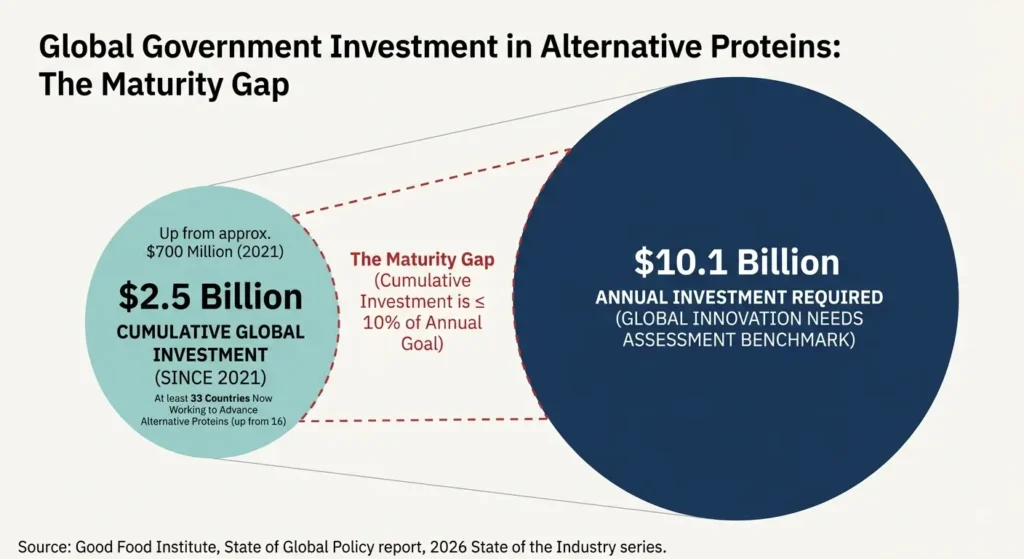
Government alternative-protein funding covers no more than 10% of the annual need.
What that Chinese state capital is actually funding looks different from the cultivated meat and plant-based burger categories that consumed most Western venture dollars over the past decade. The capital is flowing toward fermentation-derived functional ingredients, built on the same industrial fermentation infrastructure that already gives China a dominant share of global vitamin and amino acid production, redirected toward protein-adjacent applications where the country already holds a manufacturing advantage. That is a different bet than trying to replace a chicken breast with something grown in a bioreactor. It is a bet on ingredients that supplement an existing diet rather than substitute for the center of a plate, aimed at a market where the underlying protein categories, not the alternative to them, are still the growth story. It is also, notably, a bet placed through existing fermentation capacity rather than new cultivated meat facilities, the same brownfield logic that has already made China dominant in food and pharmaceutical ingredients extending naturally into protein-adjacent categories.
The lesson embedded in four consecutive years of declining alternative protein investment is not that the underlying science failed. Precision fermentation facilities are hitting genuine engineering milestones, and plant-based sales grew globally even as cultivated meat funding cratered. The lesson is narrower and more specific to unit economics: a novel protein product has to beat, on cost, whatever the cheapest existing protein in its target market already is, not the most expensive one. In the United States that comparison was against feedlot beef and factory chicken. In China it was against tofu, a product with two thousand years of manufacturing efficiency and zero venture capital behind it. Novel protein lost that specific comparison decisively, and the investment data of the past four years is the record of capital slowly absorbing that fact.
Listen to the full conversation with Matilda Ho on the SRI360 podcast, where she discusses why Bits x Bites prioritizes functional ingredients and animal health over novel protein moonshots.
For more interviews and insights on sustainable, responsible, and impact investing, visit the SRI360 podcast archive.