Ask almost any impact investor about additionality and you will get one of two responses. The first is a confident claim: “Our capital made this happen. Without us, this project would not exist.” The second is a careful hedge: “Additionality is hard to prove in public markets, but we believe we contribute meaningfully through engagement and anchoring.”
The first response is almost certainly overstated. The second is probably closer to the truth, but the investment industry has not always been honest about the distinction.
Additionality sits at the philosophical center of impact investing. It asks a deceptively simple question: would this positive outcome have occurred anyway, without your specific investment? If the answer is yes, what you have is a financial return with a sustainability story attached to it. If the answer is no, you have genuine impact.
The problem is that in public capital markets, where trillions of dollars change hands daily, the honest answer to that question is usually: “probably yes, mostly.” And yet the word additionality continues to appear in fund documents, investor presentations, and impact reports with a confidence that the underlying methodology rarely justifies.
Matt Lawton, Head of Impact Fixed Income at T. Rowe Price, is one of the more candid voices on this subject. His willingness to say out loud what many practitioners quietly acknowledge makes his perspective worth examining in detail.
What Additionality Actually Means (And Where It Comes From)
The concept of additionality has its roots in climate policy, specifically in the design of carbon offset markets and the Clean Development Mechanism under the Kyoto Protocol. In those contexts, additionality had a clear technical meaning: a carbon credit was only valid if the emission reduction would not have occurred in the absence of the credit mechanism. The counterfactual was, in theory, verifiable.
When impact investing borrowed the concept, it imported both the intellectual rigor and the measurement challenges. The DVFA’s framework on additionality versus investor contribution draws a useful distinction between two related but different concepts. Additionality in its strict sense asks whether the project would have happened at all without the investor’s capital. Investor contribution, a broader and more defensible concept used in frameworks like the Operating Principles for Impact Management and the Global Impact Investing Network (GIIN), asks how the investor’s activities made a difference to the quality, scale, or sustainability of the impact outcome.
This distinction matters enormously in public fixed income. A strict additionality requirement applied to secondary market bond trading would eliminate most public market impact claims entirely. A well-defined investor contribution framework, applied with intellectual honesty, opens up a credible path for impact in public markets.

A portfolio manager reviews a green bond documentation pack
The Secondary Market Problem
The most common critique of public market impact investing is also the most straightforward. When an investor buys a bond on the secondary market, no money goes to the issuer. The transaction is between two investors. The company whose bond is being traded has already received the proceeds from the original issuance and has no involvement in the transaction. How, the skeptic asks, does this create impact?
I recently spoke with Matt Lawton about exactly this question. His answer was unusually honest: “I’m not sure there is impact to be generated from buying and selling bonds in the secondary. I think you can maybe make a link or an argument that you’re reducing the cost of capital for the issuer. I think that link is a little tenuous.”
This is a significant admission from someone who runs an impact fixed income fund. But it reflects a genuine engagement with the question rather than a retreat into comfortable narratives. And importantly, it sets up the more defensible argument for where impact in public fixed income actually does exist.
A widely cited analysis suggests that for most impact investors in public markets, verifiable additionality meeting strict criteria is difficult to establish. The critique is structural: in large, efficient bond markets, if one institutional investor declines to participate in a green bond issuance, another investor will typically take their place at a similar price. No individual investor can credibly claim that their capital uniquely enabled the project.
But this argument, while valid in the narrow sense, proves too much. Applied consistently, it would also undermine the case for most institutional engagement strategies in equity markets, where individual investors similarly cannot claim exclusive credit for corporate behavior changes. The question is not whether any single investor is solely responsible for an outcome but whether a credible mechanism exists connecting investor action to real-world change.
Investor Contribution: A More Honest Framework
Lawton grounds T. Rowe Price’s approach to impact on two mechanisms that are more defensible than secondary market trading claims.
The first is primary capital provision. When T. Rowe Price participates as an anchor investor in the initial issuance of a bond, capital flows directly from the fund to the issuer for specific projects. The connection between investment and outcome is direct, auditable, and not dependent on philosophical arguments about counterfactuals. The firm targets approximately 60 percent of portfolio holdings in primary issuances.
But the more distinctive element of the approach is deal origination: identifying potential issuers before they have considered issuing labeled debt, approaching them with a framework for how they could structure a blue bond or green bond consistent with T. Rowe Price’s impact standards, and committing to act as anchor investor if the issuer proceeds. The Orchestad engagement is a concrete illustration of the stewardship dimension. When Orchestad issued a euro-denominated blue bond, the initial expectation was that proceeds would be allocated primarily to offshore wind. T. Rowe Price engaged directly with the company and made a specific request: allocate a majority of proceeds to SDG 14-aligned projects including coral reef restoration and marine biodiversity. Orchestad subsequently allocated a meaningful portion of proceeds to those categories. Lawton acknowledged the difficulty of proving causality in any single engagement, but the sequence of events is documented and the outcome matched the stated objective.
The framework used by T. Rowe Price to systematize this thinking comes from the Operating Principles for Impact Management and its concept of investor contribution across four channels: primary capital provision, direct engagement and influence over framework design and KPIs, price signals that create market-wide incentives for issuers to adopt labeled formats, and standard-setting contributions to frameworks like ICMA’s Green Bond Principles.
The FCA’s SDR Sustainability Impact label, which T. Rowe Price holds for its UK retail strategy, requires a very clear understanding of investor contribution for every investment before it is made. “A very clear understanding of what our investor contribution is” is how Lawton described the distinguishing characteristic of that label. Every investment requires a documented theory of change specifying how the firm’s activities, whether through stewardship or capital provision, contribute to a specific, measurable outcome.

Two marine biologists work side by side on the seafloor
Why Sustainability-Linked Bonds Have a Credibility Crisis
No market instrument has done more damage to the concept of additionality in recent years than the sustainability-linked bond. The format was initially positioned as a way to extend the principles of sustainable finance beyond specific projects to entire corporate strategies: rather than ring-fencing proceeds for green assets, issuers could tie their coupon rates to company-wide sustainability performance targets, creating incentives for corporate-level transformation.
The theory was compelling. The execution has been, in many cases, a failure of ambition and integrity.
Lawton has been consistently critical of the format and described several structural problems that undermine it. The most fundamental is the choice of sustainability performance targets (KPIs). He described energy companies that issued sustainability-linked bonds with targets tied to board-level gender diversity rather than carbon reduction, which while worthwhile governance practice, is not the core environmental issue relevant to the business. Separately, targets have frequently been set at levels that were already largely achieved by the issuer before the bond was issued, creating the appearance of accountability without the substance.
The structural problem of callability compounds this. Some sustainability-linked bonds are structured with call options allowing the issuer to retire the debt before the target measurement date, meaning the sustainability target is never actually measured or enforced.
The market has responded. SLB issuance fell more than 57 percent from its 2022 peak to its lowest volume since 2020, as investors shifted back toward use-of-proceeds formats where the connection between capital and outcome is more direct and less manipulable. A case study on Enel demonstrated that some SLB tranches referenced renewable capacity targets the company had effectively already met at the time of issuance.
T. Rowe Price’s portfolio holds a small percentage of SLBs, and Lawton is explicit about the conditions: “We’ll invest in them when it makes sense, really more from an issuer perspective more so than a format perspective.” The format alone, absent a strong issuer sustainability story and genuinely ambitious targets, is not sufficient.
The Downgrade Wave and What It Tells Us About Disclosure Standards
The credibility problems that plagued sustainability-linked bonds at the product level were mirrored at the fund level by the wave of SFDR Article 9 downgrades that occurred in Europe.
The EU’s Sustainable Finance Disclosure Regulation (SFDR) created a tiered disclosure system in which Article 9 funds, designated as having a sustainable investment objective, were positioned as the highest-integrity category. Asset managers rushed to label funds as Article 9, and for a time the label became a marketing asset.
When regulators clarified that Article 9 funds must have nearly 100 percent sustainable investments under a strict definition, Morningstar reported that 40 percent of Article 9 funds were shifted down to Article 8 during the 2022 to 2023 downgrade wave. By 2024, Article 9 funds continued to face net outflows as investor caution intensified and the relative performance of these funds lagged Article 6 (non-ESG) equivalents.
Lawton referenced this dynamic directly: “I think this was exactly as you say, these were strategies that were marketed in a certain manner where the actual investment process underpinning those strategies was something that was not consistent with how they were named and marketed.”
The correction was painful for the strategies that experienced it but healthy for the market. What the downgrade wave revealed is that labeling without substance is a form of financial misrepresentation, and regulators in the EU and UK were eventually willing to act on that reality.
The FCA Impact Label and What Regulators Now Require
The UK’s Financial Conduct Authority introduced the Sustainability Disclosure Requirements (SDR) and associated investment labels in 2024, creating one of the most rigorous frameworks for public market impact claims anywhere in the world.
The “Sustainability Impact” label is the most demanding of the four voluntary categories. It requires that a fund aim to achieve a pre-defined, positive, measurable impact alongside a financial return, and that the manager specify a robust theory of change describing how the fund’s investment activities and assets contribute to real-world outcomes. Critically, the FCA explicitly confirmed that impact in public markets can qualify for this label, provided the manager can demonstrate the contribution of assets to real-world outcomes, not just the selection of companies with good ESG scores.
As of January 2025, 43 funds had notified the FCA of their intention to use an SDR label, with 57 additional funds receiving approval for pre-contractual disclosures. T. Rowe Price holds the SDR Sustainability Impact label for its UK retail strategy, one of a small number of fixed income funds to have received this designation.
The practical implication, as Lawton described it, is that the label does not change what the firm was already doing but it does impose a formal requirement to document investor contribution for every investment before it is made. That discipline, applied systematically, is the difference between genuine impact and a well-intentioned story.
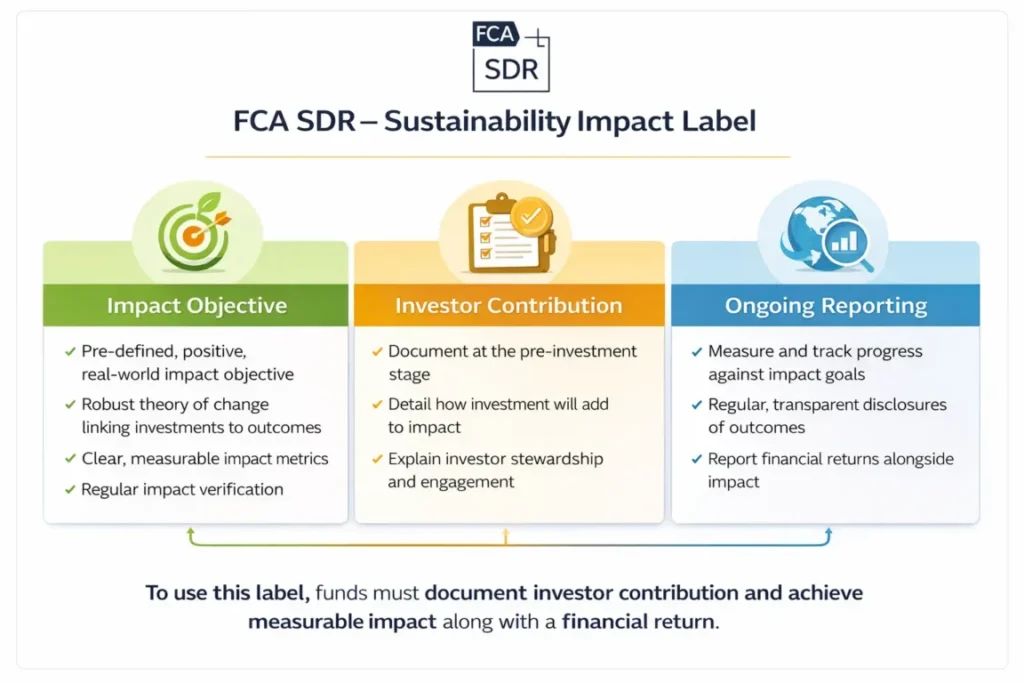
The FCA’s SDR Sustainability Impact Label framework, showing its three core requirements
The Biggest Lie in Sustainable Finance
Lawton was asked directly about the biggest lie being told in sustainable finance. His answer was precise: “The biggest lie being told is espousing additionality when perhaps it’s not there, or espousing a contribution when it’s not there.”
He was explicit about where this problem is most acute. Secondary bond trading, buying bonds in the secondary market and claiming that transaction generates impact and additionality, is where the gap between claim and reality is widest. “These are some of the concepts that I quite candidly struggle to link credibly with impact and additionality,” he said.
But the additionality problem has a mirror image that is equally damaging to the market, and this is where the “don’t let perfect be the enemy of the good” principle becomes most important. Lawton described investors who refuse to participate in bonds that do not tick every procedural box, even when the underlying projects are credible and ambitious: “I have seen transactions that have been marketed to investors where man, the credibility of the project is strong and the issuer is sound and the KPIs are there, but you know what, maybe they didn’t tick a box. Maybe their refinancing look-back was 36 months instead of 12 months, or maybe they didn’t get a second party opinion. So because they didn’t check one box, some investors just wholesale won’t buy that bond.”
He disagrees with this approach. His argument is that procedural compliance should be a starting point, not a substitute for substantive judgment. If an investor can independently verify the credibility and ambition of the projects being financed, and if the issuer has a genuine sustainability strategy, the absence of a particular checkbox should not automatically disqualify the investment. Doing your own work, understanding the substance of what is being financed, and exercising judgment is how impact investing should operate.
The REIT case he described from his own portfolio illustrated the consequences of insufficient ex-ante diligence. A US real estate investment trust issued a green bond promising high-quality, energy-efficient green buildings. The post-issuance allocation report revealed that financed buildings were certified only at silver LEED level, a relatively low standard. T. Rowe Price engaged twice, using peer comparison to illustrate better practice, and ultimately divested when the issuer showed no improvement. The lesson was not that box-ticking would have prevented the problem. The lesson was that clearer, more proactive specification of where proceeds should be allocated, before issuance, would have created a stronger basis for accountability.
That is the mature version of impact investing in public markets: not a passive filter, not an inflated claim, but an active, documented engagement with issuers that shapes outcomes, accepts honest limits on what can be proven, and directs capital to genuinely good projects rather than waiting for a perfect instrument that may never arrive.
As Matt Lawton said, and as the evidence from the SFDR downgrade wave, the SLB contraction, and the FCA’s SDR requirements all confirm: the market is moving away from comfort with vague claims and toward a genuine reckoning with what investor contribution actually means. For impact fixed income investors who have built their approach on honesty about what can and cannot be demonstrated, that is a long-overdue shift.
To hear more, listen to the complete interview with Matt Lawton on the SRI 360 Podcast.
This article is based on a discussion from the SRI 360 Podcast. For more perspectives on sustainable and responsible investing, visit sri360.com/podcast/.