The Label Is the Easy Part
A green bond gets its label before a single dollar of the money raised has been spent. An underwriter lines up a second opinion, a law firm drafts a framework, a rating agency or consultant signs off that the intended use of proceeds looks eligible, and the deal prices. That whole process happens in the weeks around issuance. What happens over the following five, ten, or thirty years, whether the money actually went where the framework said it would, is a separate question, and it is the one that gets asked far less often.
That gap between the promise and the follow-through is where the credibility of the sustainable bond market is actually decided. Not at the label stage. Later.
I recently spoke with Elizabeth Alm, Senior Investment Analyst and Portfolio Manager at Saturna Capital, who put it plainly: pre issuance opinions are now close to universal across the market. The real test comes after the money has been spent, and that is exactly where verification tends to thin out.
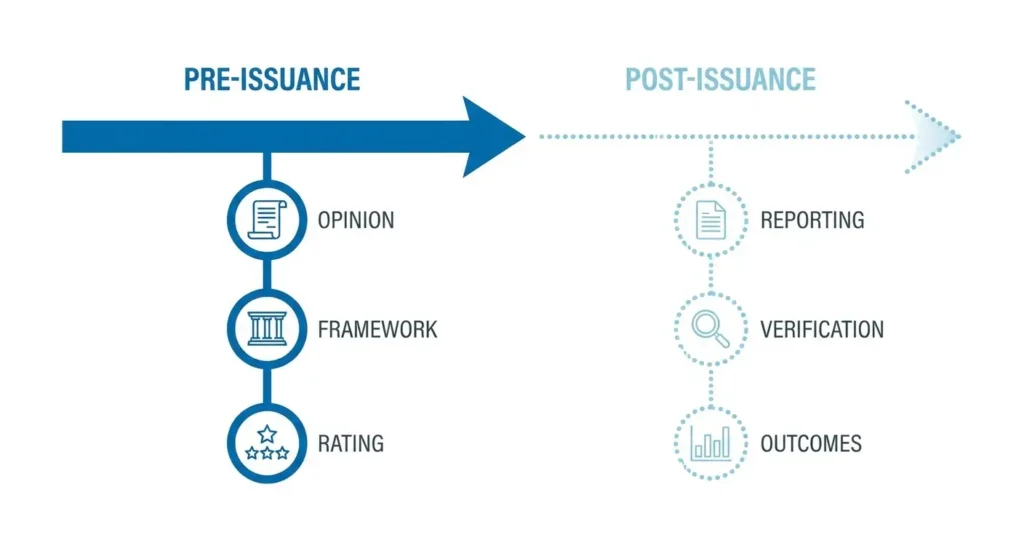
The thorough pre issuance review process with the thinner oversight that follows once bonds are issued.
What the Numbers Actually Show
The first hard evidence of this came from a 2024 study published in the Columbia Business Law Review. The author, John Patrick Hunt, built a dataset of 155 dollar-denominated corporate green bonds issued by US companies between mid-2019 and mid-2022 and checked what happened to them afterward. Almost 10% had no post issuance reporting at all. About a third had reported that no third party had ever attested to. Only around 20% of all the bonds in the sample had the most detailed form of verification, the kind that checks results at the individual project level rather than in aggregate.
That was a US-only sample, and a fairly narrow one. A separate, much larger dataset published in May 2026 by the Luxembourg Stock Exchange tells a similar story at global scale. Drawing on more than 200 data points across over 25,000 sustainable bonds from more than 4,200 issuers worldwide, the exchange’s sustainable finance data platform, the Luxembourg Green Exchange (LGX) DataHub, found that reporting itself has become fairly routine. Bonds issued before January 2023 show an 89% reporting rate. But external verification of that reporting sits at just over half for the 2019 to 2024 period, and the regional spread is wide. More than 70% of reports out of Europe and Oceania get independently verified. In Asia and among supranational issuers, it is under 40%.
There is a structural reason the gap splits this way, and it has nothing to do with issuer intent. Sustainability-linked bonds, which tie a coupon step-up to whether a company hits a stated target, show a 77% external verification rate. Green, social, and sustainability bonds, the plain use-of-proceeds kind, sit at 52%. The difference tracks the rulebook almost exactly.
Hunt’s Columbia paper turned up something else worth sitting with: pre issuance and post issuance reporting quality were, in some respects, negatively correlated. Put plainly, the bonds that came out of the gate with the most polished second opinion were not reliably the ones that kept up the strongest disclosure once the money was actually spent. A slick opinion at pricing tells you almost nothing about what the issuer will publish three years later.
Even where post issuance reports do exist, the numbers inside them deserve a second look. A 2025 study published in Environmental Research Letters checked the actual climate math behind a sample of 1,600 corporate green bonds. Only 32 of them, covering 192 individual projects, had enough project-level detail to test properly. Among that smaller, best-disclosed group, the researchers ran an independent life-cycle assessment against each issuer’s own reported avoided-emissions figure. In roughly 73% of cases, the issuer’s claimed climate benefit came in higher than the independent estimate. These were not the worst-disclosed bonds in the market. They were the ones with enough data published to check in the first place, which makes the finding harder to wave off as a reporting problem alone.
A Rulebook That Asks Nicely
The International Capital Market Association (ICMA), the industry body behind the Green Bond Principles that most issuers voluntarily follow, requires verification for sustainability-linked bonds. For green bonds themselves, its current guidance recommends an external review both before and after issuance. It does not require one.
That single word, recommended instead of required, is most of the explanation for the numbers above. An issuer that skips post issuance verification on a green bond has not broken any rule. It has simply chosen not to do the optional part.
Think of it the way you’d think of a home inspection. Buyers routinely pay for one before closing, because a bad inspection can kill the deal. Almost nobody pays an inspector to come back five years later and check whether the plumbing the seller promised to fix actually got fixed. The pre issuance review is the closing-day inspection. Post issuance verification is the five-years-later check that hardly anyone commissions, because nothing in the transaction requires it.
Hunt’s paper proposes a fix that would flip the incentive rather than just adding another disclosure requirement on top of the current one: let the pre issuance greenness opinion expire if the issuer doesn’t follow through with the post issuance reporting it promised. Right now a bond can carry its original second opinion indefinitely, whether or not the issuer ever files another word about what the money did. Tying the opinion’s validity to actual follow-through would make the pre issuance stamp mean something closer to what investors already assume it means.
Satellites as a New Kind of Proof
One place this is starting to change is in supply chains that are hard to verify through paperwork alone. Barry Callebaut, the Swiss chocolate and cocoa processor, has spent the past several years building a satellite geomapping program across its cocoa sourcing regions in West Africa. According to the company’s own 2024/25 sustainability reporting, that program now traces more than 1.5 million cocoa farms and has mapped over 725,000 individual plots. The same reporting period recorded 30,080 remediated cases of child labor across the company’s monitoring and remediation systems, up from 26,530 the year before, a rise the company attributes to expanded monitoring coverage rather than a worsening underlying problem.
That kind of geolocation data is about to become a legal requirement rather than a voluntary corporate initiative. The European Union’s Deforestation Regulation has already been pushed back twice, first from its original late 2024 start date and then again in December 2025. It is now set to apply from December 30, 2026 for large and medium companies, and from June 30, 2027 for smaller ones. From that date, anyone placing cocoa, palm oil, coffee, soy, cattle, rubber, wood, or products made from them onto the European Union market has to attach plot-level geolocation coordinates to a due diligence statement proving the commodity was not grown on land deforested after December 2020.
Barry Callebaut’s own numbers show both sides of what that kind of monitoring turns up. The company reports that 99.3% of its direct cocoa supply chain is now covered by child labor monitoring and remediation systems, up from a smaller base a few years earlier, and that 557,739 farmers in that supply chain now earn above a $3-a-day poverty line, up 30% from the prior year. But the same reporting period showed 25,288 newly identified child labor cases, more than the 19,389 found the year before. The company’s own explanation, backed by outside research from the social science research organization NORC, is that better monitoring surfaces more cases rather than the underlying problem getting worse. Whether that explanation holds up is exactly the kind of thing better monitoring is supposed to let an outside analyst check for themselves, rather than take on faith.
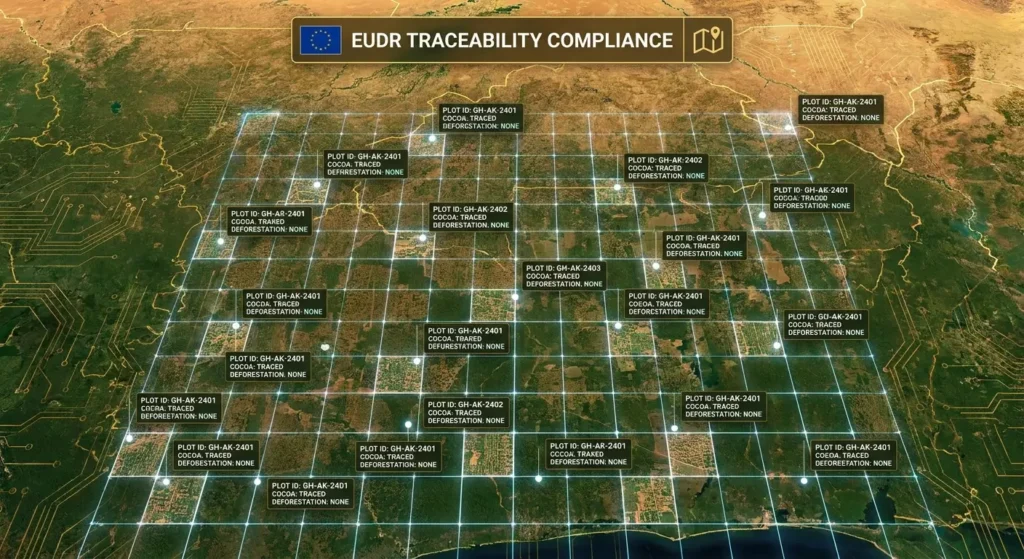
Satellite mapping like this traces individual cocoa plots, the plot level data the EU’s deforestation rule will soon require.
Alm’s own process at Saturna gives a sense of how a fixed income investor actually works around the reporting gap in practice rather than waiting for regulation to close it. She described evaluating four separate components on any labeled bond: what the proceeds are contractually allowed to fund, who decides how the money actually gets allocated, whether the issuance is new financing or just a relabeling of existing spend, and the quality of the ongoing disclosure once the bond is outstanding. For US municipal housing bonds specifically, she said her team sometimes goes as far as reading through city council and town hall meeting minutes to confirm a project got built, track a specific address, and check whether the unit count and income mix match what the bond documents promised. That is not a workflow a data feed can replace. It is closer to fieldwork, and it only exists because the standard reporting doesn’t always go that deep on its own.
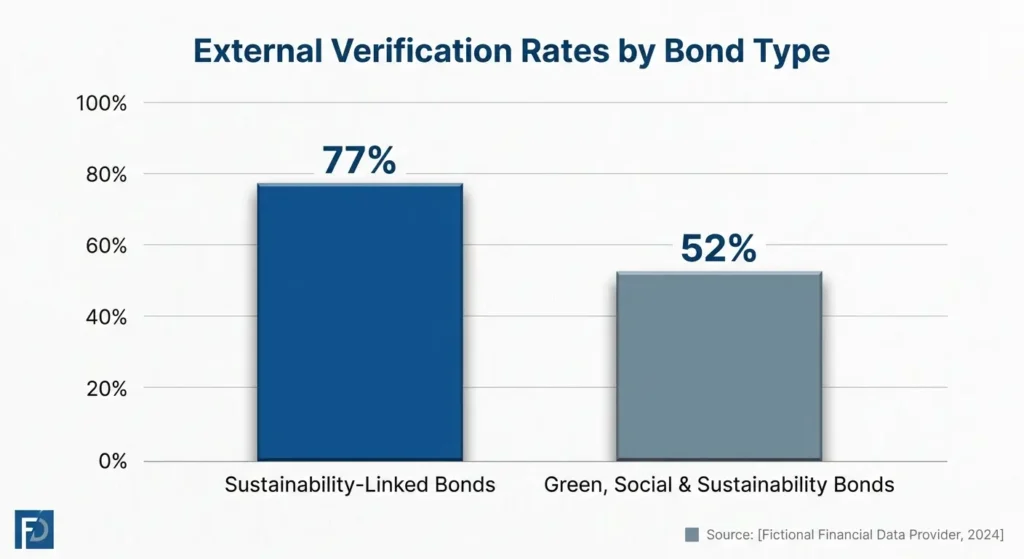
Sustainability linked bonds get verified externally far more often than ordinary green bonds, a gap tied to differing rules.
What the Gap Means for the People Buying These Bonds
None of this means the green bond market is a scam, or that the roughly $6.8 trillion in cumulative aligned green, social, sustainability, and sustainability-linked debt that Climate Bonds Initiative had tracked by the end of 2025 is built on nothing. Green bonds alone accounted for $653.5 billion of new issuance in 2025, out of a global bond market worth more than $100 trillion. The instrument works. The label, on its own, just doesn’t prove anything.
What the data does mean is that the label was never the finish line. It’s closer to a receipt. A serious investor still has to go check what the money bought, and for now that checking is done unevenly, by a patchwork of exchanges, regulators, corporate sustainability teams, and analysts willing to read town council minutes rather than by any single standard that applies across the market. Satellite monitoring and mandatory geolocation rules are starting to make some of that checking automatic, at least for a handful of commodities where the physical footprint of a supply chain is visible from orbit. Bond proceeds spent on things that don’t show up on a satellite image, a hospital wing, a job training program, a batch of affordable housing units, will keep depending on someone actually reading the disclosure, or the town council minutes, to know whether the money did what it said it would.
Until verification becomes as routine as the pre issuance opinion already is, the gap between what a green bond promises and what gets independently confirmed will keep falling on whoever is willing to look past the label. For now, that is a smaller group than the size of the market would suggest.
Hear the full conversation with Elizabeth Alm on how Saturna Capital evaluates sustainable and Islamic fixed income on Episode: Elizabeth Alm, SRI360°.
For more conversations with the investors, analysts, and asset managers building the sustainable finance market, visit the SRI360° podcast.