“There’s no point in retreating from impact now. It’s more how do we make impact more rigorous, more investable, more connected to mainstream economic decision-making? ”
— Elizabeth Boggs Davidsen
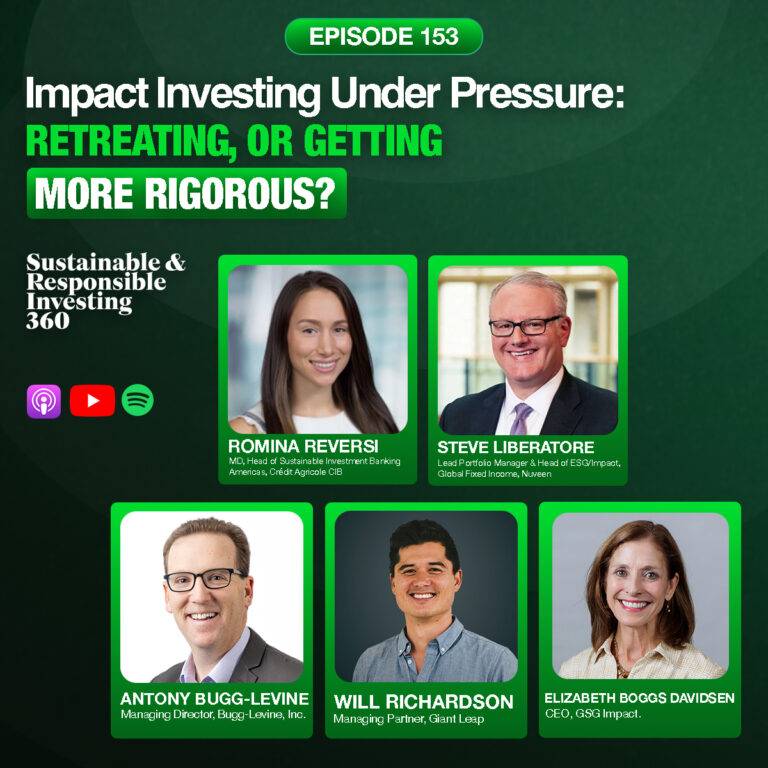
In Retreat, or get more rigorous? Money has pulled out of sustainable funds and the White House has tried to cut the fund behind America’s community lenders. Five people close to the capital say what impact investing should do now.
This compilation takes one passage from each of four recent SRI360° conversations and puts them in an order that argues with itself: the retreat, where practitioners draw lines, how one fund locks impact in, and the case for making impact more rigorous rather than smaller.
The retreat — Antony Bugg-Levine
Antony stands by his 2020 critique that impact investing had become an elite pursuit, and adds a test: if a manager can administer its impact methodology “without ever speaking to someone whose life you came to be improving,” that is a red flag. On why big managers pulled back, he suspects it was about protecting the wider franchise from political risk, not about fund performance. He separates the CDFI Fund from the politics around it, pointing to a congressional caucus with support across parties, and argues that community finance survives without federal support, though it gets harder. His closing point: the investors who were never committed have found it easy to leave, while very large family offices are doing work “of a remarkable scale” without announcing it.
Where the lines are drawn — Romina Reversi & Steve Liberatore
On behind-the-meter gas for data centers, Romina says a pure green label would be a challenge and that her frameworks look for renewables, storage and community costs. Steve, asked whether he would own such an asset, says he doesn’t think so, while noting that gas is preferable to coal and that turbine backlogs are long. Romina cites a University of Pennsylvania survey from August in which about 61% of US adults opposed new data centers in their area. Steve treats tariffs that make weaker borrowers post collateral as credit positive. On AI, he argues that if its business case stays cost savings rather than revenue growth, financing it means funding infrastructure built to cut jobs.
Impact that can’t be stripped out — Will Richardson
Will explains “impact lock” through two portfolio companies: Who Gives A Crap, backed for what it sells rather than for its donations, and Clean Slate Clinic, a telehealth alternative to residential rehab. He describes Amber Electric growing from 100 customers at Giant Leap’s entry to 100,000, with over $33 million in revenues, and says Giant Leap now sees 1,200 to 1,500 deals a year against 100 when it started. He also says impact money is not softer: if a company drifts from its impact, follow-on capital can be withheld.
No point retreating — Elizabeth Boggs Davidsen
Elizabeth describes the Impact Economy Index GSG Impact is building with the LSE’s Marshall Institute and Dalberg Advisors to compare countries on the conditions for impact capital, which she said she hoped to pilot by the end of this year and showcase in The Hague in March 2027. With aid budgets cut, she argues that scarce public money has to crowd in private and domestic capital, and that impact has to be understood “as the solution, as value creation, as risk management.”
–
Listen to the episode on Apple Podcasts, Spotify, Overcast, Podcast Addict, Pocket Casts, Castbox, YouTube Music, Amazon Music, or on your favorite podcast platform. You can watch the interview on YouTube here.


What was your favorite quote or lesson from this episode? Please let me know in the comments.
SHOW NOTES:
[03:10] “An elite activity”: Antony Bugg-Levine revisits his 2020 critique
[05:46] The red-flag test: impact managed without talking to anyone it serves
[06:38] Why did institutional money prove so fragile?
[08:57] Forget the headline number: who among your clients still wants this?
[09:32] The CRA and the CDFI Fund under threat, and the caucus that crosses party lines
[12:34] Can community finance survive on private capital alone?
[14:22] Did the 2007 thesis overestimate private capital?
[15:20] Who left, and who is quietly building
[16:51] Behind-the-meter gas: a 40-year asset for an 18-month problem?
[20:25] Who pays for the grid? The permission question
[22:17] Cost-causer-pays rules and rising local opposition
[24:40] Are protective tariffs credit positive for a bondholder?
[26:57] AI turns political: where does that leave a sustainable investor?
[27:38] An infrastructure built to eliminate jobs?
[30:49] Impact lock, in 30 seconds
[31:20] Why the donations weren’t the reason Giant Leap backed Who Gives A Crap
[33:43] Missionaries, mercenaries, or visionaries?
[34:57] Does impact always mean a concession? The Amber Electric story
[37:38] Ten years in: the evidence to look at
[39:17] Where purpose has been a disadvantage
[41:10] Does impact investing outperform?
[42:38] Why SMEs in emerging markets?
[44:05] The Impact Economy Index: ranking countries on impact
[48:04] How to avoid becoming the next Doing Business Index
[49:22] USAID gone, aid redirected: where are we now?
THE FOUR FULL EPISODES
- Episode 148 — Impact Investing’s Retreat: Purification or Defeat? Who’s Leaving & Who’s Quietly Building? | Antony Bugg-Levine
- Episode 149 — Green Bonds, Gray Areas: How Do AI Data Centers Fit in a Sustainable & Responsible Portfolio? | Romina Reversi & Steve Liberatore
- Episode 150 — Does Impact Investing Cost You Returns? The Case for “Impact Lock” | Will Richardson, Giant Leap
- Episode 138 — Good Deals Don’t Make Good Markets: Why Impact Investing Needs More Than Capital | Elizabeth Boggs Davidsen, GSG Impact