“We are globally transitioning to renewables not because they’re better for the environment. We’re transitioning because at the utility scale, they’re cheaper on the marginal level as a power source. ”
— Steve Liberatore
A majority of new US labeled bond issuance now finances data centers. One of the people who helped write the Green Bond Principles says the label alone tells you very little.
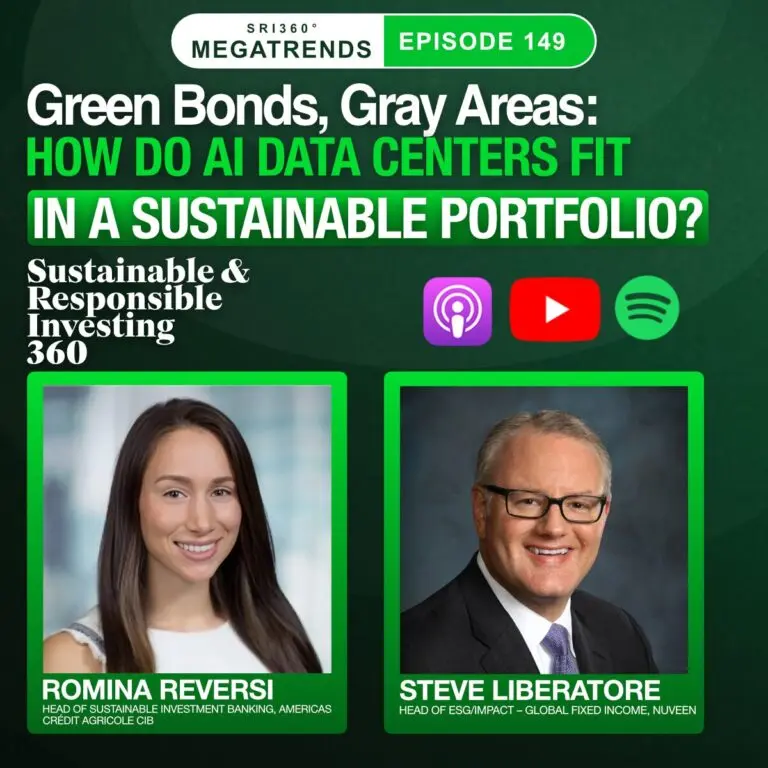
For the first SRI360° Megatrends episode, Scott Arnell brings back two previous guests who sit on opposite sides of the same trade. Romina Reversi structures green bonds for data center issuers; Steve Liberatore decides whether Nuveen owns them. The question underneath the whole conversation: how does a sustainable portfolio own any part of the AI build-out without taking the label on faith?
KEY TAKEAWAYS
The label is a communication tool, not proof
Romina argues a green framework is how data center issuers show they are handling energy, water, land use and community risk — risks now tied to completion and permitting. Steve, who helped write the Green Bond Principles, doesn’t look at PUE at all. He underwrites power sourcing, location, water and community work instead, because cooling is the biggest cost in a data center and those same factors drive its long-run economics.
Use of proceeds wins; sustainability-linked doesn’t
Romina would start a data center client with a green use-of-proceeds label. For Nuveen, anything sustainability-linked is “a very easy no.”
Capital is the easy constraint — for now
Romina picks power as the binding constraint. Steve agrees permissioning and power are the real problems, and says capital is the easiest of the three. But the hyperscalers, still triple- and double-A names, have gone from massive free cash flow generators to not being free cash flow positive.
Watch the supply
Hyperscaler bond issuance averaged $28 billion a year from 2020 to 2024, topped $100 billion last year, and reached $160 billion in the first five months of this year. When that much paper floods one sector, Steve says, it is “usually a sign of some type of bubble” — which, for a bond buyer, means more diligence on every deal, not less.
The label market is shrinking into one sector
Big Tech issued labeled bonds in 2020 and 2021, then stopped. Romina puts labeled debt at under 1% of US issuance, down from around 5% five years ago, with most of what’s left in data centers — a concentration problem for green bond funds whose investors keep asking for diversification.
The pushback is about who pays
Romina cites a University of Pennsylvania survey from August: about 61% of US adults oppose new data centers in their area, up 12 percentage points from February. Her read is that opposition is about bearing the costs, not about the facilities.
TWO GUESTS, OPPOSITE CHAIRS
Romina Reversi — Head of Sustainable Investment Banking for the Americas, Crédit Agricole CIB. A founding member of J.P. Morgan’s ESG debt capital markets team, she structures sustainable debt for issuers across the Americas. Her team was green structuring agent on Constellation’s 2024 bond, the first US corporate green bond for nuclear energy. She first appeared on SRI360° in episode 84.
Steve Liberatore — Portfolio Manager, Head of ESG/Impact, Global Fixed Income, Nuveen. He runs just over $20 billion of fixed income assets inside a firm that manages more than a trillion dollars, and sat on the original executive committee of the Green Bond Principles. He first appeared on SRI360° in episode 61.
IN THEIR WORDS
“Just because something is labeled a green bond doesn’t mean it is, and just because it isn’t labeled a green bond doesn’t mean it is not.” — Steve Liberatore, Nuveen
“I don’t think people are fundamentally opposed to data centers, it’s that they don’t want to be the ones who are bearing the burden of rising energy costs and decreased water availability.” — Romina Reversi, Crédit Agricole CIB
What success looks like, in their words. For Steve, tracking the impacts in a use-of-proceeds deal is “the roadmap” for checking whether an issuer’s free cash flow improvement is actually on track. For Romina, it comes down to “the criteria, the transparency, and the expected impact metric reporting.”
Listen to the full conversation.
–
Listen to the episode on Apple Podcasts, Spotify, Overcast, Podcast Addict, Pocket Casts, Castbox, YouTube Music, Amazon Music, or on your favorite podcast platform. You can watch the interview on YouTube here.



What was your favorite quote or lesson from this episode? Please let me know in the comments.
SHOW NOTES:
[00:00] Labeled green doesn’t mean it is
[00:48] $700–800 billion of capex, and 71% who don’t want a data center near them
[03:17] One structures the paper, one decides whether to own it
[05:12] Argue the other side: what keeps a banker up at night
[08:31] If the whole market goes down a sinkhole, is it still green?
[11:00] PUE 1.5: “I still don’t know what it really means”
[15:12] 98% refinancing: what does a green label actually add?
[16:53] What gets a no, and the one red flag that makes Nuveen walk away
[18:57] Sustainability-linked bonds: “a very easy no”
[21:18] Capital, power or permission: which one stops a project?
[27:02] Who’s on the hook when the power is five to seven years away?
[30:02] $160 billion in five months: when issuance floods one sector
[32:07] Why Big Tech stopped labeling its bonds
[34:23] GPU-backed private credit and NVIDIA’s $105 billion backstop
[37:14] A ninefold jump in grid capacity prices
[40:01] Three Mile Island, nuclear green bonds, and a flat no
[43:25] Are data centers cannibalizing clean power?
[47:28] On-site gas: a 40-year asset for an 18-month problem
[50:59] Permission: who pays for the grid?
[57:07] AI’s politics: when cost savings means job elimination
[01:01:07] Data centers in orbit: Skynet, or “why not?”
[01:06:42] Rapid fire: transition catalyst or relabeling?
[01:09:00] One principle for your investment committee
Additional Resources:
- Romina Reversi on LinkedIn
- Crédit Agricole CIB — sustainable finance – website
- Steve Liberatore on LinkedIn
- Steve Liberatore at Nuveen – website
RELATED EPISODES:
Episode 84 — Romina Reversi on why green bonds still struggle with investor trust — Romina’s first appearance, and the 98% refinancing debate this episode picks up.
Episode 61 — Steve Liberatore on why public fixed income does more impact work per dollar — The case behind Steve’s line that the instrument matters as much as the intention.