
The annual financing gap facing the United Nations Sustainable Development Goals (SDGs) stands at approximately $4 trillion for developing economies, according to the 2024 Financing for Sustainable Development Report published by the United Nations Conference on Trade and Development (UNCTAD). Set against that vast shortfall, the operational instinct across the impact investing sector is to accelerate deployment, maximize transaction volume, and accept any available capital that flows toward social or environmental objectives. In practice, that instinct frequently produces costly structural failures.
The pressure to execute transactions permeates both sides of the table. Private fund managers face deployment pacing targets, management fee schedules, and fund investment periods. Philanthropic and developmental organizations confront annual disbursement cycles. Operating enterprises in emerging and underserved markets face persistent working capital constraints. In an ecosystem governed by that deployment pressure, deliberately refusing available capital because its structural terms fail to fit the enterprise requires rigorous institutional discipline that the market has not systematically fostered.
I recently spoke with Laurie Spengler, Founder and Chief Executive Officer of Courageous Capital Advisors. Her perspective on this challenge is unequivocal: ‘Walking away is actually discipline. It is not failure, it is discipline.’ That framing reframes deal rejection from a failure of negotiation into the essential exercise of professional underwriting and governance.
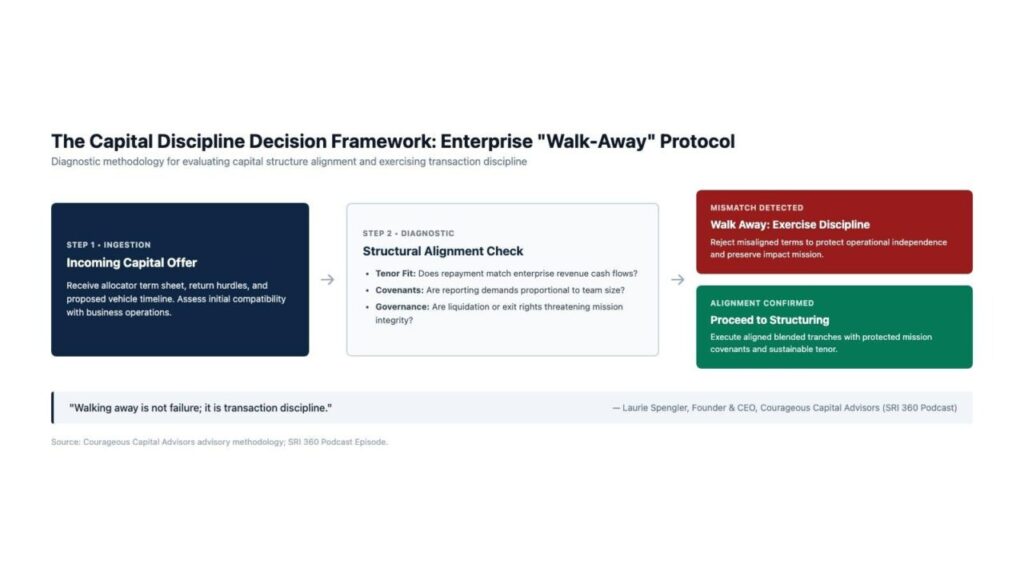
Figure: The enterprise walk-away evaluation protocol: diagnostic decision framework for assessing capital alignment and exercising transaction discipline.
THE DEAL PRESSURE THAT SHAPES THE MARKET
Impact investing operates under a permanent sense of social urgency that has no direct parallel in traditional commercial finance. The financing shortfall is visible in real-world deficits: unbuilt clinics, unfunded agricultural cooperatives, deficient rural power grids, and unfinanced housing communities. Refusing capital directed toward those critical needs can feel morally indefensible to enterprise founders and board members.
That moral urgency often flattens the vital distinction between capital that is accessible and capital that structurally fits the enterprise. A structured credit facility carrying a seven-year maturity and floating commercial interest rates may be offered to a Community Development Financial Institution (CDFI), a specialized, certified financial entity dedicated to expanding credit in economically distressed and historically underbanked communities. While the capital is branded as impact funding, the instrument’s timeline directly contradicts the CDFI’s generational community lending horizon. Accepting that capital introduces balance sheet instability that surfaces long before the facility matures.
The harm caused by misaligned capital is institutional and operational. When an enterprise accepts capital structured around investor preferences rather than operational cash flows, it is compelled to make cascading strategic compromises. It revises growth targets, defers community initiatives, redirects staff toward compliance reporting, and renegotiates operating covenants. The enterprise may survive, but its original impact purpose is diluted to satisfy investor requirements.
WHAT MISALIGNED CAPITAL ACTUALLY COSTS
The most frequent source of structural friction in impact finance is the conflation of patient capital with permanent capital. While frequently used as interchangeable marketing terms, they describe fundamentally different financial instruments with opposing governance implications.
Patient capital refers to investment capital willing to accept an extended gestation period, often tolerating below-market returns or delayed cash distributions over five to ten years. However, patient capital remains structured within closed-end fund vehicles that require a liquidity event, refinancing, or enterprise sale at fund maturity. Permanent capital, by contrast, is evergreen equity or perpetual subordinated capital with no mandated redemption date, exit horizon, or liquidity requirement. It resides on the company’s balance sheet indefinitely, allowing leadership to reinvest operational surpluses and plan across decades.
Community housing developers, conservation forestry enterprises, and microfinance networks inherently require permanent capital. Their business models operate with thin operating margins, gradual equity accumulation, and long asset depreciation cycles. When these organizations accept patient capital because true permanent capital is unavailable, they take on exit obligations their operational models cannot service. The resulting refinancing crunch often forces asset sales or mission abandonment.
For institutional investors, the consequence of a misaligned transaction is equally destructive. Capital becomes trapped in illiquid, underperforming positions requiring intensive covenant renegotiations, workout committees, or emergency restructuring. These entanglements deplete executive resources and generate reputational friction for fund managers who promised their limited partners seamless impact performance. Identifying and preventing structural mismatch during initial transaction design is far less costly than managing an operational restructuring post-deployment.
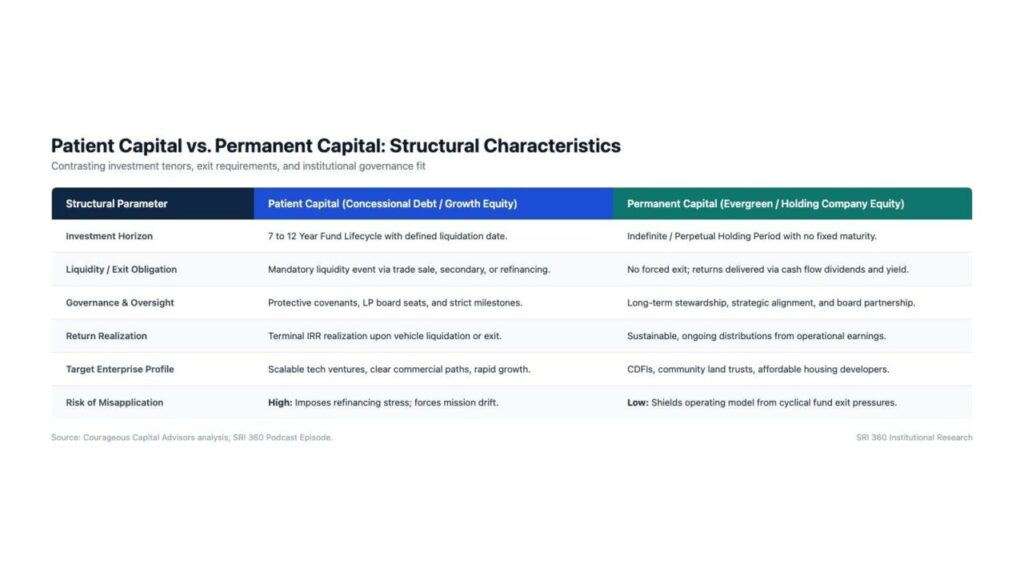
Figure: Patient capital versus permanent capital: institutional comparative parameters, exit mechanics, and enterprise suitability.
DEMYSTIFYING THE FINANCIAL MECHANICS OF ALIGNMENT
Evaluating capital alignment requires fluency in the specific financial instruments and structuring mechanisms that govern institutional transactions. Too often, capital negotiations falter or produce misaligned contracts because technical financial jargon obscures the practical operating risks being transferred to the enterprise.
A central concept in structured impact transactions is the layered capital stack, where an investment vehicle is sliced into horizontal tiers or tranches, each possessing a distinct priority of repayment, risk profile, and return expectation. At the base of this stack sits first-loss capital, the most junior, subordinate layer in the vehicle. In the event of borrower defaults or portfolio impairment, the first-loss tranche absorbs initial losses up to its total committed value before any mezzanine or senior commercial lenders incur a reduction in principal. By absorbing this initial risk, first-loss capital provides a protective credit cushion that de-risks the vehicle, allowing senior institutional investors, such as pension funds and insurance companies bound by fiduciary duties, to participate at investment-grade risk levels.
The quantitative efficiency of this structure is measured by the mobilisation ratio, also referred to as the private capital mobilization ratio. This metric calculates the total volume of private commercial capital unlocked for every single dollar of catalytic or concessional public funding deployed. For example, if a $25 million catalytic commitment enables a fund to secure $1 billion in commercial institutional commitments, the transaction achieves a mobilisation ratio of 40 to 1. Tracking mobilisation ratios allows development finance institutions and foundations to measure how effectively their risk-tolerant capital mobilizes private commercial investment.
Catalytic capital and concessional capital represent funding provided by philanthropic foundations, bilateral development agencies, or multilateral institutions on terms deliberately more flexible or lenient than commercial market standards. This capital accepts subordinated payment positioning, concessionary return hurdles, or extended liquidity horizons specifically to absorb transaction risks that commercial capital will not bear.
One of the most powerful instruments in this category is the unfunded guarantee, a binding contractual credit enhancement wherein a creditworthy guarantor, such as a major philanthropic foundation or development finance institution, pledges to reimburse senior lenders up to a defined monetary cap if underlying assets default, without transferring upfront cash. The guarantor maintains its capital in its own liquid reserves, only disbursing cash if a default occurs, while the senior lenders gain the credit comfort needed to release commercial capital.
At the loan execution level, enterprises must scrutinize debt covenants, which are legally binding contractual restrictions and operational performance thresholds embedded in credit agreements. Positive covenants mandate specific borrower behaviors, such as providing audited financial statements or maintaining minimum insurance coverage, while negative covenants restrict enterprise actions, such as capping additional debt incurrence, limiting executive compensation, or prohibiting asset sales. Financial covenants impose strict numerical ratios, such as minimum debt service coverage ratios (the ratio of operating cash flow to debt servicing obligations) or minimum liquidity buffers. For an impact enterprise facing seasonal agricultural revenue or macroeconomic fluctuations in emerging markets, overly rigid covenants designed for developed-market corporations can trigger technical defaults even when the underlying enterprise is solvent and growing.
Furthermore, cross-border impact enterprises must manage foreign exchange (FX) exposure, the financial vulnerability that occurs when a company borrows in hard foreign currencies like US dollars or Euros while generating operational revenues in volatile domestic currencies. If the local currency depreciates against the borrowing currency, the enterprise’s local-currency debt servicing burden escalates immediately, turning an operationally sound business into an insolvent borrower. Sound transaction structuring requires specialized currency hedging facilities or local-currency lending structures to neutralize this risk.
WHEN STRUCTURE IS THE CONSTRAINT
Operating on the side of the entity seeking capital makes the structural diagnostic central to Courageous Capital Advisors’ practice. The initial inquiry in any transaction advisory engagement is not whether institutional capital is available, but whether the capital on offer will permit the enterprise to execute its mission across the full life of the vehicle without requiring destabilizing compromises.
Affordable housing developers require long-term, fixed-rate debt that mirrors the twenty-to-thirty-year operating life and tenant leasing cycles of their real estate developments. Microfinance networks in developing markets require local-currency credit facilities to eliminate foreign exchange risk that has historically driven viable institutions into currency-induced insolvency. Community Development Financial Institutions serving rural, distressed populations require equity that carries no mandatory redemption covenants that would force them to liquidate community loan portfolios.
Spengler emphasizes that professional sell-side advisory includes the explicit fiduciary duty to advise an enterprise leadership team to reject a capital offer, even when management has spent months pursuing it. Delivering that recommendation demands a precise understanding of capital structuring and the standing to prioritize long-term enterprise solvency over transaction closing fees. Capital discipline cannot be imposed from the outside; it requires governance commitment from the enterprise’s board of directors and chief executive.
THE SDG LOAN FUND AS A CASE IN FIT
The SDG Loan Fund provides an institutional demonstration of how structural alignment unlocks large-scale commercial capital while shielding frontline borrowers. Co-created by Allianz Global Investors and FMO (the Dutch entrepreneurial development bank), the fund was structured to deploy $1.1 billion in private debt across financial inclusion, renewable energy, and sustainable agriculture across more than 80 developing and frontier economies.
The vehicle’s capital structure incorporated a $25 million unfunded guarantee from the MacArthur Foundation through its Catalytic Capital Consortium, paired with a subordinate first-loss investment tranche provided by FMO. By absorbing initial portfolio credit risk, this junior concessional layer provided sufficient credit enhancement to unlock over $1 billion in senior debt from institutional asset managers, including Allianz and Swedish pension fund Skandia. The resulting mobilisation ratio exceeded 40 to 1, demonstrating that institutional scale is achieved when risk is allocated to the balance sheets best equipped to absorb it.
The MacArthur guarantee succeeded not because of its gross financial scale, but because it was inserted into the exact tier of the capital stack where institutional credit committees required protection. Had that same $25 million been distributed across senior notes or deployed as fragmented project grants, it would have failed to mobilize private institutional capital. In blended finance and impact investing, structure is not financial decoration; it is the fundamental mechanism that determines whether capital functions or fails.
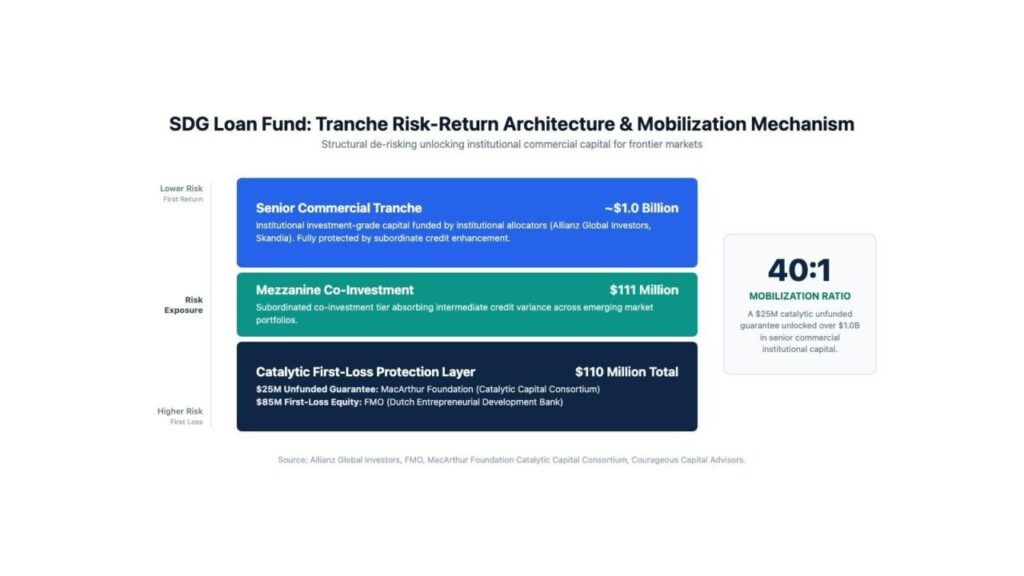
Figure: SDG Loan Fund tranche risk-return architecture: $25M MacArthur catalytic guarantee mobilizing over $1.0B in senior commercial capital.
THE DISCIPLINE OF THE DELIBERATE NO
The institutional logic underpinning capital discipline is straightforward: executing a structurally flawed transaction creates operational liabilities far more expensive to remediate than the immediate capital injection was worth. The practical barrier is temporal: the commercial pressure to close transactions is immediate, whereas the operational consequences of covenant mismatch or premature refinancing deadlines only emerge two to four years into a fund’s lifecycle.
Historically, the impact investing industry has evaluated success using headline volume metrics: gross capital committed, vehicles closed, and headline mobilisation ratios. While these metrics were helpful in demonstrating market emergence, they provide no verification of whether individual capital structures sustained the operational health of the underlying enterprises.
A mature impact market that institutionalizes capital discipline, where independent advisors are retained to evaluate structural fit and empowered to advise against flawed transactions, may execute fewer transactions in the immediate term. However, the transactions that close under this standard will demonstrate superior operational stability, mission preservation, and commercial resilience over the long term. That track record of durability is the only credible foundation for institutional capital mobilization at global scale.
This episode of the SRI 360 podcast featuring Laurie Spengler is available at https://sri360.com/podcast/laurie-spengler/ The discussion examines the structural prerequisites for institutional capital discipline, the mechanics of layered capital stacks, and the strategic distinction between patient and permanent capital.
To access comprehensive podcast interviews and institutional analysis covering global sustainable finance, explore the SRI 360 platform archive at https://sri360.com/podcast/