The numbers tell a precise story of the gap. In 2024, blended finance deals globally totalled $18 billion across 123 transactions. The annual climate investment requirement for developing countries alone runs to $1.3 trillion. The blended finance market, after more than a decade of growth, is operating at roughly 1.4 percent of the scale required for the problem it is supposed to address. The OECD has a phrase for this: cottage industry.
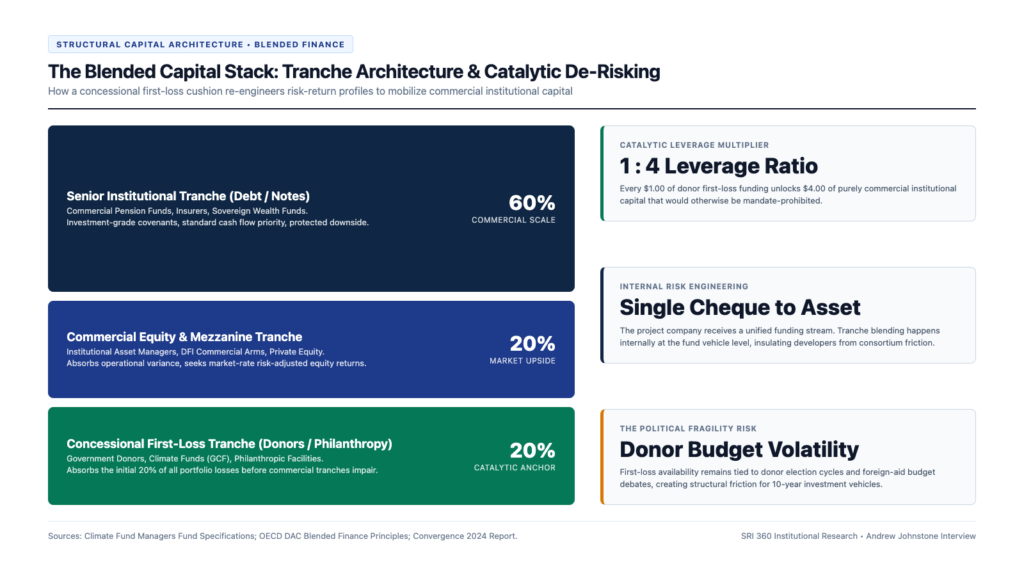
Blended finance capital stack: first-loss tranche and commercial leverage
I recently spoke with Andrew Johnstone, Chief Executive Officer of Climate Fund Managers (CFM), whose firm manages the Climate Investor One (CIO) facility, one of the most cited examples of blended finance working as designed. After more than 10 years of building funds that use concessional first-loss capital to unlock commercial investment in emerging market infrastructure, he is direct about the gap between what the model demonstrates at fund level and what it has achieved at market level. The diagnosis he offers is institutional, not structural.
THE OECD VERDICT AND WHAT IT ACTUALLY MEANS
The Organisation for Economic Co-operation and Development (OECD) has characterized blended finance as having remained a “cottage industry” of largely bespoke, fragmented interventions, a description formalized in its blended finance guidance materials. The Convergence State of Blended Finance 2024 report provides the market data behind that verdict: 123 deals reached close in 2024, with a median transaction size of $65 million. Three individual transactions exceeded $1 billion. For a financing mechanism that has been presented for a decade as the tool capable of mobilizing trillions of private capital into climate and development infrastructure, these are not market-scale numbers.
The cottage industry critique is both accurate and slightly misleading. It is accurate in that blended finance has not produced the standardized, off-the-shelf investment product that pension funds and insurance companies can buy in volume. It is slightly misleading in suggesting that the primary bottleneck is product design. Johnstone, who has lived in the middle of this problem for a decade, locates the primary bottleneck elsewhere.
THE STRUCTURAL REASONS THE MODEL DOES NOT REPLICATE
The first reason is diligence friction. Every institutional investor has a due diligence process that must be completed before capital is committed, regardless of how similar the new fund is to one the investor already reviewed and approved. Personnel turnover at pension funds and insurance companies means that the team that approved fund one may not be present for fund two. Their successors run the review from the beginning. Each iteration consumes six to eighteen months. The economics of running that process for a $50 million allocation to a fund that has already been audited by the same institution are difficult to justify, but the compliance requirement does not bend to the economics.
The second reason is a preference problem that sits inside institutions rather than between them. Investors who would benefit from standardization on one hand want their own specific features on the other. Blended finance funds are technically collective investment schemes where all participants agree to a common mandate. In practice, the standard documentation is supplemented by a substantial volume of side letters that carve out individual investor requirements. Every carve-out erodes the standardization that would make replication cheaper. The result is a fund that is standardized in architecture but bespoke in execution.
The third reason is political instability. Blended finance requires sustained commitment from public donors for the first-loss layer, and donor budgets are set by governments. Johnstone notes that one of the things he did not anticipate when founding CFM in 2015 was how much more volatile the public sector would prove relative to the private sector. He had assumed governments were the stable party in the table. Over the following decade, the Netherlands cycled through four governments, aid budgets in major donor countries came under sustained political pressure, and US foreign assistance was effectively dismantled under one administration. The commercial investor sitting in the senior tranche of a blended fund needs confidence that the first-loss layer will not disappear mid-fund.

Institutional investment committees and fiduciary due diligence constraints
WHAT STANDARDIZATION WOULD REQUIRE
The OECD DAC Blended Finance Guidance is specifically designed to address the cottage industry problem by pushing practitioners toward more repeatable structures. Johnstone’s view, from inside a fund manager that has been held up as evidence that standardization is possible, is that the limiting factor is not primarily product design. It is the incentive structure of the institutions that need to participate.
CFM has replicated the same fund architecture three times across Climate Investor One, Climate Investor Two (water and oceans), and Climate Investor Three (industrial decarbonization and hydrogen). The architecture is copy-and-paste. The fundraising timeline is not, because each new fund requires a fresh diligence cycle from each investor, and the due diligence processes at institutional investors are not designed for previously-reviewed structures.
Two things would actually shift this. First, a category of rated, standardized blended finance notes that institutional investors could buy without fund-level diligence, analogous to what green bonds provided for use-of-proceeds financing but with a first-loss structural element embedded. Second, a durable and predictable supply of concessional first-loss capital that does not depend on the political cycle in donor countries. Neither exists at scale today. The bridge-to-bond structure that CFM is developing with the Climate Bonds Initiative is an attempt to solve the first problem by using guarantees to connect a partially-built portfolio to listed bond markets. It is a promising architecture and, at $100 million test size, too small to move the dial.
The OECD’s cottage industry verdict is not a criticism of the funds themselves. The funds work. Climate Investor One has developed over 70 projects, completed construction on 16, refinanced seven or eight, and exited three. The model is proven. What has not been proven is that the institutional ecosystem around the model can support it at a scale that closes any meaningful fraction of the $1.3 trillion annual developing-country climate finance gap. That gap keeps growing while the ecosystem debates the terms of the next fund.
It is also worth being direct about a more fundamental constraint that sits beneath all three structural problems. Even if diligence friction were eliminated, preferences aligned, and political instability resolved, the total pool of capital currently available for blended finance mandates would remain far too small to move the dial on a multi-trillion-dollar gap. The institutional capital that could theoretically be mobilised for climate infrastructure in emerging markets is not absent because of a pipeline problem or a structuring problem alone. There is simply not enough money currently committed or commitable to blended finance mandates to generate the volume of impact that is needed. Solving for friction and standardisation matters, but it matters most in a world where the supply of willing capital has already grown to match the scale of the challenge. That precondition has not yet been met.
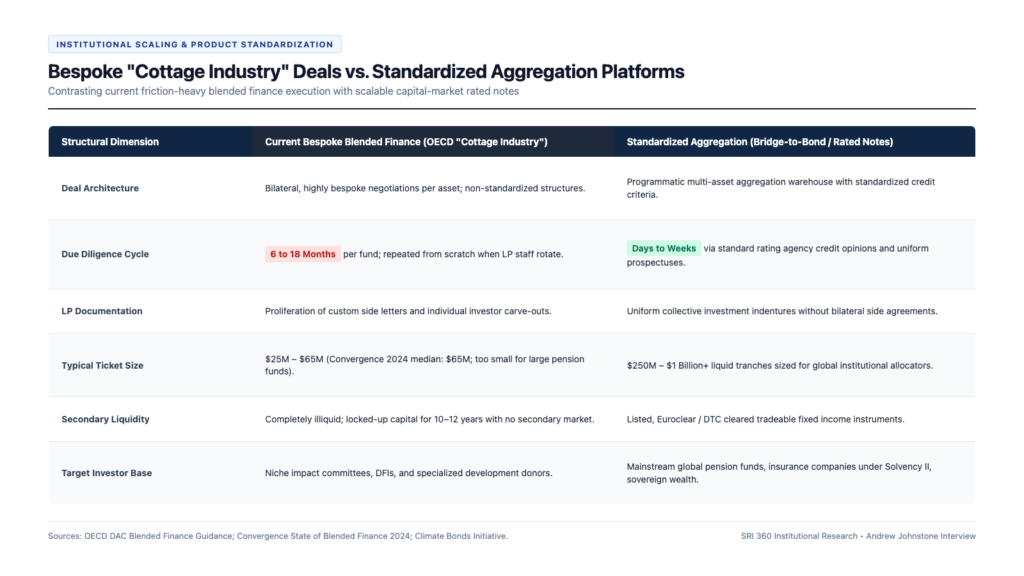
Bespoke cottage industry deals vs. standardized aggregation platforms
The full conversation with Andrew Johnstone is available at https://sri360.com/podcast/andrew-johnstone/. It covers the OECD’s cottage industry verdict, the structural obstacles to standardization, the fee debate, and how Johnstone frames the next decade of climate infrastructure finance.
For more conversations at the intersection of institutional investing and sustainable finance, visit the SRI 360 podcast platform.