Blended finance has accumulated enough jargon around it that the underlying mechanism can be difficult to see. Catalytic capital, concessional tranches, first-loss facilities, risk-adjusted mobilization ratios: each term is technically accurate and each one obscures the same basic fact. A blended finance vehicle is a capital structure. It has equity that absorbs losses first, mezzanine that absorbs losses next, and senior debt that gets paid first. The only difference from a regulated bank or a leveraged buyout fund is that the equity is provided by entities that accept below-market returns in exchange for verified development or climate impact. The architecture is not novel. What is new is who fills the bottom of the stack and why.
I recently spoke with Clemens Calice of Cygnum Capital, which manages seven funds across African credit markets, including the African Local Currency Bond Fund (ALCB Fund) established in partnership with KfW, the German development bank. His description of how these structures actually work in practice is the clearest account I have heard of why blended finance is not a charitable arrangement layered on top of an investment but a functioning capital structure that assigns risk to the party best equipped to absorb it.
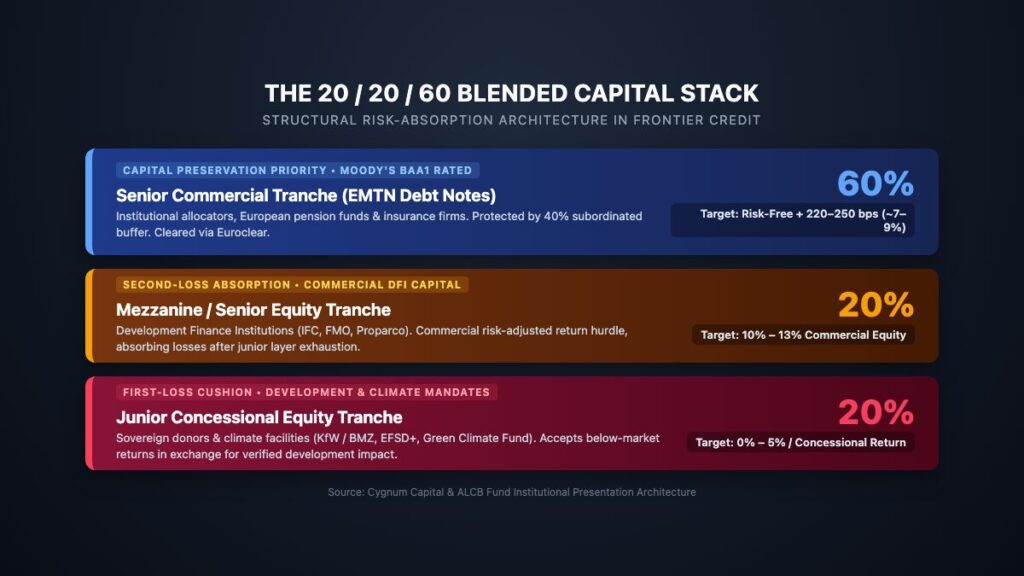
The mechanics of alignment: catalytic public equity absorbing first-loss to unlock commercial pension capital at scale.
WHAT BLENDED FINANCE IS ACTUALLY DOING
Convergence, the global network for blended finance, defines it not as an asset class but as a structuring approach: one where catalytic public or philanthropic capital lowers perceived or actual risk to mobilize private commercial capital. As of the most recent data available through Convergence’s published blended finance primer, blended finance has mobilized approximately $295 billion in aggregate capital toward sustainable development across around 6,800 financial commitments.
The four archetypes Convergence identifies all share a common function. Concessional capital within the capital structure provides first-loss absorption or lowers the cost of capital. Guarantees and risk insurance shift default risk to a public balance sheet. Grant-funded technical assistance reduces transaction costs and builds deal pipeline. Design-stage grants help structure transactions that would otherwise not reach investability. In each case, public money is doing something that unlocks private money to follow at scale.
What this means in practice is that a blended finance fund is not a welfare program that happens to use financial instruments. It is a mechanism for matching risk appetite to risk exposure. The equity layers take on losses that a commercial investor cannot accept at scale. In exchange, they claim impact returns, whether measured in avoided carbon emissions, affordable credit deployed to underserved borrowers, or households connected to renewable electricity. The senior layer gets the credit quality it needs and the ticket size it requires to deploy efficiently.
The analogy that makes the structure legible for institutional investors is a bank’s own capital structure. A bank holds Tier 1 equity that absorbs the first losses, Tier 2 capital in a mezzanine position, and senior deposits and bonds that are the last to be impaired. Regulators require this layering precisely because it ensures that credit losses fall on equity holders before they reach depositors. A blended finance fund applies the same logic: concessional equity at the bottom, commercial equity in the middle, and rated debt at the top. The difference is that the bottom equity provider is a donor government rather than a private shareholder.
THE THREE LAYERS AND WHAT EACH ONE EXPECTS
The 20/20/60 ratio that Calice uses to describe the ALCB Fund’s capital stack captures the approximate proportions that have emerged from operational experience in frontier African credit markets. The specifics vary by fund and by transaction, but the structure is consistent, and the logic behind each proportion is worth understanding.
The junior equity tier (approximately 20 percent of the capital structure) is funded by concessional capital from donor governments and climate facilities. Junior, in capital structure terms, means lowest in seniority: this tranche is the first to absorb losses if any occur, and the last to receive repayment. For the ALCB Fund, this includes the German government via KfW and contributions through the European Union’s EFSD+ (External Investment Plan Guarantee) and the Green Climate Fund. This tranche accepts below-market returns and absorbs the first losses in the portfolio. Without it, the credit losses that inevitably occur in any portfolio of frontier market corporate debt would be distributed across all investors, raising the effective risk of every dollar in the fund to the point where commercial capital cannot participate.
The decision to deploy capital in the junior equity position is not purely philanthropic. These investors receive verified impact data: the number of borrowers served, the carbon emissions avoided, the jobs created or sustained, the hectares of agricultural land supported. For government development agencies operating under development effectiveness mandates, this impact return is the primary metric, and the financial return is secondary. That mandate alignment is what allows them to take a below-market financial position without violating their fiduciary obligations.
The senior equity or mezzanine tier (approximately 20 percent) is funded by commercial DFIs (development finance institutions) such as FMO (the Dutch development bank), the IFC, and Proparco (the French development finance institution). These institutions require commercial or near-commercial risk-adjusted equity returns. They are not making concessions on return. But they are accepting a middle position in the capital structure, which means their capital absorbs losses only after the junior equity is fully exhausted. Their presence in the stack also signals creditworthiness to the commercial investors above them: a fund that has FMO and IFC as equity holders has undergone their respective due diligence processes, which reduces the information asymmetry problem that otherwise makes institutional investors reluctant to allocate.
The senior leverage tier (approximately 60 percent) is where purely commercial institutional capital sits. For the ALCB Fund, this layer is accessed through Euro Medium Term Notes (EMTNs) rated Baa1 by Moody’s. The rating reflects the structural protection provided by the two equity layers below, not the average credit quality of the underlying frontier market borrowers. The notes are benchmarked against comparable regional development bank paper, such as Afreximbank paper trading around risk-free rate plus 220 to 250 basis points, giving European institutional debt investors a reference point that fits within standard fixed income frameworks and can be evaluated without expertise in frontier African corporate credit.
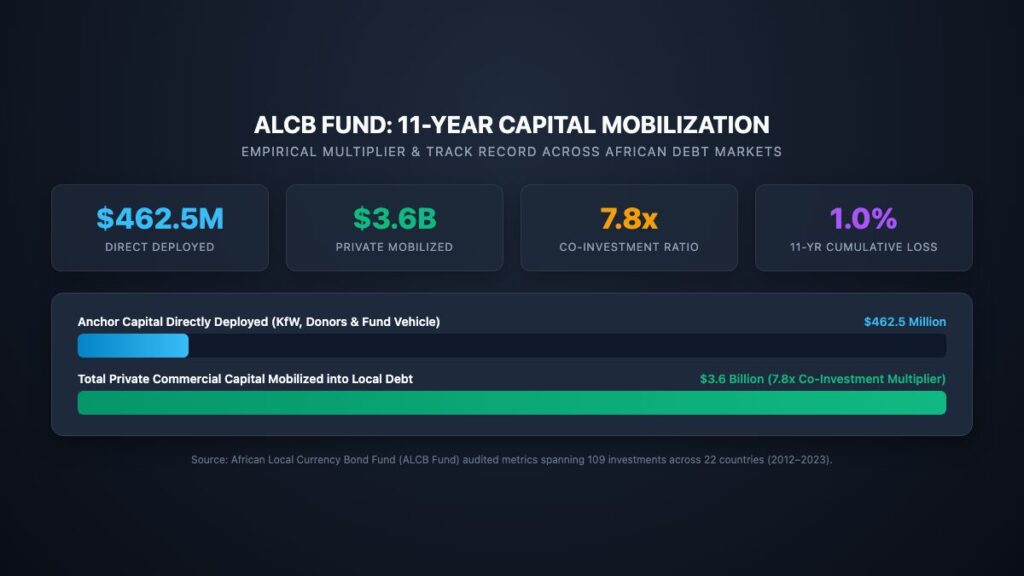
Catalytic leverage in action: turning less than half a billion in anchor capital into nearly four billion of private deployment.
WHY COMMERCIAL INVESTORS GET INVESTMENT-GRADE EXPOSURE TO FRONTIER CREDIT
The Baa1 rating is the mechanism that allows a European pension fund or insurance company to hold exposure to corporate borrowers in Tanzania, Rwanda, or Senegal without classifying the allocation as speculative grade. The underlying borrowers are not Baa1-rated entities. The instrument is, because the structure around it has absorbed enough risk that the probability of loss reaching the senior notes is remote under the scenarios Moody’s models.
This is how the leveraged lending market has always worked. A senior secured loan to a mid-market company with a Ba3 corporate rating can itself be rated investment grade because the collateral package, the covenant structure, and the subordination of other tranches provide credit enhancement at the instrument level. The blended finance fund applies the same logic to frontier market corporate debt, with concessional equity playing the role that subordinated corporate debt and collateral play in a leveraged deal.
The difference is that the junior equity providers are not expecting to be made whole in the usual commercial sense. They are accepting that their capital absorbs losses in exchange for verified development outcomes: local currency bonds mobilizing private sector financing for small and medium enterprises (SMEs), renewable energy installations, and affordable housing across 22 African countries. That is the bargain that makes the senior note rating possible, and the senior note rating is what makes the structure accessible to institutional allocators who cannot hold unrated or speculative paper under their investment mandates.
THE ROLE OF THE RATING IN MAKING THE STRUCTURE ACCESSIBLE
It is worth being precise about what the Baa1 rating does and does not do. It does not mean that the fund’s underlying borrowers have investment grade credit quality. A microfinance institution in Senegal issuing a local currency bond through the ALCB Fund is not a Baa1 credit. The rating applies to the EMTN issued by the fund vehicle, reflecting the structural credit enhancement of the stack below.
What the rating does, functionally, is route the instrument into the standard fixed income compliance infrastructure of institutional investors. A European insurance company operating under Solvency II (Solvency 2) has specific capital charge tables that govern the regulatory capital it must hold against different asset categories. A Baa1-rated EMTN issued under English law and cleared through Euroclear is a category of asset that those tables handle. An unrated loan to a Senegalese microfinance institution is a category of asset that requires a bespoke internal rating model, additional legal review, and likely a higher capital charge, regardless of whether its realized default risk is actually higher.
This regulatory asymmetry has material consequences. Even when the underlying credit risk of a frontier African portfolio is demonstrably equivalent to, or better than, comparably rated developed market credits, the regulatory treatment of the instrument adds a cost that makes direct access to frontier markets less attractive for regulated institutional investors. Rated blended finance structures work around this by presenting the institutional investor with an instrument that fits the existing compliance framework.
THE LIMITS OF THE STRUCTURE
Blended finance is not a mechanism for unlimited capital mobilization. The 7.8x co-investment multiplier that the ALCB Fund reports (approximately $3.6 billion in private sector capital mobilized against $462.5 million deployed) reflects what is achievable with a mature, rated, multi-tranche structure in a specific asset class with a 12-year track record. Not every frontier market asset class can support that kind of leverage. Not every donor capital base is large enough to anchor a structure at scale.
There is also a dependency that the model does not resolve: the junior equity tier requires ongoing commitment from donor governments and climate finance facilities. If concessional capital flows shift, or if development finance priorities change, the bottom of the stack weakens and the leverage available to the senior tiers contracts. The commercial investors are participating precisely because the structural protection is there; reduce that protection and the returns required to attract them rise, which pushes up the cost of capital for frontier borrowers.
The capital stack works. The track record demonstrates it. The remaining constraint is not the structure itself but the regulatory environment around it and the ongoing supply of concessional anchor capital to keep the junior equity tier funded at scale.
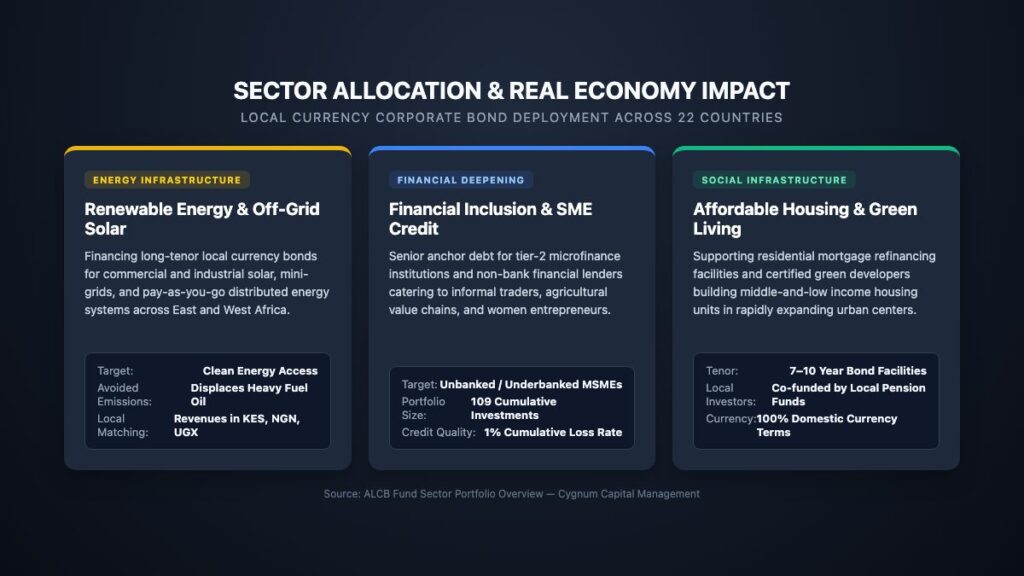
Directing patient capital where it matters: financing essential services and domestic growth drivers across Africa.
The full conversation with Clemens Calice is available at https://sri360.com/podcast/clemens-calice/. The episode covers the design logic of the 20/20/60 capital stack, the ALCB Fund’s origination history, and the structural conditions under which institutional capital can access frontier African credit at scale.
For more conversations at the intersection of sustainable finance and institutional investing, visit the SRI 360 podcast platform.