Currency risk in cross-border African lending has a standard institutional response: use a currency swap. The problem is that standard hedging markets do not extend to most of Africa’s frontier economies. Commercial foreign exchange hedging is routine against major emerging market currencies, but against the Kenyan shilling, the Tanzanian shilling, the Ugandan shilling, or the Zambian kwacha, a liquid commercial hedging market does not exist. Currency swaps are a well-established instrument. What they require is a counterparty willing to take the other side of the trade at a price that leaves any economic logic in the underlying loan. In most frontier African currencies, that counterparty does not exist at commercial terms. This is not a generalised problem affecting all African finance. It is a specific problem affecting the segment of African borrowers that development-oriented institutional capital is most trying to reach: the financial inclusion providers, renewable energy distributors, and affordable housing developers that operate in local currency and service markets with no meaningful hard currency revenue. The choice most cross-border lenders make, denominating debt in dollars or euros and leaving currency exposure on the borrower’s balance sheet, is not always careless. In the absence of accessible hedging infrastructure, it is often the only viable structure available. What it produces is a systematic mechanism for converting exchange rate moves into credit events that are entirely disconnected from borrower quality.
I recently spoke with Clemens Calice of Cygnum Capital. His firm has built African local currency bond programs operating across 22 frontier markets using a specialised currency intermediation facility that fills the gap left by commercial hedging markets. The performance data from eleven years of operation is precise enough to make the case for the structural approach without needing much further argument.
Where domestic balance sheets meet real assets: local currency debt deployed across 22 African markets.
THE MISMATCH THAT TURNS SOLVENCY INTO DEFAULT
The foreign exchange mismatch problem is not subtle. A microfinance institution in Uganda lends to farmers whose harvests are priced in Ugandan shillings. If that institution borrows in dollars from an international lender, it must either pass the currency risk to its borrowers (making their effective interest rates unpredictable) or absorb it on its own balance sheet (making its own solvency vulnerable to a currency move it cannot control). Neither outcome serves the underlying credit quality of the loan portfolio.
This is not a hypothetical risk. Between 2014 and 2016, the Ghanaian cedi lost approximately 50 percent of its value against the US dollar. Microfinance institutions and corporate borrowers in Ghana that had taken on dollar-denominated debt found their debt service obligations effectively doubling in local currency terms, even as their revenues remained stable. Several institutions that had been considered sound credits entered distress or default not because their underlying business deteriorated but because the currency assumption baked into their borrowing structure failed catastrophically.
Multiply this pattern across hundreds of institutions across dozens of African countries over multiple currency cycles, and you get a structural distortion where the proximate cause of defaults is not borrower credit quality but currency volatility layered on top of viable businesses. That pattern helps explain why Africa’s aggregate credit default statistics tend to look worse than the underlying business fundamentals of individual borrowers would predict. The structure is generating credit events that the borrower’s commercial performance would not.
The solution sounds straightforward: lend in the borrower’s local currency. The practical difficulty for international capital has always been that doing so requires accepting local currency returns, which introduces its own volatility relative to the hard currency benchmarks that institutional investors use. A European pension fund whose liabilities are denominated in euros cannot simply absorb Kenyan shilling returns; the currency translation creates a reporting and regulatory problem that most investment committees are not equipped to manage.
The African Local Currency Bond Fund (ALCB Fund), established in 2012 by the German development bank KfW on behalf of the German Federal Ministry for Economic Cooperation and Development (BMZ), was built to resolve exactly this problem at the institutional level. The fund acts as an anchor investor in local currency corporate bonds across financial inclusion, renewable energy, affordable housing, agriculture, and healthcare, directly matching the currency of borrowing to the currency of revenue generation across 22 African countries. It was one of the first institutional vehicles to demonstrate that the local currency model is operationally viable at scale, not just theoretically correct.
WHAT ELEVEN YEARS OF LOCAL CURRENCY LENDING ACTUALLY LOOKS LIKE
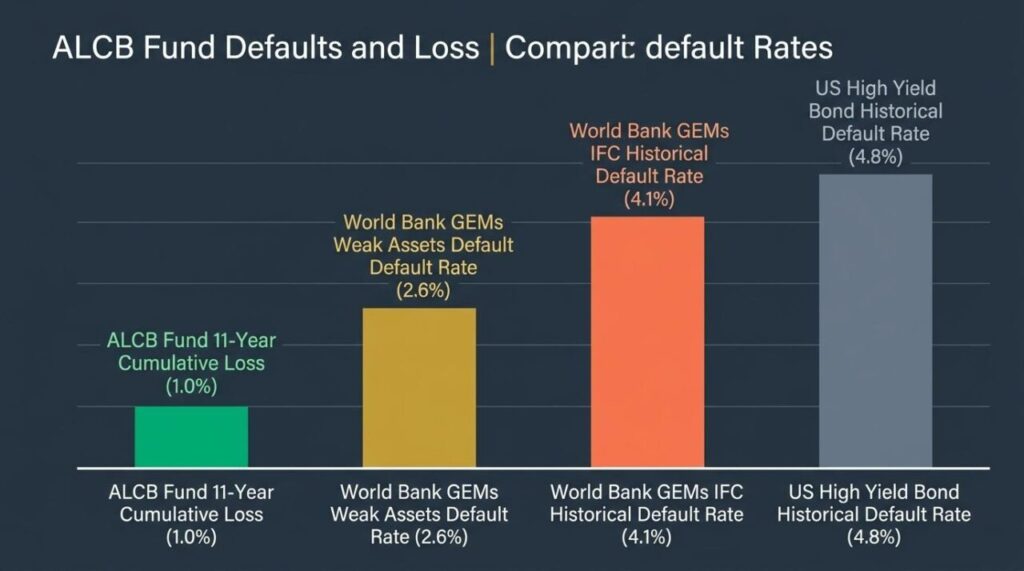
Over eleven years of operation, the ALCB Fund has deployed approximately $462.5 million in cumulative investment, with total private sector capital mobilized reaching $3.6 billion, a co-investment multiplier of 7.8x. Across 109 individual investments, the fund’s cumulative credit loss rate is approximately 1 percent.
That number requires some framing. A 1 percent cumulative loss rate across eleven years is not the outcome you would expect from lending in markets that most institutional investors describe as too risky to enter. It is lower than the 11-year cumulative default rates recorded in sub-investment grade corporate debt in the United States over comparable periods. The difference is not that Africa has become less complex or that the borrowers are exceptionally strong. The difference is structural: when debt is denominated in the same currency as revenue, the mechanism that converts currency volatility into credit events does not exist.
The World Bank Group’s 2024 release of data from the Global Emerging Markets Risk Database (GEMs) Consortium reinforces this finding at the portfolio level. Drawing on credit risk data from 25 multilateral development banks and development finance institutions (DFIs), the GEMs Consortium represents the most comprehensive empirical record of emerging and frontier market credit performance that exists. The IFC’s (International Finance Corporation) private sector loan portfolio across nearly 40 years of data recorded an average annual default rate of 4.1 percent. For assets internally rated as “weak,” default rates between 2017 and 2023 averaged only 2.6 percent. Sovereign borrower defaults averaged 0.7 percent annually, with recovery rates consistently exceeding 90 percent of principal and interest.
These figures matter because they establish a baseline: Africa’s credit markets, in aggregate, do not perform as badly as the institutional narrative suggests. The ALCB Fund’s 1 percent cumulative loss rate over eleven years improves significantly on even that aggregate picture, which suggests that the local currency methodology is itself a credit-enhancing discipline, not just a borrower-friendly accommodation.
Disciplined local currency matching cuts realized default risk well below emerging and developed market baselines.
HOW THE HEDGING INFRASTRUCTURE ACTUALLY WORKS
The logical objection from a European pension fund or insurance company is that even if local currency debt performs better at the credit level, accepting returns benchmarked in Kenyan shillings or Tanzanian shillings creates a currency translation problem relative to their euro or dollar liabilities. That objection is real. It is also solvable, through a mechanism that has been operating for nearly two decades.
The Currency Exchange Fund (TCX) was founded in 2007 by a consortium of DFIs and multilateral donors, including KfW, FMO (Financierings-Maatschappij voor Ontwikkelingslanden, the Dutch development bank), the European Bank for Reconstruction and Development (EBRD), the European Investment Bank (EIB), and the IFC, to address precisely this gap. TCX provides cross-currency swaps and foreign exchange forwards in frontier market currencies where no commercial hedging market exists. By absorbing currency risk onto its own balance sheet, TCX enables lenders to extend local currency financing while receiving returns indexed to a hard currency benchmark. The institutional investor participates in the credit performance of the local currency loan without holding the currency exposure directly.
This structure does not eliminate currency risk from the system. It redistributes it to an entity with the balance sheet, the diversification, and the specific mandate to absorb it at scale. TCX’s portfolio covers a wide range of frontier currencies across Africa, Asia, and Latin America, which means that individual currency dislocations are partially offset by the diversification across the broader portfolio. An entity that only holds Zambian kwacha swaps is highly vulnerable to a Zambian currency event; an entity that holds swaps across 60 or more currencies is in a meaningfully different risk position.
The combination of local currency origination at the borrower level and currency intermediation at the fund level is what allows institutional capital to participate in frontier African debt without either accepting unhedged currency exposure or pushing that exposure back onto the borrower. It separates the two problems that tend to be conflated: the credit risk of the underlying borrower and the currency translation risk of the return. These are distinct problems, and they have distinct solutions.
WHY THE MODEL HAS NOT ALREADY DISPLACED HARD CURRENCY LENDING
If the local currency model produces better credit outcomes and adequate hard currency returns through TCX hedging, the obvious question is why hard currency lending to Africa has not already been replaced by local currency structures as the institutional standard.
The answer is operational. Setting up a local currency bond program in an African market requires regulatory approval from the local securities commission, a local law firm with capital markets experience in that jurisdiction, a local custodian or depository institution, and ongoing compliance with local reporting requirements. Doing this across 22 countries, as the ALCB Fund has, is a multi-year infrastructure project that requires institutional knowledge, local relationships, and patience with regulatory timelines that vary enormously by market.
Hard currency lending, by contrast, is executed under New York or English law, uses familiar documentation, and requires no engagement with local securities regulators. For a first-time lender entering an African market, hard currency is simply faster and cheaper to set up, even if it is structurally inferior for the borrower’s credit profile. The local currency model asks lenders to pay an upfront infrastructure cost in order to get better credit outcomes over time. Many lenders, particularly those without a long-term commitment to a specific African market, are not willing to make that investment.
What the ALCB Fund has effectively done is build that local market infrastructure once, and then allow other investors to access it through the fund vehicle without replicating the setup cost. The rated note programs it issues allow investors to enter the local currency asset class through a single due diligence process on the fund, rather than building their own country-by-country origination and compliance apparatus.
THE STRUCTURAL LESSON THAT DOESN’T TRAVEL FAST ENOUGH
Despite the track record, the local currency model has not yet become the default structure for cross-border lending to Africa. Hard currency deals remain common, in part because they are simpler to execute from an origination standpoint and in part because many institutional investors do not yet have exposure to programs through which they could access the rated, aggregated version of the local currency opportunity.
The deeper problem is that the wrong lesson is often drawn from Africa’s credit history. When a microfinance institution in Zambia defaults on a dollar-denominated loan after the kwacha depreciates by 40 percent, the event gets recorded as an African credit default. The structural cause, a currency mismatch that made the loan unpayable regardless of the borrower’s business performance, is rarely isolated in the post-mortem. That makes the aggregate African credit risk statistics look worse than the underlying borrower quality justifies, which reinforces institutional reluctance to allocate, which reduces the pool of patient capital available to build local currency market infrastructure.
What the 11-year track record establishes is a fact base that can interrupt that cycle. The currency decision that most cross-border African lenders still get wrong is not an irreversible feature of the market. It is a design choice, and the data now exist to show what a different design choice looks like over time.
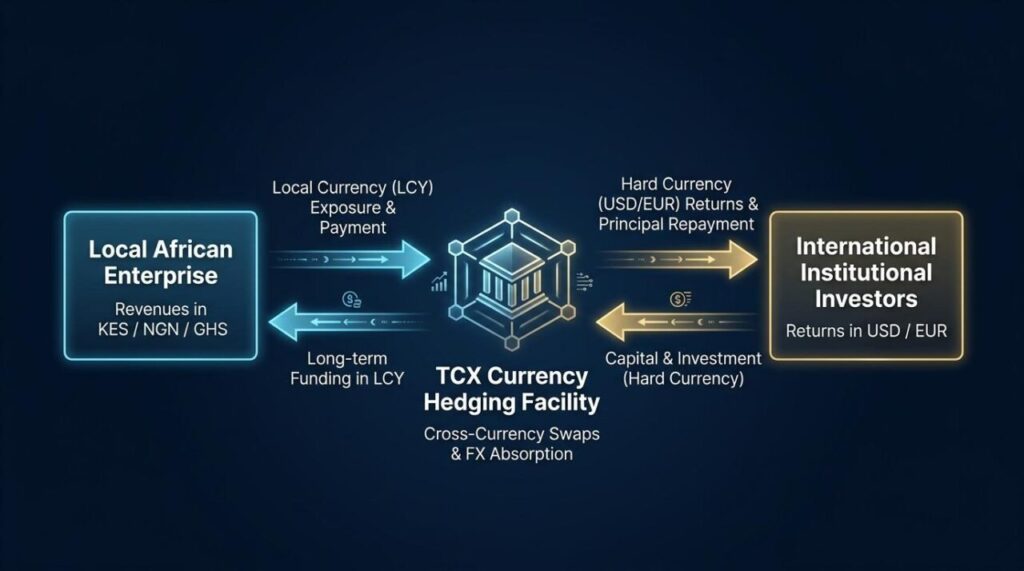
Bridging the currency divide: how specialized swap facilities insulate domestic borrowers while returning hard currency to allocators.
This episode of the SRI 360 podcast featuring Clemens Calice is available at https://sri360.com/podcast/clemens-calice/. It covers the mechanics of local currency lending, the ALCB Fund’s structure and track record, and how the blended finance capital stack is designed to aggregate fragmented frontier transactions into institutional-grade investment programs.
For more conversations at the intersection of institutional investing and sustainable finance, visit the SRI 360 podcast platform.