Every sub-fund created under China’s new national venture capital guidance fund is capped at one billion yuan, and no regional fund is permitted to be the largest investor in any sub-fund it backs. At least 70 percent of the capital has to go to seed and early-stage companies, according to the same China Daily report on the fund’s launch. And the fund itself, launched in Beijing on December 26, 2025 by the National Development and Reform Commission and the Ministry of Finance, has a twenty-year lifespan, roughly four times the life of a typical venture fund anywhere else in the world. Those are not the design choices of an entity trying to make a quick return. They are the design choices of a government building an investment structure meant to outlast several venture cycles, capitalized at the national level with 100 billion yuan, or $14 billion, and expected to grow into more than 600 sub-funds across three regional clusters, according to state media coverage of the launch.

China’s new venture guidance fund launches with $14 billion and a twenty-year horizon.
That fund did not appear out of nowhere.
I recently spoke with Matilda Ho, founder and managing director of Bits x Bites, about how government money has become the single largest source of liquidity driving innovation financing in China, a shift she has watched unfold over the roughly two decades she has operated as an investor there. Her own fund has adapted to it directly: Bits x Bites exited one of its portfolio companies, a precision fermentation dairy business, by selling its stake to a provincial government investment vehicle that had become the company’s largest external shareholder at its Series B round. For her, that outcome was not a consolation prize. It was proof that distributions to paid-in capital, the actual cash returned to investors, matters more than a headline internal rate of return that can be shaped by how a fund chooses to mark its own book.
The new fund targets seven fields specifically: integrated circuits, artificial intelligence, biomedicine, quantum technology, sixth-generation wireless networks, aerospace, and future energy, according to a January 2026 market report from the Chinese research platform 36Kr. Biomedicine sits in the first batch of investment priorities alongside artificial intelligence and quantum technology, placing biomanufacturing squarely inside the same state capital strategy reshaping semiconductors and defense technology. The fund’s twenty-year term breaks down into a ten-year investment period followed by a ten-year exit period, a structure explicitly built to hold positions through multiple technology cycles rather than exit on a conventional venture timeline.
That fund is arriving into a market where state capital already dominates by a wide margin. Chinese investors established 6,127 new funds in 2025, up 27 percent year over year, raising a combined 3.086 trillion yuan, according to the same 36Kr report. State-owned platforms accounted for 41.8 percent of total investment amount that year, and government guidance funds specifically accounted for another 17.6 percent, meaning state-affiliated capital of one form or another sat behind roughly six of every ten yuan invested. The report’s own framing captures the shift precisely: the Chinese primary market now runs on a pattern of investment led by industrial capital, driven by financial capital, and precisely regulated by state-owned capital. Corporate venture capital is growing too, up nearly 25 percent year over year as large enterprises use investment to bind suppliers and partners more tightly into their own industrial chains, but it remains a smaller share of the whole than either state platforms or guidance funds.
The scale of what state guidance funds have built is well documented, and so are the limits of what they have actually delivered. By 2021, more than 1,800 government guidance funds existed in China with a combined target capital size of $1.52 trillion, according to research published in The China Quarterly and hosted by the Stavros Niarchos Foundation Agora Institute at Johns Hopkins University. The same research found that only 26 percent of those funds had actually hit their target capital size by 2021, with the shortfall concentrated in non-coastal regions and driven by a shortage of quality private-sector partners, leadership turnover, and the inherent difficulty of evaluating a government-backed fund’s performance. The ambition and the execution gap have coexisted in this system for two decades. The new national guidance fund is best understood as Beijing’s attempt to close that gap with more central capital, tighter fund-size discipline, and a longer time horizon, rather than a wholly new experiment. Officials overseeing the new fund have been explicit that it is meant to address the specific structural weaknesses that hollowed out the fundraising totals of earlier guidance funds: chronic fundraising shortfalls, weak exit pathways for the venture investors that do provide early capital, and the absence of a clear policy signal that would give private co-investors confidence to commit alongside the state for the long haul. Whether tighter design solves a problem that scale alone did not is precisely what the next several years will test.
China’s semiconductor sector offers the clearest precedent for how this kind of fund escalates over time, and what can go wrong along the way. The National Integrated Circuit Industry Investment Fund, known as the Big Fund, launched its first phase in 2014 with 139 billion yuan. Its second phase, launched in 2019, raised that to 204 billion yuan. Its third phase, launched in 2024, brought in 340 billion yuan, or $47.5 billion, nearly matching the combined size of the first two phases, according to analysis from the Asia Society Policy Institute. That same analysis notes the second phase was not a clean success story: it was marked by corruption scandals and poor investment choices serious enough to force a strategic reset when the third phase launched, redirecting its focus toward specific technology bottlenecks like lithography and chip design software rather than broader manufacturing capacity. The pattern across three phases is one of escalating scale paired with escalating oversight, each round bigger than the last and each round trying to correct for the failures of the one before it.
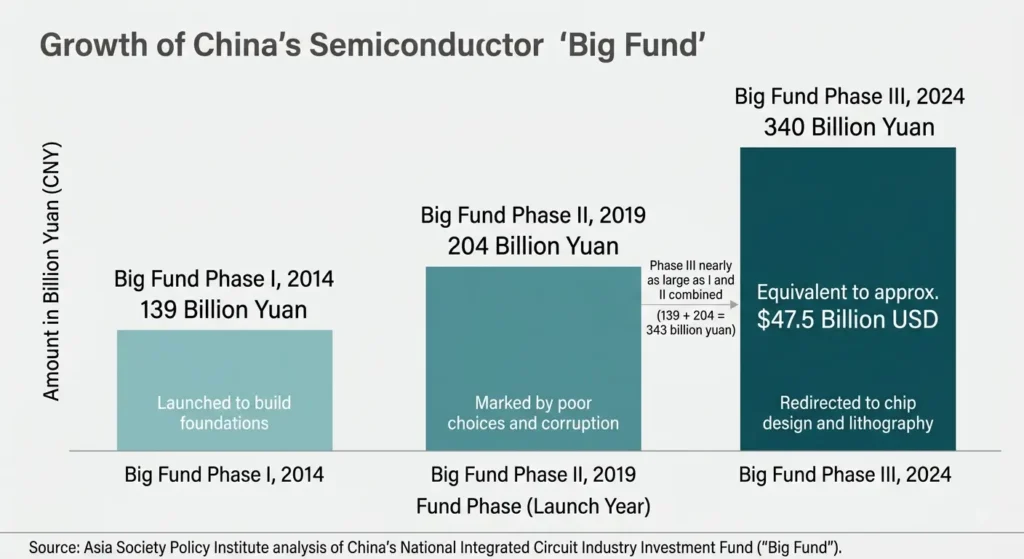
China’s semiconductor guidance fund has nearly doubled in size with each phase.
The Big Fund’s third phase is capitalized by nineteen state-owned shareholders led by the Ministry of Finance and China Development Bank Capital, alongside the country’s largest state banks, a structure that closely mirrors the layered, multi-institution backing behind the new national venture capital guidance fund. That overlap is not a coincidence. Both funds are expressions of the same underlying model: a central government anchor investor drawing in provincial governments, state-owned enterprises, and commercial banks as co-investors, all coordinated toward a technology sector Beijing has designated a national priority. The difference is scope. The Big Fund exists to build one industry. The national venture capital guidance fund is designed to apply that same model across seven industries simultaneously, from biomedicine to aerospace, for the next twenty years.
The exit environment that state capital is being asked to unlock has genuinely started moving again, even if it looks different from the exits of a decade ago. Chinese enterprises completed 294 initial public offerings in 2025, up nearly 30 percent year over year, and 61 percent of those listings took place on overseas exchanges rather than domestic ones, per the 36Kr report. The average exit return rate across the market fell to 289 percent, a meaningful decline from prior years but one the report frames as a rebalancing rather than a collapse, occurring alongside a genuine rebound in the book value of equity held across the venture and private equity system. A market that spent much of 2022 through 2024 starved of exits is finding some liquidity again, just increasingly through Hong Kong listings and state-brokered acquisitions rather than the Nasdaq debuts that defined the previous decade.
Foreign capital has been retreating from China at almost exactly the moment domestic state capital has been expanding to fill the space. Fundraising by mainland China-focused private equity and venture capital funds totaled just $350 million in the first half of 2025, equivalent to only 1.4 percent of the full $24.88 billion raised for the entire year in 2024, according to Preqin data reported by S&P Global Market Intelligence. Over the same period, domestic capital came to dominate deal activity almost entirely: of 1,686 private equity investments and funding rounds logged in mainland China through July 2025, 1,664 involved mainland China-based firms, with the most active foreign investors, from the United States and Singapore, participating in a combined 78 deals. A KPMG executive quoted in the same report put the dynamic plainly: there is easier money to be made outside China right now than inside it, at least for capital with other options. The capital that does not have other options, state guidance funds built with a national mandate and a multi-decade horizon, is the capital doing the investing instead.
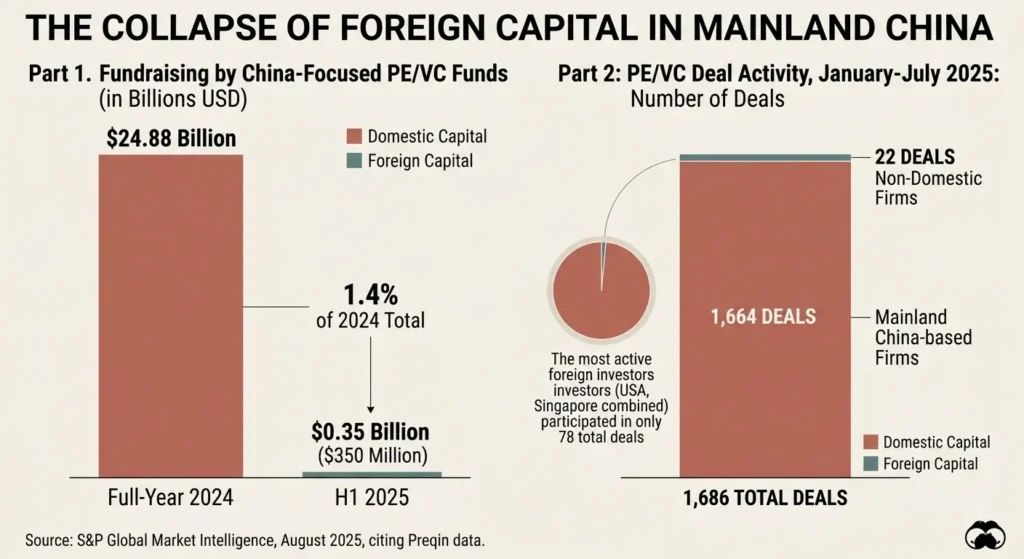
Foreign PE fundraising for China collapsed as domestic firms now dominate deal activity.
That divergence is what makes the distributions-to-paid-in-capital framing Matilda Ho described so central to how the system actually functions now. When international limited partners are pulling back and initial public offering markets remain constrained relative to their 2021 peak, a venture fund’s paper valuation matters less than whether it can actually return cash. State guidance funds are structurally positioned to provide exactly that kind of exit: a fund with a twenty-year mandate and a policy objective, rather than a return target measured against a ten-year clock, can afford to be the buyer when a private venture investor needs to sell. That is precisely the mechanism through which Bits x Bites generated its own distribution event, and it is becoming a more common exit path across Chinese venture capital as traditional routes to liquidity, strategic acquisitions and public listings among them, remain constrained.
What this means for capital allocators outside China is a genuine open question rather than a settled one. State-directed capital of this scale and patience can crowd out independent price discovery, subsidizing sectors and companies that would not otherwise attract commercial investment on their own merits. It can also, as the semiconductor fund’s history shows, waste enormous sums on poor investment choices before correcting course. But it is also, on the evidence of the last decade, capital that does not disappear when a venture winter arrives, and that increasingly determines which Chinese companies survive to the next funding round and which do not. For any investor trying to price risk in a market where the largest, most patient buyer in the room now operates on a national mandate rather than a return target, understanding how that buyer thinks is no longer optional context. It is the market structure itself.
Listen to the full conversation with Matilda Ho on the SRI360 podcast, where she discusses exiting a portfolio company to a provincial government investor and why actual cash returned to investors has become the metric that matters most in China.
For more interviews and insights on sustainable, responsible, and impact investing, visit the SRI360 podcast archive.