
Every venture investor says they back the team, not the idea. In African fintech, that claim is less a platitude than an operating principle: what actually gets backed is a founder’s proven ability to operate, not the idea itself.
I recently spoke with Mohamed Okasha, founder and managing partner of DisrupTech Ventures, an early-stage fintech investor based in Cairo. Okasha co-founded Fawry, the payments company that became Egypt’s first billion-dollar technology listing on the Egyptian Exchange (EGX), before stepping away in 2020 to build a venture fund. His view of founder risk is specific: the biggest threat to an African startup usually isn’t a bad idea. It’s an operator who has never had to navigate currency shocks, credit bureaus, or a regulator that changes its mind halfway through the year. “There is no great idea,” he said. “You can do a Google search and you will come up with ten great ideas in financial services.”
The data backs that view up more than a founder’s origin story usually does. It also raises a harder question for anyone allocating capital into frontier fintech: if execution is the real differentiator, how do you underwrite it before a founder has proven anything?

Cairo’s dense, cash-heavy commercial districts reflect the informal-economy conditions founders must navigate long before any product can scale.
The failure data tells a different story than the pitch decks
Startup failure is a global phenomenon, and it’s a brutal one. Roughly 90% of startups fail worldwide. The most commonly cited reason, showing up in about a third of postmortems, is a lack of real market demand rather than bad execution, according to Stripe’s analysis of startup outcomes. DesignRush’s breakdown of failure statistics puts the product-market-fit figure at 34%, with team misalignment, cash flow problems, and weak go-to-market execution filling out the rest.
Africa’s numbers tell a related but distinct story. BROOT Consulting found the average startup failure rate across the continent stood at 54% in 2020, with wide swings by country: Ethiopia and Rwanda as high as 75%, Kenya as low as 24%. The report’s authors don’t blame ideas or ambition. They blame founders importing a Silicon Valley playbook, built for a market with deep capital, predictable regulation, and forgiving investors, into a market with none of those conditions. Moving fast without the underlying financial discipline, in their words, leads to collapse rather than iteration.
The practical screening implication is significant. A first-time graduate with no operational scars is a harder bet in a market where currency devaluation, bureaucracy, and inconsistent enforcement can undo a good product overnight. Silicon Valley sets a lower bar for young, unproven founders chasing a novel wedge into a market. The bar for African founders is deliberately higher, and it has nothing to do with pedigree.
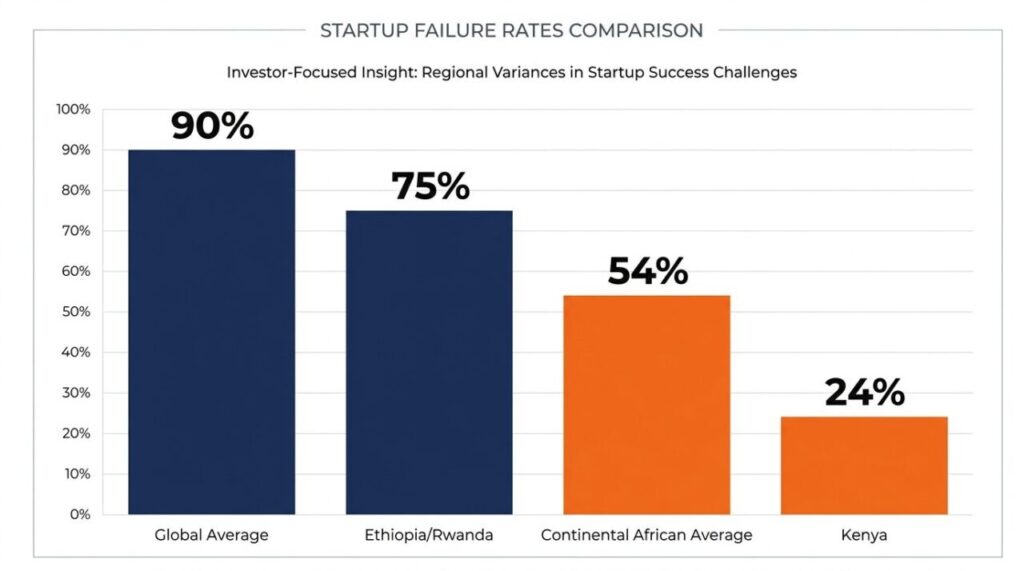
Startup failure rates swing sharply by geography, from Kenya’s 24% low to highs of 75% in Ethiopia and Rwanda, both still well below the 90% global benchmark reported by DesignRush.
Why regulation is a due-diligence line item, not a footnote
Egypt’s regulatory environment has shifted considerably over the past decade and a half. The country passed its Non-Cash Payment Law in April 2019, requiring government bodies and large private employers to settle payments electronically and establishing a licensing framework for payment service providers, according to a summary from ELDIB & CO. The Central Bank of Egypt (CBE) followed with a Financial Inclusion Strategy running from 2022 to 2025 that pushed the country’s financial inclusion rate from roughly 14% in 2014 to 77.6% by the end of 2025, according to the CBE’s own figures as reported by Daily News Egypt. Few fintech markets this size move regulation that fast.
Faster regulation isn’t the same as simpler regulation. It just changes what a founder has to get right, and when. The skill that matters isn’t relationships with regulators. It’s timing: knowing when to go to the regulator and with what. That is closer to a compliance officer’s instinct than a product founder’s, and it’s a capability investors in Egypt increasingly have to price into diligence given how fast the rules shift underneath a company.
Look across Africa and the same dynamic shows up elsewhere. Regulatory openness helped Lagos, sometimes nicknamed “Yabacon Valley,” become a hub for platforms like Moniepoint and OPay, and cross-border settlement infrastructure such as the Pan-African Payment and Settlement System (PAPSS) is being built specifically to reduce the currency fragmentation that has slowed fintech scaling across borders, per reporting from Techmoonshot on Africa’s decade of fintech growth.
The operator premium, and its limits
Across emerging markets, a consistent pattern holds: founders who have already been through one exit, successful or not, tend to outperform first-timers on their next venture, a gap that shows up consistently across founder-outcome research tracked by aggregators such as DesignRush. Operator-turned-investor models have become more common for a plain reason: the person writing the check has already absorbed lessons a first-time founder is about to learn the hard way.
There’s a limit to how far that experience should push an investor toward control, though. The emerging-market VC approach that has gained traction is one of coaching founders through decisions rather than making the decisions for them, what Okasha calls “backseat leadership.” It is slower and costs more than simply directing a portfolio company, and it only scales when it is built around a concentrated thesis rather than trying to run each company directly. Whether this style beats a more directive one is genuinely unsettled in emerging-market venture capital. There isn’t much independent, cross-fund data to prove it either way, and the honest framing of it (that it costs money and time) suggests no one is claiming it is the only path that works.
Applying old models to new problems, not the reverse
The clearest evidence that execution matters more than invention in African fintech is in what actually gets backed and why. Bokra, an Egyptian fintech offering Sharia-compliant, asset-backed investment products, closed a $4.6 million pre-seed round led by DisrupTech in 2024, aimed at a market where roughly two-thirds of Egyptians remain unbanked, according to IBS Intelligence’s coverage of the round. The product isn’t novel. Sukuk-based, Sharia-compliant investment structures have existed for decades. Bokra’s contribution is packaging that structure for a retail and small-business audience that has never had digital access to it before.
The same instinct shows up at the portfolio level more broadly. i’SUPPLY, a business-to-business pharmaceutical supply platform, raised a pre-Series A round in 2024 with DisrupTech returning as a repeat investor, part of a pattern in which the fund pushes portfolio companies to build on each other’s licensing and compliance groundwork instead of each solving it from zero, according to Wamda’s coverage of the round. That kind of deliberate cross-portfolio support is more common in later-stage private equity than in early-stage venture capital.
Even the move into artificial intelligence fits the pattern. WideBot’s AQL-7B, an Arabic-language large language model (LLM), isn’t trying to out-invent OpenAI or Google. It targets a specific, underserved gap: Arabic dialect performance on standard benchmarks like MMLU (Massive Multitask Language Understanding) and ARC (AI2 Reasoning Challenge), according to WideBot’s own technical writeup of the model. The company won by localizing an existing category of technology for a market global labs had underserved, roughly the same playbook Fawry ran on agent-based payments over a decade earlier.
What this means for capital allocators
None of this means ideas don’t matter in Africa. It means the market has little patience for a specific kind of overconfidence: the assumption that a good idea and enough capital will carry a founder through a currency devaluation, a licensing delay, or a regulator that changes course mid-year. The venture capital data supports this in a roundabout way. According to the International Finance Corporation’s May 2025 report on African tech startups, venture capital deals in Africa fell roughly 52% between 2022 and 2024, more than in any other region, and around 80% of African startup funding still comes from abroad, mostly Europe and North America, a higher share than in other emerging markets. In a capital environment that thin, a founder’s ability to operate without a constant funding drip stops being a nice-to-have. It becomes the whole test.
That’s a harder thing to underwrite than a pitch deck. It helps explain why the most experienced practitioners in this market consistently offer the same advice to aspiring investors: work for a startup first. Be part of an operation before writing checks. It’s a biased view from people who took exactly that path. It also fits everything else the data shows about how to size up founders: care less about what someone says they’ll build and more about whether the market has already tested them and they’re still standing.
To hear the full conversation with Mohamed Okasha on building Fawry, stepping away at the height of its success, and building DisrupTech Ventures from scratch, listen to the episode on the SRI 360 podcast.
For more conversations with the investors shaping sustainable and responsible investing across public and private markets, visit the SRI 360 podcast archive.