
Impact investing has a scale problem, and the most underexamined part of it is this: most of the world’s impact capital is sitting inside asset classes that do not look like impact capital.
Pension funds, insurance companies, and university endowments manage trillions of dollars in fixed income. These institutions need yield, duration matching, and predictable cash flows. They have fiduciary obligations that constrain their risk tolerance. And they already hold massive allocations to mortgage-backed securities, municipal bonds, and government-guaranteed debt. What most of them have not done is ask whether the specific composition of those holdings could be shifted toward underserved communities without accepting lower returns or greater risk.
That question is the one Ron Homer has been answering with evidence since 1997.
I recently spoke with Ron Homer, Chief Strategist for U.S. Impact Investing at RBC Global Asset Management (RBC GAM), and one of the architects of community development fixed income as an institutional asset class. His core argument is not complicated: the same instruments that mainstream fixed income investors already own can be targeted toward low and moderate income (LMI) borrowers without compromising the institutional parameters those investors operate within. The question is whether investors have the patience and the operational infrastructure to do it.

Institutional fixed income markets manage tens of trillions of dollars. The share currently directed toward underserved communities is a fraction of what the market structure would permit.
The Biggest Market That Impact Investing Mostly Ignores
Fixed income is the largest asset class in the world. According to SIFMA (the Securities Industry and Financial Markets Association), total outstanding U.S. fixed income securities stood at $49.6 trillion at the end of 2025. U.S. Treasuries account for $30.3 trillion of that, and corporate bonds for $11.5 trillion. Agency MBS (mortgage-backed securities guaranteed by Fannie Mae, Freddie Mac, or Ginnie Mae, which are U.S. government-sponsored enterprises that support the mortgage market) make up much of the remainder.
For context: the global equity market is roughly $100 trillion. Fixed income at the U.S. level alone is half that. And yet, when most people think about impact investing, they picture private equity funds, green infrastructure investments, or concessionary loans to emerging market borrowers. Fixed income rarely comes up, especially the plain-vanilla agency MBS and municipal bond markets that institutional investors already own.
The practical implications are significant. U.S. sustainable investment assets reached $6.6 trillion in 2025, representing 11% of the total market, according to US SIF’s 2025-2026 Sustainable Investing Trends Report. But the portion of that figure directed toward community development fixed income remains small relative to the size of the underlying markets. Ron Homer’s insight is that this gap is not primarily a demand problem. It is an infrastructure and awareness problem.
“It’s not recreating the wheel,” he said. “It’s just applying a greased wheel and pointing it in a different direction.”
Where Impact Capital Actually Goes (And Where It Mostly Does Not)
The GIIN’s (Global Impact Investing Network’s) 2024 sizing report put total global impact investing assets under management at $1.57 trillion, up from $715 billion in 2020. That is a compound annual growth rate (CAGR) of 21% over four years. The number is large and growing.
But the asset allocation within that figure reveals the gap. According to BlueMark’s research on fixed income impact opportunities, while private equity accounts for 73% of impact allocations among general investors, fixed income is actually the dominant impact asset class for large institutional asset owners, representing 44% of their dedicated impact portfolios. Pension funds and sovereign wealth funds (government-managed investment funds) hold more impact capital in fixed income than in any other asset class.
This makes sense when you understand how these institutions operate. A pension fund managing $300 billion in assets has to pay retirees every month. It needs predictable cash flows, specific duration profiles, and minimal credit risk. Private equity funds offer none of those things. Agency MBS does. So when a pension fund wants to deploy impact capital, fixed income is the natural home. The problem is that most of the fixed income market has not been organized to deliver targeted impact alongside competitive returns.
Ron’s model addresses precisely this gap. Rather than asking institutional investors to hold something outside their existing fixed income parameters, he asks them to hold agency MBS that is deliberately selected to include LMI borrowers in specific geographies. The credit profile is identical. The government guarantee is the same. The only difference is who the borrowers are and where they live.
Green Bonds, Social Bonds, and Community Development MBS
The global fixed income market has developed specific instruments for impact over the past decade. The most widely known are green bonds (debt instruments where proceeds are restricted to environmentally beneficial projects) and social bonds (debt instruments where proceeds go toward projects addressing specific social issues, such as affordable housing or financial access). Social bonds are governed by the ICMA’s (International Capital Market Association’s) Social Bond Principles, which define eligible project categories and disclosure requirements.
Institutions like Morgan Stanley have issued social bonds directly. Morgan Stanley’s 2025 Social Bond Impact Report documents $1 billion in social bond proceeds financing affordable housing for LMI families.
Community development MBS is structurally different from these instruments. A corporate social bond relies on the general credit quality of the issuing bank. If the issuing institution faces financial stress, the bond’s performance depends on the institution’s overall balance sheet. Community development MBS, by contrast, is directly collateralized by the underlying mortgages and wrapped in a federal agency guarantee. The credit risk is at the loan pool level, not the institutional level. And because the loans are to LMI borrowers with the behavioral characteristics Ron Homer identified (slower prepayment, shelter-motivated borrowing, low incentive to default), the risk profile in many rate environments is favorable compared to conventional agency MBS.
These are not the same instrument wearing the same label. The mechanics and risk profile are genuinely different, and the community development MBS structure has a performance track record that social bonds do not yet have at scale.
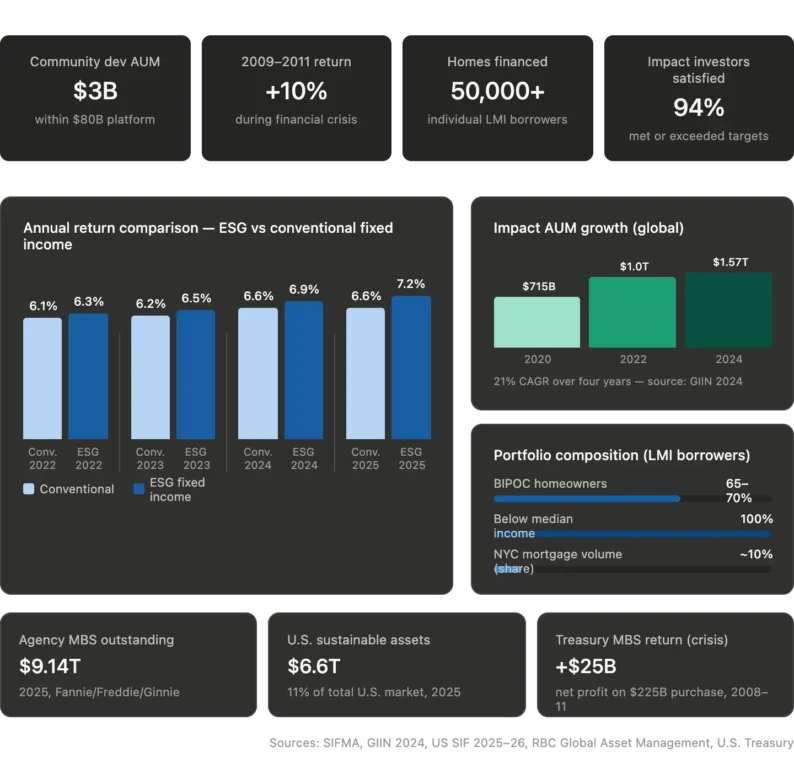
A decade of performance data across ESG and impact fixed income strategies has consistently challenged the assumption that social impact requires a financial sacrifice.
What the Performance Data Shows After a Decade of Evidence
The assumption that impact investing requires accepting lower returns has been the single most persistent barrier to institutional adoption. It is also, at this point, not well supported by the evidence.
In 2025, focused sustainable long-term bond funds achieved an average 12-month return of 7.2%, according to SustainableInvest.com’s analysis. Comparable conventional funds in the same categories generated an asset-weighted average return of 6.55%. That is a gap of roughly 65 basis points (a basis point is one one-hundredth of a percent, so 65 basis points equals 0.65%) in favor of ESG (Environmental, Social, and Governance) fixed income. This is one year of data, and one year proves nothing. But it is consistent with a multi-year pattern.
Research on the specific performance of LMI-targeted MBS, documented in studies accessible through ResearchGate, shows that the structural characteristics of LMI mortgage pools (slower prepayment, lower refinancing sensitivity, shelter-motivated borrowing) produce competitive risk-adjusted returns relative to conventional agency MBS benchmarks, particularly in falling-rate environments.
Ron Homer’s own data is the most specific: his portfolios at Access Capital Strategies consistently outperformed MBS benchmarks from 1996 onward, and generated approximately 10% returns in 2009 and 2010, the worst period for most fixed income strategies in a generation.
The GIIN’s 2024 impact investor survey found that 94% of institutional respondents reported their impact investments met or exceeded both their financial and impact performance expectations, according to GIIN’s sizing research. That is a remarkably high satisfaction rate for any investment category.
Why the Return Assumption Is Wrong
Ron Homer’s explanation for why LMI-targeted MBS performs well is grounded in borrower behavior, and it is worth understanding in some detail.
Every mortgage contains an embedded call option. The borrower can prepay at any time. When interest rates fall, borrowers with high-rate mortgages refinance, returning capital to MBS investors at the worst moment for reinvestment. This is negative convexity, and it is the structural risk that makes conventional MBS less attractive in rate-cutting environments.
LMI borrowers behave differently. Their mortgages typically have smaller balances, so the absolute dollar savings from refinancing are modest. Many face friction in the refinancing process. And families who purchased homes primarily for shelter, not as financial instruments, do not monitor rate environments and respond the way that financially sophisticated borrowers do. They stay in their homes and keep paying.
“People who had 30-year fixed-rate mortgages and were buying them for shelter didn’t default on their loans, but they also couldn’t refinance at that time,” Ron explained, describing the 2008 to 2011 period. “So rates went from eight or nine percent to three or two percent and the value of those mortgages went up. Our prepayment rate was a lot slower.”
This is not a special case. It is a structural feature of this borrower population. The financial advantage exists precisely because of the socioeconomic characteristics of LMI borrowers, which creates a direct alignment between the impact objective and the financial performance of the instrument.
The Specific Barriers Keeping Institutional Capital on the Sidelines
If community development fixed income performs competitively and institutional investors already hold large allocations to fixed income, why is the field not larger?
The barriers are real, even if they are not insurmountable.
Insurance companies operate under NAIC (National Association of Insurance Commissioners) regulations that impose capital charges on unrated or non-standard debt. Community development loans originated by small, mission-based lenders are typically not rated by major credit rating agencies, not standardized in their documentation, and not large enough to form institutional-scale pools on their own. An insurance company’s asset-liability management (ALM) system, which matches the duration and yield of assets to the duration and timing of liabilities, cannot process loans that do not fit standard categories. Until those loans are pooled, rated, and securitized into standardized tranches, insurance capital cannot access them.
Endowments face a different version of the same problem. University endowments, which manage long-horizon, tax-exempt capital, have traditionally favored private equity and alternative assets for their higher return potential. Community development fixed income sits in a different part of the portfolio: investment-grade bonds with moderate yields. For endowments whose boards are focused on maximizing total return, the case for redirecting existing fixed income allocations toward community development MBS requires a clear articulation of why the risk-adjusted return profile justifies the added operational complexity.
Ron described the barrier in operational terms: it costs more to hand-select loans, work with lenders, and construct targeted MBS pools than it does to buy generic agency MBS on the open market. “If we bought them on an open market, it’s ten seconds and you put a bid in. If you work with a lender and you hand select the loans, that takes manpower.” The client does not see the difference in returns. But the manager absorbs higher costs to produce the targeted impact.
What a Major Pension Fund Did with Community Fixed Income
The most instructive example of institutional community development fixed income at scale is the New York City Retirement Systems (NYCRS), which manages nearly $294.6 billion in assets across five funds and covers approximately 760,000 members, according to the NYC Comptroller’s 2024-2025 returns report.
NYCRS operates an Economically Targeted Investment (ETI) program that allocates fixed income capital to community development programs. It was among Ron Homer’s earliest institutional clients. The pension system has tracked, on its public website, the number and location of mortgages its investment has supported across New York City’s five boroughs, along with the income levels of the borrowers.
Ron described the scale of that relationship: “We probably own maybe 10% of the overall mortgage volume in the city of New York and it’s to the people at the lower end.” He estimated that the cumulative portfolio has financed over 50,000 individual homes and tens of thousands of multifamily units.
In 2024, NYCRS deployed $60 million into Community Stabilization Partners, a joint venture targeting the preservation of over 35,000 rent-stabilized housing units at risk following the collapse of Signature Bank. This kind of targeted allocation, executed within a pension fund’s existing fixed income framework, demonstrates that community development impact is achievable without violating institutional mandates.

Over 50,000 individual home loans in New York City have been financed through community development fixed income strategies managed for the New York City Retirement Systems.
The 2008 Test Case: Agency MBS Held While Everything Else Broke
The most direct proof of concept for community development fixed income is what happened between 2008 and 2011.
When the subprime mortgage market collapsed, private-label securitizations (MBS backed by subprime loans without government guarantees) destroyed trillions in global wealth. But agency MBS, backed by Fannie Mae, Freddie Mac, and Ginnie Mae, held their value. The credit guarantee meant that even as borrowers struggled, investors received their principal and interest on schedule.
The U.S. Treasury entered the market directly. According to the Treasury’s own press release, the government purchased $225 billion in agency-guaranteed MBS to stabilize the housing market. When it wound down that portfolio, it recorded a net positive return of $25 billion for American taxpayers. Government-guaranteed agency MBS did not just survive the crisis. They generated positive returns while the rest of the structured credit market was in freefall.
For community development MBS specifically, the performance was even stronger, for the reasons Ron Homer has described. LMI borrowers holding 30-year fixed-rate mortgages purchased for shelter did not default at elevated rates. They could not refinance, which meant the high-yield mortgages stayed in place longer than expected. Portfolios that had been constructed around these borrowers generated roughly 10% annual returns at a moment when most institutional portfolios were scrambling to recover from historic drawdowns.
This is the stress test that matters most for institutional investors. And community development fixed income passed it.
The SBA Secondary Market and What Comes Next
Beyond mortgages, the SBA (Small Business Administration) secondary market offers the next expansion opportunity for community development fixed income.
The SBA 7(a) loan program allows lenders to originate small business loans with up to 85% of the principal guaranteed by the federal government. Lenders can sell the guaranteed portion into a secondary market as tradeable pool certificates, freeing their capital to make new loans. According to the SBA’s secondary market documentation, Guidehouse (the Fiscal Transfer Agent, or the entity that processes SBA secondary market transactions) handles over $1 billion in monthly transaction volume.
More recently, financial engineering has opened the unguaranteed portion of these loans to securitization. In 2025, Guidehouse successfully executed multiparty securitizations of the unguaranteed portions of SBA 7(a) loans, pooling residual risk from multiple community lenders and tranching it into rated securities. This allows institutional buyers to purchase small business debt at scale while recycling capital back to local lenders for new originations.
Ron Homer’s team at RBC GAM has been developing programs to connect mission-based SBA lenders to this secondary market, following the same pattern that worked for mortgages: use secondary market access to amplify the origination capacity of lenders already serving underserved communities.
Municipal Bonds as the Bridge Institutional Investors Already Use
For institutional investors who are not yet comfortable with the operational complexity of community development MBS, municipal bonds offer an accessible entry point.
Municipal bonds are debt instruments issued by state and local governments to fund public infrastructure and services. They are widely rated, tax-advantaged, and familiar to virtually every institutional fixed income manager. They finance affordable housing projects through Low-Income Housing Tax Credit (LIHTC) structures, public water and transit infrastructure, and local economic development initiatives.
According to NAIC data, 56% of all social impact investments made by U.S. insurance companies, totaling approximately $89 billion, are held in municipal bonds. Insurance companies are among the most conservative institutional investors in the market. The fact that they have found a way to direct nearly $90 billion toward social impact through municipal bonds, without departing from their core investment framework, demonstrates that the gap between conventional institutional fixed income and community development finance is smaller than most assume.
The challenge going forward is moving from broad infrastructure finance through municipal bonds toward the more targeted, neighborhood-level impact that community development MBS can deliver. Municipal bonds fund the hospital. Community development MBS funds the mortgage for the nurse who works there. Both matter, and neither is sufficient alone.
Ron Homer’s career has been an extended argument that the capital is not the problem. The mortgage market has always been large enough to finance homeownership in underserved communities. The SBA has always had enough statutory authority to support small business lending in those same communities. The tools existed. What was missing was the will, the infrastructure, and the evidence base to redirect those tools deliberately.
The evidence base now exists. Three decades of performance data, stress-tested through the worst financial crisis in a generation, show that community development fixed income does not require a return sacrifice. Institutional investors who understand this and build the operational capacity to access it are not choosing between financial performance and social impact. They are choosing to own the same asset class they already own, with more specificity about who benefits.
Walter Wriston, the former CEO of Citibank, had a line that Ron quotes: “Capital goes where it is invited and stays where it is welcome.” The work of community development finance, as Ron has practiced it for fifty years, is building the invitation.
To hear Ron Homer’s full conversation, including how he built the Access Capital model from scratch, what the 2008 crisis taught him about LMI borrower behavior, and where he sees the biggest remaining opportunities in community development investing, listen to Episode 113 of the SRI 360 Podcast.
For more conversations with institutional investors on the front lines of sustainable and responsible investing, visit the SRI 360 Podcast and browse the full archive at sri360.com.