In the 19th century, British colonial administrators in India noticed a cobra problem. There were too many venomous snakes, so they offered a bounty for dead cobras. The policy made logical sense as a first-order intervention. It did not survive contact with human incentives. People started breeding cobras to collect the bounty. When the administrators eventually cancelled the program, the cobra farmers released their now-worthless snakes into the wild. The cobra population ended up larger than when the whole exercise began.
Sarah Nolet uses this story to explain something she sees happening across agricultural impact investing right now. When a metric becomes a target, it stops being a reliable signal of the thing it was designed to measure. And in an investment landscape where impact credentials have become a major fundraising tool, the incentive to optimize for the metric rather than the underlying reality is powerful and often irresistible.
I recently spoke with Sarah Nolet, co-founder and Managing Partner of Tenacious Ventures, about where she sees the biggest cobra effects operating in agtech and impact investing, what honest measurement looks like in practice, and why the industry’s recent reckoning with alternative protein and vertical farming is a useful, if painful, lesson.
The story behind the Cobra Effect
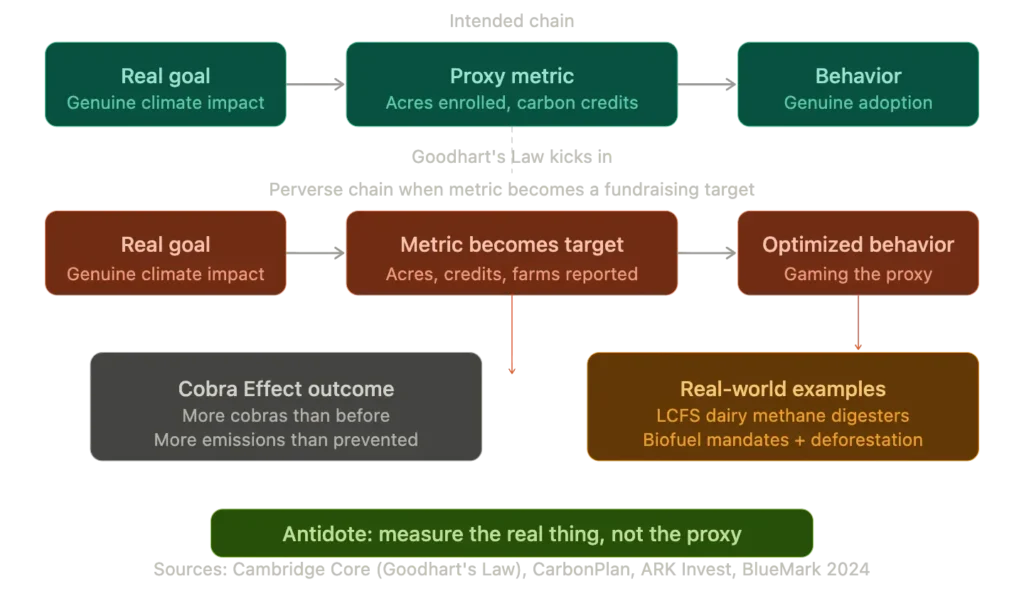
The Cobra Effect is another name for Goodhart’s Law, the well-documented psychological principle that when a measure becomes a target, it ceases to be a good measure. In an impact investing context, this manifests as what researchers call proxy failure: the financial incentive to report on an easily measurable proxy for a complex underlying goal becomes so strong that the proxy gets optimized at the expense of the goal itself.
Sarah is careful to say this is not unique to agtech or impact investing. It happens whenever financial incentives are attached to imperfect measurements. But she argues it is particularly acute in agricultural climate investing for a specific reason: the combination of difficult measurement, high investor appetite for climate credentials, and genuine complexity in how agricultural systems interact with the carbon cycle creates exactly the conditions where cobra effects thrive.
How it plays out in agtech
Sarah describes the pattern clearly. A startup is building a genuine solution to a real agricultural problem. But it is also raising venture capital in an environment where climate impact credentials matter to investors. The incentive is to show metrics that look good on a pitch deck. More farms. More acres enrolled. Bigger carbon sequestration claims. Whether those numbers actually reflect what is happening in the soil, or whether the business is genuinely building toward scale, becomes secondary to whether the metrics match what the investor is expecting to see.
The result, as she puts it, is founders showing metrics that are really about what they think investors want to see, not about what actually drives business success. A company might have had a slow season because of a drought that reduced apple harvests and therefore reduced demand for its orchard management technology. The honest story is that the underlying product relationships are strong and the business is building toward higher lifetime value customers. The cobra story is to cut that out and show only the new product line, the new minimum viable product (MVP), the acres and farms that make the deck look like the standard growth chart investors want.
There is a structural pressure here that Sarah acknowledges is genuinely difficult for founders to resist. The conversation about nuance, about why a seasonal setback is not a fundamental business problem, requires a level of investor trust and sophistication that takes time to build. Early in a fundraise, founders often do not have that relationship yet. And so they give investors the language they want.
Goodhart’s Law / Cobra Effect in agtech impact investing
The alternative protein and vertical farming reckoning
The most visible recent example of cobra-effect thinking in agfood tech is the boom and bust of alternative proteins and vertical farming. Both sectors attracted enormous capital based on narratives that were compelling at the pitch-deck level but ignored physical and economic constraints that the actual biology and chemistry of food production impose.
Vertical farming investment peaked at roughly $10 billion globally, with roughly $2.4 billion raised in 2022 alone. By 2023, funding had collapsed by 79%. High-profile companies like AeroFarms filed for bankruptcy. AppHarvest, which had been valued at over a billion dollars, was forced to auction off its facilities. The core problem was not technological. The systems worked. The problem was that the energy costs of artificial lighting made unit economics structurally unviable at any realistic scale, a constraint that should have been visible from first principles.
Alternative protein followed a parallel arc. Global investment dropped 42% year on year in 2022, and a further 27% in 2024. The consumer behavior change that the sector assumed did not materialize at the price points required. Beyond Meat’s valuation collapse became the most visible symbol of a broader miscalculation about the pace and depth of dietary transition.
Sarah’s critique of both sectors is not that the underlying goals were wrong. She makes this explicit. She is not against alternative protein or regenerative practices. Her criticism is of the investment thesis: the idea that a technology-first, software-scaling approach could be applied to systems governed by physics, chemistry, and consumer behavior at the same pace that SaaS businesses iterate. As she puts it, the lesson is not just what fell apart. It is what the underlying thematic was, what worked within it, and how to carry those lessons forward without throwing out the genuine opportunity.
Soil carbon and the additionality problem
The most analytically complex version of the Cobra Effect in agricultural climate investing is currently playing out in voluntary soil carbon markets. This is the area where Sarah’s concerns about impact measurement are most consequential and where the research is most sobering.
The fundamental problem with soil carbon credits is measurement. Natural soil carbon density varies by more than 30% within a single agricultural field. Achieving a scientifically credible 95% confidence level in detecting actual carbon changes requires between 50 and 100 physical core samples per field, making rigorous measurement prohibitively expensive at scale. Most current carbon protocols rely on modeled estimates rather than physical verification.
The deeper problem is additionality. Research by CarbonPlan found that an estimated 40% to 60% of enrolled farmers in certain carbon protocols lack true additionality, meaning they were already practicing or would have practiced the sustainable behavior being credited, purely for economic reasons. Corporations are paying for carbon credits that represent farming practices that would have happened regardless.
Permanence is the third structural issue. Any soil carbon gains can be reversed by future tilling, changes in land ownership, or extreme climate events. Commercial registries issue credits with 100-year permanence guarantees, but underlying contractual monitoring requirements often expire after 30 years, leaving a 70-year window of unmonitored reversal risk.
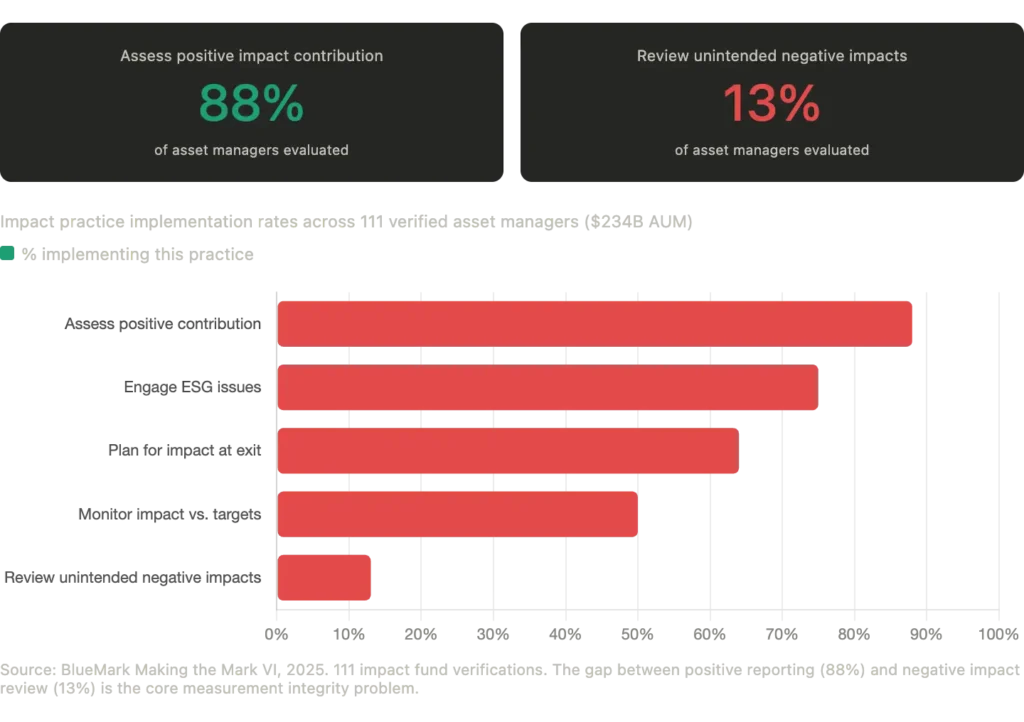
A BlueMark analysis of 111 impact fund verifications representing $234 billion in impact assets under management (AUM) found that while 88% of asset managers assess their positive contribution to impact, only 13% routinely review unintended negative impacts. The overwhelming majority of impact reporting in contemporary venture capital functions primarily as marketing rather than rigorous ecological risk management.
BlueMark impact practice gap: what funds actually measure vs. what they should
What honest impact measurement looks like
Sarah does not argue against impact measurement. She argues for integrity in how it is done and realism about what it can and cannot prove at different stages of a company’s development.
At Tenacious, the approach is to positively screen for impact when a company first enters the funnel, writing an impact assessment using third-party data wherever available. For some companies, the impact-to-revenue correlation is clean and direct. With Gotera, every tonne of organic waste processed is a tonne that does not go to landfill. More revenue equals less methane. The calculation is simple and the measurement is robust.
For other companies, the near-term and long-term impact pathways look different. Rapid Aim, a company building insect pest detection sensors for farms, has a clear long-term impact case: real-time pest data enables farmers to reduce synthetic pesticide use, with significant emissions and biodiversity benefits. But that transition happens at scale, not immediately. In the near term, the measurable impact is fewer diesel truck miles driven by farmers checking physical traps, because they are now getting alerts on their phones. That is the metric Tenacious agreed to report annually in the term sheet. The long-term metric, the one that actually matters, is tracked but recognized as a future state rather than a current reality.
This kind of staged, honest measurement requires agreeing with founders upfront about what is being tracked and why. It is written into the term sheet. It acknowledges the difference between what is provable now and what the impact thesis is actually building toward. And it is the opposite of optimizing for the metric that looks best in a fundraising deck.
Progress over perfection
Sarah’s most pointed critique in the broader agricultural sustainability conversation is aimed at the regenerative agriculture movement, not at its goals but at the rigidity with which some of its proponents apply its standards.
She is personally aligned with regenerative principles. She lived and worked on regenerative farms in Argentina. She wears the Patagonia jacket. But from an investment perspective, she worries about an idealism that requires every step of the transition to be fully regenerative before it counts. A farming system where any use of chemistry automatically disqualifies you from certification, regardless of context or necessity, is not a system that most commercial farmers can participate in. And a transition that only rich consumers can afford to support through premium pricing is not a transition that happens at scale.
The Cobra Effect shows up here too. When certifications become revenue streams, the incentive to game them grows. When the alternative is losing market access and premium pricing, the pressure on farmers to meet certification standards through any available means intensifies. The system designed to reward genuine ecological improvement ends up rewarding the appearance of it.
Her position is that the path to genuine impact in agriculture runs through pragmatism, not purity. Technologies that reduce chemical inputs by 40% while keeping a farm commercially viable are more valuable to the actual ecological transition than a certification standard that 90% of commercial operators cannot meet. Progress over perfection is not a compromise on the goal. It is the only realistic strategy for achieving it at the scale that actually matters.
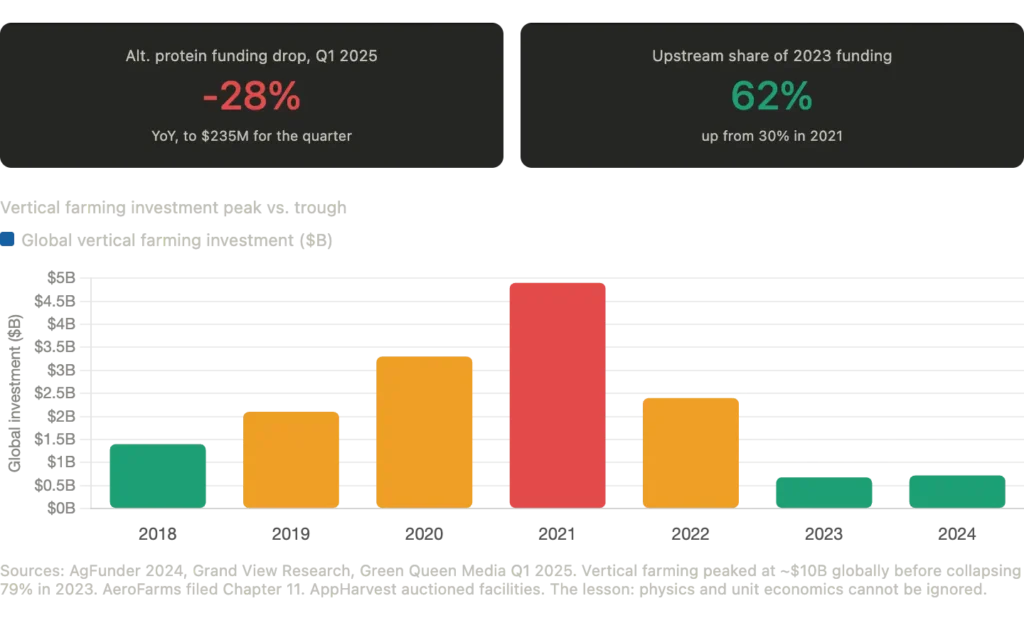
Agrifood tech sector funding collapse by subsector with upstream contrast
🎙️ Listen to the full conversation with Sarah Nolet on the SRI 360 Podcast: Episode
For more interviews with leading SRI, ESG, and impact investors, explore the full archive at sri360.com/podcast.