When most investors think about climate tech, they picture solar panels, wind turbines, electric vehicles, and carbon capture systems. These are important technologies. They are also where the vast majority of climate venture capital is concentrated. And they are, increasingly, not where the most interesting investment opportunities lie.
The most compelling climate investments are often hiding in plain sight inside companies that would never describe themselves as climate startups. They are solving specific industry pain points, reducing costs, improving safety, or optimizing logistics, and delivering massive environmental impact as a secondary effect. They are what one investor calls “non-obvious climate companies.”
This framing challenges a fundamental assumption in the climate investing world: that the best way to find climate impact is to look for companies explicitly built around a climate thesis. The evidence increasingly suggests the opposite may be true.
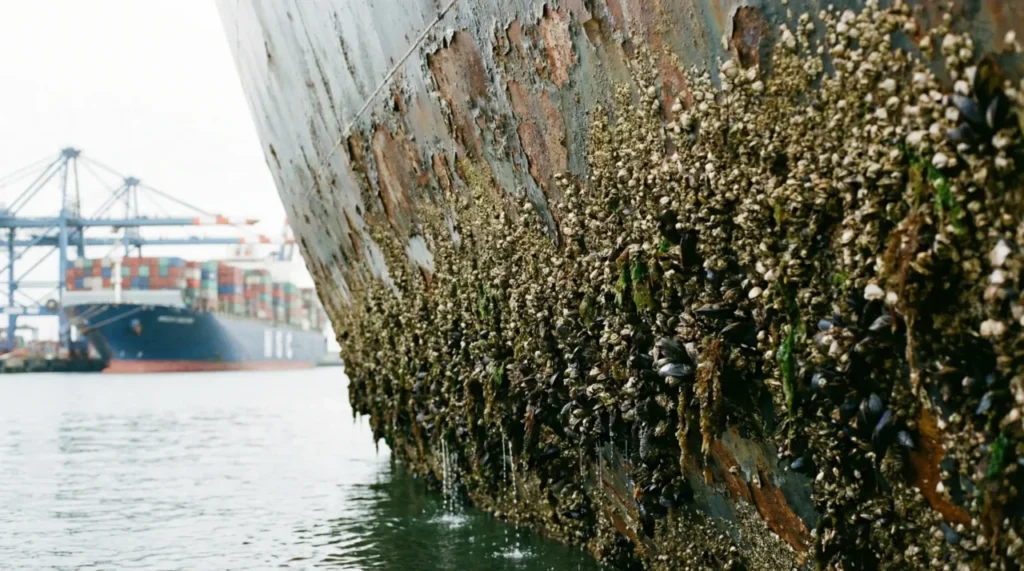
Barnacles and marine growth on a ship hull, illustrating the biofouling problem that drives emissions in the maritime industry
The Robot That Saves 25% of a Ship‘s Fuel
I recently spoke with Alina Truhina, co-founder of Utopia Capital Management and managing partner of the Radical Fund, a Southeast Asia climate tech VC. One of her portfolio companies illustrates the non-obvious thesis perfectly.
Alicia Bots is a Singaporean company founded by Inder, a second-time entrepreneur who has developed a robotic crawler that cleans the hulls of commercial ships. On the surface, this looks like a maritime maintenance business. In reality, it is one of the most efficient decarbonization investments in the Radical Fund’s portfolio.
The physics are straightforward. When microorganisms, algae, and barnacles accumulate on a ship’s hull, they increase hydrodynamic drag, forcing the vessel to burn more fuel to maintain speed. The impact is not marginal. According to IMO research, a thin layer of slime just 0.5 millimeters thick covering half a hull can increase fuel consumption and greenhouse gas emissions by 20% to 30%. Severe barnacle growth can push that figure to 55% to 85%.
The global shipping industry is responsible for approximately 3% of global greenhouse gas emissions, roughly equivalent to the entire country of Germany. Traditional hull cleaning requires dry-docking, an expensive and infrequent process. Alicia Bots’ robotic solution enables more frequent cleaning while ships are still in port, maintaining optimal hull conditions and reducing fuel consumption by up to 40%.
“He’s developed this robot that not only cleans, it also provides prevention and inspection for capturing data around any potential risks of the ship,” Truhina explains. “It’s all around preventing that buildup and therefore preventing the expenditure of energy.”
The business has already expanded from Singapore to Greece and secured global funding from both a global and European VC. Truhina sees potential for expansion across Europe and the US.
What makes this a “non-obvious” climate company is that Inder did not set out to build a climate startup. He set out to solve a specific, expensive problem in the maritime industry. The climate impact is enormous but embedded in the business model rather than bolted on as a mission statement.
Electric Motorcycles and the Last Mile in Jakarta
The second portfolio example operates in an entirely different sector but follows the same logic.
Dash is an Indonesian company founded by two co-founders, DTI and Robert, who previously worked at Grab and GoJek, Southeast Asia’s dominant ride-hailing platforms. They started a white-label electric vehicle fleet management business serving small and medium enterprises in Indonesia’s booming last-mile delivery market.
The context makes this significant. Indonesia is the third-largest market for two-wheelers in the world, with over 132 million registered motorcycles and scooters. The market is valued at $10.48 billion in 2025, and the government has targeted 13 million electric motorcycles by 2030. BEV car sales grew by 151% year-over-year in 2024, reaching 43,188 units, and total EV market penetration hit 15.2% of passenger car sales by mid-2025.
But the transition to electric is not happening fast enough in the commercial fleet segment, where most urban emissions actually originate. Dash addresses this by providing both drivers and electric vehicles to SMEs, enabling them to create their own delivery fleets without the capital expense of purchasing EVs or building charging infrastructure.
“They both come from very product-focused backgrounds. They previously worked in Grab and GoJek, so they understood this space of logistics very well,” Truhina explains. “They have really exuded and showed how much knowledge they have in their space and how much they have learned from their previous employers.”
The climate impact is direct: every electric motorcycle replacing a combustion engine motorcycle reduces urban emissions. But the founders did not start with a climate thesis. They started with a logistics problem. They knew from their experience at Grab and GoJek that SMEs needed fleet solutions, and they knew from market data that electric vehicles offered a lower total cost of ownership for high-utilization commercial fleets.
The delivery and fleet applications market in Indonesia is projected to grow at 9.22% CAGR through 2030, driven by e-commerce expansion into secondary cities. The market opportunity is enormous regardless of the climate angle. The climate impact makes it even more compelling.

Electric motorcycles are being used for delivery in an Indonesian city, showing the electrification of last-mile logistics
Why Domain Experts Build Better Climate Companies
These two examples, a maritime robotics company and a fleet management startup, share a common thread that Truhina has elevated into a core investment thesis: the founders are domain experts first and climate entrepreneurs second (if at all).
“We’re looking for people who have spent time in the industry, in a specific sector, where they really understand the pain points and the gaps of that specific industry, and they are in close proximity to those problems,” she explains. “They may have started a venture in that space because of the obsession with that problem and wanting to actually fix that problem for themselves.”
This is a deliberate inversion of how most climate funds source deals. The conventional approach is to start with a climate thesis (we need to decarbonize shipping, we need to electrify transport) and then find founders building solutions. Truhina starts with founders who deeply understand an industry and then identifies the climate impact embedded in what they are already building.
“I even remember saying to a lot of founders, ‘You might not think that you’re a climate startup. You might not look like a climate startup.’ Because we’re so used to having climate startups be clean tech or renewable energy. But actually, you could be a logistics fleet management company and have an incredible climate impact.”
The logic extends to sectors that seem even further removed from traditional climate tech. Data center energy consumption in Southeast Asia is projected to nearly double by 2030, with data centers potentially accounting for up to 30% of national power demand in markets like Malaysia. Companies building cooling solutions or energy optimization software for tropical data centers are solving an infrastructure problem with massive embedded climate impact.
In the GCC, supply chain inefficiencies are responsible for an estimated 35% of food waste. A B2B food procurement platform that reduces that waste is simultaneously solving a business problem and a climate problem. Truhina has identified opportunities for Radical Fund portfolio companies to expand from Southeast Asia into Qatar precisely because the same supply chain pain points exist in both regions.
“A lot of the problems are the same. Not exactly the same, but there’s a lot of similarities,” she notes. “Looking at decarbonization, looking at cross-border logistics, looking at materials, looking at energy consumption and optimization, looking at data centers and data cooling solutions. A lot of these are very much transferable.”
The Measurement Challenge
If non-obvious climate companies deliver embedded impact rather than explicit impact, how do you measure it? This is the question that separates genuine climate investing from greenwashing, and Truhina takes it seriously.
“We really spend a lot of time thinking about how do we put the right checks and balances and the right systems and processes across the board,” she says. “It’s not just at sourcing or at due diligence but across the entire investment process.”
The Radical Fund uses a six-dimension analysis framework that evaluates: who is being impacted, how they are being impacted, how the impact is delivered, what risks exist, whether it contributes to broader systems change, and whether it is delivered equitably and sustainably.
But Truhina acknowledges that for adaptation-oriented investments, the metrics are inherently different from mitigation. “Identifying KPIs around resilience or risk reduction or avoiding losses, there’s a lot of probability, a lot of hypothetical, a lot of assumptions,” she says. The fund measures across three levels: venture level (working with individual companies to build climate management plans), portfolio level (aggregating greenhouse gas emissions, livelihoods impacted, losses averted), and fund level (overall climate performance alongside financial returns).
The emerging industry consensus, reflected in the UNEP Adaptation Gap Report, is that adaptation metrics should focus on “losses averted,” “risk reduction,” and “resilience metrics” for households and hectares. Adaptation deals featured in 28% of all climate tech deals in 2024, suggesting that the measurement frameworks are maturing even if they are not yet standardized.
For non-obvious climate companies specifically, the measurement process often involves helping founders see and quantify impact they had not previously tracked. “A lot of what we do is to identify that and help them build a robust enough system by which they can measure, monitor, and leverage their climate impact,” Truhina explains.
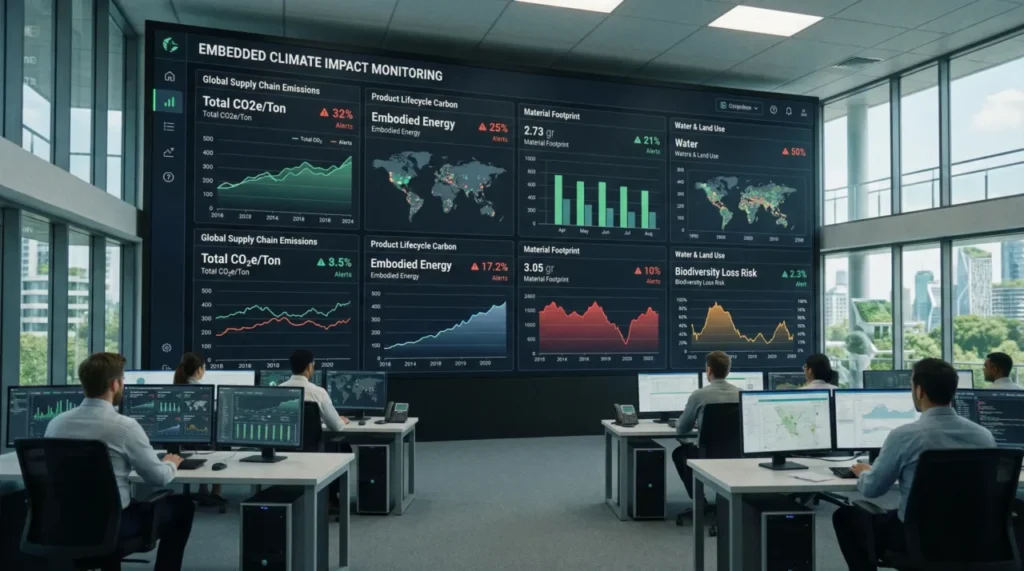
An image of a monitoring screen showing environmental metrics, representing the measurement of embedded climate impact
The Consumption Question
There is a deeper philosophical question embedded in the non-obvious climate thesis, and it relates to who bears the burden of emissions reduction.
Southeast Asia’s emerging middle class is projected to grow significantly through 2030. By 2024, over half of Asians were projected to be “middle class” ($12 to $120 per day), with the region expected to add 1 billion new entrants to the consumer class by the end of the decade. These are people who are, for the first time in their lives, able to afford air conditioning, motorized transport, and varied diets.
Truhina frames the tension directly: asking the poorest 50% of the population to sacrifice for climate is elitist. They are responsible for only a fraction of global emissions but bear the brunt of climate impacts.
“Consumption is inevitable,” she says. “To think we’re going to get people to all of a sudden change their behavior is perhaps a little bit radical, excuse the pun. So I think it’s less about is consumption bad and how do we stop it, but more about how and what people consume.”
This is where non-obvious climate companies become essential. Rather than asking the emerging middle class to forgo motorized transport, you build electric fleet solutions that make the transport cleaner. Rather than asking growing cities to stop building data centers, you build cooling and energy optimization technologies that reduce the carbon intensity of each unit of compute. Rather than asking people to eat less, you build supply chain platforms that reduce the 35% of food that is currently wasted before it reaches a plate.
“How do we build businesses that allow for that in a less carbon-intensive way than what the Western nations have been building?” Truhina asks. “It’s a real opportunity and at the same time affecting the bottom line because we can do that at a very cost-effective manner.”
The investment thesis is that the companies solving these problems will grow as fast as the middle class itself, because they are not asking anyone to sacrifice. They are making aspiration compatible with sustainability. That is a market measured in the trillions of dollars, and the founders who understand it best are not climate idealists sitting in accelerators. They are domain experts who know exactly how their industries work and where the waste is.
Finding What Others Miss
For investors evaluating climate allocations, the non-obvious thesis suggests a reexamination of deal sourcing strategies. If the best climate investments are not in companies that self-identify as climate startups, then the traditional approach of attending climate conferences and reviewing climate-tagged deal flow will systematically miss the most compelling opportunities.
Truhina’s sourcing approach reflects this. The Radical Fund works closely with its studio to conduct problem-oriented deep dives across sectors, identifying opportunity spaces where climate impact is embedded but not labeled. The fund looks at maritime efficiency, industrial logistics, food supply chains, data center infrastructure, and agricultural value chains, sectors where the environmental impact is substantial but the company’s primary value proposition is commercial.
“We’re doubling down on looking for people who have spent time in the industry in a specific sector where they really understand the pain points,” Truhina says. “They may have started a venture because of the obsession with that problem. They might not even think about it as starting a climate company.”
The global climate adaptation technology market reached $25.5 billion in 2025, with Asia-Pacific as the largest regional market. The maritime decarbonization market, the EV fleet management market, the food supply chain optimization market, and the data center efficiency market each represent billions more in addressable opportunity. These markets will be served by companies that solve real operational problems. The climate impact will come along for the ride.
For climate investors willing to look beyond the obvious, the returns may be better, the impact may be larger, and the founders may be stronger. The best climate investments, it turns out, don’t look like climate investments at all.
To hear Alina Truhina’s full perspective on finding climate impact in non-obvious companies, listen to the complete interview on the SRI 360 Podcast, Episode 124.
This article is based on a discussion of climate investing from the SRI 360 Podcast. For more perspectives on sustainable and responsible investing, visit
sri360.com/podcast.