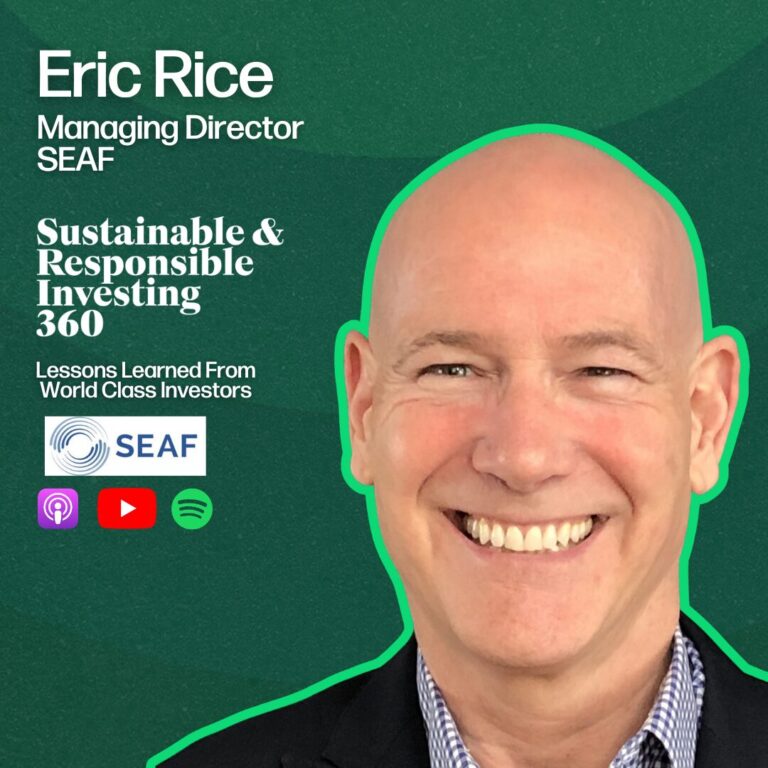
“Is Impact Investing a disaster? Is what happened at BlackRock and elsewhere in the US the end of the impact story? I don’t think so. ”
— Eric Rice
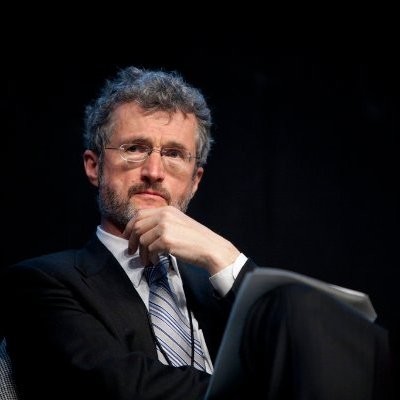
Impact investing is at an inflection point, but not in the way the headlines often suggest. In this episode of Sustainable & Responsible Investing 360, I’m joined once again by Eric Rice for his third appearance to unpack what’s really happening beneath the surface.
Eric brings over two decades of experience across Wellington Management and BlackRock, where he helped pioneer large-scale public markets impact strategies. Today, he is focused on private markets through his work with SEAF (Small Enterprise Assistance Funds), investing in small and medium-sized enterprises across emerging markets. That perspective, spanning asset classes and geographies, offers a grounded view of how the space is evolving.
We begin with what I describe as the “great divergence.” In the United States, political pressure has driven a retreat from ESG language and, in some cases, from high-profile impact strategies. Meanwhile, Europe, Japan, Asian markets, and other regions continue to accelerate, strengthening regulation, expanding capital allocation, and embedding sustainability into investment decisions. Eric shares his experience from inside BlackRock during this period, helping to distinguish between cosmetic changes and more structural shifts.
A key part of the discussion is the distinction between ESG and impact investing. As Eric explains, ESG is about how companies operate, while impact investing is about what companies actually do, their products, services, and role in solving real-world problems. That difference matters, especially in a moment where terminology is shifting but underlying investment activity often continues.
We also explore the limits of impact capital in replacing development finance. With institutions like USAID scaling back, there is growing pressure on private investors to step in. But impact investing operates within commercial constraints, and not all challenges, particularly those requiring concessional capital, can be addressed through market-based approaches.
At the same time, there are clear signs of progress. Pension funds are beginning to incorporate impact considerations more explicitly, and the investable universe has expanded significantly, allowing for greater selectivity and stronger alignment between financial returns and real-world outcomes.
Looking ahead, we turn to climate adaptation and resilience as emerging areas of focus. These are increasingly driven by economic necessity rather than ideology, creating new pockets of opportunity, even if scalability remains uneven.
What emerges is a more balanced picture: impact investing is not retreating; it is maturing.
Listen to the full conversation.
–
Listen to the episode on Apple Podcasts, Spotify, Overcast, Podcast Addict, Pocket Casts, Castbox, YouTube Music, Amazon Music, or on your favorite podcast platform. You can watch the interview on YouTube here.



What was your favorite quote or lesson from this episode? Please let me know in the comments.
SHOW NOTES:
[07:18] Messaging vs Reality
[11:07] Capital Moves Globally
[20:18] Impact vs ESG
[29:06] Limits of Impact Capital
[35:41] Institutional Adoption Grows
[54:47] Adaptation as Opportunity
Additional Resources:
- Eric Rice LinkedIn
- SEAF on LinkedIn
- SEAF website
- Eric Rice previous episode:
– Democratizing Impact Investing Through Public Equities, BlackRock’s Global Impact Fund and More - Eric Rice previous episode:
– Impact Update: What’s Working, What’s Not, and What’s Next
MORE QUOTES FROM THE INTERVIEWS:
“There’s nothing new about this. The last three years have been on a steady path toward this point. It’s almost nothing more than making sure that Larry lives up to his fiduciary duty, which is to save the company. The company was under complete assault from, I think, its 14 red states. ”
— Eric Rice
“I’m a former foreign service officer. So to watch USAID be not just dismantled but hacked to death was, for all its flaws, a tragedy in my eyes. I think the baby was much bigger than the bathwater, um, and much more desirable. ”
— Eric Rice