When Jamie Friedland talks about environmental, social, and governance (ESG) investing, he does not reach for the language of mission or values. His framing is simpler: ESG is data. More information is always better than less when you are making an investment. If that information is material, meaning it is likely to affect the long-term performance of a company, then investors should have it and factor it in.
That sounds almost obvious when you say it out loud. But the political backlash against ESG in the United States has essentially been an argument that investors should have less information about long-term risks. That is a harder position to defend than the culture war framing suggests.
I recently spoke with Jamie Friedland, sustainability analyst at AXA Investment Managers, about how one of the world’s largest asset managers thinks about ESG as a risk management tool rather than a political stance.

ESG analysis functions as an additional layer of financial data, covering long-term risks that traditional financial statements may not capture until they materialize.
The Backlash Has a Geography
The anti-ESG movement in the United States has produced real legislative consequences. According to Ballotpedia’s tracking data, 22 of the 23 US states with Republican legislative control enacted laws opposing ESG integration in state financial operations between 2020 and 2025. In 2025 alone, 106 anti-ESG bills were introduced nationally, with 11 passing across 10 states, according to ESG Dive.
These laws take different forms. “Sole fiduciary” laws require state pension funds to maximize financial returns without considering environmental or social factors, unless a direct link to short-term financial returns can be demonstrated. “Anti-boycott” legislation financially penalizes institutions perceived to be excluding certain industries, primarily fossil fuel producers and firearms manufacturers. States like Texas have pushed asset managers to choose between maintaining public contracts and upholding firm-wide climate commitments.
The practical cost of this has been documented. Implementation of anti-ESG laws in Texas has been associated with higher municipal borrowing costs, driven in part by reduced competition among underwriters who withdrew from state business rather than comply with restrictions, according to research tracked by Pleiades Strategy.
For large global asset managers like AXA, which now operates as part of BNP Paribas Group and manages roughly 1.5 trillion euros in assets, the challenge is operating across jurisdictions with directly opposing regulatory environments. Friedland was direct about this: ESG is not a political statement at a firm like AXA. It is the standard operating procedure for managing long-term risk.
ESG Is a Data Problem First
The philosophical backbone of ESG integration is the concept of materiality. Under the International Sustainability Standards Board (ISSB) framework, specifically the IFRS S1 and S2 standards, sustainability-related information is considered material if omitting, misstating, or obscuring it could reasonably be expected to influence the decisions of investors and creditors who rely on financial reports for decision-making, according to the IFRS Foundation.
That is not a values statement. It is a definition of financial risk.
The Sustainability Accounting Standards Board (SASB), now integrated into the ISSB framework, translated this into industry-specific standards identifying which ESG factors are most likely to be financially material for each sector. A mining company faces different material risks than a software company. The framework is designed to help investors ask the right questions for the specific business they are evaluating.
MSCI provides the primary data infrastructure for much of this analysis in institutional settings. Its ESG ratings cover more than 17,000 issuers and approximately 999,000 securities globally. Crucially, the MSCI methodology is not a moral ranking. It assesses a company’s financial resilience to long-term, industry-specific ESG risks relative to its peers. That distinction is important: the system is built to flag risk exposure, not to reward or punish companies based on ideology.
According to MSCI, 98 of the world’s top 100 asset managers currently use its ESG ratings in some capacity. That is not a niche practice. It is standard institutional infrastructure.
What the Research Actually Shows
The argument that ESG integration hurts financial performance is not well supported by the evidence base that has accumulated over the past decade.
A meta-analysis conducted jointly by the NYU Stern Center for Sustainable Business and Rockefeller Asset Management reviewed more than 1,000 studies published between 2015 and 2020. The findings showed a positive relationship between ESG and financial performance in 58% of corporate-focused studies, with 59% of investment-focused studies showing ESG portfolios performing similarly or better than conventional alternatives, according to the NYU Stern Center for Sustainable Business. A more recent meta-analysis published in 2024 in the Journal of Financial Reporting and Accounting, drawing on 233,390 observations, confirmed a positive correlation between sustainability practices and financial performance, with particular strength in downside protection during periods of social or economic crisis.
The performance case for ESG is not that it consistently beats conventional investing in every market condition. It is that it provides better information for managing tail risks, particularly those that take years to materialize. Regulatory changes, evolving consumer preferences, physical climate events, and reputational crises are real financial risks. They just do not always show up in the next quarter’s earnings.
Friedland made this point clearly when discussing fixed income in particular. ESG risks on the fixed income side often take a long time to show up in the numbers. A company can continue to look financially stable while underlying ESG risks are building. The investor who ignored those risks may not feel the consequences for years, but that does not mean the risks were not there.

European regulators have pursued mandatory ESG disclosure standards through the Sustainable Finance Disclosure Regulation (SFDR), requiring funds to classify themselves by sustainability objective and back those claims with evidence.
Europe Went the Other Direction
While the United States pulled back, Europe pushed forward. The Sustainable Finance Disclosure Regulation (SFDR) created a classification system that now shapes how most European funds are marketed and structured.
SFDR divides funds into three categories. Article 6 funds do not claim to integrate ESG criteria in any meaningful way. Article 8 funds, often called “light green,” promote environmental or social characteristics as part of their investment process. Article 9 funds, called “dark green,” must have a sustainable investment objective as their core purpose, with a corresponding burden of proof and disclosure requirements.
By late 2025, Article 8 funds accounted for roughly 56% of the EU fund market, while Article 9 funds represented about 2.7%, according to Morningstar. The disparity reflects a major wave of fund reclassifications that took place in late 2022 and early 2023, when approximately 307 funds were downgraded from Article 9 to Article 8, representing roughly 175 billion euros in assets, according to ETicaNews. Asset managers concluded that the documentation burden for Article 9 status was too high and the greenwashing risk too significant if any portfolio holdings touched fossil fuel-adjacent activities.
AXA’s public portfolio sits squarely within this framework. Approximately 90% of its listed assets are classified as either Article 8 or Article 9 under SFDR, one of the higher rates among large global asset managers. The 2025 ShareAction “Point of No Returns” report, which benchmarks responsible investment practices across 76 of the world’s largest asset managers controlling more than 63 trillion pounds in total assets, ranked AXA among the top performers in its peer group. The report found that only 10 of the 76 managers achieved more than half of the benchmark’s key sustainability standards, and only four demonstrated credible policies restricting fossil fuel expansion, all of them European.
European institutional investors, including pension funds and sovereign wealth entities, have watched the US backlash but have not followed it. Their general position is that ESG integration is a fiduciary necessity for navigating long-term geopolitical volatility and physical climate risks, not a political preference. The US rollback is largely viewed in European institutional circles as a localized phenomenon rather than a signal that the underlying financial logic of ESG is flawed.
The Definition Problem
One area where critics of ESG have a legitimate point is on the question of definition. Friedland raised this directly in our conversation. A major challenge has been the lack of a standard definition. Without consistent standards, what counts as an ESG strategy varies enormously across the industry. This has created genuine confusion among clients, regulators, and the public.
Even within SFDR’s Article 8 category, the range of what qualifies is wide. Asset managers with very different levels of sustainability ambition can both legitimately call their funds Article 8. That inconsistency has handed critics a real target: they can point to funds claiming ESG credentials while holding companies with poor environmental records, and they are not always wrong.
This definitional looseness has been one of the main factors fueling the backlash. The solution, as Friedland sees it, is more precision, not retreat. The community needs to get better and more specific about what different strategies actually do, how sustainability is defined in each context, and what investors should expect. That is a different argument from saying ESG should be abandoned. It is an argument for doing it more rigorously.
Where This Is Going
Global assets in funds formally disclosing the use of responsible and sustainable investment approaches reached $16.7 trillion, a 49% increase over a two-year period, according to the Global Sustainable Investment Alliance (GSIA) 2024 review. The capital flow does not suggest a market that is abandoning ESG. It suggests one that is maturing and, in some cases, tightening.
Friedland’s view is that the current pressure, including the political backlash, will ultimately make the sustainable investing community stronger. The sloppier claims and weaker frameworks will get filtered out. What remains will be more defensible, more consistent, and more clearly connected to financial performance.
The data argument, in the end, is hard to dismiss. Investors who choose to ignore material information about long-term risk are not being neutral. They are making a choice to be less informed. That may have political appeal in certain jurisdictions right now. It is a harder position to defend when the risks eventually show up in the portfolio.
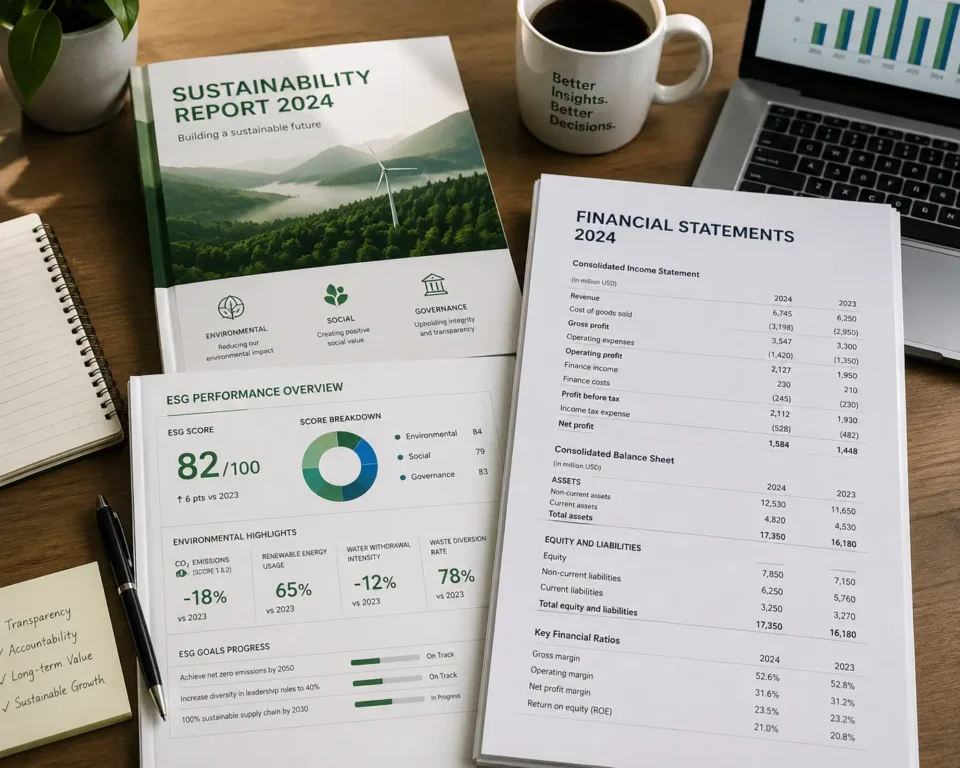
ESG data functions alongside traditional financial metrics. The Sustainability Accounting Standards Board (SASB) and the International Sustainability Standards Board (ISSB) have developed industry-specific standards to define which sustainability factors are most likely to be financially material for each sector.
You can listen to the full conversation here. For more conversations with institutional investors on sustainable finance, visit the SRI 360 podcast.