In the taxonomy of sustainable finance, green has dominated for a decade. Green bonds account for the majority of labeled sustainable debt issuance, green targets anchor most corporate sustainability frameworks, and green has become synonymous in many investors’ minds with the concept of environmental impact altogether.
But a parallel market is emerging around a theme that addresses some of the most underfunded and urgent environmental and social challenges on the planet: water. Blue bonds, which direct capital to ocean health, clean water infrastructure, and marine conservation, represent what may be the most compelling underdeveloped opportunity in the entire impact fixed income universe.
The numbers behind the gap are striking. Sustainable Development Goal 14 (Life Below Water) consistently receives less than 1 percent of total SDG finance and philanthropic funding, making it the least funded of all 17 SDGs. Estimates for the annual financing needed to support a sustainable ocean economy transition range from $383 billion to $717 billion per year. Meanwhile, ocean acidity has increased by approximately 30 percent since the pre-industrial era, and as of early 2025, the world is experiencing its fourth and most intense mass coral bleaching event on record, impacting 84 percent of the world’s reef area across 83 countries.
The financial system has been slow to respond. The blue bond market is changing that, one transaction at a time.
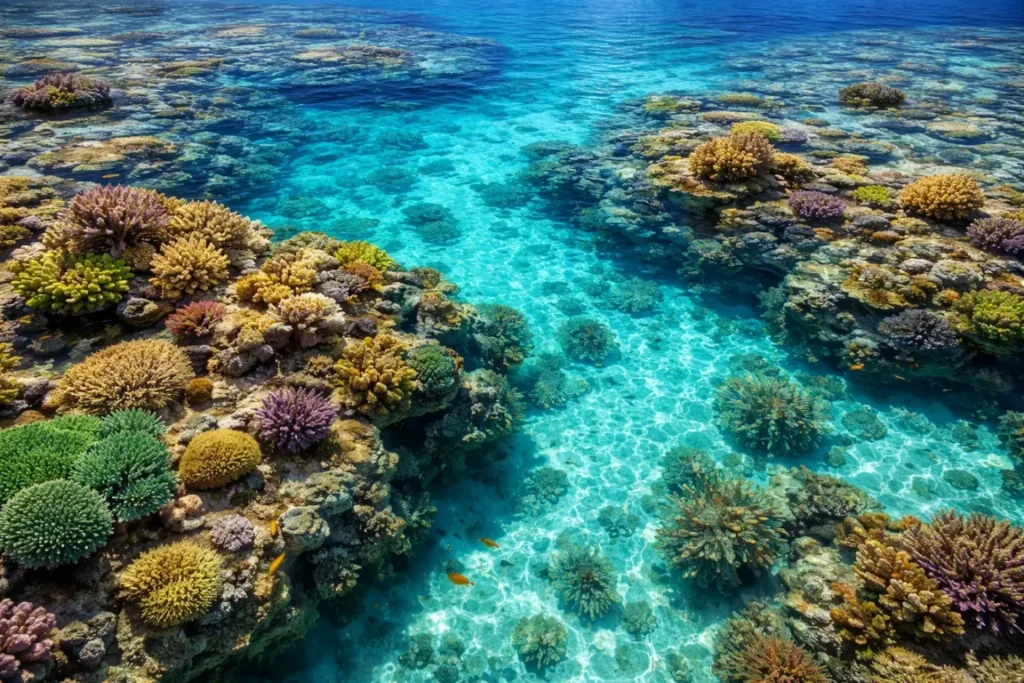
A shallow tropical coral reef photographed from above
What Is the Blue Economy and Why Does It Matter?
The term “blue economy” refers to the sustainable use of oceanic and water resources for economic growth, improved livelihoods, and job creation, while preserving the health of aquatic ecosystems. As defined by the United Nations, it encompasses sectors including fisheries and aquaculture, maritime transport, coastal tourism, offshore energy, and marine biotechnology, united by the principle that economic activity must be decoupled from ecological degradation.
The blue economy is not a small or niche sector. The OECD estimates that the gross value added of the global ocean economy doubled in real terms over the past 25 years, reaching $2.6 trillion in 2020. The ocean regulates the global climate, produces approximately half of the Earth’s oxygen, and provides food security for billions of people, particularly in coastal and island developing states.
It is also deeply vulnerable. Unsustainable fishing practices, coastal pollution, sea-level rise, and ocean warming are degrading the resource base on which this economic activity depends. The economic cost of climate-change-induced coral loss alone is projected to reach $500 billion annually by 2100.
Blue bonds are the financial instrument designed to direct private and institutional capital toward addressing these pressures.
SDG 14: The Least Funded Goal on the List
The financing gap behind SDG 14 is not just large in absolute terms. It is large relative to every other goal, which is a remarkable fact given the ecological and economic importance of ocean health.
To achieve universal access to safely managed water and sanitation by 2030, the World Bank estimates that annual investment must triple to $114 billion per year. Other analyses put the annual spending shortfall for water infrastructure at $131.4 billion to $140.8 billion. The total cumulative investment needed in water infrastructure globally by 2040 has been estimated at €11.4 trillion, revealing a financing gap of €6.5 trillion compared to current spending trajectories. Asia alone faces a $4 trillion gap in water infrastructure investment.
These figures make SDG 14 and its close counterpart SDG 6 (Clean Water and Sanitation) two of the most urgent and underfunded priorities in global sustainable development, and both sit squarely within the scope of blue bond financing.
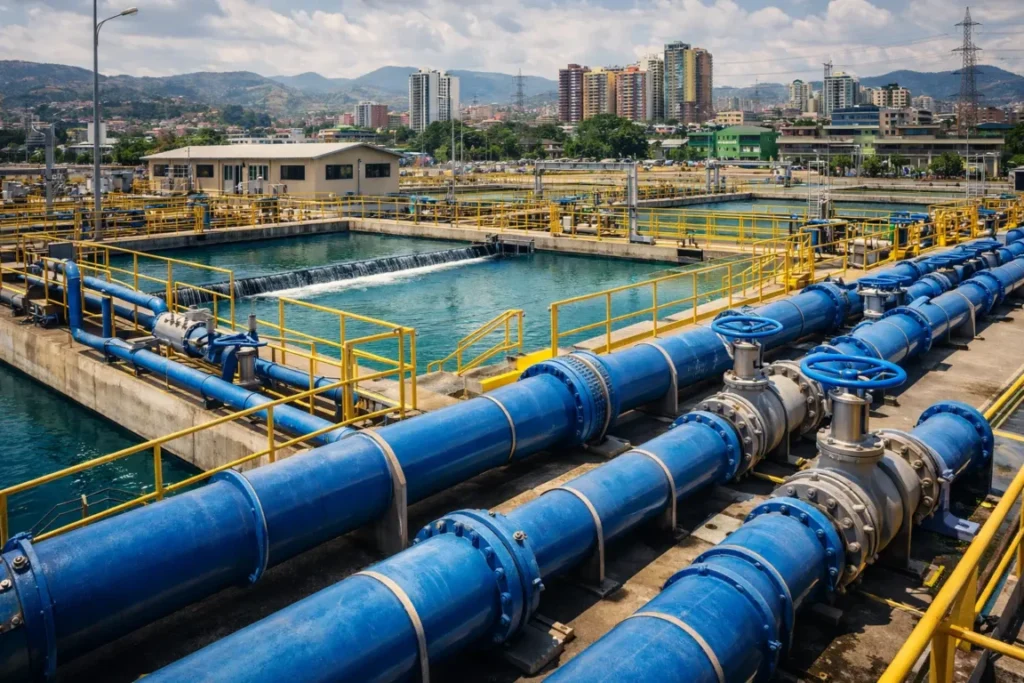
Large-diameter blue water mains and manual shutoff valves run along the edge of an open aeration basin at a municipal water treatment plant
How Blue Bonds Work and Who Is Issuing Them
Blue bonds are a subset of green bonds. They fall within the broader ICMA Green Bond Principles but are distinct in that they allocate 100 percent of proceeds to projects aligned with SDG 6 (Clean Water and Sanitation) or SDG 14 (Life Below Water), or both. ICMA published a dedicated practitioner’s guide to Bonds to Finance the Sustainable Blue Economy in September 2023, providing the first comprehensive framework for eligible project categories and reporting standards in this market.
The guide identifies five broad categories of eligible blue projects: coastal climate adaptation (flood defense, sea-level rise infrastructure), marine ecosystem management (coral reef and mangrove conservation), sustainable marine value chains (fisheries management, certified aquaculture), marine renewable energy (offshore wind, tidal, wave), and marine pollution control (wastewater treatment within coastal drainage areas).
Since the market’s inception, at least $10.4 billion in dedicated blue bonds have been issued. A broader analysis including bonds with significant blue-aligned use of proceeds suggests over $48 billion of issued debt could be classified as blue in nature.
Sovereign issuers, particularly small island developing states and coastal nations, have led the market’s development through innovative structures. The Seychelles issued the world’s first sovereign blue bond in 2018, a $15 million instrument supported by the World Bank, directing proceeds to sustainable fisheries and marine conservation. This transaction established the template for sovereign blue finance and proved that ocean-related projects could be structured into capital markets instruments.
More recently, the market has accelerated through debt-for-nature swaps, a structure in which a country’s existing debt is refinanced at lower rates in exchange for commitments to protect marine ecosystems with the interest savings generated. Barbados signed a $300 million blue sustainability-linked loan in December 2024, expected to yield $125 million in interest savings directed toward water-related climate resilience. The Bahamas signed a $300 million marine conservation-focused debt conversion loan in November 2024. Ecuador completed a $1.5 billion debt-for-nature swap in December 2024 securing conservation funding for the Amazon and Galapagos ecosystems.
Multilateral development banks including the World Bank, the Asian Development Bank, and the International Finance Corporation have provided critical technical assistance and anchor capital that has helped establish standards and de-risk blue bond transactions for private investors. Corporate blue bond issuance is also expanding, with utilities, port operators, and water companies increasingly bringing blue-labeled transactions to market.
The IFC RFP That Started Everything
I recently spoke with Matt Lawton, Head of Impact Fixed Income at T. Rowe Price, whose firm has become one of the most active blue bond originators in the institutional asset management world. The origin story of T. Rowe Price’s emerging market blue economy bond strategy traces directly to an unusual approach by one of the world’s most influential development finance institutions.
Approximately two and a half years ago, the IFC (the International Finance Corporation, the World Bank’s private sector arm focused on emerging market development) sent a request for proposals to roughly 15 to 20 asset managers. Lawton described it as the most distinctive RFP he had seen in his career.
Rather than leading with tracking error budgets and fee schedules, the RFP spotlighted a specific problem: the chronic underfunding of SDG 6 and SDG 14, the two sustainable development goals most tied to the blue economy. SDG 14 is, as Lawton noted, “the least funded of the sustainable development goals.” The RFP framed the challenge as engineering a connection between that funding gap and the world’s largest securities market in the global bond market, then asked asset managers to design a solution.
T. Rowe Price was selected after what Lawton described as an unusually thorough diligence process. The partnership with IFC was announced roughly two years ago, launching what was positioned as the world’s first emerging market corporate blue bond strategy. Two parallel workstreams followed: engaging corporate issuers in emerging markets to build a supply of credible blue bonds, and raising capital from institutional investors willing to anchor the strategy.
The first close of $200 million was announced a few months before our conversation, with anchor investors including IFC itself, Builder’s Vision, and Xylem. Lawton noted that the timing of the launch announcement coincided with a wave of blue bond supply coming from emerging market corporates, supply that T. Rowe Price had spent two years helping to cultivate.
One of the transactions that exemplified this origination approach was the DP World blue bond. DP World, one of the world’s largest port and logistics companies, connected with the T. Rowe Price team at a blue economy event in New York during Climate Week. A senior executive from the company, after hearing T. Rowe Price present on blue bond frameworks, initiated a conversation about a potential transaction. The T. Rowe Price team provided guidance on project eligibility and measurement standards over several months. In December 2024, DP World issued a $500 million blue bond allocating proceeds to sustainable shipping retrofits, marine pollution prevention, and coral reef restoration through a partnership with Coral Vita, a company specializing in artificial coral reef restoration.
The Sebastes example, a Brazilian utility that issued a blue bond with proceeds directed toward clean water and sanitation in the state of São Paulo, illustrated another dimension of the blue economy investment case. Beyond the direct SDG 6 impact of expanding water access, Lawton described co-benefits that became clearer through the due diligence process: Brazil records an estimated 350,000 hospitalizations and 12,000 deaths annually from poorly managed sanitation, with a significant share occurring in the regions where Sebastes operates. The investment addresses not just water infrastructure but public health outcomes and biodiversity recovery in adjacent ecosystems.
Blue Washing: The Risk That Could Sink the Market
Any market in its early stages of development faces the risk of poor quality entrants exploiting the label. Blue bonds are no exception. “Blue washing,” the practice of misrepresenting environmental benefits or funding activities inconsistent with the spirit of ocean and water protection, is a genuine concern that Lawton addressed directly.
T. Rowe Price’s response is a proprietary blue impact framework co-developed with IFC, which defines 11 eligible project categories and qualifying criteria within each. For a water efficiency project to qualify, the framework requires a minimum expectation of 30 percent water efficiency savings on an annual basis. For desalination projects, there are requirements governing brine management and the use of renewable energy to power the facility. These are specific, measurable thresholds rather than broad directional statements.
The framework’s qualifying criteria address a real vulnerability in the blue bond market identified by researchers and practitioners: the absence of standardized global taxonomies has led to market fragmentation and inconsistent impact reporting, particularly among smaller issuers that avoid third-party certification due to cost. Regulatory updates including the 2025 expansion of the EU taxonomy to include social and biodiversity aspects are expected to provide greater clarity over time, but the standards gap remains a live issue.
Lawton’s team has also established an external advisory committee with scientific and sector experts to inform best practices, and has undergone verification through BlueMark, which assessed T. Rowe Price’s practices against the Operating Principles for Impact Management. The verification results are published on the firm’s website.
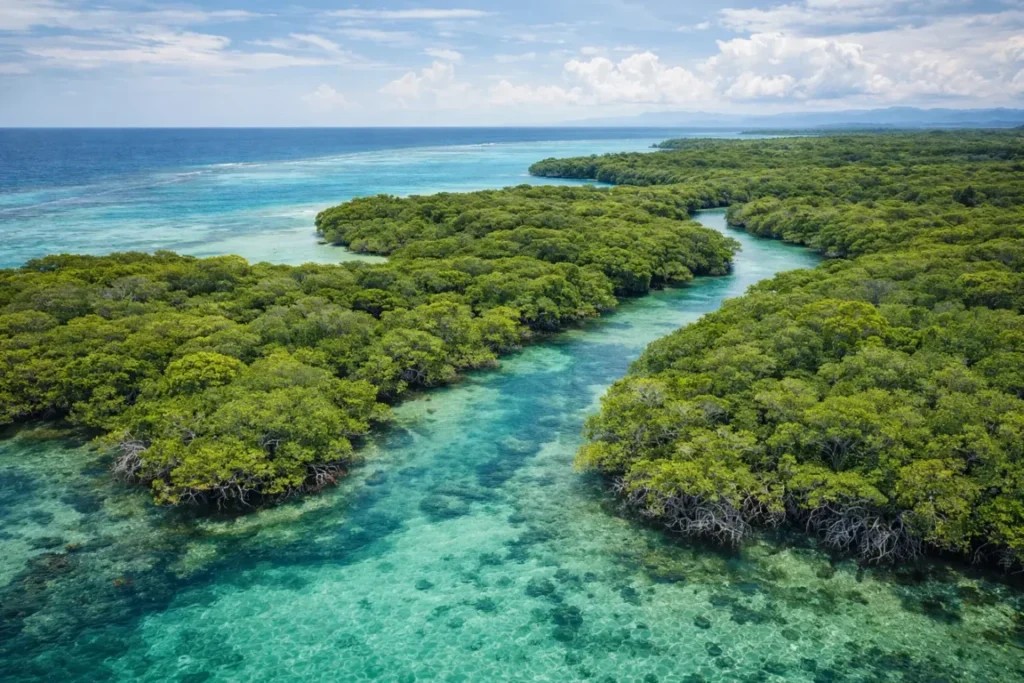
Dense tropical mangrove forests wind along crystal-clear turquoise channels in an aerial view
Why Water Is the Most Unifying Theme in Sustainable Finance
Beyond the technical investment case, Lawton offered an observation about the political economy of blue bond investing that distinguishes it from other thematic impact strategies.
The broader ESG and sustainable finance space has become politically contested in certain markets, particularly in the United States. Climate investing has become entangled in culture war debates. Social impact frameworks are challenged on ideological grounds. But water occupies a different position in public discourse.
“Water is one of those uniquely unifying sustainability themes,” Lawton said. “For all the politicization of ESG, water is one of those topics that I haven’t met anyone that’s against having clean drinking water or clean oceans.”
This political resilience matters for institutional investors operating under fiduciary scrutiny and subject to regulatory and stakeholder pressure from multiple directions. A strategy anchored to water finance, coral reef restoration, and marine pollution prevention is harder to politicize than one branded around carbon or social equity, even if the underlying environmental case is equally strong.
Lawton also identified three structural tailwinds that make him particularly bullish on blue bonds reaching a tipping point similar to where green bonds were a decade ago. The first is policy: water was formally placed on the COP agenda three years ago, and public sector investment tends to precede and catalyze private sector capital flows, as was observed after the Paris Agreement mobilized a wave of green investment. The second is the unifying political nature described above. The third is a growing market appetite for thematic issuance that resonates across the full finance ecosystem, from issuers and underwriters to investors.
“I would say they’re at a quite a bit, I would say, a tipping point today,” Lawton said of the blue bond market, noting that it is at a similar stage of development to where green bonds were 10 to 15 years ago.
Green bonds reached cumulative issuance of over $4 trillion. If blue bonds follow even a fraction of that trajectory, the capital flows toward ocean and water protection over the coming decade will be measured in hundreds of billions of dollars. That is not guaranteed. It depends on the integrity of the standards, the credibility of the issuers, and the discipline of the investors who anchor the market in its formative years. But the opportunity is real, the need is urgent, and the institutional infrastructure to deliver it is being built.
To hear more, listen to the complete interview with Matt Lawton on the SRI 360 Podcast.
This article is based on a discussion from the SRI 360 Podcast. For more perspectives on sustainable and responsible investing, visit sri360.com/podcast/.