Amazon, Alphabet, Meta, Microsoft and Oracle sold $121 billion of bonds in 2025. Between 2020 and 2024, the same five companies had issued an average of $28 billion a year. That is not a gradual increase. It is a different market, built in roughly twelve months.
By October 2025, debt tied to artificial intelligence (AI) had grown to $1.2 trillion, enough to overtake US banks as the largest single sector in JPMorgan’s US Liquid investment grade index. AI now accounts for 14% of the entire high grade corporate bond market. For a fixed income investor, that raises a fairly direct question: is this where the opportunity is, or is the real trade sitting somewhere else in the capital stack?
I recently spoke with Elizabeth Alm, co-portfolio manager on Saturna Capital’s Global Sustainable Bond Fund and deputy portfolio manager on its Amana Participation Fund, a sukuk (Islamic bond) portfolio. Her answer is that the interesting bet isn’t the hyperscaler bonds themselves. It’s the utilities, the transmission lines and the municipal infrastructure being financed to keep those data centers running.
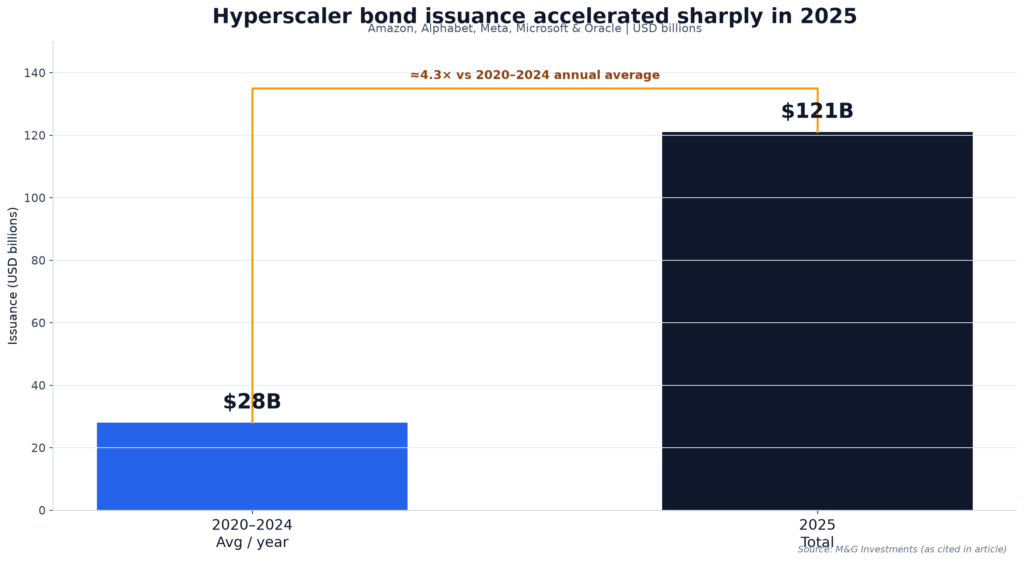
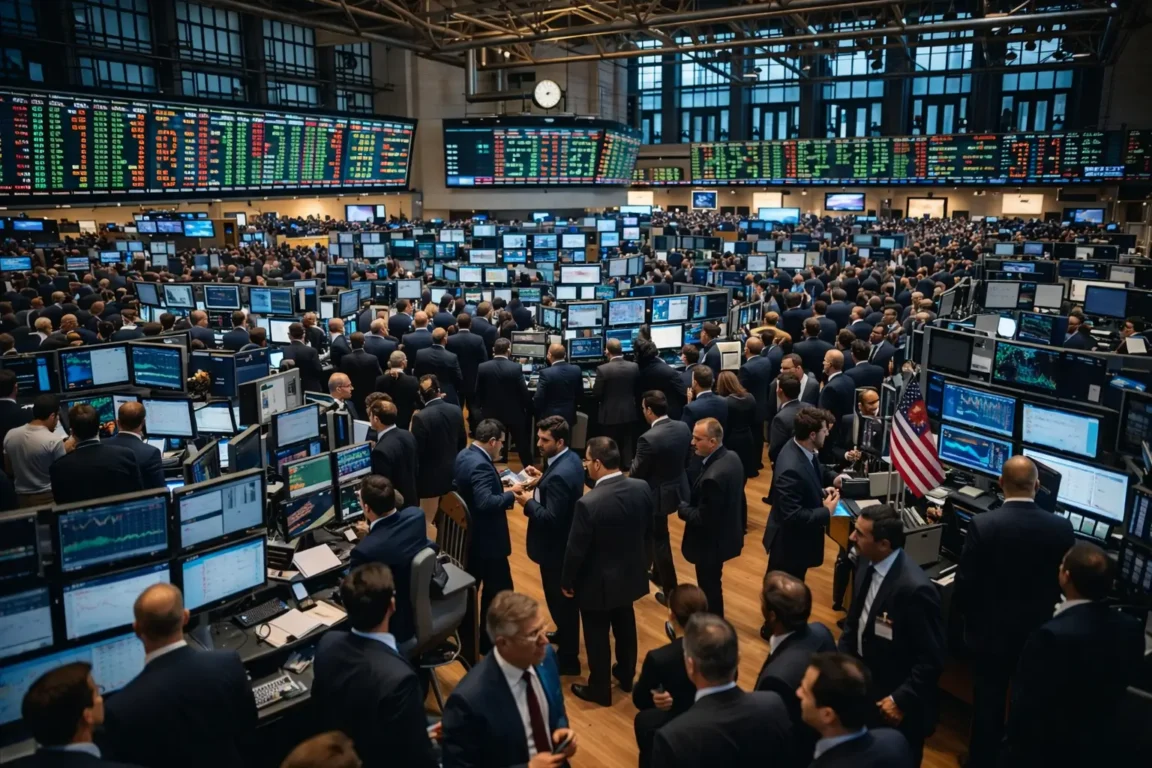
Hyperscaler bond issuance jumped from an average of $28 billion a year to $121 billion in 2025 alone
A bond machine four times its old size
The scale of hyperscaler issuance is easier to grasp next to what these companies used to borrow. Not so long ago, Amazon, Alphabet, Meta, Microsoft and Oracle largely funded their expansion out of free cash flow. In 2025, tapping the bond market became the norm instead, driven by capital expenditure needs that outpaced even that cash flow and by a desire to lock in still cheap funding costs while optimizing shareholder payouts.
Gartner projects worldwide AI spending will hit $2.52 trillion in 2026, a 44% jump from the year before and more than the entire $1.6 trillion spent on AI globally between 2013 and 2024 combined, according to M&G Investments’ research on the sector. Debt issuance is starting to track that curve.
Credit quality isn’t the concern here. These five issuers carry strong balance sheets and low leverage, even after the borrowing binge; even fully geared, most sit at 0.4 to 0.7 times leverage, against an average of roughly three times for the broader US investment grade market. Alphabet’s sterling denominated century bond, roughly £1 billion of 100 year debt sold as part of a multi-currency package of around $32 billion, drew close to ten times demand. A maturity that long is almost never issued outside of sovereigns. Investors are effectively treating some of these companies as safer than the government bonds they’re priced against.
There’s a useful precedent for that kind of confidence, and it’s a cautionary one. Motorola issued a century bond of its own in 1997, back when it was investment grade and dominant in its field. The bond never defaulted, but technology disruption gutted Motorola’s core business within a decade, and the company that eventually paid off the debt bore little resemblance to the one investors originally lent to. A hundred year loan asks a lender to bet not just on today’s balance sheet but on a business model holding up across generations. Alphabet’s bond may age fine. The point is that near unanimous investor confidence in a tech giant’s permanence has been wrong before, at a similar moment of dominance, in living memory.
That history is precisely the problem for an active manager pricing today’s hyperscaler debt. When the safest names in the market are also the most crowded trade, the reward for holding them shrinks even if the credit risk stays low. Saturna isn’t underweight the hyperscalers because of default concerns. It’s underweight them because the yield doesn’t compensate for that crowding, and because the fund can find similar or better credit quality, plus a genuine sustainability story, in markets few competitors are covering as closely.
Why the safest bonds in the market don’t make the cut
Alm was direct about the reasoning during our conversation. Saturna runs a genuinely global bond book, and with almost the entire world available to choose from, US mega cap tech debt has to compete on a tactical relative value basis like everything else. Right now it doesn’t win that competition: yields on the hyperscaler names are tight relative to comparable emerging market credits the fund already holds with strong governance and cleaner sustainability profiles.
There’s also a more direct issue. Data center power demand carries a real and unresolved climate impact debate, and Saturna would rather not hold that controversy in a fund built around climate risk analysis.
That doesn’t mean the door is permanently shut. Alm described a version of hyperscaler debt she could own: bonds tied to data centers with genuine community input on siting, renewable generation built to support the load rather than raise prices for existing customers, and proper zoning and governance around the build. Under those conditions, the more interesting position for a sustainable bond manager isn’t the hyperscaler’s own paper. It’s the ecosystem growing up around the data centers: utilities upgrading transmission, and municipal debt issued by the communities hosting the clusters.
The unglamorous buildout underneath the boom
That ecosystem is where the third party data gets interesting. Deloitte’s 2026 Power and Utilities Industry Outlook found that US electricity demand, flat for decades, began accelerating sharply in 2025, driven by AI training workloads alongside electrification in transport and industry. Deloitte projects peak demand will grow roughly 26% by 2035. Data center demand alone could reach 176 gigawatts (GW) by 2035, a fivefold increase from 2024.
Meeting that demand is expensive. Deloitte puts the US electric sector’s capital needs at more than $1.4 trillion through 2030, a figure traditional equity and debt financing alone can no longer comfortably cover. Utilities are responding the way any capital intensive business responds when spending needs outrun cash flow: they borrow, the same logic behind a homeowner financing a major renovation with a loan rather than draining savings in one go. Utility mergers and acquisitions in the US electric power sector already exceeded $109 billion in the first nine months of 2025 alone, as companies repositioned portfolios to fund the buildout.
None of this is happening quietly or for free. In Indiana, rate case settlements now require hyperscalers to help pay for the grid upgrades their own data centers demand. Oregon passed legislation creating a separate utility rate class specifically for large data centers, so the cost of serving them doesn’t fall on ordinary ratepayers by default. Deloitte’s framing is telling: hyperscalers are shifting from being treated as inflexible mega loads to being negotiated with as grid partners, expected to share telemetry, demonstrate demand flexibility and, increasingly, help fund the infrastructure their growth requires.
That shift is more than a negotiating posture. Deloitte’s research found that fewer than 5% of data center facilities currently participate in demand response programs, where a facility agrees to cut its power draw during periods of grid stress. But pilot programs show that 10% to 30% of a data center’s load can be flexed during peak events without disrupting operations, essentially letting a hyperscaler’s facility function like a battery for the grid rather than a fixed drain on it. Regional grid operators including the Electric Reliability Council of Texas and the Midcontinent Independent System Operator are already building telemetry and interconnection rules around that flexibility. The infrastructure required to make it work, from grid enhancing technologies to storage, is itself a growing line item in utility capital budgets, and by extension in utility bond issuance.
Utilities are financing new transmission lines and substations to keep pace with surging data center electricity demand
The second municipal trade, and why it isn’t a data center trade
There are two separate municipal opportunities in this story, and they are worth keeping apart, because conflating them is how investors end up buying the wrong thing.
The first is genuinely data center adjacent. When a hyperscaler lands in a county, the host community has to finance its share of what arrives with it: substations and distribution upgrades, water and wastewater capacity, road access, and the utility scale generation needed to serve the load. Some of that is funded by the utility and recovered through rates, and some of it runs through municipal issuance by the county, the city, or a public power authority. Indiana’s rate settlements and Oregon’s separate data center rate class are both attempts to decide who pays for that, and the answer determines whether the municipal credit strengthens or weakens. This is the part of the AI buildout that shows up directly in municipal bond documents.
The second is the one Alm’s attention actually keeps returning to, and it is not connected to data centers at all. It is the municipal market’s older and better established role in financing physical climate resilience, the corner of fixed income she started her career in.
Rhode Island’s 2024 Green Bond is her example of the type. Ten million dollars of it funds the state’s Municipal Resilience Program, administered through the Rhode Island Infrastructure Bank, providing matching grants of up to 75% to help cities and towns harden coastal habitats, river and stream floodplains and other infrastructure against increasingly frequent flooding and storms. The program has already issued 48 action grants across 26 participating communities, and the new funding is meant to extend it to all 39 of Rhode Island’s municipalities over the next two years.
That bond has nothing to do with artificial intelligence, and no one should pretend otherwise. Coastal flood defence in Narragansett Bay is not a data center story. What links it to the rest of this piece is a way of choosing investments rather than a shared end market. In both cases the interesting credit sits one layer below the headline: the substation rather than the server farm, the seawall rather than the insurance claim. Both finance something physical that has to exist whether or not the current growth story holds. And both sit in the parts of the market large asset managers check least often, which is where Alm’s fund has consistently found its edge, whether that is a Gulf sukuk desk or a state infrastructure bank’s grant program.

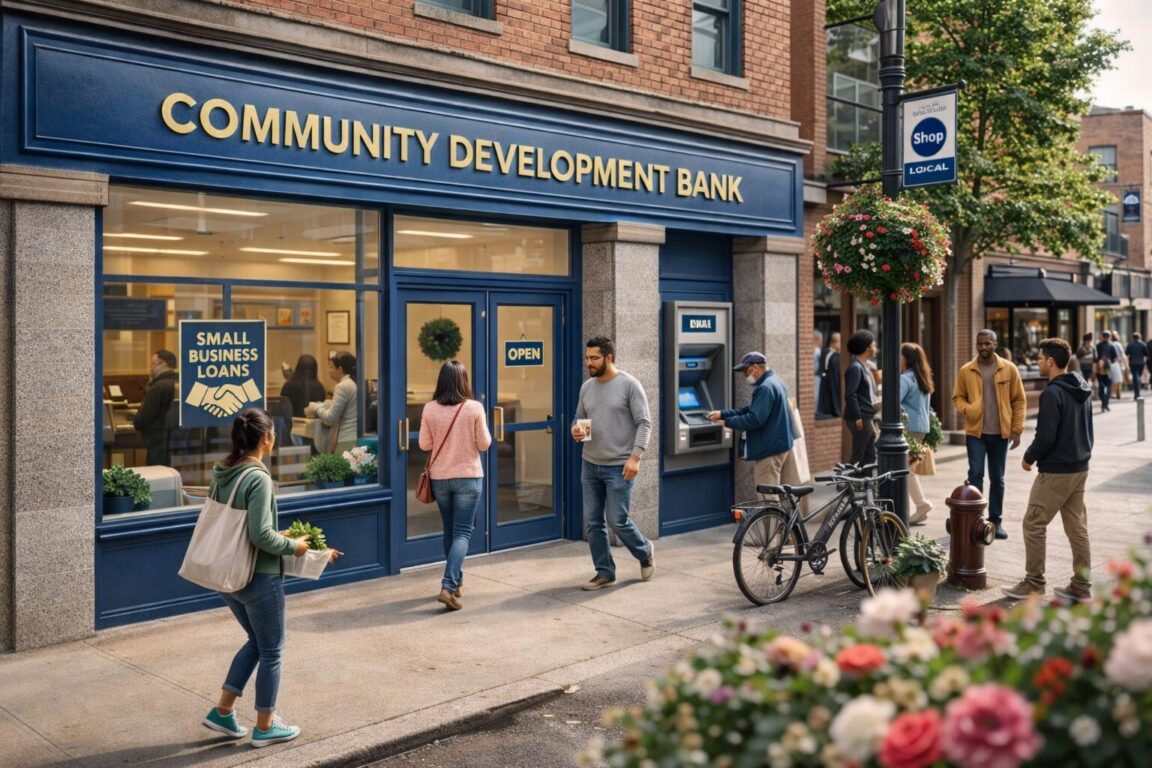
Municipal resilience bonds fund projects like shoreline restoration and floodplain protection to guard communities against worsening storms
The risk that doesn’t disappear either way
None of this erases the risk sitting inside the hyperscaler trade itself. A rerating of the broader investment grade market is possible if capital keeps rotating into new hyperscaler deals at the expense of other issuers, and a correction in AI related valuations, should growth expectations fail to materialize, is a live scenario bond investors are watching closely. The concern isn’t really default risk on five of the world’s most cash generative companies. It’s contagion: what happens to credit spreads more broadly if AI-tied debt, now the largest single slice of the investment grade market, gets repriced all at once. M&G Investments, which tracks the sector for its own institutional clients, frames the real warning sign as companies that start disguising genuine liabilities to keep a growth story intact, the kind of behavior that tends to surface late in a hot credit cycle rather than early in one.
That’s a reason to stay selective about the hyperscaler names, not a reason to ignore the buildout happening around them. The transmission lines, substations and resilience infrastructure being financed today will still be needed if the AI capex cycle cools next year or keeps accelerating for another five. The municipal bonds and utility debt paying for that work don’t unwind along with a valuation correction in Big Tech’s own paper. They’re tied to physical demand for electricity and physical exposure to storms and flooding, both of which will keep rising regardless of what happens to any single hyperscaler’s credit spread.
For a fixed income investor looking past the headline number, that’s the gap worth watching: not whether Amazon or Alphabet can pay their coupons, but who is financing the poles, wires and resilience infrastructure straining to keep up with them, and at what price the market is currently letting an investor in.
Listen to the full conversation with Elizabeth Alm on SRI360’s podcast page, where she also walks through how sukuk (Islamic bonds) work and why non-Muslim institutional investors are buying into them.
For more conversations with investors putting sustainability at the center of their process, visit the SRI360 podcast.