An investor trying to assess the impact of a portfolio company in 2026 can choose between IRIS+, the Operating Principles for Impact Management, the Global Reporting Initiative, the Sustainable Finance Disclosure Regulation, the Corporate Sustainability Reporting Directive, the standards of the International Sustainability Standards Board, the impact accounting methodologies of the former International Foundation for Valuing Impacts, and the SDG Impact Standards produced by the United Nations Development Programme. Several more exist at national level.
The usual response is to complain about fragmentation and predict consolidation. That prediction has been made annually for about a decade.
What is actually happening is more specific and more useful. One layer of this architecture is consolidating quickly, with regulators doing the consolidating. Another layer is not consolidating at all, and the reason has nothing to do with a lack of goodwill.
I recently spoke with Elizabeth Boggs Davidsen, chief executive of GSG Impact, the Global Steering Group for Impact Investment, who helped build one of the frameworks now sitting on the pile. She led the creation of the SDG Impact Standards at the United Nations Development Programme, which makes her assessment of the proliferation problem more interesting than most. She describes standards moving through stages: divergence, in which everyone builds a taxonomy, then bridging, then eventually consolidation “when one or two dominant standards actually crystallize everyone else.”
The evidence suggests she is right about the sequence and that the two layers are at different points in it.
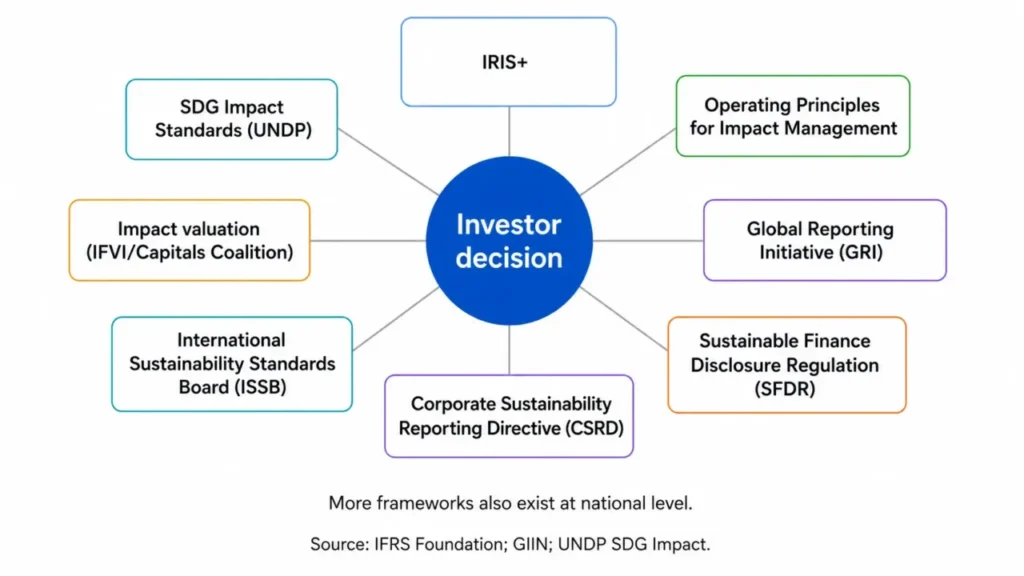
Eight overlapping frameworks investors must navigate when assessing a company’s impact and sustainability performance.
The layer that is consolidating
Sustainability disclosure is converging, and faster than most of the sector’s commentary acknowledges.
The International Sustainability Standards Board published two standards under the International Financial Reporting Standards (IFRS) banner: IFRS S1, covering general sustainability related financial disclosure, and IFRS S2, covering climate. As of 22 April 2026, 28 jurisdictions had adopted the standards on a voluntary or mandatory basis, with a further 12 planning to, according to S&P Global’s tracker.
The list of adopters is not the usual roll call of wealthy markets. The IFRS Foundation has published full jurisdictional profiles for Ghana, Kenya, Nigeria, Rwanda, Tanzania, Zambia, Bangladesh, Pakistan, Sri Lanka, Jordan, Qatar, Brazil, Chile and Mexico, among others, with snapshots for China, Canada, South Korea, the United Kingdom, Indonesia and Switzerland.
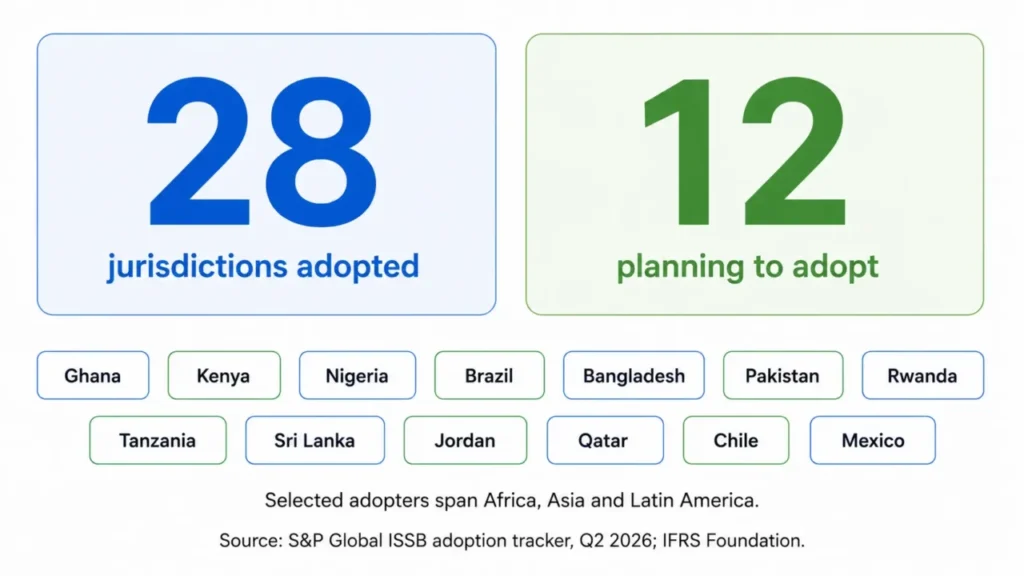
28 jurisdictions, including Ghana, Kenya and Bangladesh, had adopted the ISSB’s sustainability disclosure standards.
Momentum continued through early 2026. South Korea issued two standards based on the ISSB’s. The United Kingdom published its own UK Sustainability Reporting Standards, and the Financial Conduct Authority opened a consultation on aligning corporate climate disclosure, with rules due to take effect from 1 January 2027. Ethiopia published a draft adoption roadmap.
This is what convergence looks like when it is real. Not a memorandum of understanding between two standard setters, but supervisors writing one baseline into national law across four continents inside three years.
Europe rewrites its own rulebook
The more revealing development is that the European Union, which built the most elaborate sustainability disclosure regime in the world, has decided to dismantle a large part of it.
On 19 November 2025 the European Commission proposed a substantial revision of the Sustainable Finance Disclosure Regulation. The Commission’s own diagnosis is blunter than regulators usually are about their own work. Disclosures were “often too long and complex,” it wrote, and the regulation “has effectively been used as a de facto labelling system, causing confusion among investors and increasing the risk of greenwashing and mis-selling.”
That last point deserves attention. Articles 8 and 9 of the SFDR were designed as disclosure categories. The market immediately read them as a quality ladder, and fund marketing followed. A rule intended to inform allocation instead distorted it.
The proposed replacement drops entity level principal adverse impact disclosure and introduces three voluntary product categories: sustainable, transition, and ESG basics. Categorised products must ensure 70 percent of the portfolio supports the stated strategy and must exclude harmful activities. Claims about environmental, social and governance characteristics in fund names and marketing become reserved for categorised products.
Whatever one thinks of the design, the direction is consolidation by subtraction. Fewer requirements, clearer categories, one framework doing less work more legibly.
The layer that is not consolidating
Now consider the other half of the architecture, which asks a fundamentally different question. Not what a company discloses about sustainability risks to its own enterprise value, but what effect that company’s activity has on people and the environment, and what that effect is worth.
Here there is no ISSB equivalent and no supervisor forcing the issue. What there is instead is a merger.
In July 2025 the Capitals Coalition and the International Foundation for Valuing Impacts announced a strategic merger, completed by the end of that year. Their stated rationale reads like an admission: “After a decade of significant growth and proliferation of impact-focused organizations and frameworks, the sector now needs to prioritize collaboration, standardization, and consolidation to achieve lasting results. This merger is a direct response to that need.”
Rob Zochowski, who led IFVI, framed the original ambition plainly. The aim when the foundation launched in 2022 “was to make impact information as critical to decision-making as financial information.” The merged organisation has since established an independent Impact Value Standards Board to set the baseline for impact valuation work.
Boggs Davidsen is a proponent of impact accounting and does not oversell its timeline. “The logic is so logical,” she said. “Why would you not have a way to monetize your impact as you do your financial reporting? I think it’s going to take several more years to solidify that thinking.”
Her organisation’s contribution is to test the methodology where it is hardest to apply. GSG Impact’s stated role is piloting in emerging markets to see what survives contact with reality.
The closest thing this layer has to an industry standard shows the limits of voluntary coordination. The Operating Principles for Impact Management, launched by the International Finance Corporation and now hosted by the Global Impact Investing Network, require signatories to publish an annual disclosure statement and to commission periodic independent verification. That is real discipline, and rarer than it sounds. The signatory base stood at 183 investors as of May 2024, with 64 percent investing in private equity and 44 percent in private debt, and asset owners, development finance institutions and multilateral development banks accounting for over 70 percent of covered assets.
A voluntary code with 183 signatories and a mandatory disclosure standard adopted by 28 national supervisors are not competing for the same position. They are operating in different regimes entirely, and only one of them can compel anyone.
Why the two move at different speeds
The gap between the two layers is not a failure of coordination. It reflects a difference in what each is measuring and who is compelled to care.
Disclosure standards ask what a firm must tell investors about risks to its own value. That is a question securities regulators already have the authority and the machinery to answer. They have been mandating financial disclosure for a century. Extending the perimeter to climate risk is an incremental act.
Impact measurement asks what a firm’s activity is worth to everyone else. No securities regulator has a natural mandate over that, because it is not, in the first instance, an investor protection question. It requires agreement on valuation methods for outcomes that have no market price, which is a genuinely hard problem rather than a coordination failure.
Europe’s fight over double materiality is exactly this boundary being contested.
Double materiality is the requirement that a company report in both directions at once. Single, or financial, materiality covers how sustainability issues affect the company: what a drought does to a food producer’s margins, what a carbon price does to a cement maker’s cost base. Double materiality adds the reverse view, covering how the company’s activity affects people and the environment, whether or not that ever shows up in its accounts. The European Union built this two way test into its reporting rules. The ISSB standards, by design, cover only the first direction.
That difference explains most of the friction between the two systems, and it is why the European simplification debate matters well beyond Europe. GSG Impact has been advocating consistently for the European Commission to preserve double materiality reporting through the simplification of the European Sustainability Reporting Standards, with its head of thematics arguing that regulators should focus on improving implementation rather than weakening ambition. That argument is live, not settled.
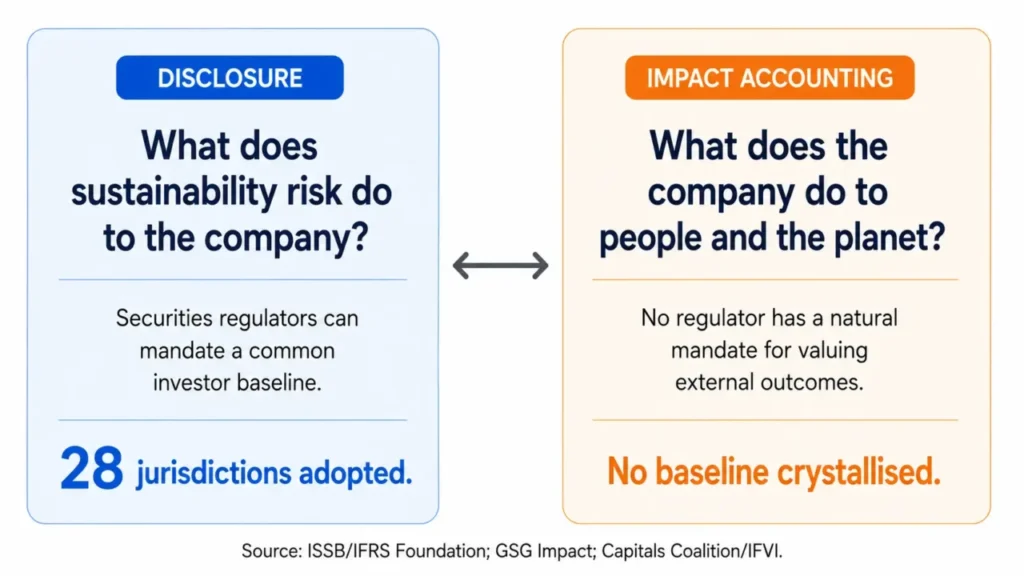
Disclosure standards converging under regulators while impact accounting still lacks any agreed baseline for valuation.
What actually changed at the standard setters
Boggs Davidsen’s own experience at the United Nations Development Programme illustrates where the useful work sat, and it was not in producing another metrics taxonomy.
“Investors really wanted to align with these sustainable development goals, but they genuinely did not know how to do that,” she said. The behaviour that followed is familiar to anyone who has read a fund’s impact report: mapping investments to a Sustainable Development Goal after the fact rather than building the investment thesis from the goal in the first place.
The SDG Impact Standards were built as management standards rather than reporting standards, asking what outcomes an investor was actually trying to achieve, how impact was embedded in governance and incentives, and how trade offs were assessed. Her summary of the shift: standards moved the conversation “from reporting outputs to trying to manage for impact.”
That work did not stay at the United Nations. In September 2024, UNDP and the International Organization for Standardization launched the first international guidelines for organisations contributing to the Sustainable Development Goals, published as ISO/UNDP PAS 53002:2024. The release states that the guidelines are set to evolve into the first International Standard for the goals, “building on the foundation laid by UNDP’s SDG Impact Standards.”
A framework becoming an ISO management standard is one of the few genuinely durable outcomes available in this space. It is also nearly invisible from the outside, which is part of why the fragmentation story persists.
How allocators should read the gap
The practical implication for an investor is that the two layers should be treated as different tools with different maturities.
For disclosure, the answer is now reasonably clear. Build reporting around the ISSB baseline. Twenty eight jurisdictions have adopted it, twelve more intend to, and the frameworks that once competed with it are being folded into it or rewritten alongside it. A firm that aligns now is not making a bet.
For impact measurement, the honest position is that no baseline has crystallised, and pretending otherwise produces the exact behaviour the standards were meant to eliminate. The useful discipline in the interim is the one Boggs Davidsen describes from the UNDP work: fewer frameworks reported against, more attention to whether the information changes an allocation decision. She is candid about the failure mode, having watched companies report “against multiple frameworks without using the information to manage the business differently.”
There is a reasonable argument that firms building serious impact management capability now will be advantaged when consolidation does arrive, on the grounds that the underlying data work transfers even when the reporting template changes. That is plausible rather than proven.
What is proven is narrower. Twenty eight supervisors have now written the same disclosure baseline into law, which settles that question for practical purposes. Nobody has settled the valuation question, and the two organisations best placed to try have just merged so that they can stop competing over it. That is progress, but it is the kind that takes years and produces no announcement worth reading until it is finished.
Hear the full conversation with Elizabeth Boggs Davidsen on the SRI 360 podcast: https://sri360.com/podcast/elizabeth-boggs-davidsen/
For more interviews with world class sustainable and responsible investors, along with research and analysis on impact investing, visit https://sri360.com/podcast/