
There are roughly nine to ten tech unicorns across the entire African continent. India, with a comparable population, has dozens. Silicon Valley has produced more unicorns in a single funding cycle than Africa has in its entire recorded startup history.
That gap is not evidence of a broken ecosystem. It is evidence of a different market, one with different economics, different exit dynamics, and different rules for what constitutes a viable return. Investors who miss that distinction tend to come in at the wrong valuation, wait for an exit that never materializes in the form they expected, and leave disappointed, blaming the continent rather than their own assumptions.
I recently spoke with Mohamed Okasha, co-founder of Fawry and founding partner of DisrupTech Ventures, about how African venture returns actually work in practice. Having been on both sides, taking Fawry through Egypt’s most successful tech IPO and then executing exits as a fund manager, his framework for this is grounded in a single premise: you have to invest in Africa the African way.

Fawry’s August 2019 debut on the Egyptian Exchange, oversubscribed more than 30 times, showed that a local listing alone could carry a company to unicorn status within a year
The Exit Landscape No One Warned You About
The data tells the story clearly: according to the 2025 Africa Venture Capital Exit and Liquidity Report, 181 verified venture-backed exits took place across the continent between 2011 and 2026, and 81% of them were concentrated in four markets: South Africa, Nigeria, Kenya, and Egypt. Trade sales through mergers and acquisitions account for approximately 73% of liquidations. Secondary sales between private equity and venture firms represented approximately 23% of 2025 exits. Initial public offerings account for roughly 10% of the total.
International buyer participation in those exits dropped to 33% in 2025, down from 56% in 2020. That shift tells you something important: the exit market is becoming more regional and more domestic. The assumption that a global trade buyer will come in and pay a premium based on comparable multiples from US or European transactions is weakening.
The AVCA 2024 Venture Capital in Africa Report recorded 26 venture-backed exits in 2024, flat year-on-year, driven mostly by M&A led by local and regional trade buyers. Exit volume has not grown proportionally with the capital deployed over the preceding decade. That mismatch is the core tension that makes African venture capital hard.
None of this is disqualifying. But it does require a specific kind of portfolio construction discipline that many fund managers importing templates from other markets simply have not developed.
What a Local IPO Can Prove That a London Listing Cannot
Fawry launched its IPO on the Egyptian Exchange (EGX) under the trading code FWRY.CA on August 8, 2019. The company floated 36% of its share capital, comprising 254.6 million shares, raising approximately $97 million to $100 million at an offer price of LE 6.46 per share. The offering was oversubscribed 30.3 times overall, per Reuters, as reported by Al Arabiya. Shares surged 31% on the first day of trading, achieving an initial market cap of approximately $366 million.
By August 2020, the stock had risen 274% from its IPO price, the market cap crossed $1.07 billion, and Egypt had its first tech unicorn. MENAbytes documented the listing at the time; Fintech News UAE has tracked its subsequent trajectory.
The conventional wisdom in 2019 said Egyptian and African tech companies should list in London or New York if they wanted serious valuation recognition. The Fawry listing did the opposite, and the decision worked for a specific reason: local retail investors understood the product because they used it every day. You do not need a prospectus translator when you pay your electricity bill through a company’s kiosk every month. Domestic familiarity with a product creates a retail investor base that is willing to participate in a way that foreign institutional analysts, working from a desk in London who have never been to Egypt, cannot replicate.
The downstream effect was real. Fawry’s listing demonstrated to the Egyptian Exchange that listing good technology companies attracts international capital to local exchanges, not just local capital. The e-finance for Digital and Financial Investments IPO in October 2021 reinforced this: raising $372 million at a $2.5 billion valuation, with the offering oversubscribed 61.4 times, making it the largest offering in EGX history, per African Capital Markets News.
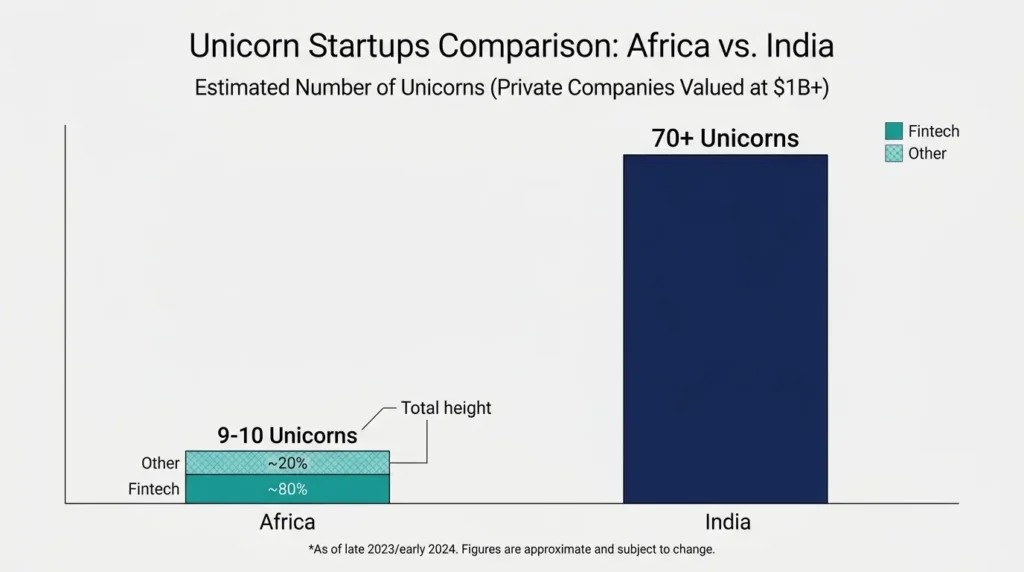
Africa’s roughly nine to ten unicorns are dwarfed by India’s far larger, more diversified cohort, underscoring how concentrated the continent’s tech successes remain in fintech and payments
Nine Unicorns for a Continent of 1.4 Billion People
Africa’s current unicorn count sits at nine to ten by 2025/2026, combining valuations exceeding $16 billion across names including Flutterwave, Interswitch, OPay, Wave, Andela, Chipper Cash, MNT-Halan, Moniepoint, and TymeBank, per Techmoonshot’s decade review and Afridigest’s complete list of African unicorns. Over 80% operate in fintech or payments.
Compare that to India, which has a large and diverse unicorn cohort spanning software-as-a-service (SaaS), edtech, e-commerce, and logistics alongside fintech. Southeast Asia follows a similar pattern with super-apps, logistics platforms, and consumer internet companies alongside financial services.
The African concentration in fintech is not a failure of imagination. It reflects where the genuine infrastructure gaps are. African unicorns address what analysts at Included VC have described as “painkillers,” foundational problems in transaction infrastructure and credit access, rather than the “vitamins” of discretionary consumer services. That is a structurally different market and commands structurally different valuation logic.
A fintech solving for the unbanked in a 110-million-person market with 77% recent financial inclusion growth has a large addressable market with clear demand. But that same company faces currency risk, regulatory friction, compressed exit options, and a valuation ceiling that a comparable company in an OECD market would not. Investors who ignore those constraints and price at OECD multiples are setting up an exit problem they cannot later resolve.
The Currency Math That Silently Kills Returns
Pitch decks rarely dwell on this. Post-mortems can’t avoid it.
Egypt’s pound has lost approximately 70% of its value against the US dollar since COVID-19, per Old Mutual Invest’s Egypt market analysis. Devaluations occurred in 2016, 2022, and 2024. GDP per capita fell from $4,587 in 2022 to $3,570 in 2024, per Sovereign Africa Ratings.
If you invested US dollars into an Egyptian company in 2020, your portfolio company could have grown its local-currency valuation by 100% and you could still be sitting on a negative dollar return, because the currency depreciated 70% in the same period. A company that doubled in pound terms during a 70% devaluation returns approximately -40% in dollar terms when the currency hit is applied.
This is not a hypothetical. It describes the actual experience of many USD-denominated funds in Egypt and across sub-Saharan Africa over the past several years. The 2025 Africa VC Exit Report documents that local investor participation is reshaping how liquidity forms across the continent, with domestic and regional buyers stepping in as international buyer participation has declined. Part of that shift reflects local capital outperforming imported capital on a net basis, because local investors operating in local currency are not facing that conversion headwind.
The structural response to this at the portfolio level is deliberate: back companies that build in Egypt but generate revenue in multiple currencies. Back office in Egypt means low-cost talent and operations. Customer base outside Egypt means dollar or euro revenue that hedges the EGP exposure. Several DisrupTech portfolio companies now generate the majority of their revenue outside Egypt. That structure is not accidental. It is the specific design required to make a USD-denominated fund viable in a market with recurrent devaluation risk.
Valuation Discipline as the Core Competitive Skill
AVCA reported that the median African venture deal size rose to $2.5 million in 2024, reflecting a concentration of capital into fewer, more mature startups even as overall deal volumes declined. That concentration in higher-quality, smaller deals reflects a post-correction maturation. The Partech Africa 2023 Report documents a 46% decline in total African tech funding in 2023 versus the 2022 peak, part of the broader global correction that followed the end of the zero-interest-rate-policy (ZIRP) era, forcing funds to move from growth-at-all-costs metrics toward cash sustainability and conservative entry pricing.
The discipline this demands is specific: investing in a company at $5 million to $10 million and realistically targeting an exit at $60 million to $80 million is achievable in the current M&A market for African fintech. Assuming an acquisition at $200 million or more is a low-probability outcome, and building a fund return model on low-probability outcomes is how funds disappoint their LPs.
DisrupTech’s first exit illustrates the alternative. The fund was an early investor in Fatura, a Cairo-based B2B digital marketplace founded in 2019. DisrupTech exited when Tanmeyah (a subsidiary of EFG Holding) acquired the company in 2022. Fatura’s marketplace subsequently integrated into the MaxAB-Wasoko platform after that company’s acquisition of Fatura in May 2025, following MaxAB and Wasoko’s all-stock merger in 2024, which created one of Africa’s largest B2B commerce platforms, valued at over $500 million and serving 450,000 merchants across five African markets. The EFG Holding press release from May 2025 confirms the transaction structure.
A disciplined entry. A trade sale exit. Not a unicorn. But a return.
What a Realistic Exit Strategy Looks Like in Practice
The local IPO trend in Africa is reinforcing a broader point: domestic exchanges are beginning to function as real exit pathways, not just fallback options.
Beyond Egypt’s EGX, signs of this are appearing across the continent. Cash Plus listed on the Casablanca Stock Exchange in 2025 at a $550 million valuation. Ethiopia launched the Ethiopian Securities Exchange in January 2025. The Nairobi Securities Exchange ended a five-year dry spell of equity listings in July 2025, per the 2025 Africa Exit Report. These are not major markets. But they represent a directional shift: capital markets on the continent are maturing, and local listings are becoming legitimate exits rather than consolation prizes.
The Fawry precedent suggests that local listings can actually attract international institutional capital rather than repel it. If the company is good enough, the exchange location is secondary. That thesis has enough evidence behind it now that investors can treat local exchange exits as part of the return calculus, not just M&A.
What the African way of venture capital requires, in practice, is entry prices anchored to realistic local exit multiples rather than global comparables, revenue structures that hedge currency exposure, and a clear-eyed view of what M&A exits in this market actually look like rather than what the Silicon Valley template says they should. The trust-building timeline runs in years, not quarters, and patient capital is not optional.
Those constraints are real. But they are navigable. The funds that have adapted to them are beginning to show it in their returns. The funds that have not are still waiting for the global trade buyer who is not coming at the valuation they modeled.
Listen to the full conversation with Mohamed Okasha on the SRI 360 podcast. For more articles and insights on sustainable and responsible investing, visit sri360.com.