“Thanks to artificial intelligence – and the fact that it’s now accessible – we have much better ways to measure what’s happening on the ground, especially in terms of biodiversity. The same applies to water and soil. Because of that, we believe at Serena that this is the perfect timing to invest in nature tech. ”
— Xavier Lorphelin
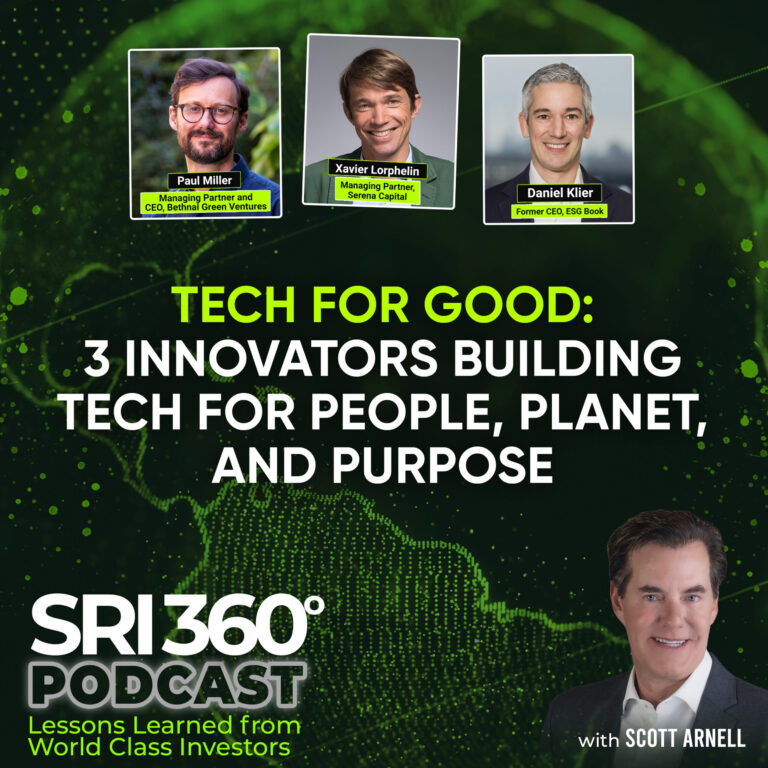
What do an AI-powered investment engine, a grassroots organizing platform, and a nature-tech-focused VC have in common?
They’re all built on the conviction that technology should be in service of real-world problems – not just market efficiency or shareholder return. And increasingly, investors are stepping up not only to fund that kind of innovation, but to actively shape it.
In this 3-in-1 compilation, we revisit past episodes with investors who are doing exactly that: using capital to steer technological progress toward social and environmental outcomes.
Each brings a different angle – whether it’s using AI to build better investment decisions, rethinking how electricity grids handle renewables, or backing startups working on nature-based solutions to the climate crisis.
The case they make is clear: if we want a more equitable and sustainable future, we’ll need to reshape what tech is for – and who it’s built to serve.
Here are the featured voices:
Paul Miller, Managing Partner & CEO, Bethnal Green Ventures
Paul Miller launched Bethnal Green Ventures in 2012 – before “tech for good” was even a phrase most investors recognized.
At the time, brilliant developers were stuck building tools for banks and ad agencies, while the problems they wanted to solve – climate, health, inequality – sat on the sidelines. Paul saw the gap and built something to fill it.
Bethnal Green Ventures backs founders using technology to create measurable, intentional social and environmental impact. The firm gets in early – often at prototype stage – and surrounds startups with the capital, support, and networks they need to grow.
Everything BGV backs falls under one of three themes: building a sustainable planet, a healthy society, and better lives. That’s included backing startups working on grid flexibility software for the energy transition… digital tools to streamline public healthcare… and workplace platforms helping frontline workers organize and advocate for change.
Paul’s bet is that the most valuable companies of the next decade won’t just deliver returns – they’ll solve the problems that matter most. And long before impact became a trend, he built a venture firm to prove that mission-driven businesses aren’t a tradeoff – they’re the future.
Full episode here.
Xavier Lorphelin, Managing Partner, Serena Capital
Xavier Lorphelin co-founded Serena on a simple premise: entrepreneurs shouldn’t work for VCs – VCs should work for entrepreneurs. From day one, the firm has been run like a startup itself, combining capital with hands-on operating support and the belief that founders deserve more than a check.
That belief still holds. But in recent years, Serena’s mission has sharpened. Alongside its general tech funds, the firm now manages two vehicles dedicated to sustainability: a fully SFDR Article 9 impact fund, and a new early-stage fund with a significant allocation to climate tech. Both are anchored in Serena’s broader mission: to support innovative entrepreneurs in the service of a better world.
For Serena, climate is only the beginning. The firm is doubling down on “Nature Tech” – tools that help companies measure and manage biodiversity, water, and soil health in real time. Their thesis is clear: digital infrastructure can enable breakthroughs in how we preserve natural systems, from AI-powered biodiversity monitoring to ground-based sensors that track ecosystem change.
Xavier sees that shift as urgent. If venture capital is about backing the next big paradigm, he argues, then nature-positive innovation isn’t just an opportunity – it’s the next frontier. And the real challenge now isn’t just reducing emissions. It’s building an investment framework that works across all planetary boundaries – and proves its impact along the way.
Full episode here.
Daniel Klier, Former CEO, ESG Book
At the time of this interview, Daniel Klier was CEO of Arabesque S-Ray, the predecessor to ESG Book. He helped build one of the most ambitious platforms in ESG data – by combining three distinct engines: a sustainability-focused asset manager, a data provider tracking over 150 million ESG data points, and an AI system that customizes investment strategies in real time.
For Daniel, tech for good means infrastructure – the kind that can shift how trillions are allocated. ESG Book’s mission is to mainstream sustainable finance by making data transparent, machine-readable, and usable at scale.
Their platform enables investors to screen, score, and build portfolios around specific sustainability goals – from net-zero alignment to biodiversity and human rights risks.
Daniel’s view is clear: the next era of finance will be driven by real-time, customized, data-rich tools – not gut instincts or backward-looking ESG ratings. And the most powerful role tech can play isn’t just prediction. It’s precision.
Full episode here.
Listen to the episode on Apple Podcasts, Spotify, Overcast, Podcast Addict, Pocket Casts, Castbox, YouTube Music, Amazon Music, or on your favorite podcast platform. You can watch the interview on YouTube here.



What was your favorite quote or lesson from this episode? Please let me know in the comments.
SHOW NOTES:
[00:00] Introduction
[04:51] Origin and founding of Bethnal Green Ventures
[08:06] VCs ignored impact founders – BGV filled the gap
[10:53] How Bethnal Green Ventures operates and invests
[13:11] Defining tech for good and theory of change
[18:30] How impact VC differs from other strategies
[25:27] Examples of startups demonstrating impact returns
[31:09] Role and risks of artificial intelligence
[38:43] Serena’s founding vision and VC philosophy
[39:57] Mission-driven investment and sustainability shift
[43:49] Thesis evolution from SaaS to climate
[47:26] Nature Tech and AI-powered measurement
[52:08] End-to-end early-stage investment process
[58:16] Sustainability assessment and impact methodology
[01:09:30] Daniel Klier’s dual role at Arabesque
[01:11:45] Arabesque’s mission and business model
[01:15:53] Quantitative and autonomous investing explained
[01:20:23] Using AI for ESG-driven customization
[01:25:50] How ESG data informs investment choices
[01:30:19] Tackling greenwashing with transparent data
[01:37:32] Policymakers and markets must co-drive ESG outcomes
MORE QUOTES FROM THE INTERVIEWS:
“Bethnal Green Ventures defines a tech for good startup as one that is intentionally trying to have a measurable positive impact and also deliver a return to its investors. ”
— Paul Miller
“ESG Book is our initiative to build a transparent ESG data ecosystem. I describe it like Netflix – we started by sending out data like DVDs, but the goal is a streaming-style platform where investors and companies can directly engage on non-financial issues. ”
— Daniel Klier