“We need impact accounting just as much as profit accounting. We have to be able to measure a company’s performance in delivering impacts as well as profits. ”
— Sir Ronald Cohen
The traditional view of bonds focuses only on financial returns. But social bonds turn that model on its head by aligning capital with solutions to pressing social challenges. Social bonds link financial success directly to positive societal change.
Across these 3 conversations from past guests of the SRI360 podcast, a common thread emerges. When you design investment strategies to solve real problems and hold yourself accountable for the outcomes, you can unlock new sources of alpha, resilience, and long-term value.
Social impact bonds show how shifting incentives can deliver better results for both investors and society. Social bond funds demonstrate that public markets can be a powerful force for good when capital is deployed intentionally.
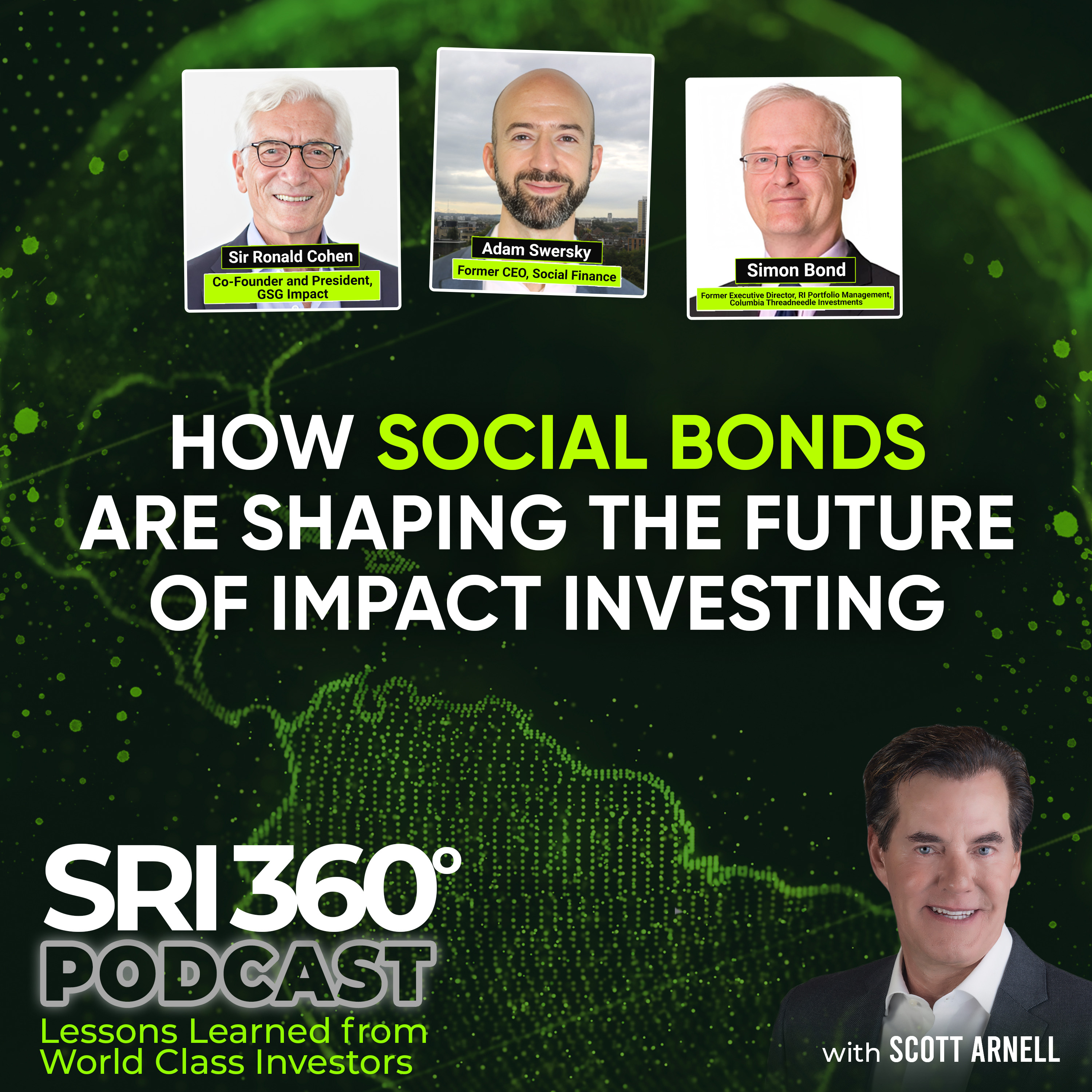
In this special compilation episode, we revisit the impact of social bonds and how they are changing how we think about the relationship between capital and societal impact.
If you’ve ever wondered what it takes to align capital with the world’s most pressing needs, without sacrificing performance, this compilation is a masterclass in how it’s done.
Here are the featured guests:
Sir Ronald Cohen, Co-Founder and President, GSG Impact
Sir Ronald Cohen’s story begins in traditional venture capital, where he saw firsthand both the power and the limitations of finance. While VC could create jobs and generate wealth, it could also widen the gap between those at the top and everyone else. Could capital markets be redesigned to actively close those gaps instead?
The answer took shape in the form of the social impact bond – a financial instrument where investor returns are tied directly to measurable social outcomes. The first was used to reduce reoffending among UK prisoners, shifting the risk from taxpayers to investors and incentivizing real results over box-ticking.
From there, Sir Ronald Cohen went further, creating “impact accounting” – a framework to measure corporate social and environmental performance in monetary terms. It’s a practical idea because people understand numbers more than anything else; hence, the approach to valuing impact is the same as valuing profit.
Impact accounting allows investors, regulators, and companies to make apples-to-apples comparisons and allocate capital where it will do the most good. Outcomes such as lower carbon emissions are valued in dollar terms.
Full episode here.
Adam Swersky, Former CEO, Social Finance
Adam Swersky’s work at Social Finance has been instrumental in the creation and scaling of social impact bonds and similar outcomes-based financing models. Adam explains how bringing finance into the equation can force a greater focus on measurable outcomes, driving partnerships that are laser-focused on solving acute social problems. From the Peterborough Prison Program to the Mental Health Unemployment Partnership, Adam’s experience demonstrates how applying capital to social issues creates a discipline around results, sustainability, and long-term impact.
By introducing private investors to social programs, Adam’s work ensured that capital was used efficiently and that social services were sustainable beyond initial funding cycles.
Full episode here.
Simon Bond, Former Executive Director, RI Portfolio Management, Columbia Threadneedle Investments
Simon Bond spent many years embedding impact into one of the largest asset classes on the planet: fixed income. At Columbia Threadneedle, Simon managed the UK and European Social Bond Funds – large-scale, diversified portfolios where every bond issued was tied to a clear, measurable social benefit.
This is not philanthropy disguised as investing. These funds delivered market-rate returns while financing projects like affordable housing, education, public health, and climate resilience. Simon calls it “positive inclusion” – actively seeking out issuers whose activities deliver net social gain.
Every investment was assessed not just on financial merit, but on its documented social outcomes. And because these are public market instruments, the scale was enormous, allowing institutional investors to channel billions into projects that might otherwise be underfunded, without sacrificing liquidity or returns.
Full episode here.
Listen to the episode on Apple Podcasts, Spotify, Overcast, Podcast Addict, Pocket Casts, Castbox, YouTube Music, Amazon Music, or on your favorite podcast platform. You can watch the interview on YouTube here.



What was your favorite quote or lesson from this episode? Please let me know in the comments.
SHOW NOTES:
[00:00] Introduction
[04:08] Transition from traditional VC to social impact focus
[07:02] Origins and significance of social impact bonds
[10:34] Need for standardized impact accounting across economies
[12:29] IFVI framework translates impact into monetary values
[17:43] Standardizing ESG data to influence investor behavior
[31:52] Market forces will lead to regulation adoption
[33:33] Social Finance’s theory of change
[36:47] Which social issues fit impact bond models best
[39:20] Peterborough prison tested the first social impact bond
[49:11] Mental health employment program expanded nationally
[59:12] End-of-life care improved through social investment
[01:06:09] Launch and purpose of the UK Social Bond Fund
[01:08:06] Structure and governance of the social bond process
[01:10:58] Investment philosophy: positive inclusion and engagement model
MORE QUOTES FROM THE INTERVIEWS:
“The key to success in the social impact space is not just about putting money to work, but ensuring that we are clear on the outcomes, measure them rigorously, and make adjustments to make sure we achieve what we set out to do. ”
— Adam Swersky
“Social bonds are proof that mainstream finance and social good are not mutually exclusive. By investing in projects that generate measurable social outcomes, we are creating a new investment class that’s both financially sound and socially responsible. ”
— Simon Bond