“Development finance should be used to provide capital where it’s not otherwise available – and that’s usually in the most difficult places to invest. ”
— Nick O’Donohoe CMG
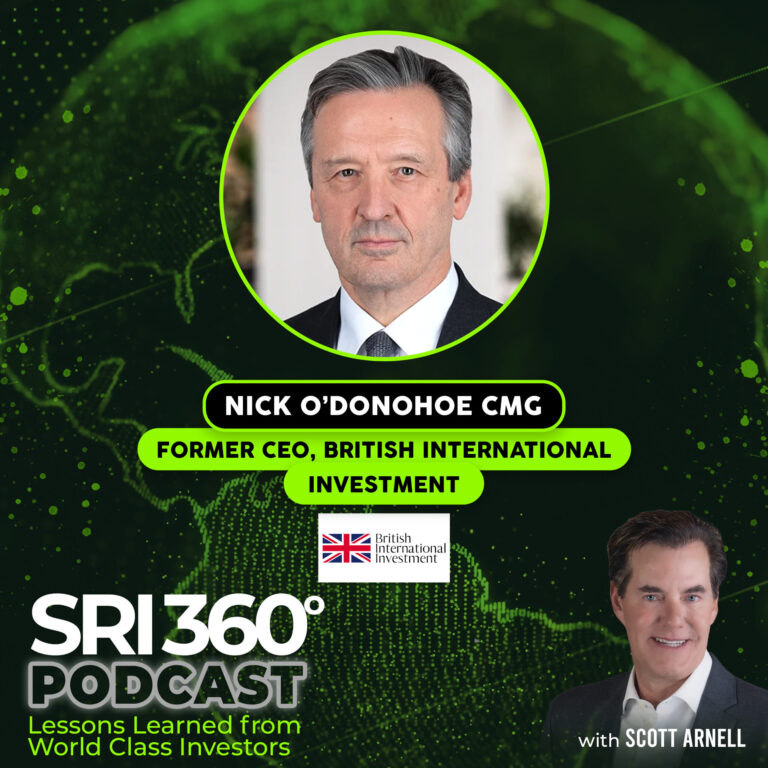
My guest today is Nick O’Donohoe CMG – former CEO of British International Investment, co-founder of Big Society Capital (now known as Better Society Capital), and one of the early figures to frame impact investing as a financial discipline.
Nick spent nearly three decades in global banking – first at Goldman Sachs, then at JPMorgan, where he rose to become Global Head of Research.
But his story doesn’t begin on Wall Street. It begins in Dublin.
Nick grew up in a family that believed in service. His father was a doctor. His mother, a social worker. He remembers people coming to their house to thank his dad for saving their child’s life. It made him realize a career could be about more than financial success.
But he didn’t follow them into medicine. What caught his attention were numbers. He studied mathematical economics and statistics at Trinity College Dublin, then crossed the Atlantic for an MBA at Wharton straight from college. No job in between. No gap year.
It was 1981. He had never lived outside Ireland. Most of his classmates were several years into their careers. He hadn’t even worked in a bank.
“I was the youngest person in my class by a long way. And I remember being sort of scared stiff.”
But he could do the math. And that turned out to be enough.
His first job offer came from Goldman Sachs. He began in New York, completing the firm’s training program before relocating to their Zurich office, where he spent about five years. He then moved to London to join the equity capital markets group, where he helped build Goldman’s UK business from scratch – advising companies on raising money by issuing shares.
After nearly fifteen years at Goldman Sachs, Nick moved to JPMorgan – not entirely sure what they wanted him to do. A few months in, they asked him to run a team of 1,200 analysts across 26 countries.
It was 2000. The dot-com bubble had just burst, and Wall Street’s research departments were losing credibility fast. His job was to steady the ship. He pushed analysts to stop obsessing over next quarter’s earnings and start asking bigger questions – like how aging populations, climate change, and new technologies would reshape industries.
But somewhere along the way, the questions began to change. He started to wonder whether all this capital and intelligence was actually solving the world’s most pressing problems.
Then came the 2008 crisis, and everything cracked open. Nick left JPMorgan not for another job, but to explore whether finance could be used to serve people who had never been served by it at all.
That search took him to Bellagio, where the Rockefeller Foundation had gathered a small group of investors, philanthropists, and bankers to explore a new idea – something that would eventually become known as impact investing. It didn’t have a formal definition yet. But the hope was to use money not just to make more money, but to make a difference.
Nick didn’t come with a business plan. But he brought a small research team – and the ability to put JPMorgan’s name on something. That gave the idea credibility. He offered to write a report explaining what impact investing could be: who it was for, how it might work, and why it mattered.
That report – Impact Investments: An Emerging Asset Class – was the first of its kind. It gave the idea a name, a structure, and a platform. For the first time, the field became legible – to banks, to investors, and to the wider world.
A few years later, he left banking to co-found Big Society Capital with Sir Ronald Cohen. It launched – quite literally – out of Sir Ronald’s basement. The mission: use dormant assets to back the UK’s social sector.
Big Society Capital was more commercial than philanthropy, but more impact-focused than traditional investing. They backed early-stage social enterprises, co-founded intermediaries, and pushed for legal structures that could attract blended capital.
In a nutshell, it was about taking risks others wouldn’t take.
Nick’s next chapter gave him the power to shape systems. In 2017, he became CEO of CDC Group – later British International Investment – the UK’s development finance institution. It was a role that fused everything he’d done: capital markets, institution-building, and impact. His mandate: deploy billions in public capital into emerging markets, while balancing risk, return, and development goals.
Under his leadership, BII invested in solar and wind, hospitals, digital connectivity, agribusiness, and venture capital. Most of that capital flowed into Africa, South Asia, and parts of the Caribbean – markets where commercial investment was scarce but deeply needed.
But it wasn’t just capital allocation. He launched the Catalyst Portfolio – where expected returns were zero or even negative. He introduced an Impact Score to measure social and environmental outcomes with the same rigor as financial ones.
And here, he didn’t mince words.
Nick was clear that if you expect every impact investment to deliver commercial returns, you’re going to leave a lot of people behind. Especially in places like Africa.
During his time at BII, over 60% of the portfolio went into African countries. These weren’t easy markets. Macroeconomic shocks, political crises, and currency devaluations were part of the landscape. But for Nick, that wasn’t a reason to walk away – it was the reason to be there.
He believes capital needs to be structured differently to reach the people and places that need it most. “If everybody demands commercial returns, we’re not going to address all the development challenges. Especially not in Africa.”
That’s where development finance has to step in – not to chase the same deals as everyone else, but to fill the gaps the market won’t touch on its own.
Now Nick is about to start as a Senior Fellow at the Mossavar-Rahmani Center for Business and Government at the Harvard Kennedy School, where he’ll be focused on what comes next.
How should development finance respond to climate without abandoning poverty?
Can we do both?
And what happens when aid budgets shrink, but expectations rise?
If I had to sum up our conversation in one word, it would be risk – financial, political, and moral. But we talked about much more.
Tune in to hear from Nick O’Donohoe firsthand.
Listen to the episode on Apple Podcasts, Spotify, Overcast, Podcast Addict, Pocket Casts, Castbox, YouTube Music, Amazon Music, or on your favorite podcast platform. You can watch the interview on YouTube here.



What was your favorite quote or lesson from this episode? Please let me know in the comments.
SHOW NOTES:
[00:00] Introduction
[04:12] Nick’s family background in Liverpool and Dublin
[06:35] Choosing mathematical economics and statistics at Trinity College Dublin
[08:48] Going straight from Trinity to an MBA at Wharton
[11:17] First job at Goldman Sachs during boom years
[16:14] Progression through Goldman Sachs roles in Zurich and London
[19:57] Joining JP Morgan to lead global research team
[20:57] Witnessing the dot-com bubble and the 2008 financial crisis at JP Morgan
[29:18] JP Morgan’s 2010 report positions impact as an asset class
[32:40] Early struggles with defining and measuring impact
[34:28] Founding Big Society Capital with Sir Ronald Cohen
[36:32] Catalyzing UK investment into underserved sectors
[40:00] Shifting from market-based investing to philanthropy at the Gates Foundation
[44:11] Nick’s decision to lead British International Investment
[46:17] Overview of BII’s mission and role
[50:43] The return vs. impact debate in high-risk markets
[01:04:19] Lessons from a trip to the DRC and what “additionality” looks like
[01:08:33] Crowding in private capital and its limitations
[01:14:11] DFIs shifting toward climate and evolving mandates
[01:22:52] Nick’s upcoming Harvard research on DFI strategy and trade-offs
[01:25:08] Rapid-fire questions
Additional Resources:
- Nick O’Donohoe CMG on LinkedIn
- British International Investment website
- ‘Impact Investments: An Emerging Asset Class‘ report
MORE QUOTES FROM THE INTERVIEWS:
“I don’t know how you can pretend to be a global impact investment fund and then say I’m precluding any investment in Africa – the continent that has the greatest distance to travel in terms of reaching the SDGs. ”
— Nick O’Donohoe CMG
“There is a point beyond which commercial capital will not go, and there’s no amount of subsidy or blended finance that’s going to encourage them to do it. ”
— Nick O’Donohoe CMG