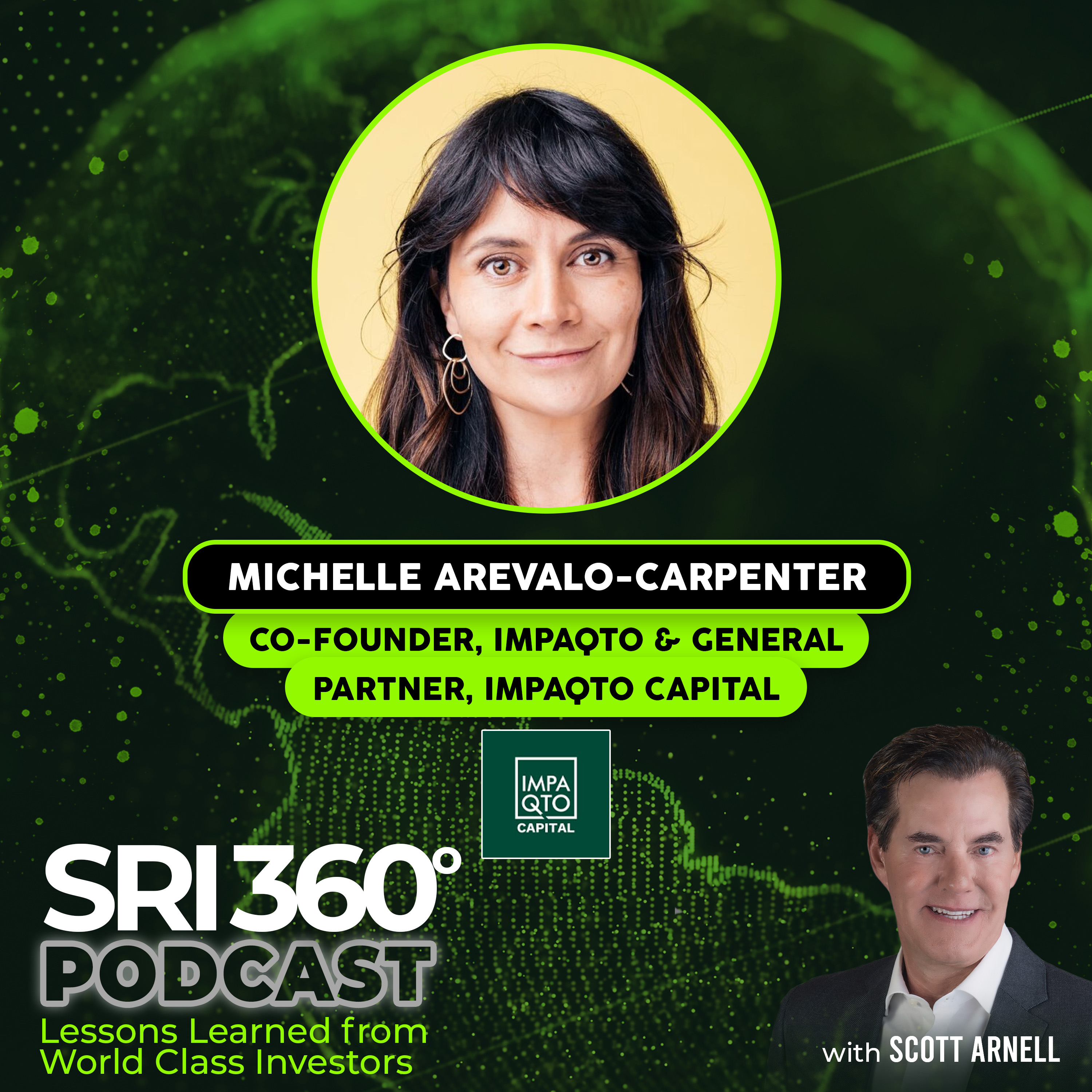
“Founding IMPAQTO was my way of asking: What if the Global South stopped waiting for capital to trickle down. What if we built our own ladders – and our own solutions? ”
— Michelle Arevalo Carpenter
My guest today is Michelle Arevalo-Carpenter, Co-Founder of IMPAQTO and General Partner at IMPAQTO Capital. Michelle is a human rights lawyer by training, a fund builder by calling, and one of the most compelling system-reimaginers I’ve ever had on the show.
She grew up in a small, middle-class apartment in Quito, Ecuador — the kind of place where the furniture was pushed aside so she and her sister could roller skate in circles on the tile floors. “That apartment was our entire lives,” she says. “But I felt very abundant.”
They didn’t go out much — not because they didn’t want to, but because their mom, a preschool teacher and English assistant, was often working and trying to make ends meet.
Though she wasn’t fully bilingual, Michelle’s mother found creative ways to make sure her daughters were. She played Mary Poppins and other VHS tapes on repeat, pausing and rewinding the same scenes until Michelle and her sister could mimic every line.
It was a childhood shaped by joy — and by the quiet fragility of knowing that middle-class life in Latin America always sits on the edge of collapse.
That tension — between resilience and precarity — became one of Michelle’s lifelong themes. It took her far: through scholarships, she made her way to Canada for undergrad and later to Oxford for a Master’s in human rights law.
But when a scholarship didn’t cover all her tuition, her grandfather sold a piece of land to help bridge the gap. He told her it was “the gift of equity” — his way of making sure she’d stand on equal footing with her future husband.
Michelle eventually landed in Geneva, where she worked for a women’s peace organization and advised Ecuador’s foreign ministry on refugee and asylum policy.
But the more time she spent in elite institutions, the more disillusioned she became. She realized that advocacy without power-building wasn’t enough — that she “could write great reports, but the systems stayed the same.”
So she did something few people do. She walked away from Geneva. From the UN system. From the career ladder she’d worked so hard to build.
Back in Quito, Michelle started where many great entrepreneurial stories begin — with no office, no plan, just an instinct that something better could exist. Over a hundred coffees with local founders, she kept hearing the same themes: isolation, lack of support, funding that didn’t fit.
In response, she created IMPAQTO, Ecuador’s first coworking space for social ventures, not because she had a real estate vision, but because people needed a place to belong. “They weren’t paying for square meters,” she said. “They were paying to not be alone.”
From there, IMPAQTO grew — into an accelerator, a research platform, a voice in policy. But the biggest problem persisted: no capital. Or rather, the wrong kind of capital.
Local businesses needed $10K–$500K. They didn’t want to sell equity. They wanted to grow on their own terms. Too big for microfinance, too small for venture. “That’s the missing middle,” Michelle said. “That’s where we live.”
So in 2021, she launched IMPAQTO Capital, a revenue-based investment fund designed not to chase unicorns but to nourish sustainable growth. Michelle described it not as alternative capital, but as capital that’s appropriate for the context they’re operating in.
Rather than chasing foreign LPs, her team went local. They raised over half their first close from Ecuadorian and Andean-region families — people with lived experience inside the very systems the fund aims to change. “Our investors aren’t impact tourists,” she said. “They’re system insiders.”
What Michelle is building isn’t just a capital vehicle. It’s an ecosystem intervention — a cultural shift that treats belonging as a precondition for growth, and care as critical infrastructure. She’s also a co-founder of CLIIQ, a regional research and advocacy platform focused on unlocking catalytic capital for women-led businesses.
At IMPAQTO Capital, every deal is evaluated not just on returns, but on whether it preserves the dignity and agency of the founder. Every exit includes a “cap party” — a ritual of closure and celebration that says: You did it. You paid us back. We’re done. And we’re proud.
There’s a lot to learn from Michelle. About capital. About leading with trust and care. About staying rooted in a place and still seeing the whole system.
But mostly, about how change happens — not from the top down, but from the inside out. Slowly. With proximity. And with people who never forgot where they started.
Listen to the episode on Apple Podcasts, Spotify, Overcast, Podcast Addict, Pocket Casts, Castbox, YouTube Music, Amazon Music, or on your favorite podcast platform. You can watch the interview on YouTube here.



What was your favorite quote or lesson from this episode? Please let me know in the comments.
SCROLL BELOW FOR LINKS AND SHOW NOTES…
ADDITIONAL RESOURCES:
- Connect with Michelle: LinkedIn
- Michelle Arevalo Carpenter website
- IMPAQTO Capital website
- IMPAQTO website
SHOW NOTES:
[00:00] Introduction
[03:20] Growing up in Quito shaped Michelle’s values
[14:16] Michelle’s high school exchange in Canada
[17:49] Studying human rights law at Oxford and the family sacrifice behind it
[20:17] Returning to Ecuador to work as a refugee claims adjudicator
[24:55] Why Michelle chose UC Berkeley
[28:39] Leaving Geneva, selling everything, and returning to Ecuador to follow her calling
[21:27] From a hundred coffees to a community space for impact
[37:14] Founding IMPAQTO – Ecuador’s first impact-focused co-working space
[43:52] The missing middle capital gap
[48:54] Founding IMPAQTO Capital and using capital as a system redesign tool
[54:29] Applying gender lens investing in practice
[59:52] IMPAQTO Capital’s investment process
[01:04:09] Structuring revenue-based finance to align with founders’ realities
[01:11:10] Overlooked founders outperform expectations (examples)
[01:23:33] Rethinking concessionary capital for emerging fund managers
[01:27:25] Measuring not just returns – but dignity, agency, and respect
[01:33:47] Emerging markets don’t lack innovation, they lack trust
[01:38:33] Leading with trust
[01:41:08] Returning home to grow something deep and lasting
[01:48:55] Rapid-fire questions
MORE MICHELLE AREVALO CARPENTER QUOTES FROM THE INTERVIEW:
“An ecosystem is like a wild plant, not like a plastic bucket. ”
— Michelle Arevalo Carpenter
“Growing up in Ecuador, I saw how easily systems can fall. But the flip side of that is, if they can fall that easily, then systemic change is possible. ”
— Michelle Arevalo Carpenter