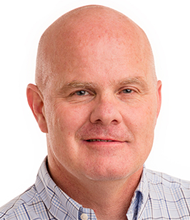
“The really simple definition of impact investing is that all you’re doing is adding more information to your decision-making process. ”
— Michael Etzel
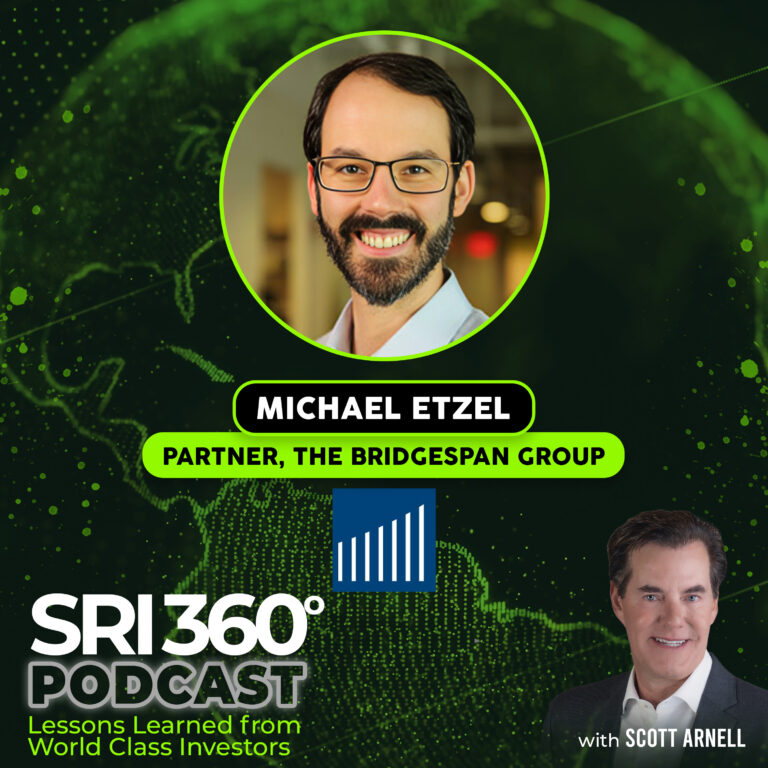
My guest today is Michael Etzel – a partner at Bridgespan, and one of the key architects behind a shift that’s still unfolding: the effort to bring hard-nosed analytical discipline to a field once seen as closer to charity than capital.
Michael is one of the most thoughtful voices in impact investing. If you’ve spent time in the field, you’ve probably read something he’s written – from early frameworks for impact-first capital to deep dives on impact measurement, decision-making, and fiduciary duty. But what you might not know is how much of the field’s architecture he’s helped build from behind the scenes.
Michael came to this work from the social sector, back when “impact investing” wasn’t yet a defined field. At Bridgespan, he began advising philanthropists and foundations – and over time, that work expanded to include some of the world’s largest asset managers as they started asking how capital could solve problems philanthropy couldn’t.
His idea was pretty simple: to put impact first.
Our conversation starts with that principle – and where it sits between two poles. On one side: traditional philanthropy willing to lose money in service of outcomes. On the other: finance-first investing chasing market-rate returns. Impact-first lives in the messy middle. The kind where the first diligence question isn’t “What’s the IRR?” – it’s “What’s the problem we’re solving?”
And that’s where Michael’s work stands out.
Michael was one of the architects of the Impact Multiple of Money, or IMM – a six-step process designed to estimate and compare the social or environmental value created for every dollar invested. It starts with what a business produces, connects those outputs to real-world outcomes, and draws on academic research to ground the analysis. The result is a dollar-based estimate of impact – not to put a price on people’s lives, but to give investors a common language for understanding what value really means.
Michael breaks it down in plain terms. He and his team actually put numbers to impact – they start with what a business produces, figure out what real-world benefits come from that, adjust for the risks, and then compare it to the money invested.
In other words, for every dollar you put in, how many dollars of social or environmental value come out? It sounds technical, but the idea is simple: if we’re going to talk about impact, we need to be able to measure it with the same rigor we use for financial returns.
The IMM framework is now used across TPG’s Rise and Rise Climate funds, together managing tens of billions of dollars in assets. It’s become part of how they underwrite investments, sitting right alongside financial measures like IRR and MOIC when evaluating performance.
Other firms have picked it up, too. AfricInvest – the largest and oldest private equity firm in Africa – has adapted it into their own “multiple of impact” to help communicate value across a diverse portfolio. And in India, a group of investors is now applying the same approach at earlier stages of investment.
And the best part – it’s open source. The full method and case studies are published in Harvard Business Review (“Calculating the Value of Impact Investing”), so anyone can see how the math works. Michael’s point isn’t to keep it proprietary or brand it as a Bridgespan product – it’s to raise the bar for how the whole industry measures and talks about impact.
But for Michael, this work has never been just about frameworks. It’s about decision-making – what actually happens inside organizations when impact moves from a good idea to something real.
He’s seen smart, well-designed projects fail – not because the math was wrong or the market wasn’t ready, but because they never made it to the top of the internal fundraising calendar. Because leadership didn’t really buy in. Because impact was still treated as an optional lens, not part of the core strategy.
He’s also worked with some of the world’s largest private equity funds, and he’s honest about how much of what gets labeled “impact” is still driven by what will sell. That used to be most of the market, he says. Today it’s less – because LPs have gotten smarter, the bar is higher, allocators are asking tougher questions, and fundraises take longer. And managers are learning that you can’t just slap an “impact” label on a deck and expect it to close.
Michael has watched the field mature – from early enthusiasm and experimentation to a more disciplined phase of real accountability and scale. And now, he says, the real test isn’t who can launch the next “impact” fund – it’s who can lead with discipline when the market gets tougher.
In this conversation, we also got into some of the bigger questions shaping the future of the field:
Fiduciary duty, and why that concept needs a serious reset
How much progress still depends on individuals, not market forces
And why one of the most overlooked disciplines in this work is simply knowing how to say no
Impact investing isn’t a field with easy answers. But Michael’s been doing this long enough to see the deeper through-lines. “We’re not in the early childhood years anymore. But we’re not fully grown either. It’s the awkward teenage phase.”
And maybe that’s the point – adolescence is messy, but it’s also where values get tested. This is the moment for the industry to decide what it’s growing into – not just bigger, but better. Whether it becomes another asset class or a community that holds itself to higher standards.
Tune in for a conversation about what it really means to raise the bar – for investors, for institutions, and for the idea of impact itself.
–
DISCLAIMER: Impact investing services are provided by Bridgespan Social Impact, Inc., a wholly owned subsidiary of The Bridgespan Group.
Listen to the episode on Apple Podcasts, Spotify, Overcast, Podcast Addict, Pocket Casts, Castbox, YouTube Music, Amazon Music, or on your favorite podcast platform. You can watch the interview on YouTube here.



What was your favorite quote or lesson from this episode? Please let me know in the comments.
SHOW NOTES:
[00:00] Introduction
[04:00] Growing up in Massachusetts shaped his worldview
[05:44] Studying social studies at Harvard
[07:01] Lessons from the 2004 John Kerry campaign
[08:52] Choosing Bridgespan over traditional consulting firms
[12:07] Shaping early U.S. impact investing policy
[20:55] Bridgespan’s mission and global operations explained
[30:12] Convincing investors that impact won’t hurt returns
[32:36] ESG and impact investing are not interchangeable
[35:30] Lack of tools for measuring impact
[40:19] Origin and uniqueness of the IMM framework
[46:23] IMM’s 6-step structure for impact evaluation
[57:13] Ethical complexities in valuing human outcomes
[01:06:22] Family offices operate within the messy middle
[01:10:11] Public equity investing faces impact measurement challenges
[01:16:11] Aligning capital stacks to de-risk innovation
[01:18:42] Connecting climate and social impact issues
[01:22:05] Redefining fiduciary duty for long-term risk
[01:32:56] Impact investing is not one market
[01:38:19] Rapid-fire questions
Additional Resources:
- Michael Etzel LinkedIn
- The Bridgespan Group website
- Article: “Calculating the Value of Impact Investing”
MORE QUOTES FROM THE INTERVIEWS:
“The biggest stumbling block is the perception that impact-first investing is bad or concessionary investing. But early lessons – where pioneers entered tough markets and some failed – clarified that you still need a strong commercial engine to reach scalability. ”
— Michael Etzel
“Impact investing still relies heavily on individuals within firms – on both the allocator and manager sides – who are willing to take bold steps forward. It’s those leaders who recognize where there are gaps and where there are opportunities to start doing things differently. ”
— Michael Etzel