“We’re investing in a space dominated by people who are very poor. So if you ask me, do I have to make this trade‑off between financial returns and impact? I don’t recall a time when I’ve had to make this trade‑off. ”
— Mark Kahn
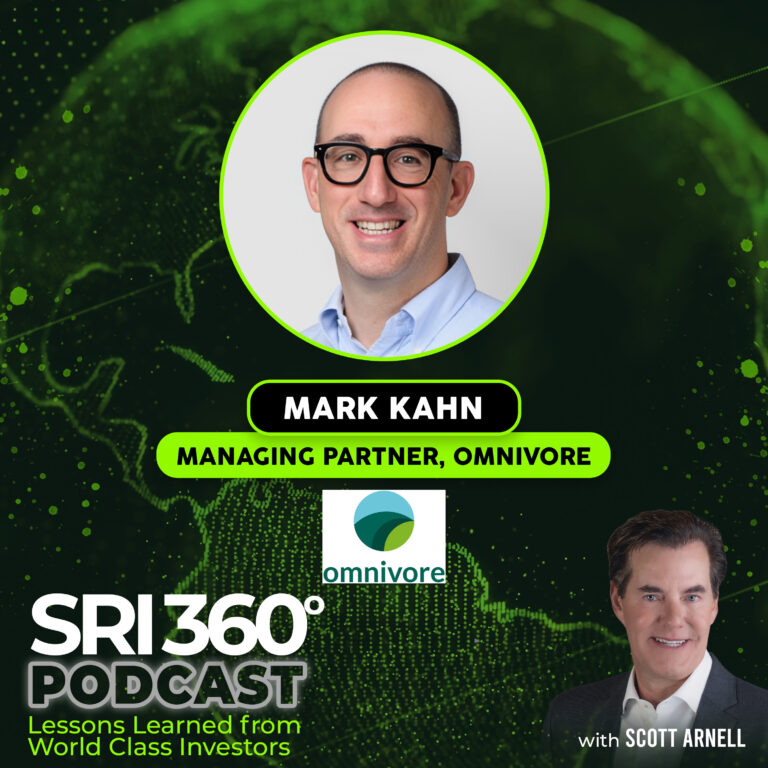
My guest today is Mark Kahn – co-founder and Managing Partner at Omnivore, the India-based firm that pioneered agritech and climate-smart venture capital in the world’s largest smallholder market. He’s also one of the most distinctive fund managers shaping this sector.
Omnivore was one of the first VCs to back startups solving real problems for Indian farmers long before anyone thought rural innovation could deliver venture-scale returns… or before institutional investors understood the scale of the opportunity.
He grew up in Houston. His father was a doctor who practiced in a rural area outside the city, and his mother was a criminal defense attorney who handled capital murder cases. Their house ran on news and debate. Three newspapers a day, constant conversation, and every morning, his mother laid out the New York Times and made him read it aloud while she cooked breakfast.
But the real education came outside the house. His closest friends were Indian, Chinese, Iranian, and Latino, the children of immigrants who brought their cultures with them. Mark moved between homes, meals, and languages with ease.
At home, he soaked up global news on his shortwave radio (the BBC, Voice of America), and became obsessed with the world beyond America. As he puts it: “I was just very much a young person desperate to get out. Who wanted to see the rest of the world and experience it as soon as humanly possible.”
After high school, Mark went to the University of Pennsylvania to study economics and history. And he’ll tell you straight up, he hated it. After graduating, he landed at a public-finance advisory firm called PFM, helping cities and states deal with budget crises and political headaches.
He’d always been drawn to politics and government, and for a moment, he thought that might be his path. But four years of watching how American politics really works burned him out. By the time he got to Harvard Business School, he knew exactly what he wanted: to get out of the U.S. and build his career somewhere else in the world.
After Harvard, that clarity pushed him toward a completely different path: agribusiness. First at Syngenta in Switzerland, then to India, where he joined Godrej Agrovet as Executive Vice President. While there, he worked on everything from M&A to rebooting the company’s R&D programs.
But in 2010, he launched an in-house corporate VC effort focused on agricultural innovation. At the time, no one (not even Indian VCs) thought agtech was viable. That project became Omnivore, and a new way of thinking about capital allocation in a country where farmers had long been ignored by mainstream venture capital.
The firm’s early thesis was simple: India’s agriculture sector, 20% of GDP and 40% of the population, was overlooked by tech and innovation. Indian farmers were doing one of the hardest jobs in the world, with little access to capital, climate protection, or markets. If you could solve problems for them, you weren’t just backing businesses, you were also backing system-level change.
Back then, India’s startup ecosystem was still young, and agritech was barely a category. Mark remembers fewer than a dozen serious startups in the space. But over the last decade, that changed. More talent stayed in India, and the best MBA grads increasingly chose startups over consulting or multinationals, which brought new energy into the space.
At the same time, the country’s digital infrastructure exploded. Thanks to systems like UPI and Aadhaar, India now offers something close to real-time financial inclusion – the kind of digital public goods that Silicon Valley dreams about, but still hasn’t figured out how to scale.
That foundational layer has unlocked entirely new markets, from fintech for inclusion to precision ag, and Omnivore has been right there, writing early checks into the entrepreneurs shaping them.
Today, Omnivore has $295 million AUM. Their investment scope has expanded beyond pure agtech to include climate resilience, rural fintech, supply chain innovation, emerging technologies, and more.
It’s a financial-first fund, but every investment is grounded in a clear, impact-driven logic: improving farmer profitability, resilience, and sustainability.
They track outcomes rigorously through an in-house impact measurement and management system built on clear measurement frameworks aligned with their theory of change. But that never comes at the expense of commercial discipline.
That theory of change guides every investment decision, structured around four foundational pillars:
Food Security: investing in technologies and business models that ensure access to safe, nutritious, and affordable food
Agricultural Prosperity: treating farmers not as charity cases but as micro-entrepreneurs, and backing solutions that boost their incomes and long-term viability
Resource Efficiency: solving for water stress, energy usage, and agricultural emissions through climate-smart tools, products, and infrastructure.
Rural Resilience: extending financial tools like insurance and credit to stabilize rural households and MSMEs, and help them deal with both economic and environmental shocks.
It’s a clear framework, but not one that always made immediate sense to investors.
For decades, India was seen as a risky, messy market: too fragmented, too informal, too poor. Investors looked at the country’s 130 million smallholder farmers and saw subsistence, not scale. Agritech didn’t fit the venture mold, and climate adaptation was seen as a cost center, not a business case.
Even when the tailwinds started to shift, many global LPs still struggled to map the opportunity. They knew the need was there. But could you really build high-growth, commercially viable companies around such low-income customers?
Omnivore didn’t wait for consensus. They went in early, stayed patient, and proved that venture-backed innovation could succeed where traditional models had failed.
It’s the kind of long-game thinking that defines Mark’s approach. He’s building a venture platform rooted in India’s realities, backing solutions that help farmers survive, adapt, and thrive in a country that’s heating up fast.
Mark’s approach is refreshingly grounded. He’s building a venture platform that works in the real world, with real farmers, solving real problems, in a country that’s heating up fast.
When I asked him what he’s learned after 15 years in the game, his answer was instant: “Back brilliant people who want to change the world. Avoid people who don’t. It’s all about people.” The rest follows from there.
Listen in.
–
Listen to the episode on Apple Podcasts, Spotify, Overcast, Podcast Addict, Pocket Casts, Castbox, YouTube Music, Amazon Music, or on your favorite podcast platform. You can watch the interview on YouTube here.



What was your favorite quote or lesson from this episode? Please let me know in the comments.
SHOW NOTES:
[00:00] Introduction
[03:57] Childhood shaped by global curiosity and diversity
[10:51] Disappointment with Penn’s pre-professional culture
[13:07] Burned out from early political consulting career
[18:40] Harvard project with ITC ignites India focus
[27:26] Omnivore’s origin and spinout from Godrej Agrovet
[35:09] Omnivore – high-level overview
[41:35] Climate adaptation over mitigation in India
[43:24] Investment strategy organized around four business models
[51:29] Impact measurement – standardized IMM and field surveys
[58:21] Agritech startups must mature into agribusinesses
[01:02:20] Global capital still overlooks India’s VC opportunities
[01:06:06] India’s life sciences sector limited by talent shortages
[01:10:41] Alternative protein is culturally irrelevant for India
[01:14:17] Agricultural subsidies need replacing with direct transfers
[01:19:58] Rapid fire questions
Additional Resources:
MORE QUOTES FROM THE INTERVIEWS:
“Indian founders are built differently. They build leaner, they commercialize faster, and they often launch a beta version of their product while navigating the regulatory complexities of the full solution. ”
— Mark Kahn
“The American Dream is good and dead for Indians, and that’s probably a blessing for India. The same people who once helped build Silicon Valley are now staying home and building it in India. ”
— Mark Kahn